Generative Engine Optimization (GEO) Services: What’s Included and What It Costs
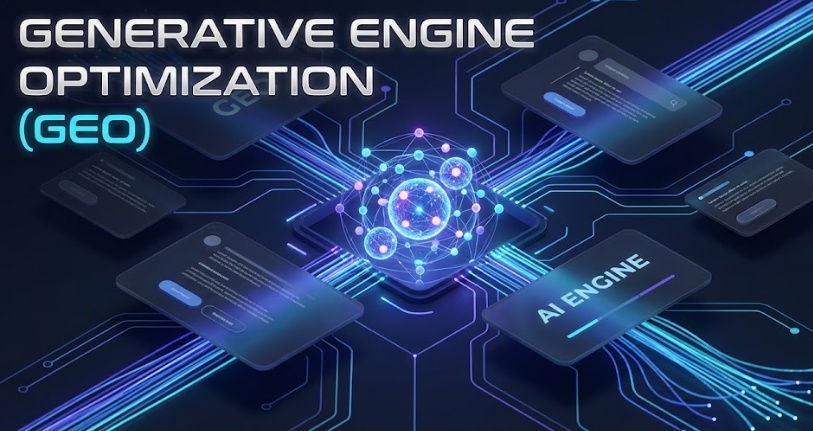
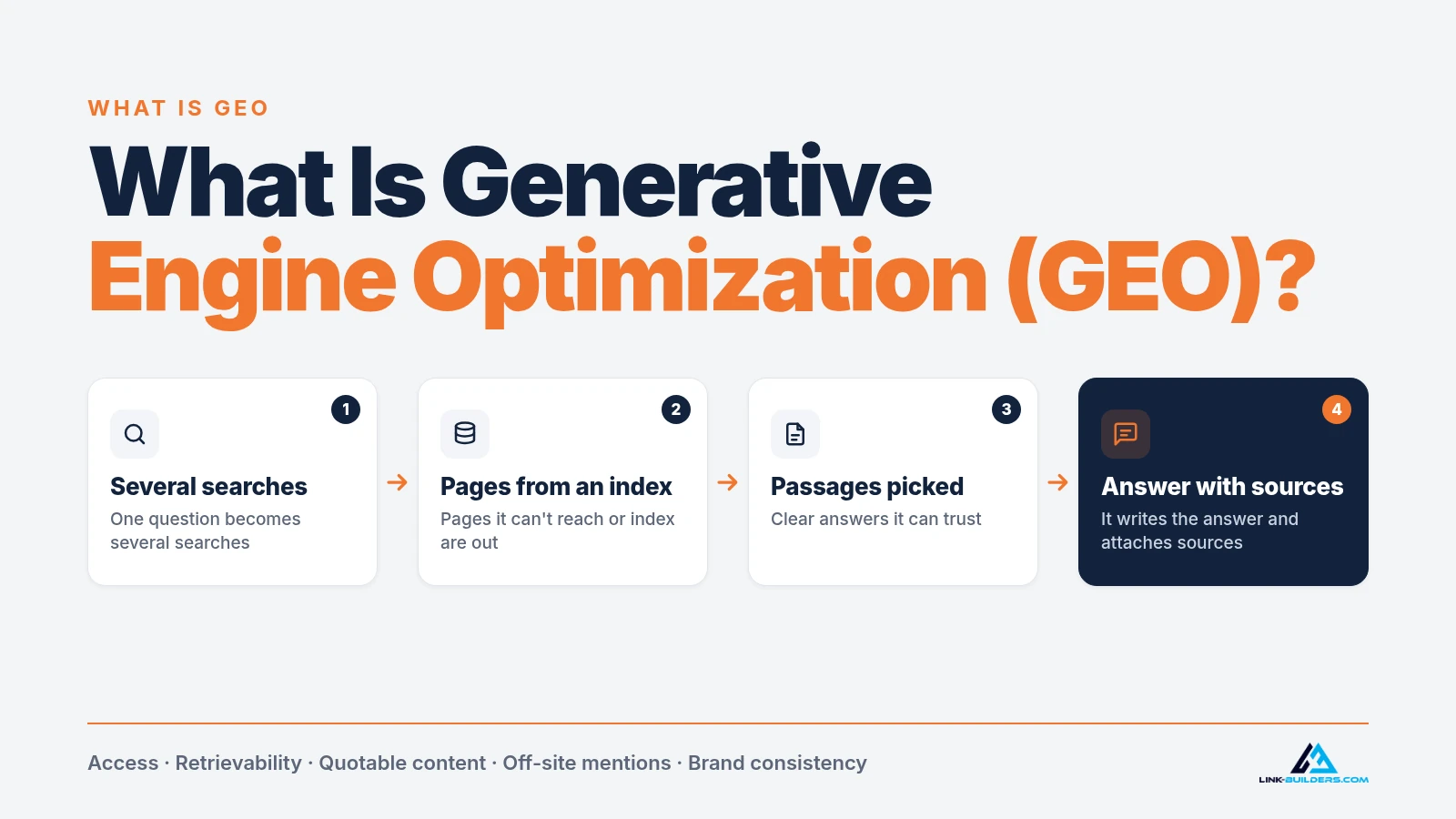
Generative engine optimization (GEO) services are the work an agency or consultant does to get your brand mentioned, cited and recommended inside AI answers from ChatGPT, Google AI Overviews and AI Mode, Perplexity, Gemini and Copilot. A typical engagement includes an AI visibility audit, content restructuring, technical access for AI crawlers, off-site brand mentions and links, and monthly tracking.
That’s the short answer. The longer one matters more if you’re about to spend money, because GEO agencies appeared almost overnight. Many of them pitch the same promises, and prices run from a few hundred dollars a month to more than $50,000. Some of what’s being sold is real work that moves the needle. Some of it is old SEO with a new label. And some of it, like guaranteed ChatGPT rankings, can’t be delivered by anyone.
This guide breaks down what GEO services actually include, what they cost in 2026, the different kinds of providers, and a 15-question checklist to use before you buy. I’ve built backlinks for clients since 2015. The off-site side of GEO, earning mentions and links on the pages AI engines trust, is what I do every day, so that part of the guide gets extra attention. It’s also the part most buyers forget to ask about.
What Are Generative Engine Optimization Services?
A Plain-English Definition
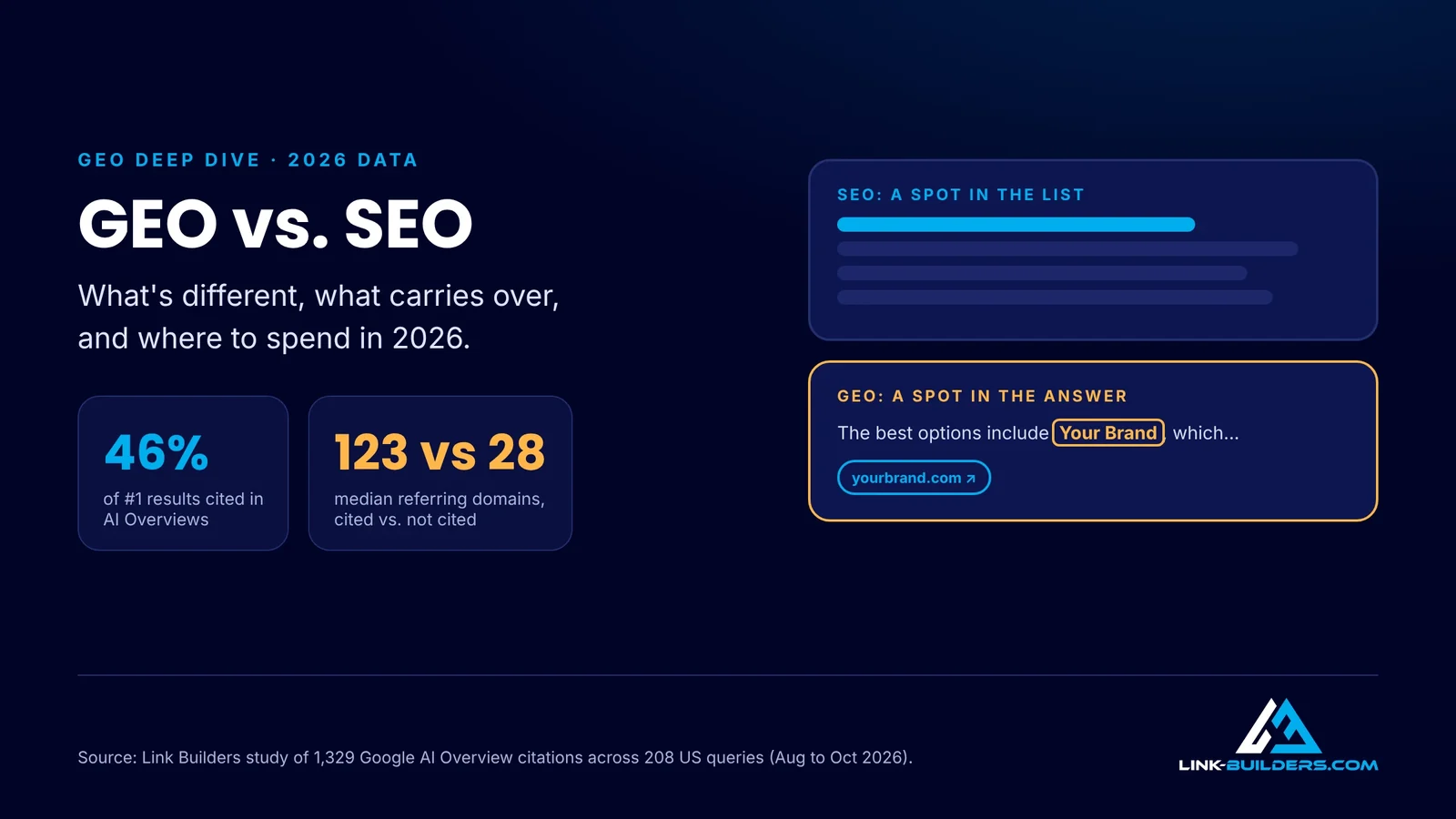
Traditional SEO tries to earn a spot in a list of ten blue links. GEO tries to earn a spot inside the answer itself. That can mean three different things:
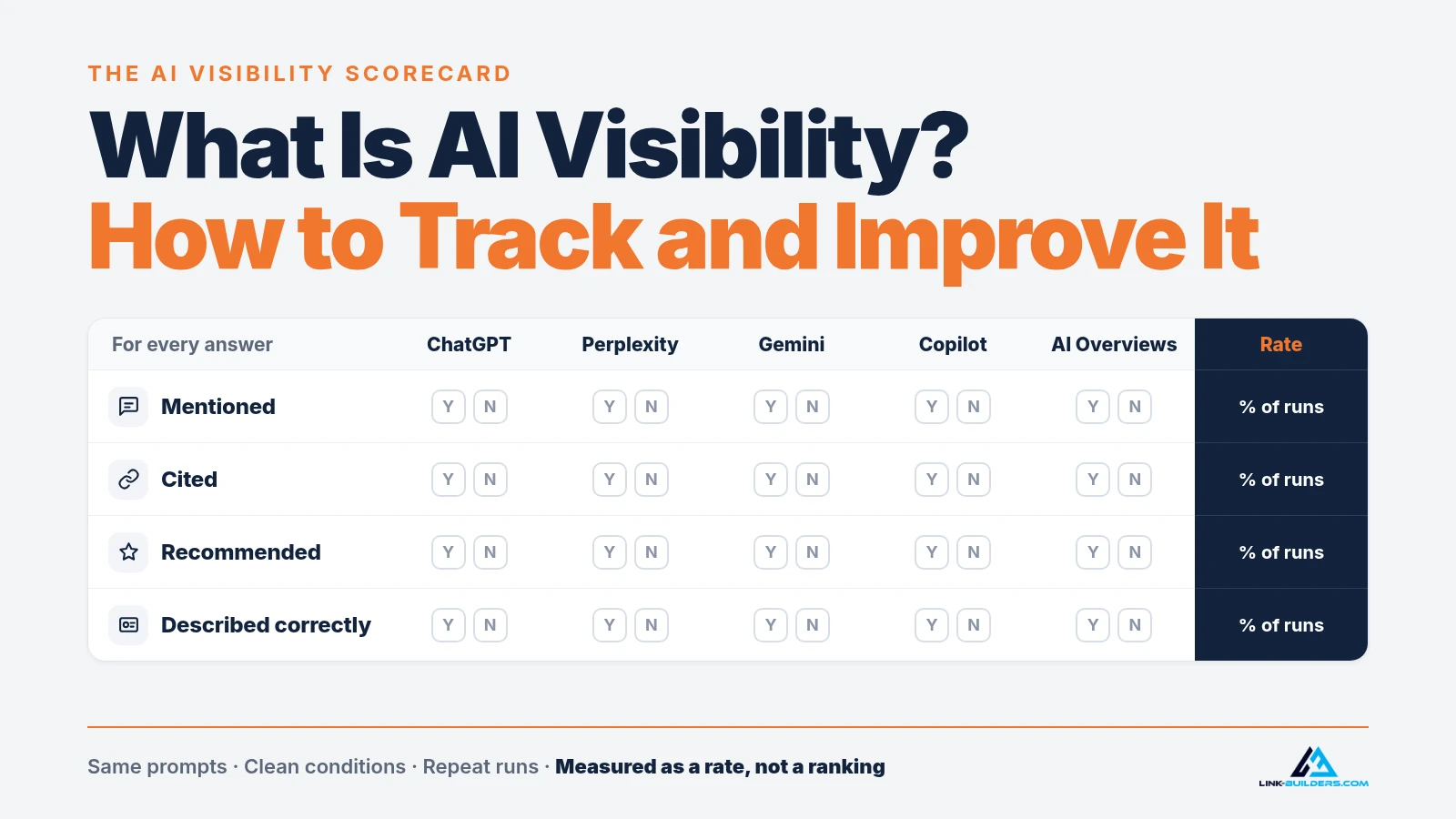
- A citation: the AI engine links to your page as a source.
- A mention: your brand name appears in the answer, with or without a link.
- A recommendation: the engine suggests your company when someone asks who to hire or what to buy.
GEO services are the work of making each of those more likely for the questions your buyers actually ask. Some agencies call the same work AI search optimization, LLM optimization or answer engine optimization (AEO). The labels overlap so much that you should judge any provider by the work they do, not the acronym on their sales page.
Where the Term Came From
The phrase comes from a research paper. In late 2023, researchers from Princeton and IIT Delhi, working with independent researchers, published “GEO: Generative Engine Optimization,” which was later presented at the KDD 2024 conference. They built a benchmark of search queries and tested how changes to a web page affected how visible that page was in AI-generated answers.
Their results are still the most cited evidence in the field. Methods such as adding statistics, citing credible sources and including quotations from experts raised a page’s visibility in generated responses by up to 40% in their tests. Keyword stuffing did little or nothing. One caution: this was a controlled research setup, not a live test of ChatGPT or Google. It shows which content changes tend to help, but it doesn’t promise that any single change will get your page cited by a real engine.
GEO vs. AEO vs. SEO
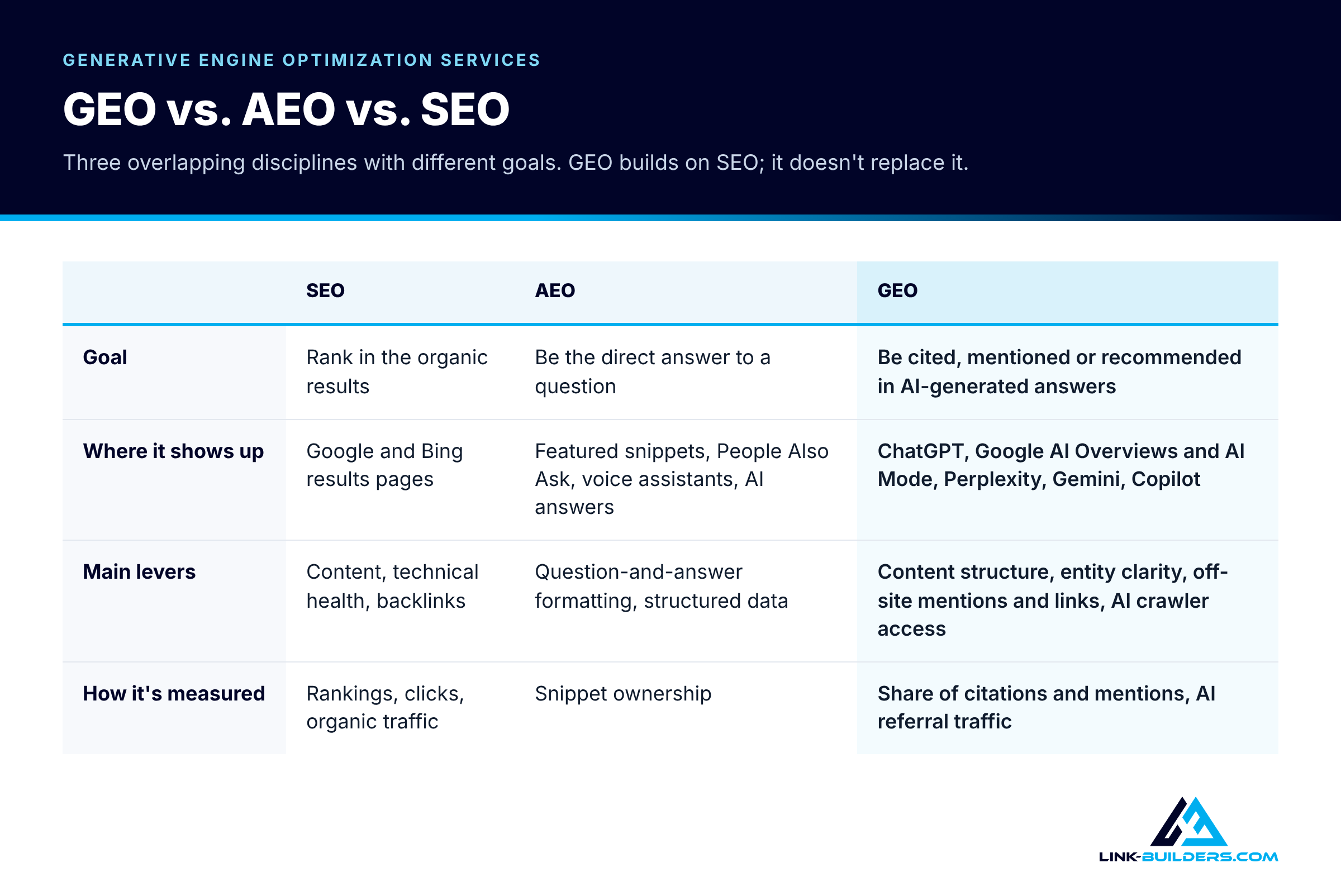
These three terms describe overlapping work with different goals. Here’s how they compare:
| SEO | AEO | GEO | |
|---|---|---|---|
| Goal | Rank in the organic results | Be the direct answer to a question | Be cited, mentioned or recommended in AI-generated answers |
| Where it shows up | Google and Bing results pages | Featured snippets, People Also Ask, voice assistants, AI answers | ChatGPT, Google AI Overviews and AI Mode, Perplexity, Gemini, Copilot |
| Main levers | Content, technical health, backlinks | Question-and-answer formatting, structured data | Content structure, entity clarity, off-site mentions and links, AI crawler access |
| How it’s measured | Rankings, clicks, organic traffic | Snippet ownership | Share of citations and mentions, AI referral traffic |
In practice, they can’t be separated. AI search engines still pull from search indexes. Google’s AI Overviews come from Google’s index, and ChatGPT search relies on its own crawler plus third-party search data. Google says plainly in its documentation on AI features and your website that there are no extra requirements or special optimizations needed to appear in AI Overviews or AI Mode, and that normal SEO best practices still apply. A GEO program built on a site with weak SEO has very little for AI engines to find. If you want the tactical side of getting cited, I covered it in detail in how to get cited by AI.
Why Businesses Are Paying for GEO Now
Three things changed in the past year that turned GEO from a curiosity into a budget line.
AI answers now sit on top of the results. For many informational and comparison searches, the first thing a buyer sees is a generated answer that names a handful of sources. The brands in that answer get the attention. Everyone else competes for what’s left.
You can finally measure it. Google added generative AI performance reports to Search Console, announced in June 2026 and rolled out worldwide at the end of August. They show impressions from AI Overviews, AI Mode and AI features in Discover. In May 2026, GA4 added an AI Assistant channel for traffic from tools like ChatGPT, though it still undercounts AI traffic in several ways. Once marketing teams could see the gap, they started paying to close it. I walk through both reports in how to read Search Console and GA4 data for SEO.
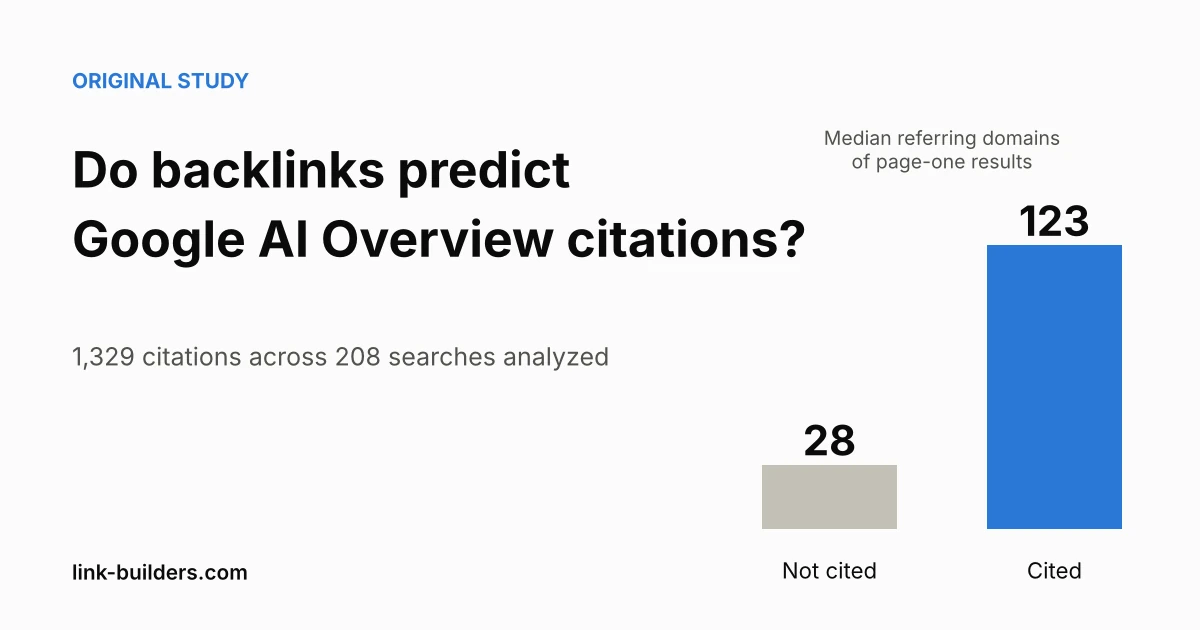
The strongest signal is one most companies have never worked on. Ahrefs studied 75,000 brands to see which factors lined up with visibility in Google’s AI Overviews. Branded web mentions had the strongest correlation, at 0.664, stronger than backlinks or Domain Rating. Correlation isn’t proof of cause, but the pattern makes sense. AI engines summarize what the web says about a topic, so brands that the web talks about get repeated. Very few companies have ever tried to earn mentions on purpose. That’s a big part of why building backlinks in an age of AI looks different than it did five years ago.
What’s Included in GEO Services: The 7 Core Deliverables
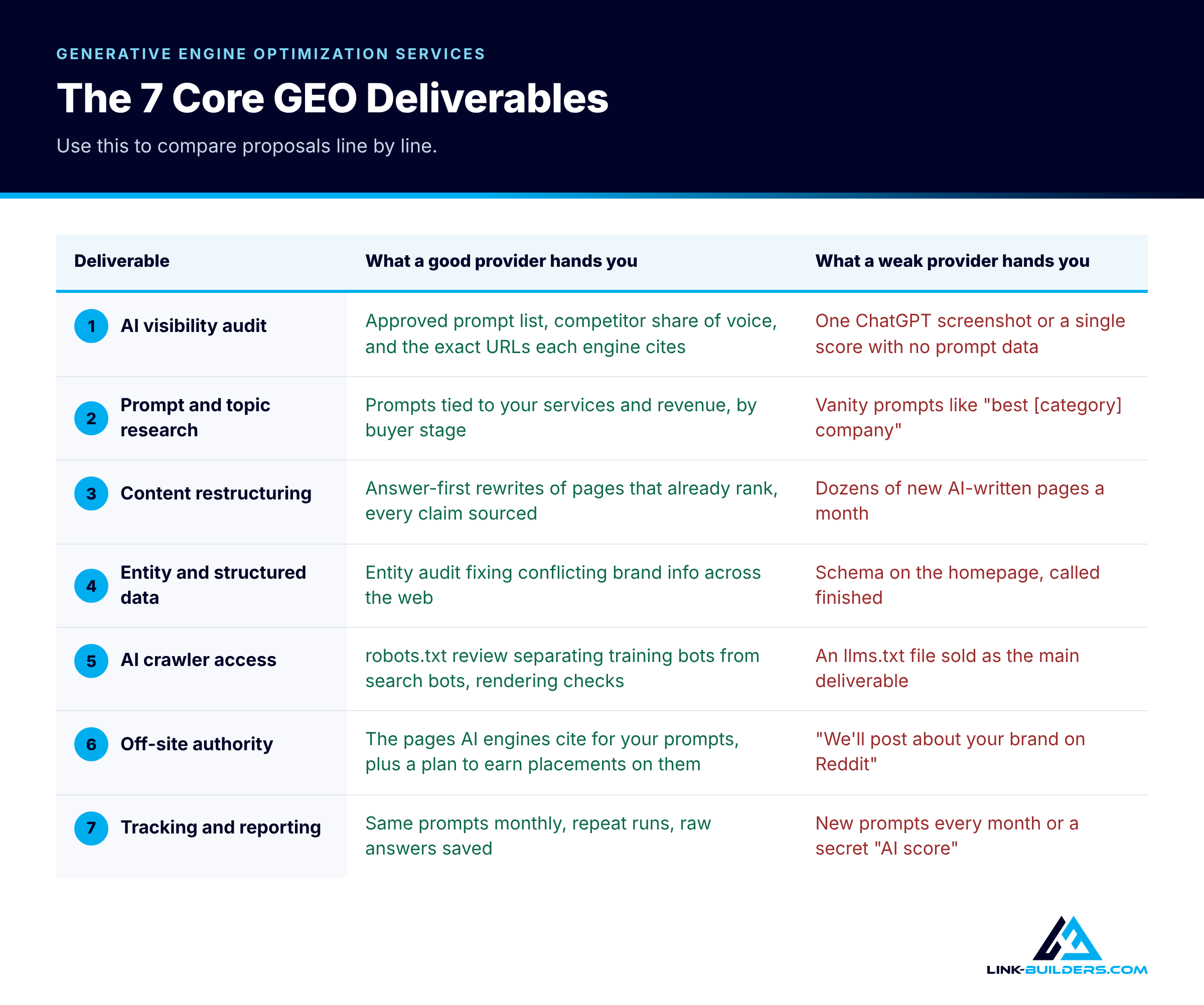
Most GEO proposals bundle some mix of the seven deliverables below. For each one, here’s what the work is, what a good provider hands you, and what a weak one hands you instead. Use this section to compare proposals line by line.
1. AI Visibility Audit and Baseline
What it is: The provider runs a fixed set of buyer questions, usually called prompts, through ChatGPT, Google AI Overviews, Perplexity and Gemini. They record which brands get mentioned, which pages get cited, and where you stand against competitors.
What a good provider hands you: a prompt list you approved, a competitor share-of-voice table, and the exact URLs each engine cited. That last item is the most valuable part of the audit, because it tells you which pages you need to be on.
What a weak provider hands you: a screenshot of one ChatGPT answer, or a single “AI visibility score” with no prompt-level data behind it.
2. Prompt and Topic Research
What it is: the AI-era version of keyword research. It finds the questions real buyers ask an assistant and groups them by stage, from “what is” questions to “who should I hire” questions.
What a good provider hands you: prompts tied to your services and revenue, with notes on which ones already trigger AI answers and which competitors own them.
What a weak provider hands you: a list of vanity prompts like “best [your category] company” and nothing that reflects how your customers actually talk.
3. Content Restructuring for AI Extraction
What it is: rewriting your important pages so an AI engine can easily lift a clear, accurate answer from them. That means putting the answer first, defining terms plainly, using tables for comparisons, adding original data with sources, and including short FAQ blocks. These changes line up closely with what the Princeton research found helps.
What a good provider hands you: rewrites of pages that already rank or already get cited, because those pages are closest to winning. They also make sure every claim on the page has a real source.
What a weak provider hands you: dozens of new AI-written pages a month. Google treats mass-produced content made mainly to manipulate rankings as spam. Shallow, self-promotional listicles written mainly to get picked up by AI tools have already drawn attention for losing organic visibility. More on that in my breakdown of the September 2026 spam update.
4. Entity and Structured Data Work
What it is: making sure search engines and AI models understand exactly who you are. That includes a consistent company description across your site and profiles, a strong About page, real author pages, Organization schema, and matching information on review sites, directories and social profiles.
What a good provider hands you: an entity audit showing where your name, description, services or location conflict across the web, with fixes for each one.
What a weak provider hands you: schema markup added to the homepage and called finished. Google says structured data isn’t required for AI features, so schema alone won’t carry a GEO program. It helps most as part of a consistent picture of your brand.
5. Technical Access for AI Crawlers
What it is: making sure the bots that power AI search can reach and read your pages. This is more confusing than it should be, because each company runs several crawlers with different jobs.
- OpenAI runs OAI-SearchBot for ChatGPT search results, GPTBot for training its models, and ChatGPT-User for visits a user triggers. You can block training and still allow search.
- Perplexity runs PerplexityBot to find and link pages in its answers. It says this bot is not used to train foundation models.
- Google uses its normal Googlebot for AI Overviews and AI Mode. Its separate Google-Extended control covers training and grounding for Gemini apps, and Google says it does not affect inclusion in Google Search.
The technical work also covers rendering. If your key content only appears after JavaScript runs, some AI crawlers may never see it.
What a good provider hands you: a robots.txt review that separates training bots from search bots, a check of what each crawler actually receives, and a written explanation of the trade-offs before anything changes.
What a weak provider hands you: an llms.txt file sold as the main deliverable. llms.txt is a proposed standard for giving AI tools a summary of your site. It’s cheap to add and doesn’t hurt, but there’s no public evidence that the major AI search engines use it to decide what to cite. It shouldn’t cost you much, and it shouldn’t be the centerpiece of anyone’s proposal.
6. Off-Site Authority: Mentions, Citations and Links
This is the deliverable that matters most and gets skipped most often.
What it is: AI engines repeat what the rest of the web says about you. When someone asks ChatGPT for the best accounting software for small law firms, the answer is built from review sites, comparison articles, industry publications, forum threads and resource pages. If your brand isn’t on those pages, your own website can be perfect and still not get named. Off-site GEO work means finding the pages AI engines already cite for your prompts and earning a place on them. It also means building mentions on the kinds of sites the engines trust, through link building, digital PR, review platforms and real participation in communities.
The data points the same way. The Ahrefs study above found brand mentions were the strongest visibility signal it measured. Ahrefs has also found that Reddit is one of the most-cited domains in AI Overviews, with more than 12 million citations. Community discussion feeds AI answers directly.
What a good provider hands you: a list of the exact pages AI engines cite for your prompts, a plan to earn placements on them (and on similar pages), and full visibility into every site contacted, every reply and every cost. This is outreach work, and it’s slow and specific. In my experience, tighter topical relevance gets far better replies than bigger lists. Earning real mentions takes steady, personal emails to the right site owners, not a software toggle.
What a weak provider hands you: “We’ll post about your brand on Reddit.” Fake accounts get banned, and Reddit communities are quick to call out brands that astroturf. Other warning signs include paid spots on low-quality “best of” lists that exist only to be cited, and link packages from marketplaces that Google already knows how to discount.
If you want to see how this works in practice, I’ve written about how I rebuilt my prospecting process as an AI agent, analyzing competitor backlinks with AI, and what the first 2,920 AI-surfaced link prospects actually looked like.
7. Tracking and Reporting
What it is: re-running the same prompt set every month and reporting on what changed. Good reports show your share of mentions and citations against competitors, which of your URLs got cited, AI referral sessions and conversions from GA4, AI impressions from Search Console, and branded search volume.
What a good provider hands you: the same prompts every month, with raw answers saved so you can check them yourself. AI answers vary from one run to the next, so a provider should run each prompt more than once and report trends over months, not single snapshots.
What a weak provider hands you: different prompts every month, or a proprietary “AI score” that rises steadily with no explanation of how it’s calculated.
What GEO Services Cost in 2026
Typical Price Ranges
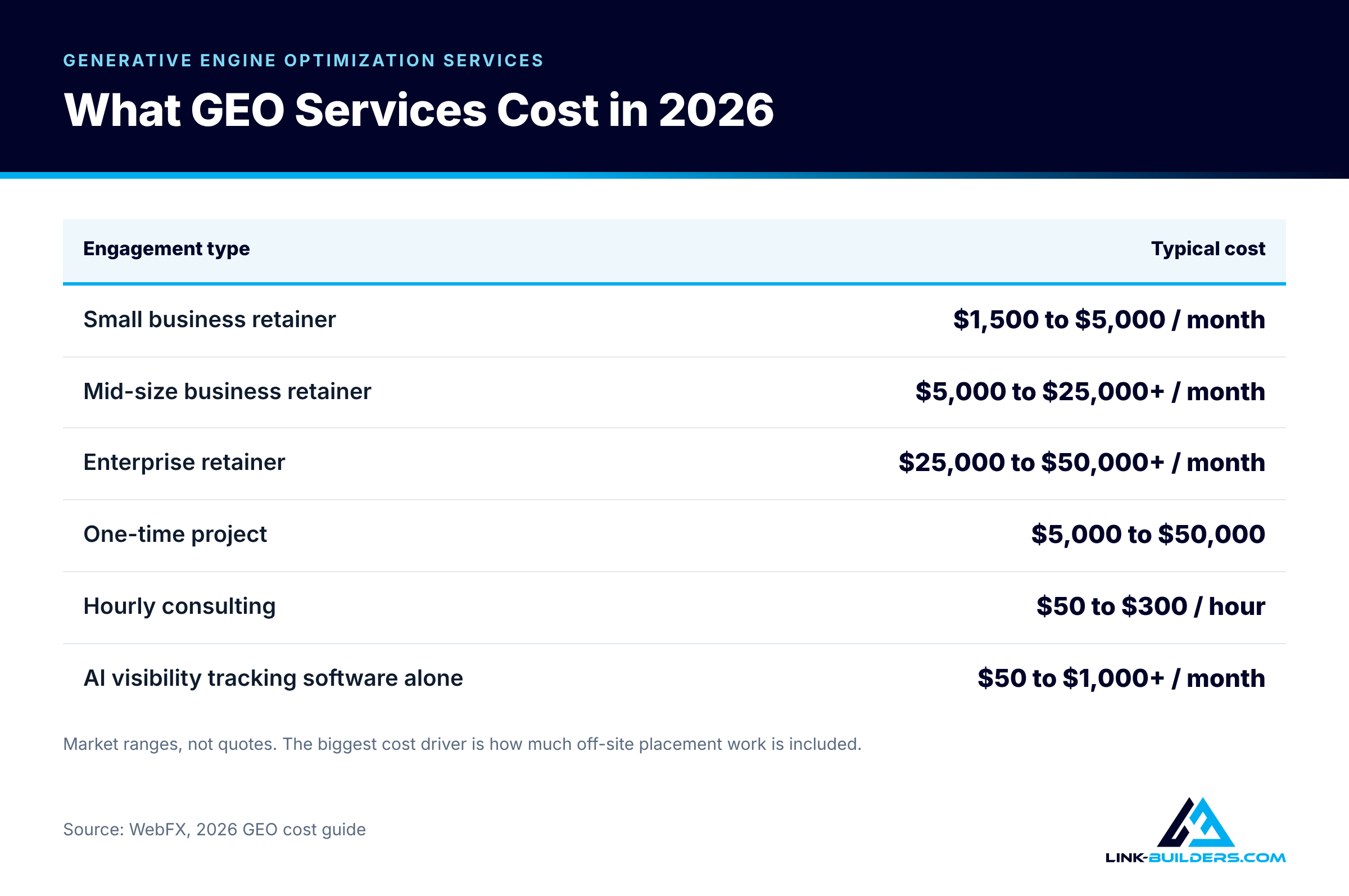
Pricing varies widely by company size and scope. WebFX’s 2026 GEO cost guide puts typical ranges here:
| Engagement type | Typical cost |
|---|---|
| Small business retainer | $1,500 to $5,000 per month |
| Mid-size business retainer | $5,000 to $25,000+ per month |
| Enterprise retainer | $25,000 to $50,000+ per month |
| One-time project | $5,000 to $50,000 |
| Hourly consulting | $50 to $300 per hour |
| AI visibility tracking software alone | $50 to $1,000+ per month |
Treat these as market ranges, not quotes. Two proposals at the same price can include very different amounts of real work.
The Three Pricing Models and the Incentives Behind Them
Monthly retainers are the most common. They’re easy to budget, but read the scope closely. A retainer pays for a set amount of effort, and if the deliverables are vague, the effort can shrink without the price changing.
Project fees suit audits, technical fixes and one-time content rewrites. They don’t fit off-site work well, because earning mentions and links is ongoing.
Hourly and pass-through pricing is less common but often the most transparent. Here’s why the model matters. When a provider charges a fixed price per placement or per deliverable, every expensive opportunity eats into their margin. That gives them a quiet reason to skip the best opportunities when those cost more. With hourly billing and third-party costs passed through at what they actually cost, you see where every dollar goes and you decide which opportunities are worth it. I explain this in more detail in the new unit economics of white-label link building and in whether backlinks should really cost hundreds of dollars each.
What Drives the Price Up
- The number of AI platforms tracked and prompts monitored
- How many existing pages get rewritten
- Whether technical changes need a developer
- Most of all, how much off-site placement work is included
Placements on real publications cost real money and real hours. A cheap retainer usually means little or no off-site work. If you’re unsure how much authority your site needs, my guide on how many backlinks you need is a good place to start.
Red Flag Pricing
Be careful with “GEO packages” priced at a few hundred dollars a month. Ask what’s actually done each month, by whom, and what you’d see in the report. If the answer is “our platform monitors your visibility,” you’re buying a dashboard, not a service.
The 6 Types of GEO Providers (and Which One Fits You)
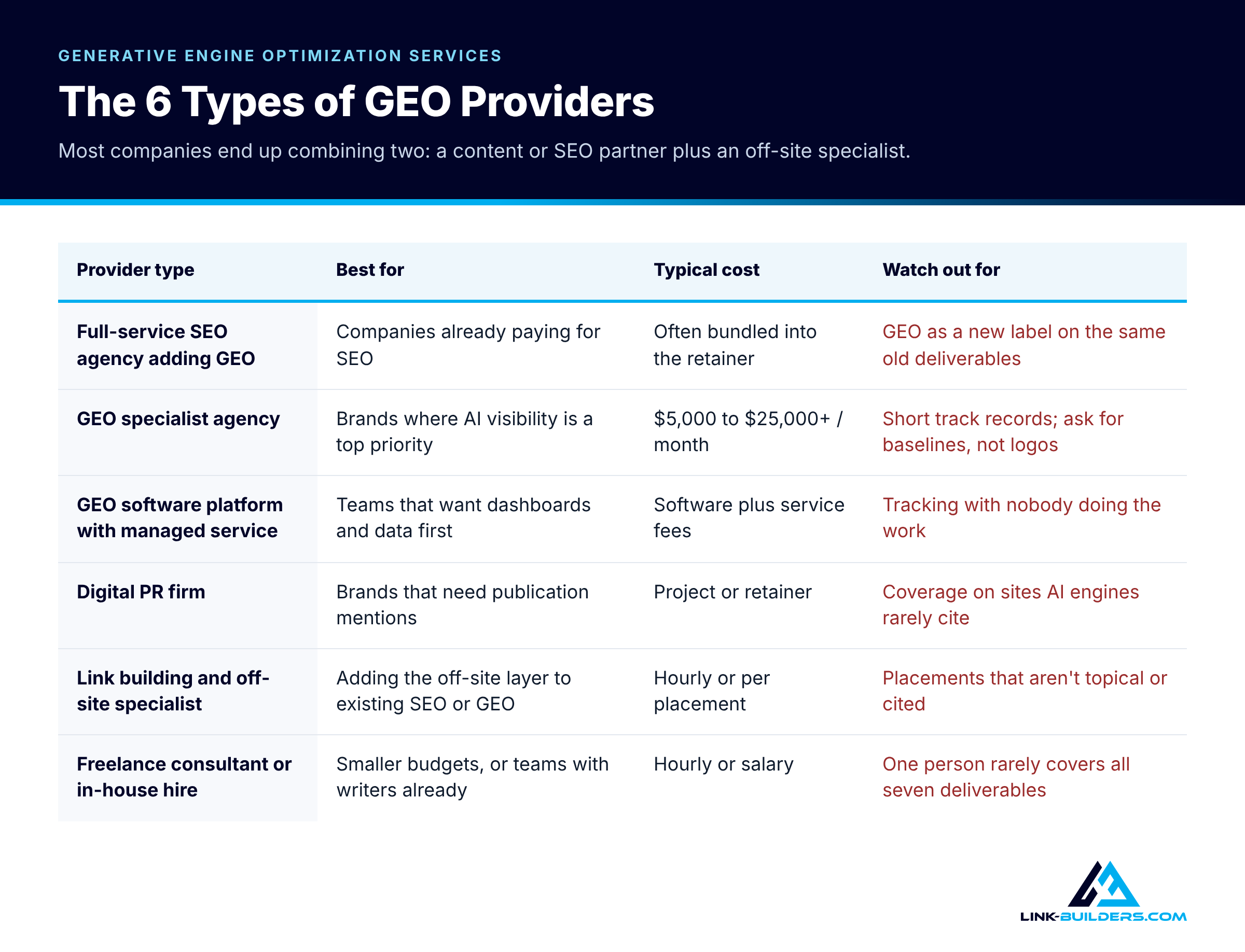
You’ll find plenty of “top GEO agencies” lists online. Most are written by agencies or tool vendors and rank themselves near the top. Lists of names also go stale fast. A more useful way to shop is to understand the kinds of providers out there and which kind fits your situation.
| Provider type | Best for | Typical cost | Watch out for |
|---|---|---|---|
| Full-service SEO agency adding GEO | Companies already paying for SEO | Often bundled into the retainer | GEO as a new label on the same old deliverables |
| GEO specialist agency | Brands where AI visibility is a top priority | $5,000 to $25,000+ per month | Short track records; ask for baselines, not logos |
| GEO software platform with managed service | Teams that want dashboards and data first | Software plus service fees | Tracking with nobody doing the work |
| Digital PR firm | Brands that need publication mentions | Project or retainer | Coverage on sites AI engines rarely cite |
| Link building and off-site specialist | Adding the off-site layer to existing SEO or GEO | Hourly or per placement | Placements that aren’t topical or cited |
| Freelance consultant or in-house hire | Smaller budgets, or teams with writers already | Hourly or salary | One person rarely covers all seven deliverables |
Full-Service SEO Agencies Adding GEO
If your SEO agency is already strong, adding GEO to that relationship can be efficient, since so much of the work overlaps. Ask them to show you which of the seven deliverables are new. If the GEO line item contains nothing you weren’t already getting, you’re paying twice.
GEO Specialist Agencies
These firms focus only on AI visibility. The good ones are sharp on prompt research and measurement. Because the field is young, few have long track records, so ask for anonymized before-and-after baselines using the same prompts at both points.
GEO Software Platforms With Managed Services
Tracking platforms are useful for measurement. Some add a service team on top. Find out how many hours of human work you get each month and what that team actually changes on your site and across the web.
Digital PR Firms
PR firms are good at earning mentions in news and trade publications. Ask whether they check which publications AI engines actually cite for your topic. A mention in a big outlet the engines never cite for your prompts helps your brand but may do little for AI visibility.
Link Building and Off-Site Specialists
This is where Link Builders fits. I sell GEO off-site work directly to companies, and I’m also the off-site specialist working behind GEO and SEO agencies, handling the outreach and placements they don’t do in-house. Agencies that want that partnership can read about my white-label link building service. The thing to check with any off-site specialist is whether their placements are on pages that are topical for your business and, ideally, already cited by AI engines.
Freelancers and In-House Hires
A skilled consultant or an in-house hire can be the best value, especially if you already have writers and a developer. Just be realistic about coverage. The seven deliverables span content, technical SEO, analytics and outreach, and one person rarely does all four well.
Most companies end up combining two of these, usually a content or SEO partner plus an off-site specialist.
How to Choose a GEO Services Provider: A 6-Step Process
Step 1: Write Down 20 to 30 Buyer Prompts
Before you talk to anyone, list the questions your customers would ask an AI assistant at each stage. Include problem questions, comparison questions and “who should I hire” questions. Next to each prompt, write the outcome you want: mentioned, cited or recommended first.
Step 2: Run Your Own Free Baseline
Ask each prompt in ChatGPT, Perplexity, Gemini and Google. Record who gets mentioned and which URLs get cited. This takes an afternoon, and afterward you’ll know more about your AI visibility than most sales calls will tell you. It also gives you a way to check each provider’s audit for accuracy.
Step 3: Shortlist Three Providers
Pick at least two different provider types from the table above. Comparing a GEO specialist with an SEO agency and an off-site specialist shows you quickly where each one is strong and where it’s thin.
Step 4: Ask the 15 Questions Below
Send the questions in writing before the call. How a provider answers in writing tells you a lot about how they’ll report to you later.
Step 5: Start With a Paid Pilot of 60 to 90 Days
Agree on a fixed prompt set, a fixed scope and the report format up front. Avoid 12-month lock-ins for a discipline this new. A provider that’s confident in their process shouldn’t need one.
Step 6: Put Ownership in the Contract
Make sure you own the content, the prompt list, the tracking data and any accounts created in your company’s name. If you stop working together, all of it should stay with you.
15 Questions to Ask Before You Hire a GEO Agency
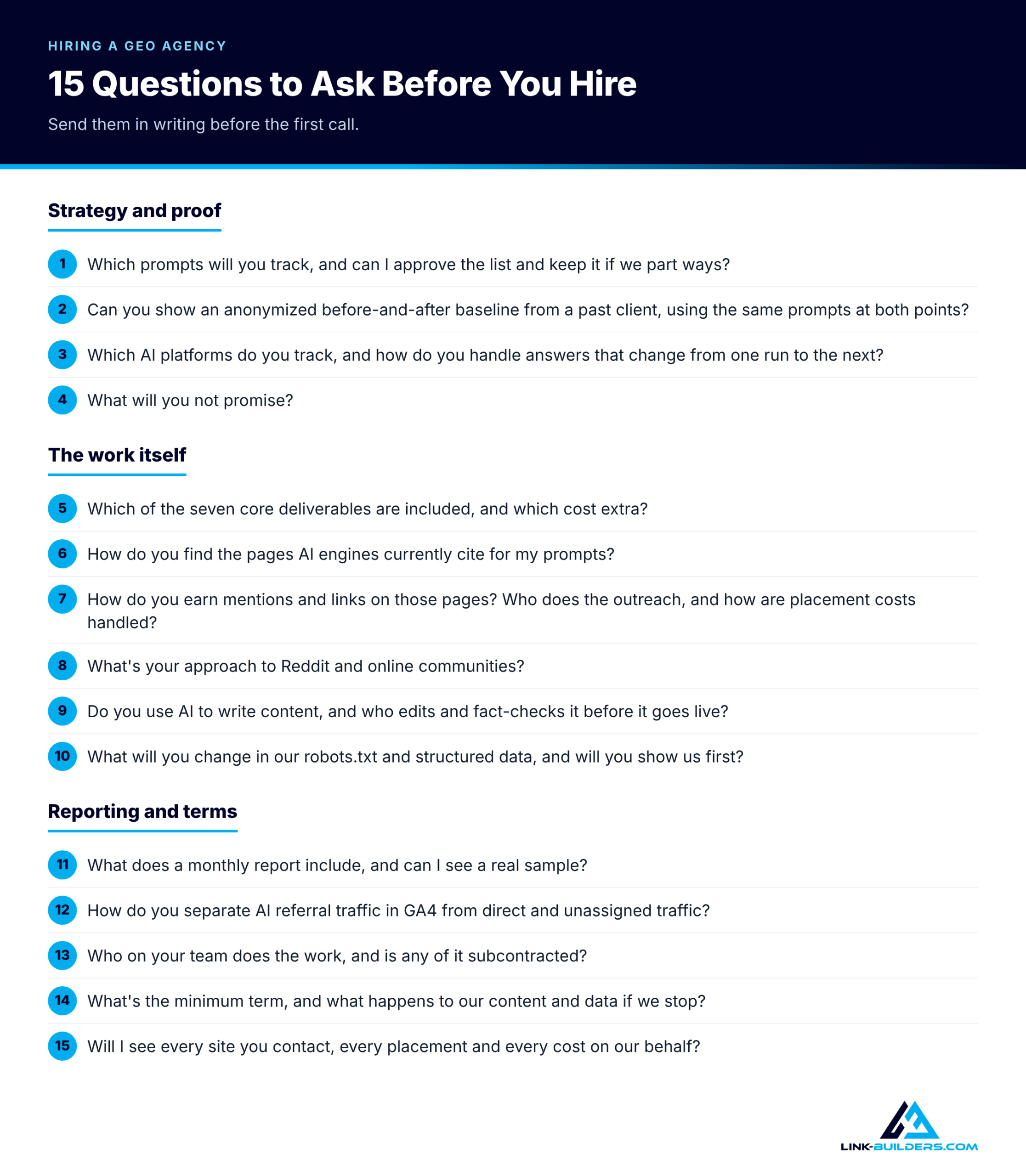
Strategy and proof
- Which prompts will you track, and can I approve the list and keep it if we part ways?
- Can you show an anonymized before-and-after baseline from a past client, using the same prompts at both points?
- Which AI platforms do you track, and how do you handle answers that change from one run to the next?
- What will you not promise? (A good answer includes “a specific position in ChatGPT.”)
The work itself
- Which of the seven core deliverables are included, and which cost extra?
- How do you find the pages AI engines currently cite for my prompts?
- How do you earn mentions and links on those pages? Who does the outreach, and how are placement costs handled?
- What’s your approach to Reddit and online communities? (Listen for “real participation,” not “accounts we manage.”)
- Do you use AI to write content, and who edits and fact-checks it before it goes live?
- What will you change in our robots.txt and structured data, and will you show us before you change it?
Reporting and terms
- What does a monthly report include, and can I see a real sample?
- How do you separate AI referral traffic in GA4 from direct and unassigned traffic?
- Who on your team does the work, and is any of it subcontracted?
- What’s the minimum term, and what happens to our content and data if we stop?
- Will I see every site you contact, every placement and every cost on our behalf?
On question 13: subcontracting isn’t a red flag. Plenty of good agencies use specialists for parts of the work, and I do white-label off-site work for agencies myself. What matters is that the agency is upfront about it and the specialist meets the same standards.
GEO Agency Scorecard
Score each provider from 1 to 5 on these six areas, then compare totals:
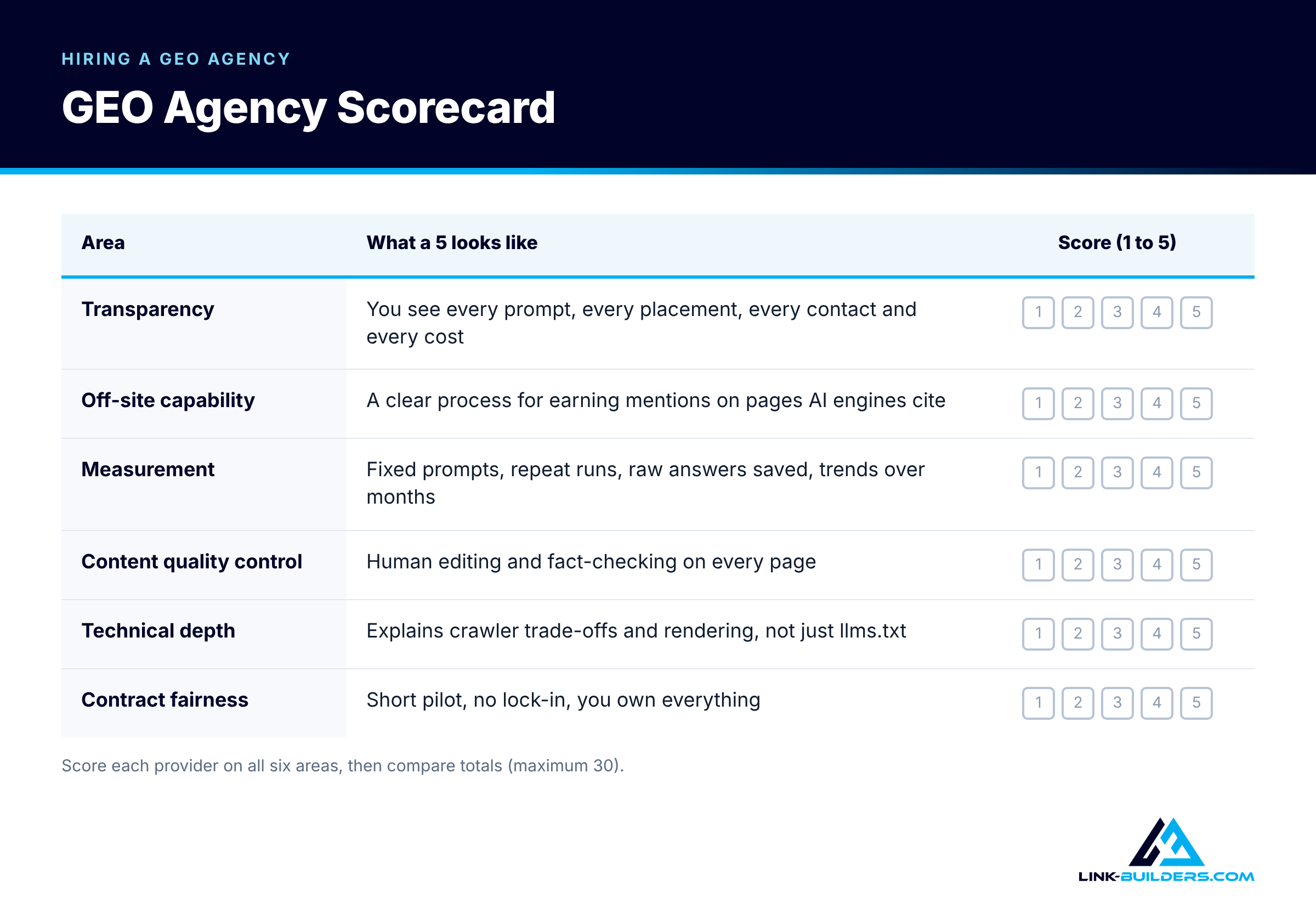
| Area | What a 5 looks like |
|---|---|
| Transparency | You see every prompt, every placement, every contact and every cost |
| Off-site capability | A clear process for earning mentions on pages AI engines cite |
| Measurement | Fixed prompts, repeat runs, raw answers saved, trends over months |
| Content quality control | Human editing and fact-checking on every page |
| Technical depth | Explains crawler trade-offs and rendering, not just llms.txt |
| Contract fairness | Short pilot, no lock-in, you own everything |
GEO Red Flags: Promises No Honest Agency Makes
“We guarantee you’ll be number one in ChatGPT.” AI answers change based on how the question is worded, the user’s location and history, and the model version. Nobody controls them. A guarantee here is a sign the provider either doesn’t understand the work or isn’t being straight with you.
“llms.txt will get you cited.” It may become useful someday. Right now it’s an unproven proposal, and it shouldn’t be the reason you pay a retainer.
“We’ll post about you on Reddit.” Fake accounts get banned. When communities catch brands doing it, the backlash can end up in the very threads AI engines quote.
Mass AI content. Publishing large volumes of thin pages to catch prompts is the kind of scaled content Google’s spam policies target. It can drag down the pages you actually care about.
Paid placements on throwaway “best of” lists. Lists built only to be cited, where anyone who pays gets included, are an easy pattern for search engines to spot. I’ve written about how Google approaches natural backlink profiles and link spam detection.
Reports with secret scores. If you can’t see the prompts, the answers and the cited URLs, you can’t verify anything.
Can You Do GEO Yourself?
Yes, part of it. Here are five things an in-house team can do this month:
- Run the prompt baseline from Step 2 above.
- Fix your About page, author pages and Organization schema so your brand description is clear and consistent everywhere.
- Rewrite your five best-ranking pages to put a direct answer in the first paragraph, add a comparison table where it fits, and source every statistic.
- Check your robots.txt to make sure you aren’t blocking OAI-SearchBot, PerplexityBot or Googlebot by accident.
- List the pages AI engines cite for your top prompts. This is your off-site target list.
The part that’s hard to do yourself is the last step done at scale: steady, personal outreach to earn a place on those cited pages and on hundreds of similar ones. It takes research, writing and follow-up every week, which is why many companies keep the first four steps in-house and hire out the fifth. If you’re weighing that decision, my article on the truth about hiring link builders covers what to look for.
How Long Does GEO Take, and How Do You Measure It?
Nobody can promise a timeline, and you should be wary of anyone who does. What I can say is how the pieces tend to behave. Technical and content fixes can be picked up quickly by engines that search the live web, like Perplexity and ChatGPT search, because they fetch pages when someone asks. Off-site authority builds more slowly, since mentions and links pile up over months and the models and indexes take time to reflect them.
Measure progress with these:
- Share of mentions and citations for your prompt set against competitors
- How many cited URLs are yours
- AI referral sessions and conversions in GA4 (build a custom channel group so AI traffic doesn’t hide in Referral or Unassigned)
- AI impressions in Search Console’s generative AI reports
- Branded search volume, which tends to rise as more people see your name in AI answers
Judge trends over three to six months, not single snapshots. For more on setting realistic expectations with any search provider, see client expectations vs. reality.
Frequently Asked Questions
What is the difference between GEO and AEO?
AEO (answer engine optimization) focuses on being the direct answer to a question, in featured snippets, voice assistants and AI answers. GEO (generative engine optimization) focuses on being cited, mentioned or recommended in AI-generated answers from tools like ChatGPT and Google AI Overviews. In practice the work overlaps heavily, and many providers use the terms interchangeably.
Is GEO replacing SEO?
No. AI search engines still pull from search indexes, and Google says normal SEO best practices are what count for AI Overviews and AI Mode. GEO adds work on top of SEO: prompt tracking, content built for extraction, AI crawler access and off-site mentions. A site with weak SEO gives AI engines very little to cite.
How much do generative engine optimization services cost?
Typical 2026 retainers range from about $1,500 to $5,000 a month for small businesses, $5,000 to $25,000 or more for mid-size companies, and $25,000 to $50,000 or more for enterprises. One-time projects often run $5,000 to $50,000. The biggest cost driver is how much off-site placement work is included.
Do backlinks still matter for GEO?
Yes. Links and brand mentions on trusted, relevant sites help AI engines decide which brands to name. An Ahrefs study of 75,000 brands found branded web mentions had the strongest correlation with AI Overview visibility. Backlinks still matter for the organic rankings AI engines draw from, and earning links often earns mentions at the same time.
Can a GEO agency guarantee my brand will appear in ChatGPT?
No. AI answers change with the wording of the question, the user’s context and the model version, and no outside company controls them. A trustworthy provider will promise a clear process and honest reporting, not a placement in ChatGPT or any other AI tool.
Does llms.txt help with AI visibility?
There’s no public evidence that major AI search engines use llms.txt to decide what to cite. It’s a proposed standard that’s cheap to add and doesn’t hurt, but it shouldn’t be a main deliverable or a big line item in a GEO proposal.
How long does GEO take to work?
There’s no reliable timeline. Content and technical changes can show up quickly in engines that search the live web, like Perplexity and ChatGPT search, while off-site authority builds over months. Track the same prompts monthly and judge progress over three to six months.
Should I hire a GEO agency or add GEO to my current SEO agency?
If your SEO agency is strong and can show exactly which GEO deliverables are new, adding GEO there is often efficient. If they can’t explain how they’ll earn mentions on the pages AI engines cite, pair them with an off-site specialist or look at a dedicated GEO provider. That off-site layer is what I handle as a GEO agency, either directly or behind your current agency.
Key Takeaways
- GEO services aim to get your brand cited, mentioned and recommended inside AI answers, and they sit on top of good SEO rather than replacing it.
- The seven core deliverables are an AI visibility audit, prompt research, content restructuring, entity and schema work, AI crawler access, off-site authority, and tracking.
- Off-site mentions and links are the strongest visibility signal in the best data available, and the deliverable most often left out.
- Market pricing runs from about $1,500 a month for small businesses to $50,000 or more for enterprises. Ask what work is actually done each month.
- Run your own baseline, ask the 15 questions, start with a short pilot, and walk away from anyone who guarantees a ChatGPT ranking.
Get the Off-Site Side of GEO Done Right
The off-site layer is the part of GEO most providers skip or hand off to someone else. At Link Builders, I run off-site GEO work for companies directly, and I’m the off-site specialist that GEO and SEO agencies rely on behind the scenes. I find the pages AI engines cite for your buyers’ questions and earn placements on them and on similar trusted sites, with full transparency on every opportunity, every contact and every cost.
Want to see what that looks like for your site? Request a free sample of vetted link opportunities. If you run an agency and want an off-site partner for your GEO clients, read about my white-label link building service.
About the author

Justin Davis is the founder of Link Builders, a white-label backlink agency, and has been building links since 2015 for more than 150 clients in law, healthcare, real estate, software and other industries. After years of doing prospecting research by hand, he built an AI agent link building system that handles each step, from finding link opportunities and vetting sites to finding contacts and preparing outreach. He now runs that system for agencies and in-house SEO teams, and teaches it on YouTube. Find Justin Davis on YouTube, LinkedIn and X.