How to Get Your Business Recommended by ChatGPT (and Google AI)
By Justin Davis · October 31, 2026
A homeowner in Denver notices a leak in the ceiling. A parent in Austin needs a new family dentist. Someone in Miami wants to book a med spa visit before a wedding. More and more, each of them skips the usual Google search and asks ChatGPT instead.
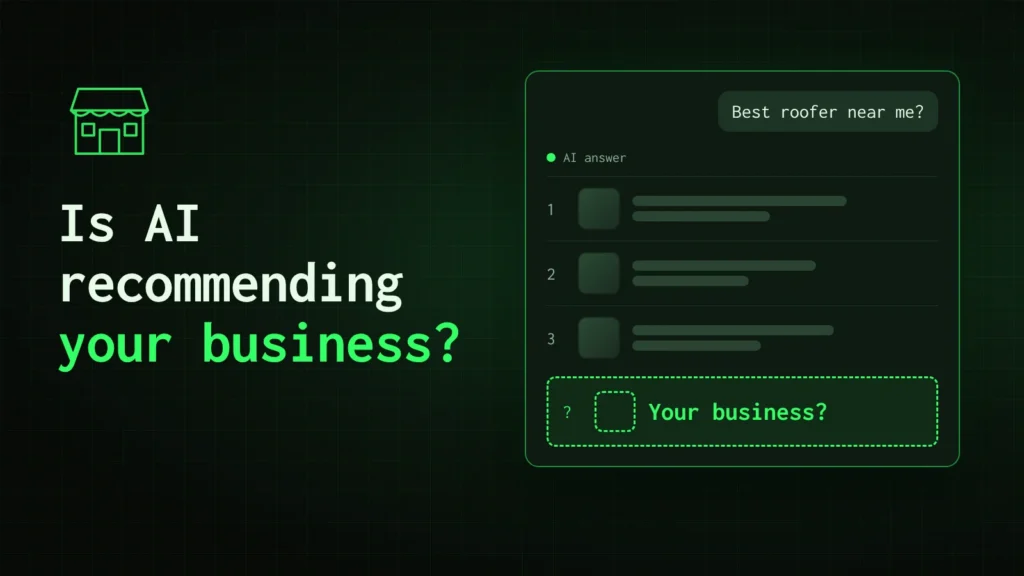
We tried all three searches on October 31, 2026. We asked ChatGPT for the best roofing company in Denver and the best family dentist in Austin. We asked Perplexity for the best med spa in Miami. Every time, the answer was a short list: a top pick, a few runners-up and nothing else. If your business isn’t on that list, the customer never hears your name.
This guide shows exactly what the AI read before it answered, and the five steps any local business can take to get recommended by ChatGPT and Google’s AI.
How ChatGPT and Google’s AI Choose Which Businesses to Recommend
When someone asks an AI tool for a local business, it runs web searches in the background. It reads the pages that come back, then names the businesses those pages mention most often and most favorably. The AI isn’t forming its own opinion. It’s repeating what the web already says. We explain why that favors some businesses over others in Why Does AI Recommend My Competitor?
To see this in action, we asked a follow-up after each answer: “What sources did you use?”
Roofers in Denver
ChatGPT pointed to a 2026 “best roofers in Denver” ranking and a “15 best roofers” list from a local guide site. It also cited a contractor directory, Birdeye reviews and a roofing trade association profile.
Family dentists in Austin
ChatGPT cited two local dentist ranking sites, Birdeye reviews, Healthgrades and the practices’ own websites.
Med spas in Miami
Perplexity cited a Miami tourism site’s “best med spas” guide and a “10 best med spas in Miami” list.

The pattern
Three industries, three cities, one pattern. The AI leaned on four kinds of pages:
- Local “best of” lists and ranking sites
- Review sites, like Birdeye and Healthgrades
- Industry directories and trade association profiles
- The business’s own website
If those pages don’t mention you, you’re not in the answer. For more on where these tools pull their information, see Where Does ChatGPT Get Its Information?

What Five AI Engines Said About Getting Recommended
We also asked the AI tools directly. Using AnswerBuilders, we put the same question to ChatGPT, Claude, Perplexity, Google AI Overviews and Google AI Mode: “How do I get my business to show up in ChatGPT answers?”
Their advice lined up closely, and it matched what we saw in the three searches. Perplexity put one point plainly: you can’t pay for or guarantee a place in ChatGPT’s normal answers.
ChatGPT does show ads now. They’re labeled as sponsored and sit apart from the answer itself. Being named inside the answer is still earned, and the steps below are how you earn it. They also line up with what we found when we studied how brands get cited by AI.
Step 1: Let AI Read Your Website
ChatGPT and Perplexity gave the same first step: make sure your site doesn’t block OpenAI’s search crawler. It’s called OAI-SearchBot, and OpenAI lists it on its crawler overview page. Your web developer can check your robots.txt file in a couple of minutes.
Next, put your key details on the page as plain text. That means what you do, where you work, your hours and how to reach you. If that information only appears inside an image or behind a login, the AI can’t read it. Adding LocalBusiness schema markup helps too, because it labels those details in a format machines read easily.
Step 2: Make Your Details Match Everywhere
Use the exact same business name, address, phone number and list of services on every site that describes you. That includes your website, your Google Business Profile, Bing Places, Apple Maps, Yelp and the directories in your industry.
Three of the five AI engines mentioned Bing Places specifically, so don’t skip it. When your details match across all those sites, the AI can be confident they all describe the same business. When one listing has an old phone number or a different suite number, that confidence drops.

Step 3: Answer Your Customers’ Questions on Your Own Pages
Give each main service its own page. On it, say what you do, where you serve, who you help and, if you can, a price range. Open with a short, direct answer to the question a customer would actually type, such as “How much does a roof inspection cost in Denver?”
This matters because your own site can be one of the pages the AI reads. In our Austin search, the dentists’ own websites showed up in ChatGPT’s source list. A page that answers clearly gives the AI something to quote.

Step 4: Get on the Lists AI Reads
This is the big one. In all three searches, the AI leaned on local “best of” lists and ranking sites. Here’s how to find the ones that matter for you:
- Ask ChatGPT and Perplexity for the best business like yours in your city.
- Ask each one for its sources.
- Write down every list, guide and directory they name.
- Contact each site owner and ask them to review your business or add you to the list.
- Claim your profile on the directories in your industry, such as Healthgrades for dentists or a trade association listing for contractors.
Each new mention on a page the AI trusts makes your name more likely to show up next time. One caution: publishing your own “best of” list with your business at the top is not the same thing. We looked at that tactic in Is Google Targeting Self-Promo Listicles?

Step 5: Earn Reviews, and Test Every Month
Review sites showed up in the source lists too. Birdeye appeared for both the roofers and the dentists, and Healthgrades appeared for the dentists. Ask happy customers for honest reviews, make it easy with a direct link and never buy or script them.
Then test. Once a month, ask the AI the questions your customers ask. Check whether your business is named and which sources the AI used. Answers change as the tools update, so the businesses that keep checking are the ones that notice when a new list starts to matter.
Frequently Asked Questions
Can you pay to be recommended by ChatGPT?
No. ChatGPT now shows ads, but they’re labeled as sponsored and kept apart from the answer. The businesses named inside the answer are there because the pages ChatGPT read mention them.
What is OAI-SearchBot?
It’s the crawler OpenAI uses to find and read pages for ChatGPT search. If your robots.txt file blocks it, ChatGPT may not be able to read your site when it looks for answers.
Why does Bing Places matter for AI search?
Three of the five AI engines we asked mentioned Bing Places specifically. Many businesses set up Google Business Profile and forget Bing, so a complete Bing listing is an easy gap to close.
How long does it take to start showing up?
There’s no fixed timeline. It depends on how fast new listings, reviews and mentions go live, and on how often each AI tool refreshes what it reads. Monthly testing shows you when the answers start to change.
Is this the same as local SEO?
They overlap a lot. Accurate listings, clear service pages and mentions on trusted sites help with both. The newer part is targeting the specific pages AI answers cite, which is often called generative engine optimization, or GEO. Our guide What Is GEO? covers it in more detail.
By Industry
The video at the top of this page walks through all five steps in about five minutes, with the real AI answers on screen. You can also watch it on YouTube.
The five steps above apply to any local business. What changes by industry is which pages the AI reads, and which details it looks for. The notes below come from additional checks we ran on October 31, 2026, in Houston, Dallas and Atlanta. They add only what was specific to those tests, not a second copy of the five steps.
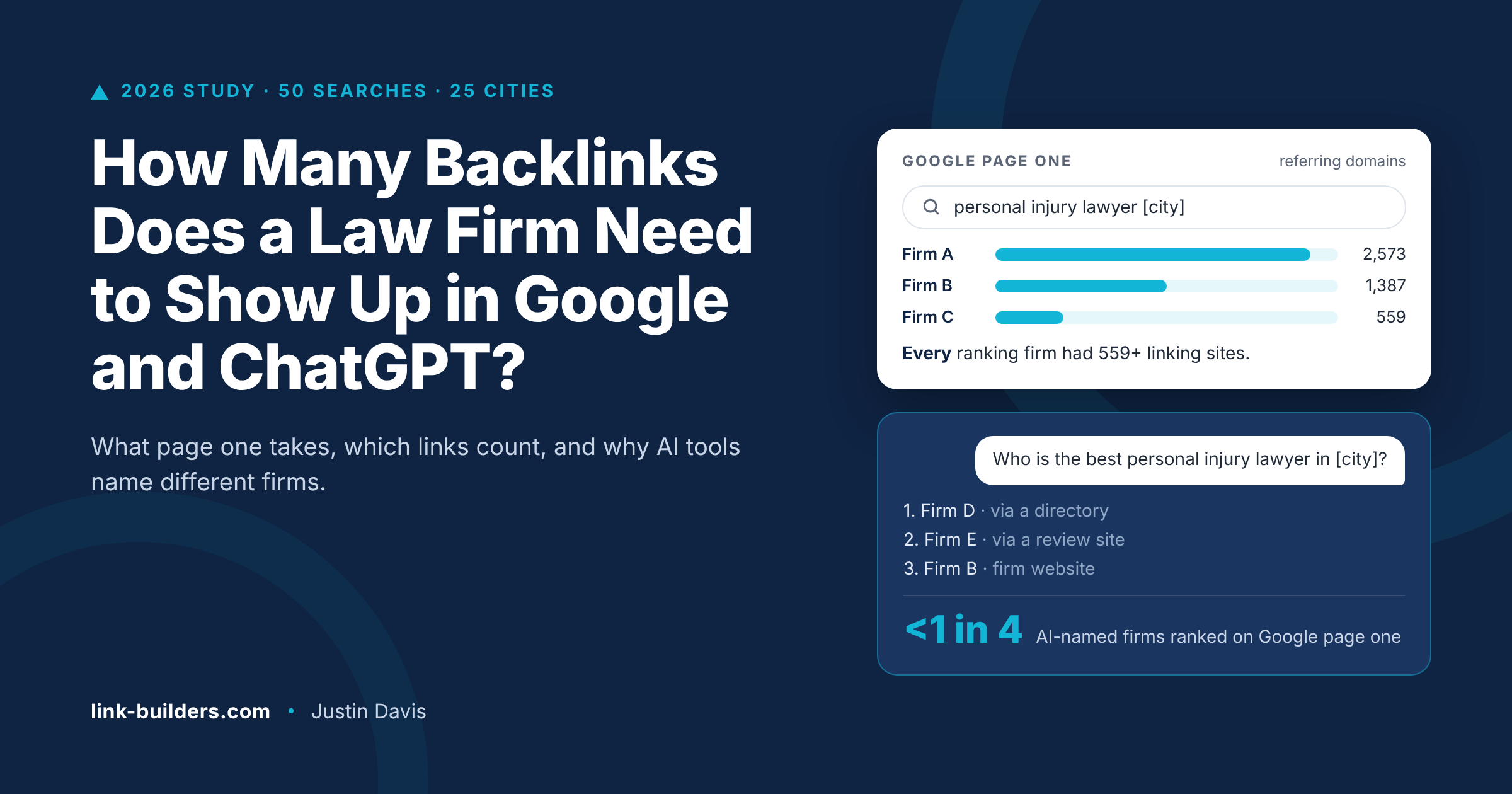
For HVAC, we published a separate Phoenix study: Which Phoenix HVAC Companies Does AI Recommend?. For law firms, see the standalone guide: How to Get Your Law Firm Recommended by ChatGPT. I also measured how many backlinks law firms needed to show up in Google and ChatGPT, based on 50 searches in 25 cities.
Dental practices
On October 31, 2026, we asked ChatGPT, “Who’s the best dentist in Houston?” and then asked what sources it used. The sources included Healthgrades, a practice’s own website (described as the place for services, credentials, technology and insurance), review pages, and local dentist ranking sites. When we asked Perplexity the same question, it also cited Zocdoc, WebMD’s doctor directory, Tebra’s Houston dentist finder, and a city magazine’s Top Dentists list.
Both tools raised insurance without being asked. Perplexity said the right dentist depends on insurance, neighborhood and the kind of care needed. ChatGPT offered to narrow its list to dentists that accept a patient’s plan. If you want to be matchable on those questions, put the following in plain text on your site, not only in a PDF or an image: the insurance plans you accept, whether you are taking new patients, whether you handle dental emergencies, and any evening or Saturday hours.
Claim the general listings in the steps above, then add the dental and health directories the tools actually cited: Healthgrades, Zocdoc, WebMD and Tebra. Vitals and the ADA’s Find-a-Dentist directory are worth claiming too. Write a real bio for every dentist (dental school, years in practice, specialty training and memberships). Keep every claim accurate. Your state dental board sets advertising rules, including how you describe specialties, so check those rules before you publish. Dentist schema markup can label those details for machines, in addition to the LocalBusiness schema already mentioned above.
Med spas
On October 31, 2026, we asked ChatGPT, “What’s the best med spa in Dallas?” Its description of its top pick stood out: “Physician-owned and MD-led. Particularly appealing if medical oversight is a priority.” Its second pick was described as a “physician-led practice.” ChatGPT also listed what it would compare beyond star ratings: injector credentials and years of experience, before-and-after photos of actual patients, physician oversight, independent reviews (including negative ones), pricing, and policies for complications or corrections. Perplexity told patients to look for a practice where a physician, nurse practitioner or physician assistant performs or closely supervises injections.
The sources those tools cited included each med spa’s own website and treatment pages, Yelp, Medical Spa Locator’s Dallas rankings (cited by both tools), MedSpa Scout’s Dallas guide, and other local ranking lists. Google’s AI Mode named RealSelf, and Perplexity also cited Mindbody listings.
Name every injector and provider on your website, with credentials and role, and name the physician who provides medical oversight. Give each treatment its own page rather than lumping similar procedures together, and keep claims accurate and easy to verify. Collect reviews on Google, Yelp and RealSelf; reviews that name the treatment and the provider give the AI something specific to match. MedicalBusiness schema markup can label the practice details. None of this is a promise that physician-led language will put you on a list. It is what the tools highlighted in this one Dallas check, and they can only use it if they can find it in plain text.
Roofing companies
On October 31, 2026, we asked ChatGPT, “Who’s the best roofing company in Atlanta?” It described companies with details it could check, such as manufacturer certification, storm-damage inspections, warranties and financing, and it told the homeowner to compare the workmanship warranty, proof of insurance, and whether the company uses its own crews or subcontractors. One of its five sources was a GAF contractor profile, which it used to confirm a certification. Perplexity, asked the same question, read a different set of lists and named a different company first. ChatGPT even added that it would not claim its top pick was definitely the best in Atlanta, because one directory’s editorial pick did not match another ranking. The practical point is that the AI is repeating the lists it reads, so which lists you are on affects whether it names you.
If you are certified by a shingle manufacturer, keep that profile complete and link to it from your site. GAF’s contractor finder is one place those profiles live. Put your license number (if your state or city requires one), proof of liability insurance and workers’ comp, warranties, crew arrangement, and current certifications in plain text on your site. Licensing rules vary by state. Georgia, for example, does not require a statewide roofing license, according to the Georgia Attorney General’s Consumer Protection Division, which makes certifications, insurance and reviews carry more weight there. Local permits and business licenses may still apply. An expired certification or a warranty you no longer offer can do more harm than leaving it off.
If you publish storm-damage pages, explain how you help homeowners with insurance claims, but do not promise outcomes you cannot control, such as a guaranteed approval or a free roof. Claim Better Business Bureau, Angi and GuildQuality in addition to the general listings in the steps above. ChatGPT cited a BBB profile as one of its Atlanta sources. RoofingContractor schema markup can label the business details.
See Which Pages AI Cites for Your Business
Checking dozens of questions across five AI tools by hand gets old fast. AnswerBuilders asks ChatGPT, Claude, Perplexity and Google’s AI the questions your customers ask. It shows whether you’re named, and it lists every page the AI cited. Those pages become your outreach list.
AI recommends businesses based on the web pages it reads. We show you which pages those are, and then we get you onto them.
If you’d rather have the work done for you, the AnswerBuilders outreach program contacts every one of those sites on your behalf.
Try it right now. Ask ChatGPT for the best business like yours in your city. If you’re not on the list, you know where to start.
About the author

Justin Davis is the founder of Link Builders, which offers link building services to companies and white label link building to agencies, and has been building links since 2015 for more than 150 clients in law, healthcare, real estate, software and other industries. After years of doing prospecting research by hand, he built an AI agent link building system that handles each step, from finding link opportunities and vetting sites to finding contacts and preparing outreach. He now works every project himself, running that system for agencies and in-house SEO teams, earning the links and mentions that help their clients show up in Google and in AI answers, and teaches it on YouTube. He also built AnswerBuilders, the AI visibility platform Link Builders uses to find the pages AI answers cite. Find Justin Davis on YouTube, LinkedIn and X.