How to Use AI to Analyze Competitor Backlinks 10x Faster
Updated October 2, 2026 · Originally published 2025; years framing refreshed
As of 2026, I’ve been building backlinks professionally for 11 years (Link Builders founded 2015). I’ve worked with more than 150 clients across every industry you can think of. And I can tell you right now that the prospecting phase has always been the absolute worst part of this job.
You know the drill. You fire up Ahrefs, pull a competitor’s backlink profile, and suddenly you’re staring at a spreadsheet with 1,000+ rows. Maybe more. You start scrolling through, trying to separate the legitimate opportunities from the garbage. An hour later, you’ve got maybe 50 decent prospects to show for it. And that’s if you’re fast.
Here’s the problem with that math. If you’re only getting a 5% positive response rate on your outreach (and 5% is pretty good), you need a lot of prospects. Like, hundreds. To build 20 backlinks, you might need to find 400 solid opportunities. At an hour per 1,000 links analyzed, you’re looking at 10+ hours just to build your prospect list.
That was my reality until about three months ago when I started experimenting with building an AI SEO link building tool. I’m not talking about using ChatGPT to write generic outreach emails. I’m talking about training AI to do the actual analysis work that eats up all your time.
What used to take me 10 hours now takes 30 minutes. And I was already one of the fastest manual analysts out there.
Let me show you exactly how I did it. I’m going to give you two methods. The first one you can start using today with tools you probably already have. The second one is what I built for myself, and it’s changed everything about how I run my agency.
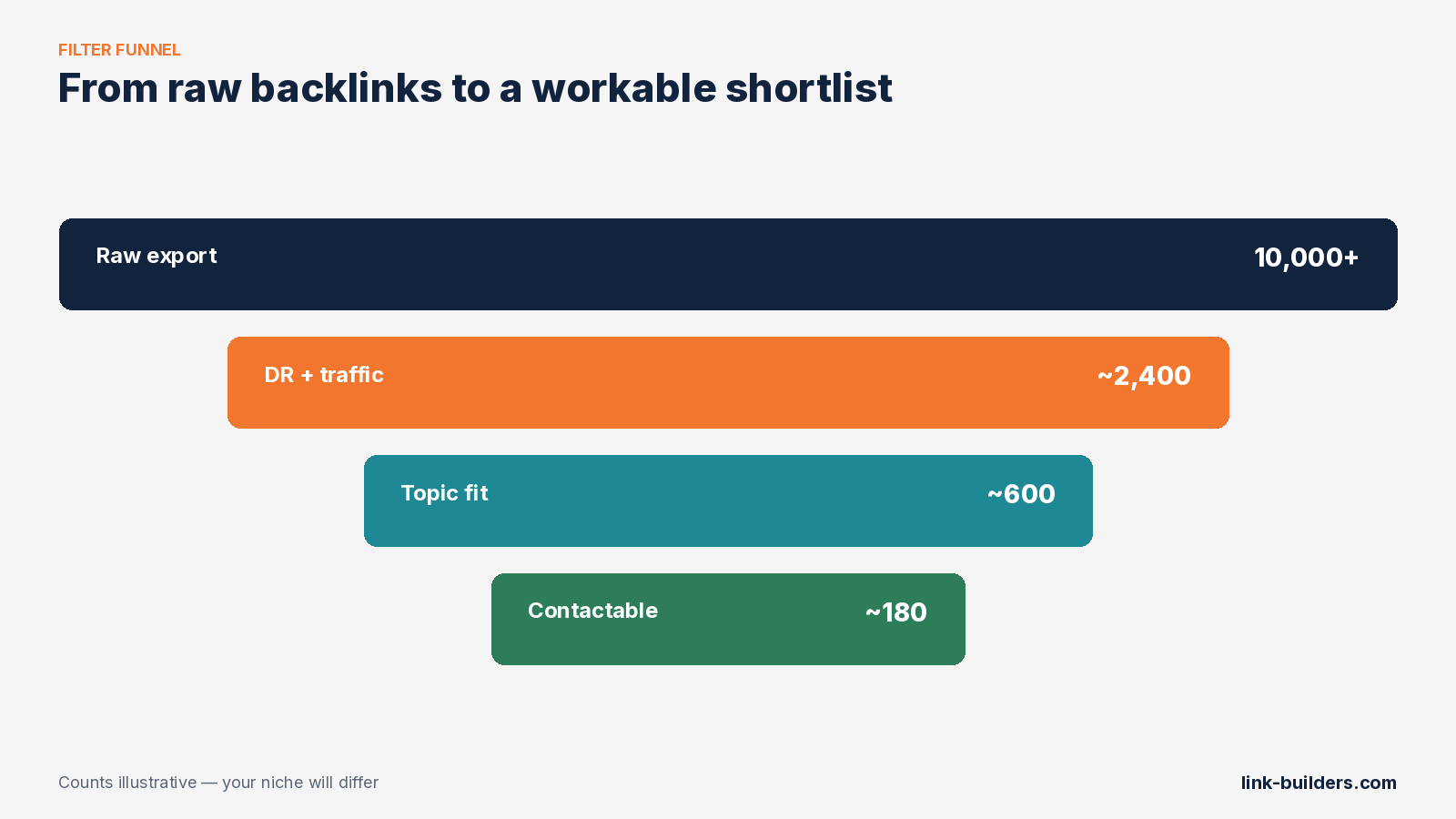
The Manual Analysis Problem
Let’s start with what the traditional process actually looks like. You export your competitor’s backlink profile from Ahrefs. You get this massive CSV file with dozens of columns of data you don’t even need. Domain Rating, URL Rating, Referring domains, Dofollow/Nofollow, Anchor text, and on and on.
The first thing I always did was delete everything except the columns that actually matter. Domain Rating, organic traffic, page title, and the URL. That alone takes a few minutes because you’re trying to make the spreadsheet readable without scrolling sideways forever.
Then the real work starts. You’re scanning through row after row, asking yourself the same questions over and over. Is this domain related to my client’s industry? Does it get real organic traffic? Is this a spam site? Is it a casino or male enhancement pill site? Does the domain look legitimate?
Every time you find something that looks promising, you copy it to another spreadsheet where you’re building your prospect list. Switch windows, paste, switch back. Over and over.
The whole process is mind-numbing. And the worst part is that you can’t really shortcut it. You need to actually look at each domain because the metrics alone don’t tell you if it’s a good fit. A DR 60 site might look great until you realize it’s a generic news aggregator with zero relevance to your niche. Meanwhile, a DR 30 site might be perfect because it’s a focused industry blog.
This is why most link builders hate prospecting. It’s necessary, but it’s not where your expertise adds value. You’re not being strategic. You’re just doing data entry and pattern matching.
Method 1: AI-Enhanced Ahrefs Analysis
Here’s the good news. You can start using AI to handle the pattern matching part right now. You don’t need custom tools or API access. Just ChatGPT or Claude and your Ahrefs export.
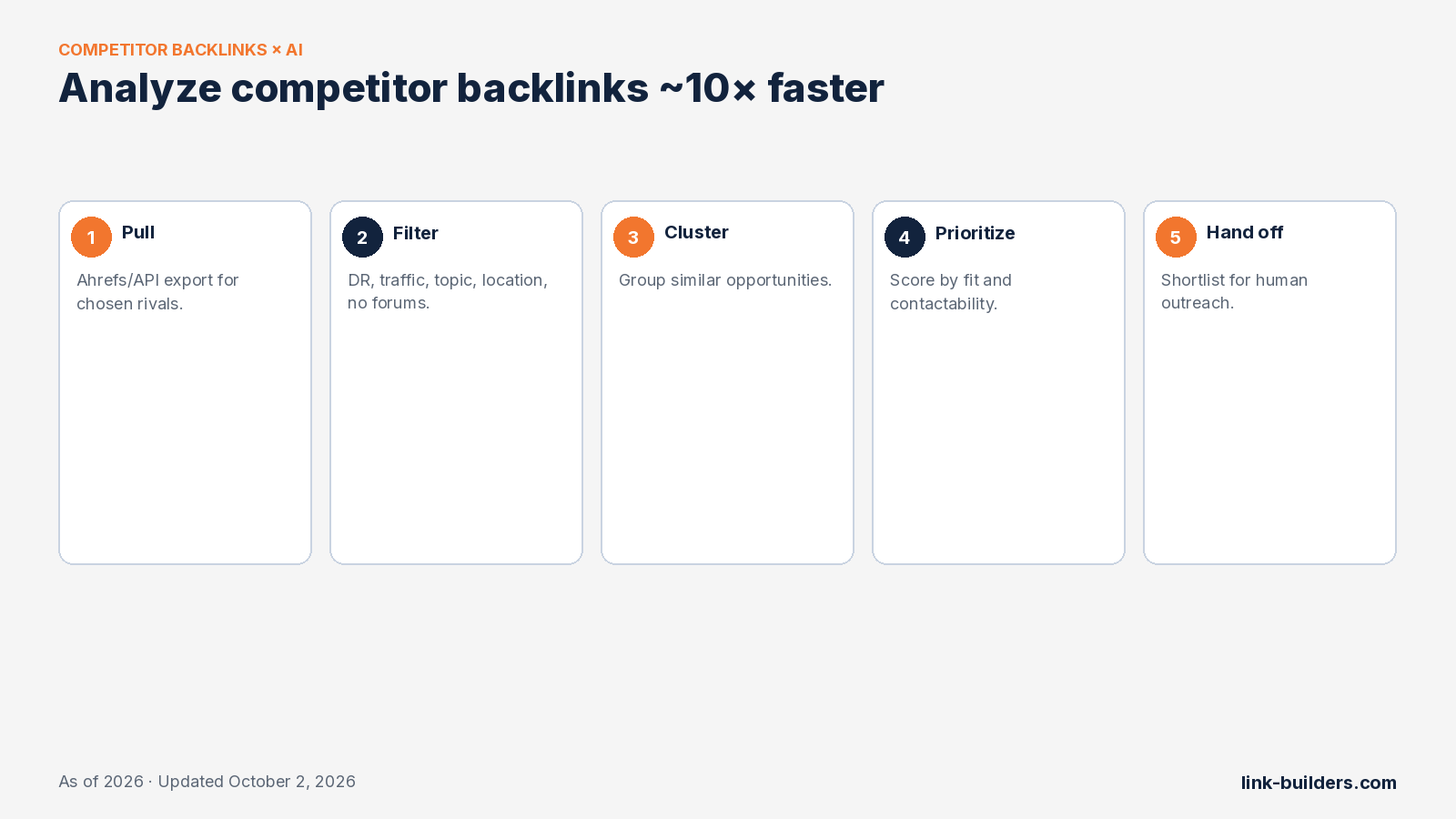
The process is straightforward. Export your competitor backlinks from Ahrefs like you normally would. Clean up the spreadsheet so you only have the essential columns: Domain, Domain Rating, Organic Traffic, Page Title, and URL.
Now here’s where it gets interesting. Instead of manually scanning through everything, you’re going to let AI do the first pass. Copy a batch of your data (maybe 100-200 rows at a time because of token limits) and feed it to ChatGPT or Claude with a prompt like this:
“Analyze this list of backlinks for a [your industry] website. Flag any domains that have zero organic traffic, are completely unrelated to [your niche], or are in spam industries like casinos, adult content, or pharmaceuticals. For each remaining domain, score it 1-10 for relevance based on the page title and whether it seems like a legitimate industry site.”
The AI will process the entire batch in seconds. It’ll identify the obvious junk (zero traffic domains, completely off-topic sites, spam industries) and give you a relevance score for everything else.
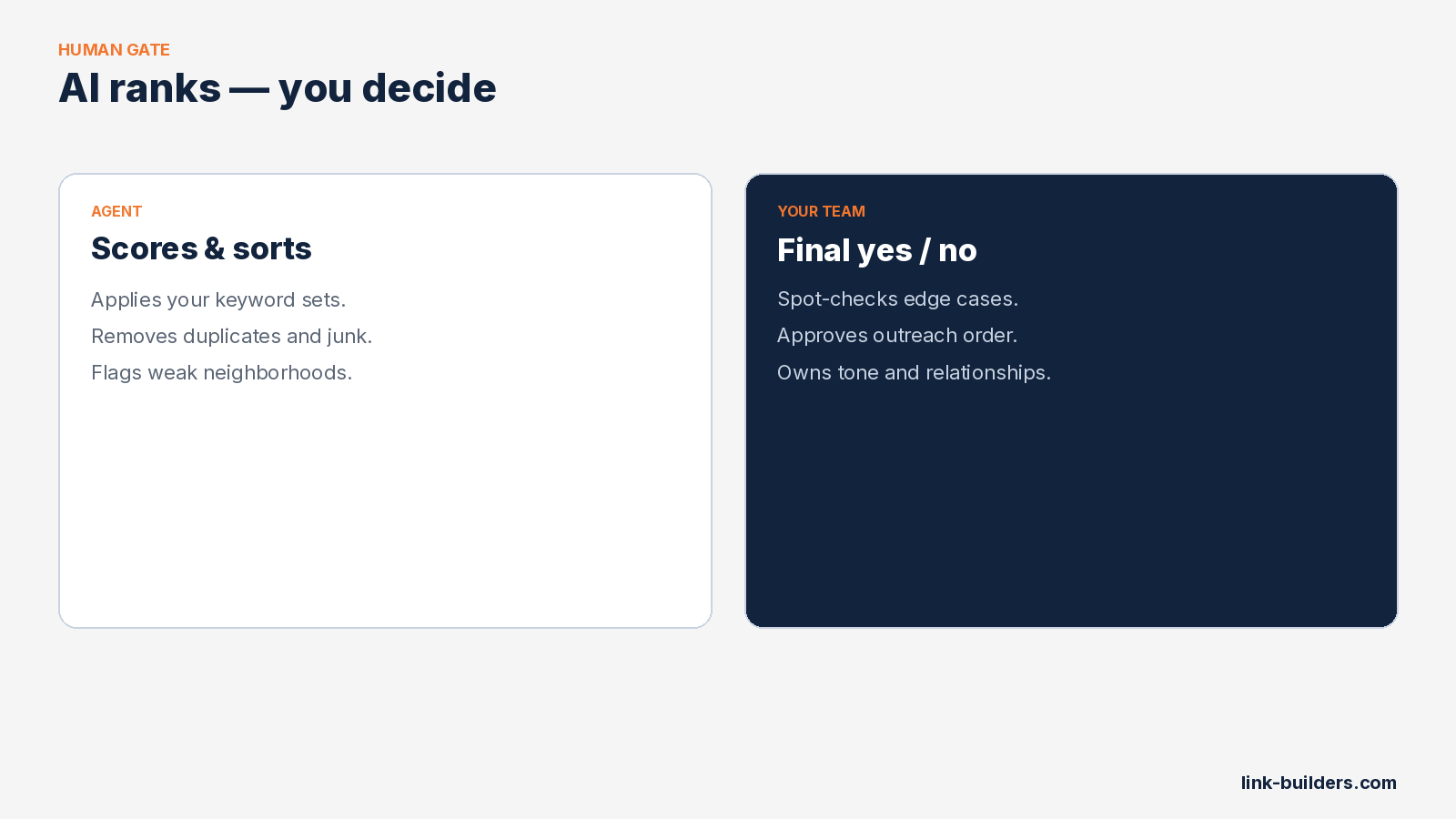
You’re still going to want to manually review the top-scored prospects. AI isn’t perfect, and you know your niche better than any model. But you’ve just eliminated 70-80% of the manual work. Instead of looking at 1,000 links, you’re now reviewing maybe 200-300 that the AI has pre-filtered for quality and relevance.
The time difference is real. What took an hour now takes 15-20 minutes. You can process multiple competitor backlink profiles in the time it used to take to get through one.
The limitation here is that you’re still working within the constraints of competitor analysis. You’re limited to the backlinks they’ve already built. You’re competing for the same prospects everyone else is targeting. And you’re missing opportunities that your competitors haven’t found yet.
Method 2: AI Prospecting From Scratch
This is where things get really interesting. About two years ago, I started thinking about this differently. Why am I following someone else’s strategy? Why am I fighting over prospects that five other link builders have probably already contacted this month?
So I built a tool that uses AI to find link opportunities from scratch based on keywords instead of competitor backlinks.
Here’s how it works. I give the system my client’s niche keywords and some basic parameters. The AI uses Google Search with advanced boolean operators (the same tactics I developed across 11 years of manual prospecting (as of 2026)) to find relevant blogs, resource pages, and informational sites.
But it doesn’t just find URLs and dump them in a spreadsheet. It automatically vets each site. It checks if the domain is live and active. It verifies the site is actually related to the industry. It filters out competitors and dead links. It looks at whether the site gets real organic traffic for industry-related keywords.
Then it does something most link builders skip because it’s so time-consuming. It classifies each opportunity. Is this a blog that accepts guest posts? Is it a resource page where we could request inclusion? Is there an existing article where a link insertion would make sense? Is it a listicle where my client could be added?
The AI even assigns a confidence score to each classification. That helps me prioritize which opportunities to pursue first.
Next, it finds the contact information. It scrapes the website looking for an editor or content manager. If it can’t find a good contact on the site, it uses Hunter.io to find a verified email address.
And then, this is the part that really saves time, it generates personalized outreach for every single prospect. The email is custom-tailored based on the site’s classification. A guest post pitch is different from a resource page request. It addresses the contact by their first name. It references specifics about their website. It includes my signature.
The entire process takes about 30 minutes. I input the keywords, click generate, and come back to a spreadsheet with 500 vetted prospects, complete with contact info and personalized outreach ready to send.
What used to take me 10 hours of focused work now happens while I’m doing something else. And remember, I was already fast at this. For most link builders, the manual process would take 20+ hours.
The Real 10x Multiplier
The speed improvement is obvious. But the real benefit isn’t just that things happen faster. It’s that I can work in parallel now.
I’ll set the AI tool to run overnight or while I’m working on something else. By morning, I have 500 fresh prospects loaded up. During the day, I can manually analyze competitor backlinks using the AI-filtering method. At the same time, I’m responding to positive replies from the automated outreach. I’m never waiting around. There’s no downtime.
Before AI, I had these natural bottlenecks. I couldn’t start outreach until I finished prospecting. I couldn’t create content until I got positive responses. Everything was sequential. Now everything runs in parallel. That’s where the real 10x comes from.
What to Train Your AI to Recognize
Whether you’re using the simple Ahrefs filtering method or building something more sophisticated, you need to teach the AI what actually matters in link prospecting.
Industry relevance is more important than Domain Rating. I’d rather have a backlink from a DR 30 site that’s directly in my client’s niche than a DR 60 generic site. The relevant link will send better traffic and hold more SEO value.
Look at the actual traffic quality, not just the number. A site might show 5,000 monthly visitors, but if they’re ranking for completely unrelated keywords, that traffic doesn’t mean much. You want sites that rank for keywords in your industry.
Pay attention to link diversity. If a site has already linked to multiple businesses similar to your client, that’s actually a good sign. It means they’re open to linking out and they understand the niche.
Content freshness matters. If a site hasn’t published anything in six months, you’re probably not going to get a response. Look for sites with recent activity. That tells you someone’s actually managing the content.
On the flip side, here are the red flags to automatically filter out. Zero organic traffic almost always means the domain is either dead or penalized by Google. Completely off-topic sites are a waste of time even if the metrics look good. Spam industries like you’d expect (casinos, pharma, adult content) are usually not worth pursuing for most clients.
And duplicate domains. If you’re pulling from multiple sources, you’ll get the same domains repeatedly. Make sure your AI is deduplicating by root domain, not just by URL.
The Content Quality Question
I need to address something because I get asked about this constantly. Won’t Google penalize us for using AI in link building?
Let me be clear about what’s safe and what’s risky. Using AI to analyze prospects and filter data? Completely safe. That’s just efficiency. It’s no different than using a spreadsheet formula instead of doing math by hand.
Using AI to write personalized outreach emails? Safe, as long as the personalization is actually relevant. If your AI is just inserting names into templates, people can tell. But if it’s analyzing the site and crafting a genuine pitch, you’re fine.
Using AI to create the actual content where your backlink will live? This is where you need to be careful. I’ve been using AI-assisted content for two years now, and here’s what I’ve learned.
Google doesn’t penalize AI content just because it’s AI. They penalize low-quality content. If your AI is spitting out keyword-stuffed articles with no real value, generic fluff, and obvious template language, yeah, that’s a problem. Google will probably just ignore those links rather than penalize you. But do it 300 times and you might be asking for trouble.
The rule I follow is simple. AI should make you faster at creating good content, not faster at creating garbage. If you wouldn’t put your name on it as a human writer, don’t publish it with AI either.
Using AI doesn’t give content any special gains. It’s just content. If it is useful, helpful, original, and satisfies aspects of E-E-A-T, it might do well in Search.
— Danny Sullivan & Chris Nelson, Google · Google Search Central: Google Search and AI-generated content
Your New Workflow
Here’s what my actual workflow looks like now. I run my AI prospecting tool overnight with keywords for my active clients. By the time I start work, I have 500 new prospects ready to review. I don’t need to do anything manually unless I want to.
During the day, I’ll also pull competitor backlink profiles and run them through AI filtering. This gives me a second stream of prospects using a completely different methodology. I’m not reliant on just one approach.
While both of those are happening, I’m responding to positive replies from previous outreach. I’m reviewing content drafts. I’m checking in with clients. The prospecting is happening in the background without eating up my time.
That’s the real transformation. It’s not just that each individual task is faster. It’s that I’ve eliminated the waiting. I used to have hours of dead time while I was building prospect lists. Now that time doesn’t exist.
If you’re just getting started with AI in link building, start with the simple method. Export your Ahrefs data and use ChatGPT to filter it. You’ll immediately save 30-40 minutes per competitor analysis. That alone will change how much you can get done in a day.
As you get comfortable with that, start thinking about automation. Look for opportunities to connect tools together. Maybe you use Ahrefs API to pull data automatically. Maybe you use Hunter.io API for contact finding. Maybe you build prompts that handle classification and personalization.
I spent two months refining my system, fixing false positives, and training the AI to match my judgment. It was worth every hour. Because now I have a tool that thinks like I do, but works 20 times faster.
As of 2026, after 11 years of doing this manually, AI is the biggest efficiency breakthrough I’ve ever seen in link building. Not because it’s magic. But because it’s really good at the repetitive pattern-matching work that used to fill my days. And that frees me up to do the strategic work that actually requires human expertise.
Want that prospecting time applied to your niche instead of a generic agency black box? See how we run campaigns on the link building process page, or start with backlink pricing — $160/hour, Justin’s Machine 30 hours for $4,800, or Buy the Machine at $9,600 (includes onboarding plus a full 8-hour prospecting cycle). We sell hours and process, not a guaranteed link count.
About the author

Justin Davis has been building backlinks since 2015 and has built links for more than 150 clients across law, healthcare, real estate, software, and other industries. He built the first version after years of doing the research by hand, and now builds the same workflow for in-house teams. More on who Justin Davis is, on YouTube, on LinkedIn, or on X.