Why Does AI Recommend My Competitor and Not Me?
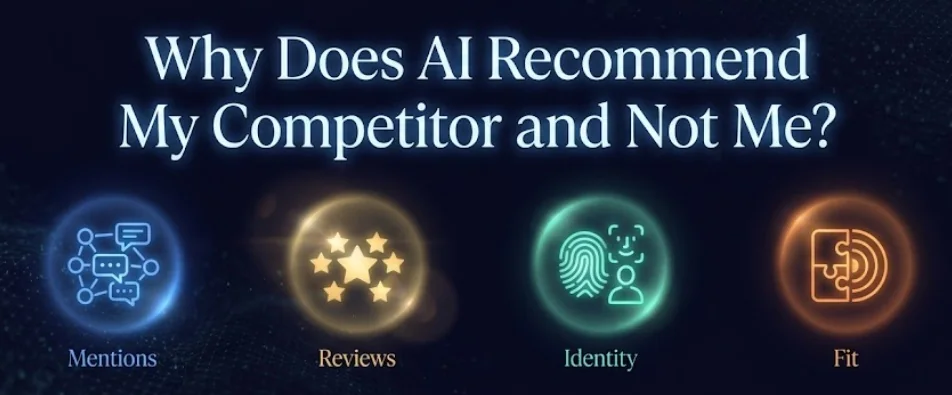
AI recommends your competitor because it can find more evidence for them. Other websites mention them, more customers have reviewed them, AI is sure which business they are, and their pages match the exact question being asked. ChatGPT and Google’s AI aren’t judging who does better work. They name the businesses they can check, and they skip the ones they can’t.
I found this out the hard way with my own tour company in Medellín. On October 18, 2026, I asked ChatGPT who offers the best Comuna 13 tour in the city. Its top pick had more than 9,200 reviews. My company’s Tripadvisor listing had zero. This guide walks through that test, the four reasons AI picks one business over another, a 15-minute process to find out which reason is beating you, and how to close the gap. It’s the written version of Episode 6 of my YouTube series, Hiring for AI Search.
Key Takeaways
- AI recommends the businesses it can verify, not the ones that do the best work.
- Four kinds of evidence decide it: mentions, reviews, a clear identity and a close fit to the question.
- AI answers change from run to run, so look for the names that keep coming back.
- You can trace which gap is costing you in about 15 minutes with a logged-out ChatGPT session.
- Nobody can pay to be named inside ChatGPT’s answer. Ads appear separately and are labeled.
The Short Answer: AI Names the Businesses It Can Check
It’s easy to take an AI answer personally. If ChatGPT lists three competitors and leaves you out, it feels like a verdict on your business. It isn’t. ChatGPT has never taken your tour, eaten at your restaurant or used your software. It builds its answer from what it can read: review sites, business listings, “best of” articles, forum threads and company websites. When a competitor shows up more often in those sources, AI has more reasons to name them.
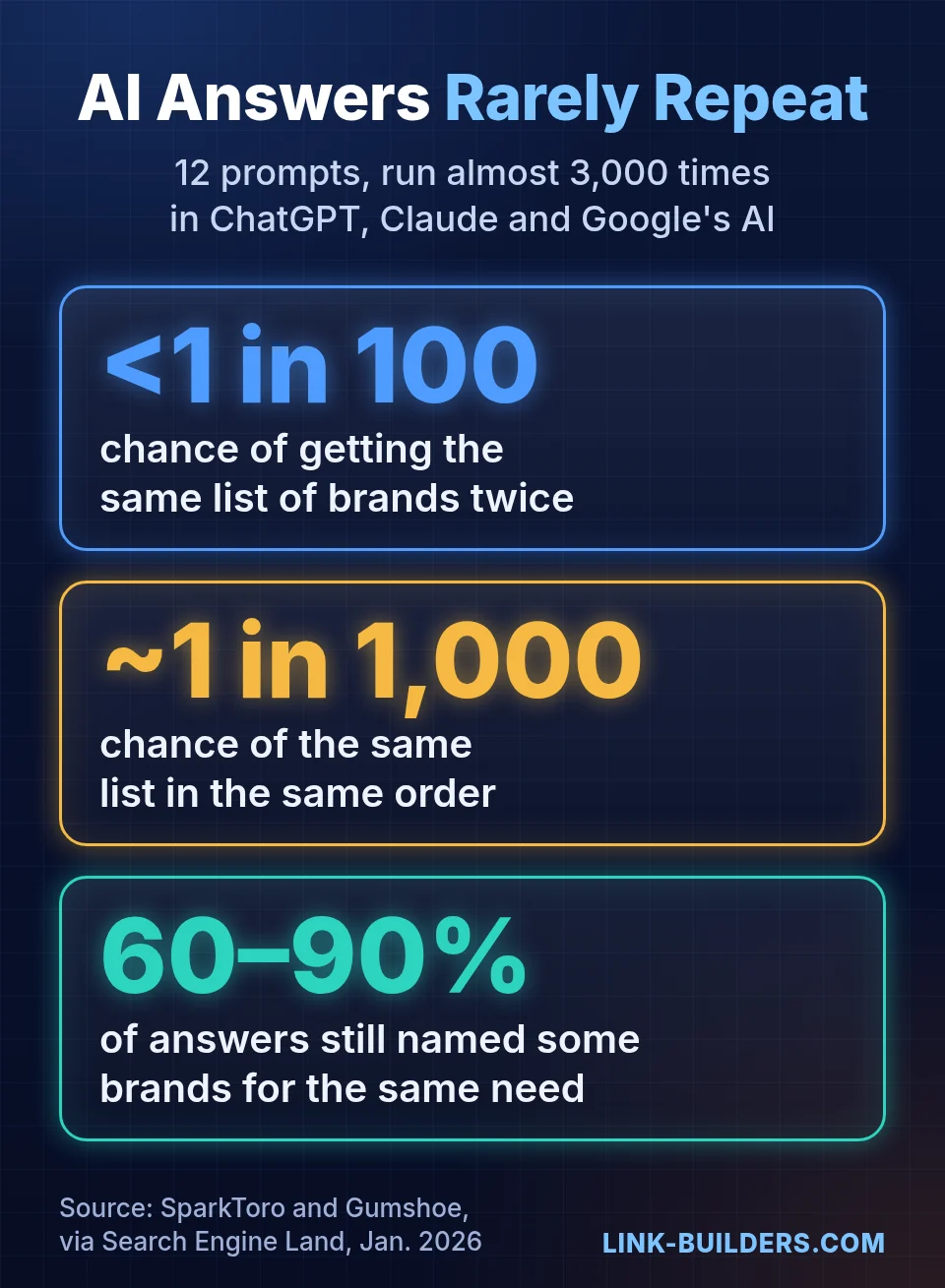
AI answers are also less stable than most people think. In a study by SparkToro and Gumshoe, 600 volunteers ran 12 prompts through ChatGPT, Claude and Google’s AI almost 3,000 times. The chance of getting the same list of brands twice was under 1 in 100, and the same list in the same order was closer to 1 in 1,000.
The same study found a pattern that matters for smaller businesses. In tight markets, such as regional service providers, answers kept coming back to a few familiar names. Some brands appeared in 60% to 90% of answers for the same need, even though their position moved around. So the useful question isn’t “why did AI rank them first?” It’s “why does AI keep finding them and not me?”
What Happened When I Tested This on My Own Business
I run a small tour company in Medellín, Colombia, alongside Link Builders. It’s a useful test case because I know exactly what it has and what it lacks, and I can show the results without exposing a client. Here’s what I found in one sitting on October 18, 2026. Competitor names are left out on purpose.
The Question
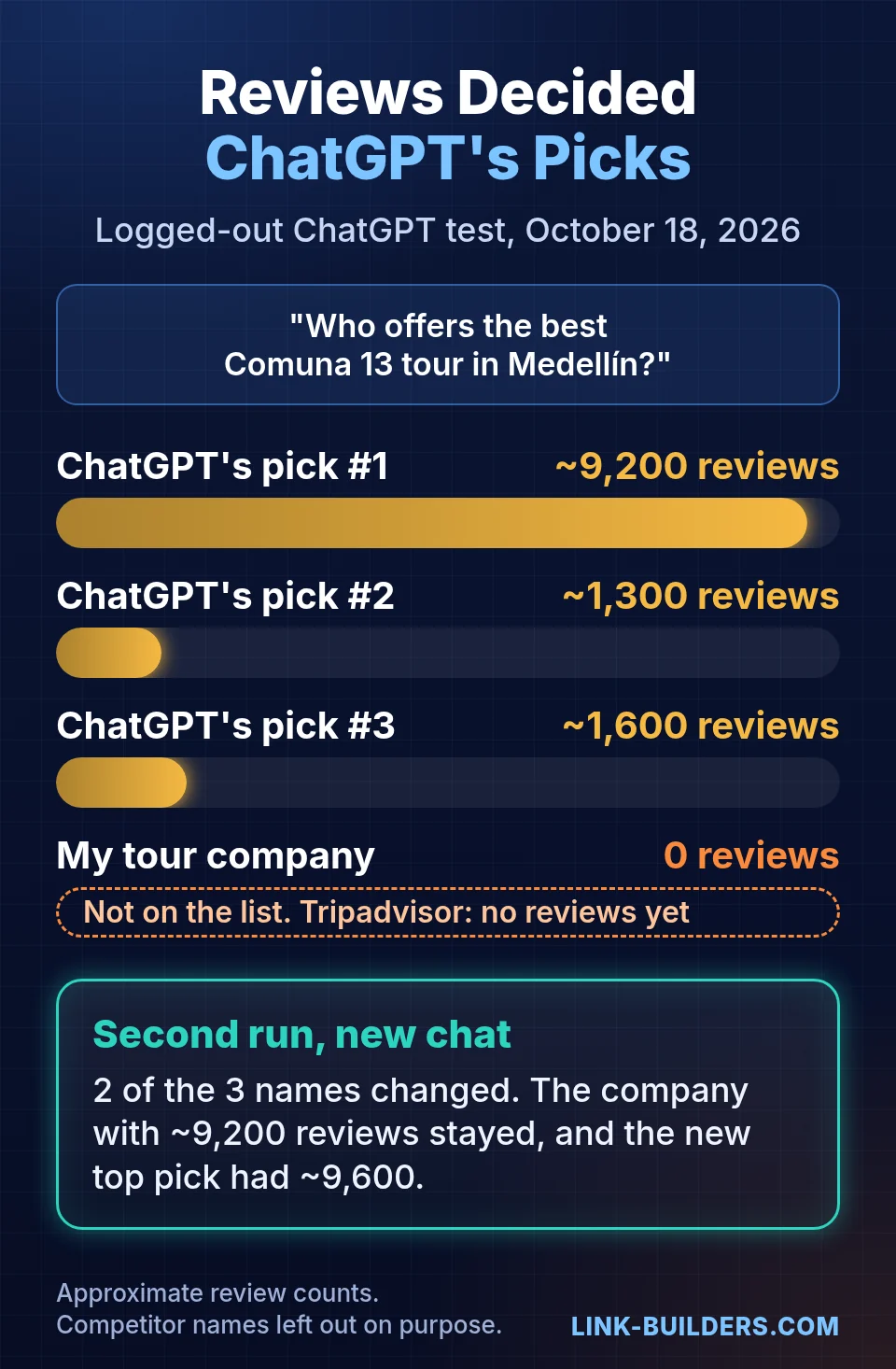
I opened a private browser window, went to ChatGPT without logging in and asked the kind of question a traveler would ask: “Who offers the best Comuna 13 tour in Medellín?” Comuna 13 is one of the city’s best-known neighborhoods, and tours there are a big part of what my company sells.
What ChatGPT Picked
ChatGPT named three operators. The first had about 9,200 reviews, the second about 1,300 and the third about 1,600. My company wasn’t on the list. When I checked our own Tripadvisor listing, the page said “No reviews for this property yet.”
Where It Got Its Information
No source list appeared on its own, so I typed “Please show your sources.” Every source ChatGPT gave me was a Tripadvisor listing, a Google Maps listing or one of the companies’ own websites. There were no travel blogs and no news articles. If you want to understand why ChatGPT and Google often lean on different pages, I tested that in detail in why ChatGPT cites different pages than Google.
The Second Run
I opened a new chat and asked the exact same question. Two of the three names changed. The one that stayed was the company with about 9,200 reviews, and the new top pick had about 9,600. The list moved, but the businesses with the most reviews held their ground.
Google’s Answer
I ran the same question in Google. The AI Overview named a different mix of three operators, and each one had a Google listing full of reviews, from about 150 to more than 4,300. My company didn’t appear there either.
For this question, reviews decided the list. A different question, or a different industry, can be decided by different evidence. That’s why it helps to know all four reasons before you start fixing things.
The 4 Reasons AI Picks Your Competitor
In the cases I’ve traced, the gap comes down to one or more of four kinds of evidence.
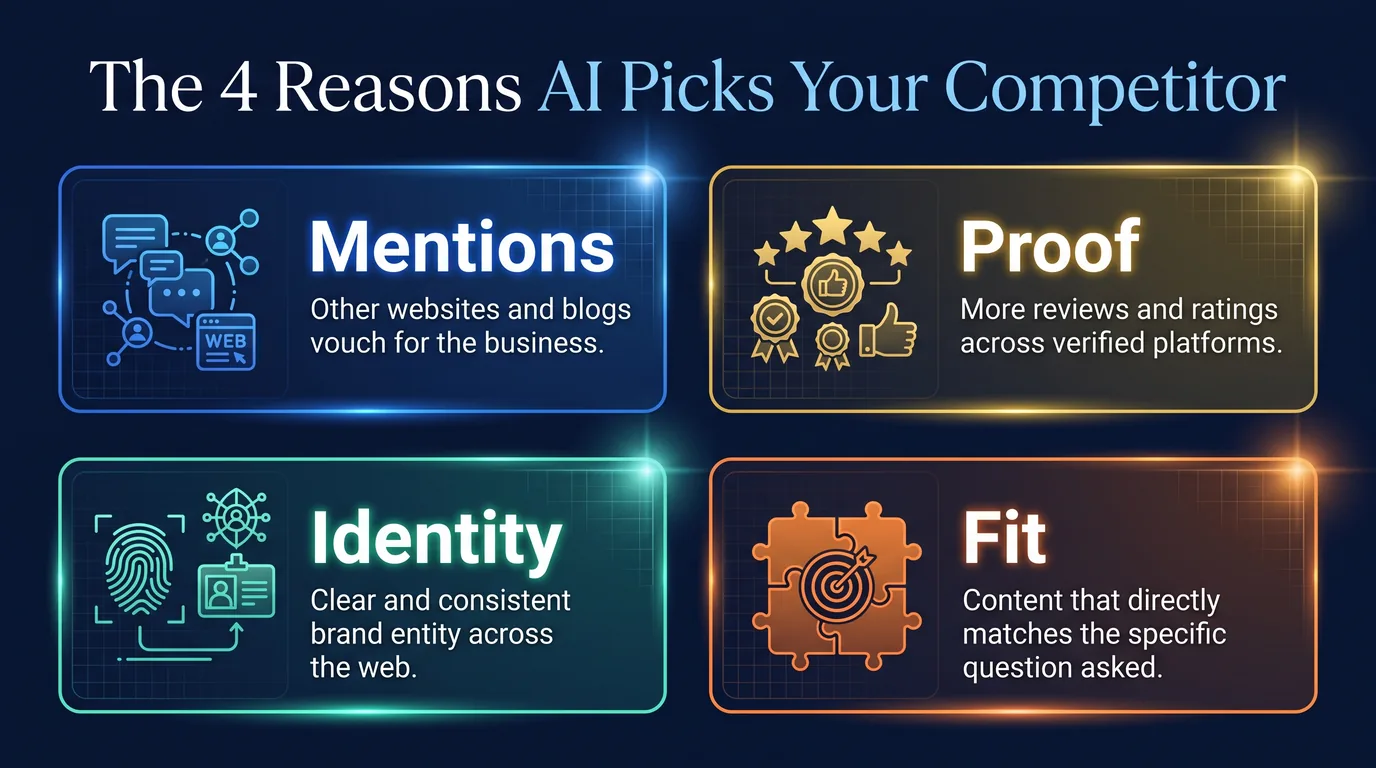
1. Other Websites Vouch for Them
AI tools trust what other people say about a business more than what the business says about itself. Ahrefs studied 75,000 brands and found that branded web mentions had the strongest link to showing up in Google’s AI Overviews, with a correlation of 0.664. Backlink count came in at 0.218.
The gap at the top is large. Brands in the top quarter for web mentions had a median of 169 AI Overview mentions. The next quarter had 14, and the bottom half had almost none. If your competitor is written about on travel blogs, local guides and “best of” lists and you aren’t, AI has more reasons to name them. One 2026 industry analysis of AI search put the share of brand discovery that comes from third-party content at about 85%, with most of it from listicles, buying guides and comparison pages.
These are correlation studies, so they don’t prove that mentions cause recommendations. Still, the large studies all point the same way. I go through the numbers in more depth in brand mentions vs. backlinks for AI search.
2. They Have More Proof
For local businesses, reviews work like a filter. SOCi’s 2026 Local Visibility Index looked at more than 350,000 locations from 2,751 multi-location brands. Google’s local 3-Pack showed those locations 35.9% of the time on average. ChatGPT recommended just 1.2% of them, and the locations it picked averaged a 4.3-star rating.
Strong Google rankings weren’t enough on their own. Locations that ranked well but had a weak presence on Yelp, Facebook or their own websites often lost out in AI answers. My test showed the same thing: 9,200 reviews against zero isn’t a close contest. The same logic applies outside local business. For software and agencies, the review platforms are sites like G2, Capterra and Clutch rather than Tripadvisor.
3. AI Is Sure Which Business They Are
Most business owners never think about this one, and it turned out to be one of my biggest problems. In an earlier test on October 1, 2026, I asked ChatGPT whether medellin-tours.com was legit. It found a Tripadvisor listing for another company with a similar name, 4.2 stars from 34 reviews, and used those reviews as evidence for my business. Then it described my real listing, Medellin Tours S.A.S., as “a separate Tripadvisor listing.” When I corrected it in the same chat, it still kept the two apart.
If AI can’t tell which business you are, it won’t take the risk of recommending you. Research covered by Search Engine Land in October 2026 describes a clothing brand whose name Google’s Knowledge Graph tied to a financial company. AI tools described the brand correctly when asked about it by name, but it appeared in none of the recommendation answers the researchers tested. The authors, writing from their published study, are careful to call this a pattern, not proof of cause. Still, it matches what I saw: being known by name and being recommended are two different tests.
Common causes include a name close to another business, different names on different listings, and a legal business name that never appears on your website.
4. They Match the Exact Question
AI answers the question it’s asked, as narrowly as it can. When I asked for a reliable private driver for a day trip from Medellín, ChatGPT named eight transportation companies. We offer private drivers too, but we weren’t on the list. Those companies had listings, reviews and pages about that one service. We had a service page and not much else.
The same thing happened when I asked whether a private or group tour is better for Guatapé, a popular day trip. ChatGPT answered using competitors’ guide pages. We didn’t have a page that answered that question, so it had nothing of ours to work with.
A business that does a bit of everything can lose to a smaller one that clearly owns a single service. The fix isn’t to drop services. It’s to make each one easy to find and easy to quote, both on your site and in what other people say about you. My guide to chunking content for AI search covers the on-page side.
Does Your Competitor Just Have Better Backlinks?
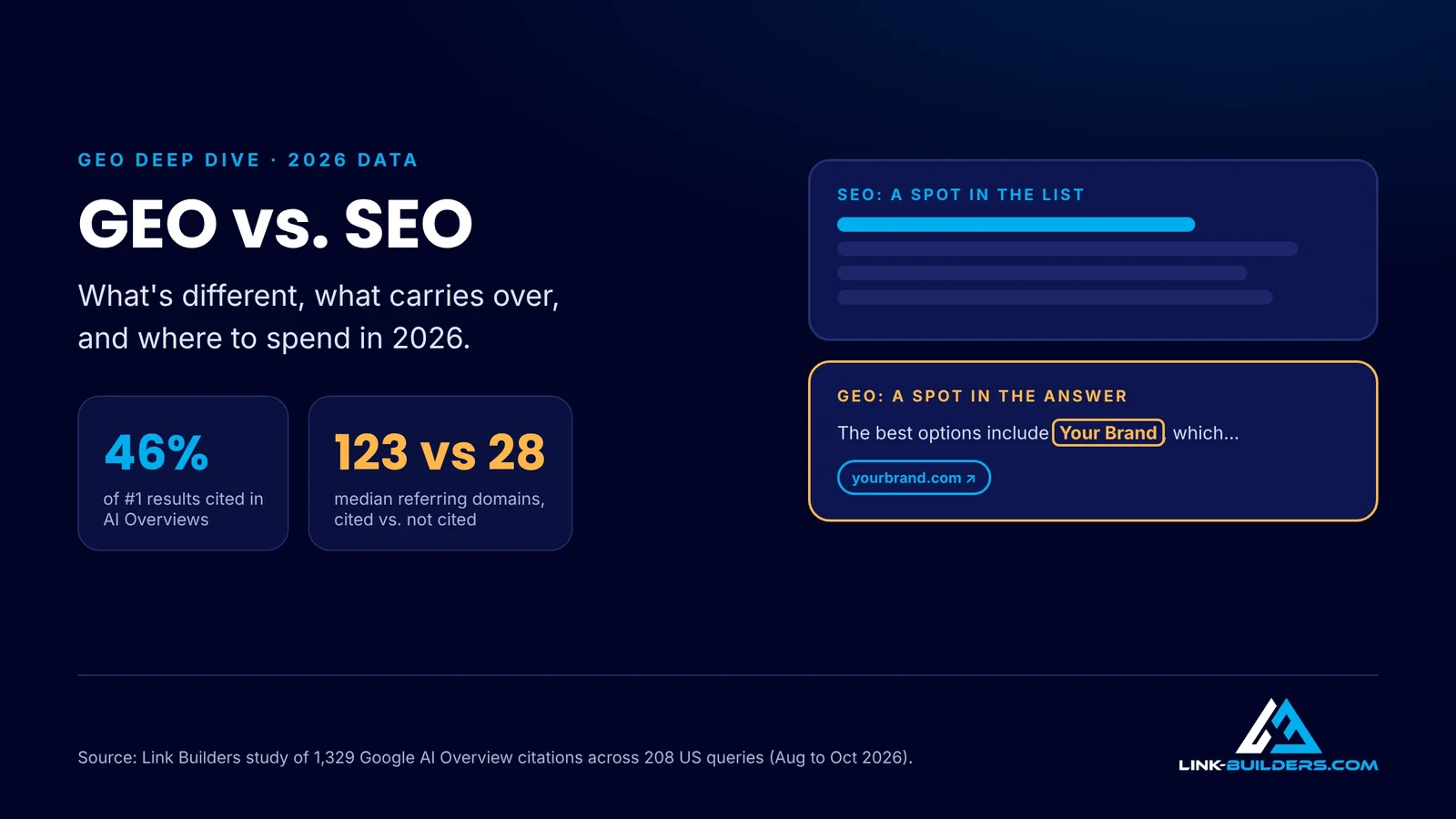
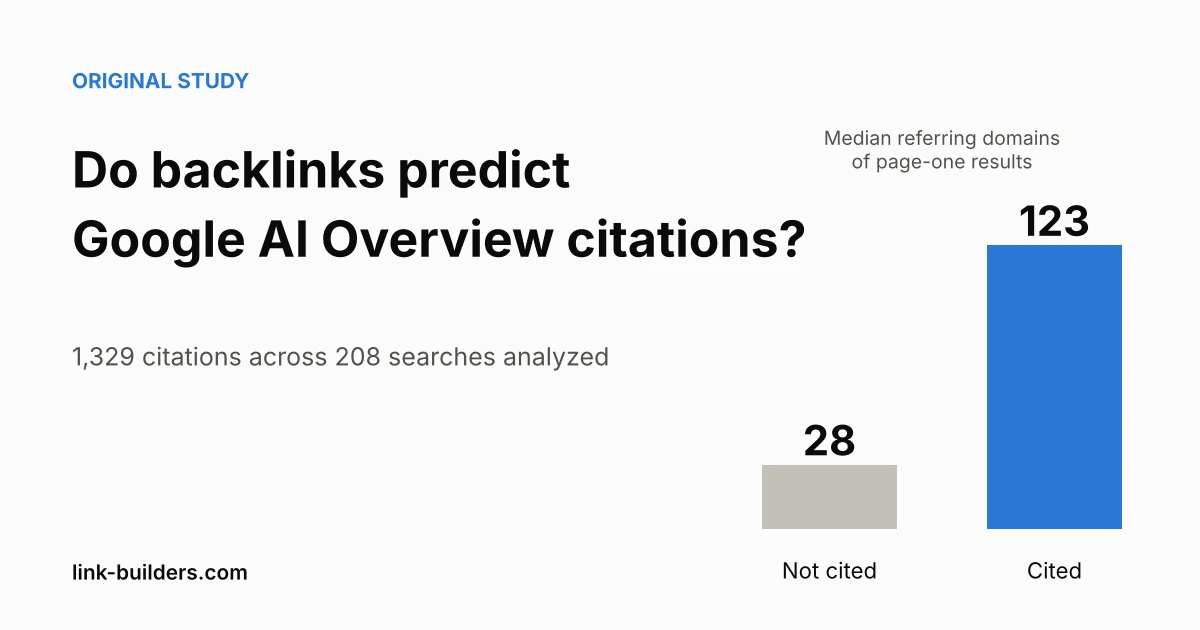
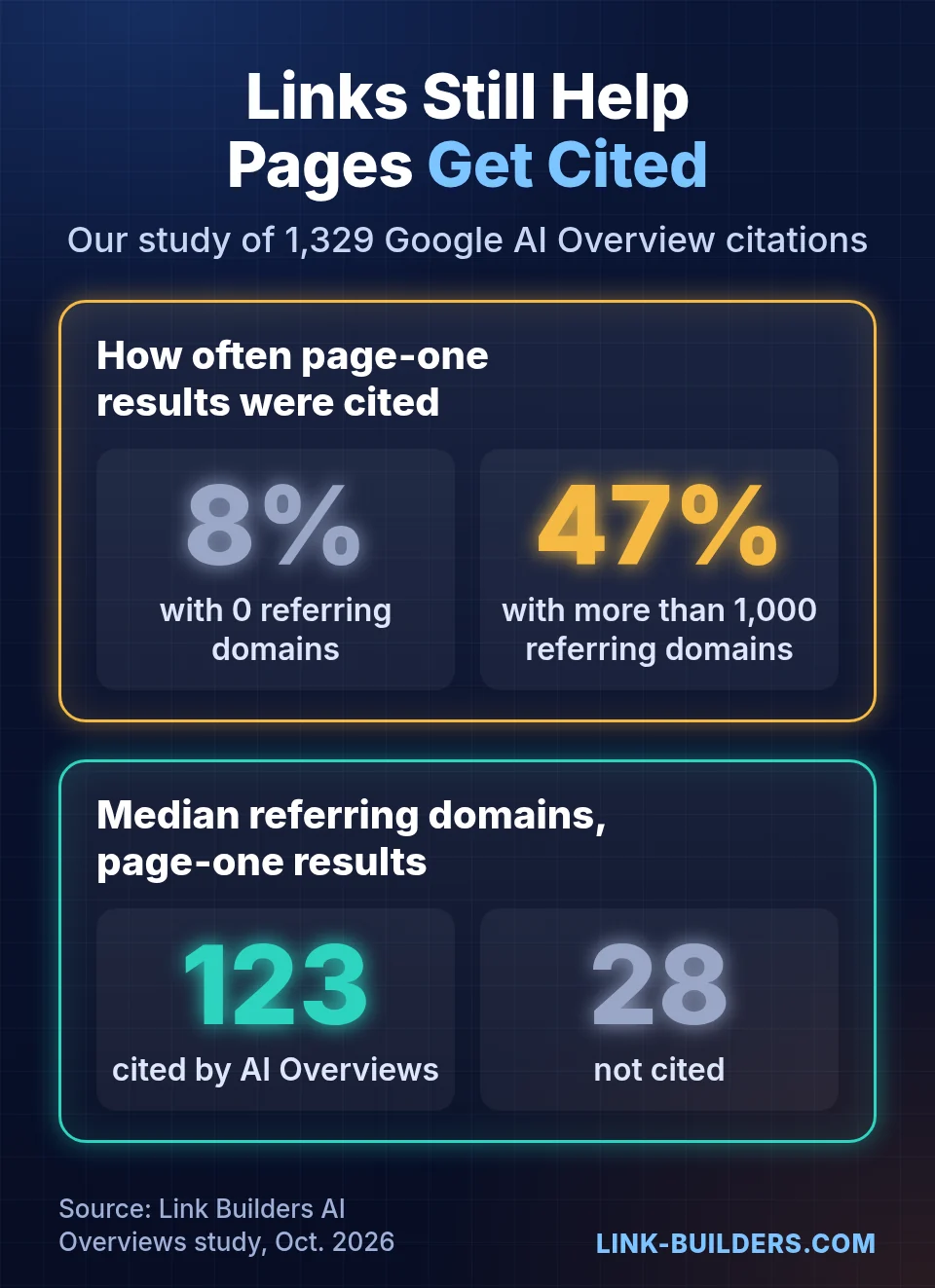
This is the question I hear most from business owners, so here’s the honest answer from someone who has built links for more than 11 years. Backlinks still help. They help your pages rank, and AI tools often run their own searches behind the scenes before they answer, so pages that rank are more likely to be found. In our own study of backlinks and AI Overviews of 1,329 citations, the median page-one result that Google’s AI cited had 123 referring domains, compared with 28 for page-one results it skipped.
But a backlink by itself isn’t what gets a business named. What gets a business named is a clear, branded mention on the pages AI already reads, ideally with a link to the right page. That changes where good link building starts. Instead of chasing domain metrics, start with the pages AI tools cite for your buyers’ questions. I wrote about how Google’s own patents shaped my thinking on which links count in What 7 Google Patents Taught Me After 11 Years Building Links, and about where link building is heading in building backlinks in an age of AI.
How to Find Out Which Reason Is Beating You
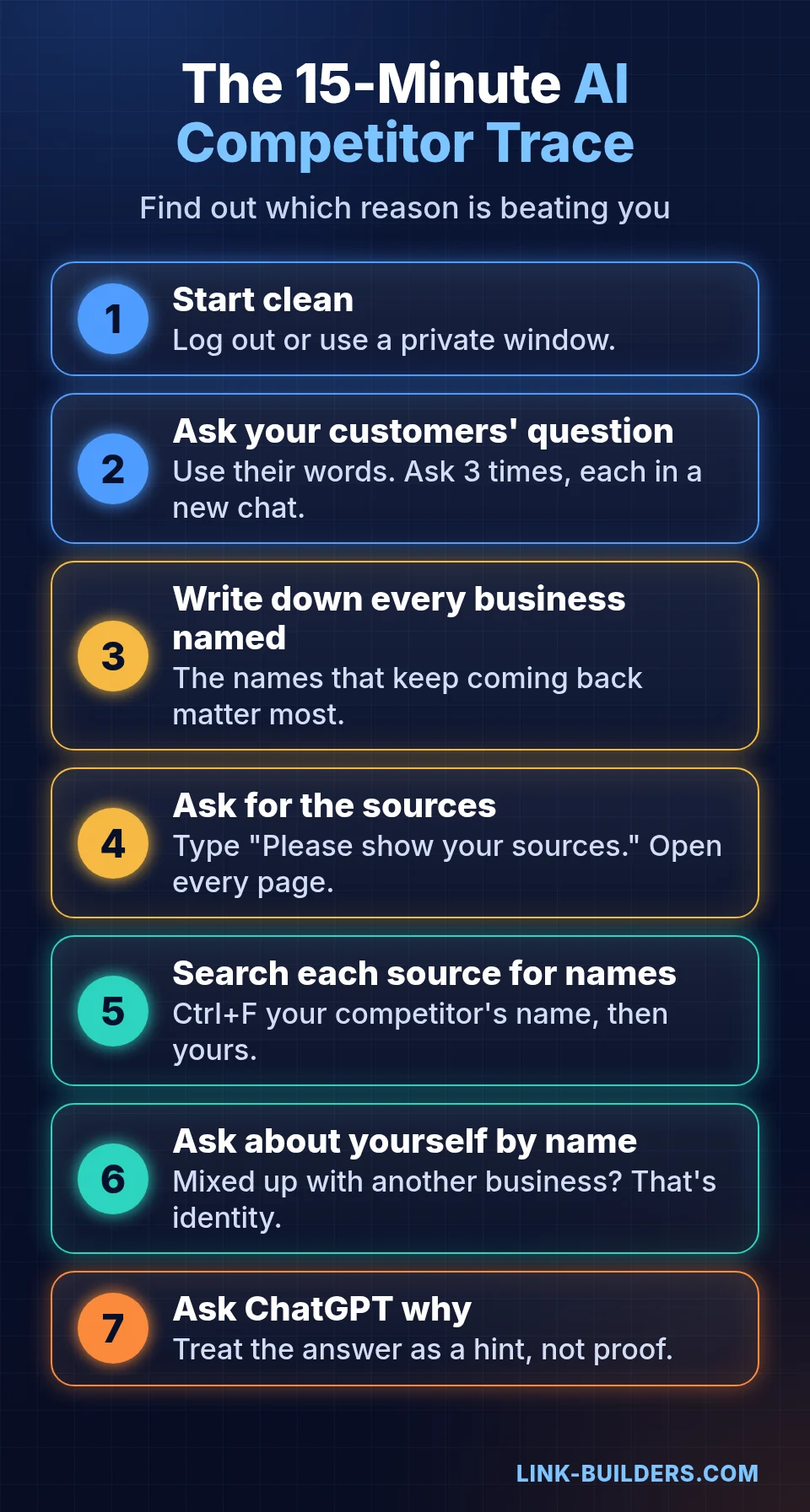
You can trace this yourself in about 15 minutes. Here’s the process I used for the test above.
- Start clean. Log out of ChatGPT or use a private window, so your past chats don’t shape the answer.
- Ask the question your customers ask. Use their words, such as “Who is the best [service] in [city]?” or “What’s the best [product] for [use case]?” Ask it three times, each in a new chat.
- Write down every business it names. Answers change from run to run, so the names that keep coming back matter most.
- Ask for the sources. If none appear, type “Please show your sources.” Open every page it lists.
- Search each source for names. Use Ctrl+F (Cmd+F on a Mac) to look for your competitor’s name, then yours. Count how many sources mention each.
- Ask about yourself by name. Ask “What is [your brand] ([your website])?” If ChatGPT mixes you up with another business or isn’t sure who you are, you have an identity problem.
- Ask ChatGPT why. Ask why it recommended those businesses and not yours. Treat the answer as a hint, not proof. When I asked, ChatGPT said its first answer was “too confident” and that it “relied too heavily on familiar tour listings and review signals.” It changed its mind the moment I pushed back. A real customer never pushes back, so the sources you opened are the stronger evidence.
The first steps match the 5-minute ChatGPT test I recommend for a quick check. The trace adds your competitor to it.
| What you find | Likely reason | Where to start |
|---|---|---|
| Your competitor is named on most sources, you’re on none | Mentions | Get included on the pages AI already cites |
| Your competitor has far more reviews | Proof | Build reviews on the platforms in your sources |
| AI mixes you up or isn’t sure who you are | Identity | Make your name and details match everywhere |
| Your competitor has pages for the exact service asked about | Fit | Build a clear page for each service, then earn mentions for it |
How to Get AI to Recommend You Instead
Once you know which reason is beating you, the work gets much simpler. Don’t try to copy everything your competitor does. Close the one gap that’s costing you the most, then run the trace again.
If It’s Mentions
Start with the sources from your trace, since those pages already shape the answer. For most categories they’ll be listicles, buying guides, comparison pages and local guides. Reach out to the editor of each one, give them accurate details and real proof, such as reviews, data or a clear point of difference, and ask to be considered in their next update. It’s outreach aimed at the right pages, which is the same skill good link building has always used. I break down the full approach in how to get cited by AI.
Finding those pages at scale is where AI tools help. In What 2,920 AI-Surfaced Link Prospects Actually Look Like, I shared what a large AI-assisted prospecting run actually turned up.
Two warnings. First, don’t publish your own “best of” list with your business at number one and expect it to carry you; I covered why in is Google targeting self-promotional content made for LLMs?. Second, don’t buy fake mentions or links. Google’s spam policies treat buying links for ranking purposes as link spam, and its recent spam updates keep tightening the rules.
If It’s Reviews
Ask happy customers for reviews on the platforms your sources point to, not only on Google. If ChatGPT pulled from Tripadvisor, that’s where you need reviews. Spread them across more than one platform and keep them coming at a steady pace, because a sudden burst looks odd to people and platforms alike. Never buy reviews or write fake ones. The FTC’s final rule on fake reviews bans them in the U.S.
In my own test, zero reviews on the listing ChatGPT reads was the clearest problem, and no amount of outreach would make up for it on its own.
If It’s Identity
Use the same business name, address and phone number on every listing. Show your legal business name on your website, in the footer and on your About page. Add Organization schema that links to your official profiles. Then ask each platform to fix any listing that mixes you up with someone else. It’s slow, unglamorous work, but it removes the doubt that keeps AI from naming you. Also make sure AI tools can reach your site at all; my AI crawler map shows which bots to allow.
If It’s Fit
Give each service its own page that answers the questions buyers ask about it, in plain words near the top. Then get other sites to mention you for that service by name. A private driver page that only you link to won’t beat eight transport companies with listings and reviews. A private driver page that two local guides and a review site point to has a real chance.
How Long Does It Take, and How Do You Know It’s Working?
It depends on the gap. Fixing listings that mix you up with another business can show results sooner. Earning reviews and mentions usually takes months, because you’re waiting on other people.
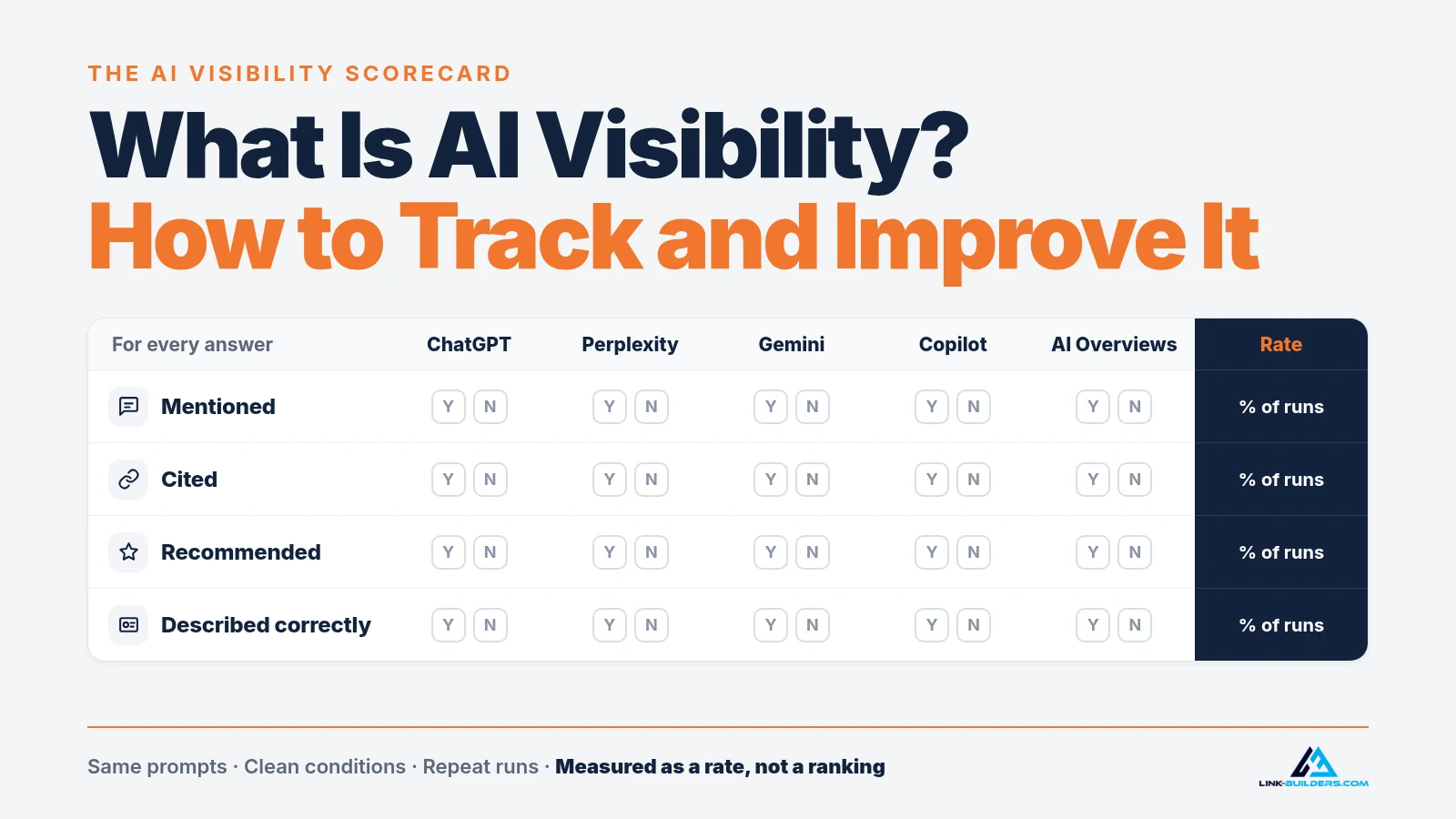
Measure progress the way AI actually behaves. Since answers change from run to run, a single check tells you very little. Pick five to ten questions your customers ask, run each one several times a month in a logged-out session, and track how often you’re named. That share of answers is a far better signal than any “rank in ChatGPT.” Google’s Search Console now has a generative AI performance report for AI Overviews and AI Mode, which helps on the Google side. For a broader look at the data, see my guide to reading Search Console and GA4 data.
Can a Competitor Pay to Be Recommended?
Not inside ChatGPT’s answers. OpenAI began testing ads in ChatGPT in the U.S. on February 9, 2026. It says ads don’t influence ChatGPT’s answers, run on separate systems from the chat model and are labeled as sponsored. In my own tests, ads from a tour marketplace and a travel booking site appeared below ChatGPT’s answers, labeled “Ad” and kept apart from the recommendations. If a competitor is named inside the answer itself, they earned it with the kinds of evidence above.
Frequently Asked Questions
Why does ChatGPT keep recommending the same competitor?
That business has the most evidence ChatGPT can find for your type of question: mentions on the pages it reads, plenty of reviews and a clear identity. In small markets, AI answers tend to cluster around a few names, so the same competitor can show up again and again even though the order changes.
Does ranking #1 on Google mean AI will recommend me?
No. Rankings help AI find your pages, but they don’t guarantee a recommendation. SOCi found that businesses with strong Google rankings but a thin presence elsewhere often missed out in AI answers. My guide to GEO vs. SEO explains how the two fit together.
How do I get my products recommended by ChatGPT?
The same four reasons apply. Get your products into the buying guides and comparison pages ChatGPT cites, build reviews on the platforms it reads, keep product names and details consistent everywhere, and give each product a page that answers the questions buyers ask about it.
Can I just ask ChatGPT to add my business?
You can correct it inside your own chat, but that doesn’t change what it tells anyone else. When I told ChatGPT that a listing wasn’t mine, it still mixed up the two businesses. Lasting changes come from fixing the evidence it reads.
Do I need a GEO agency for this?
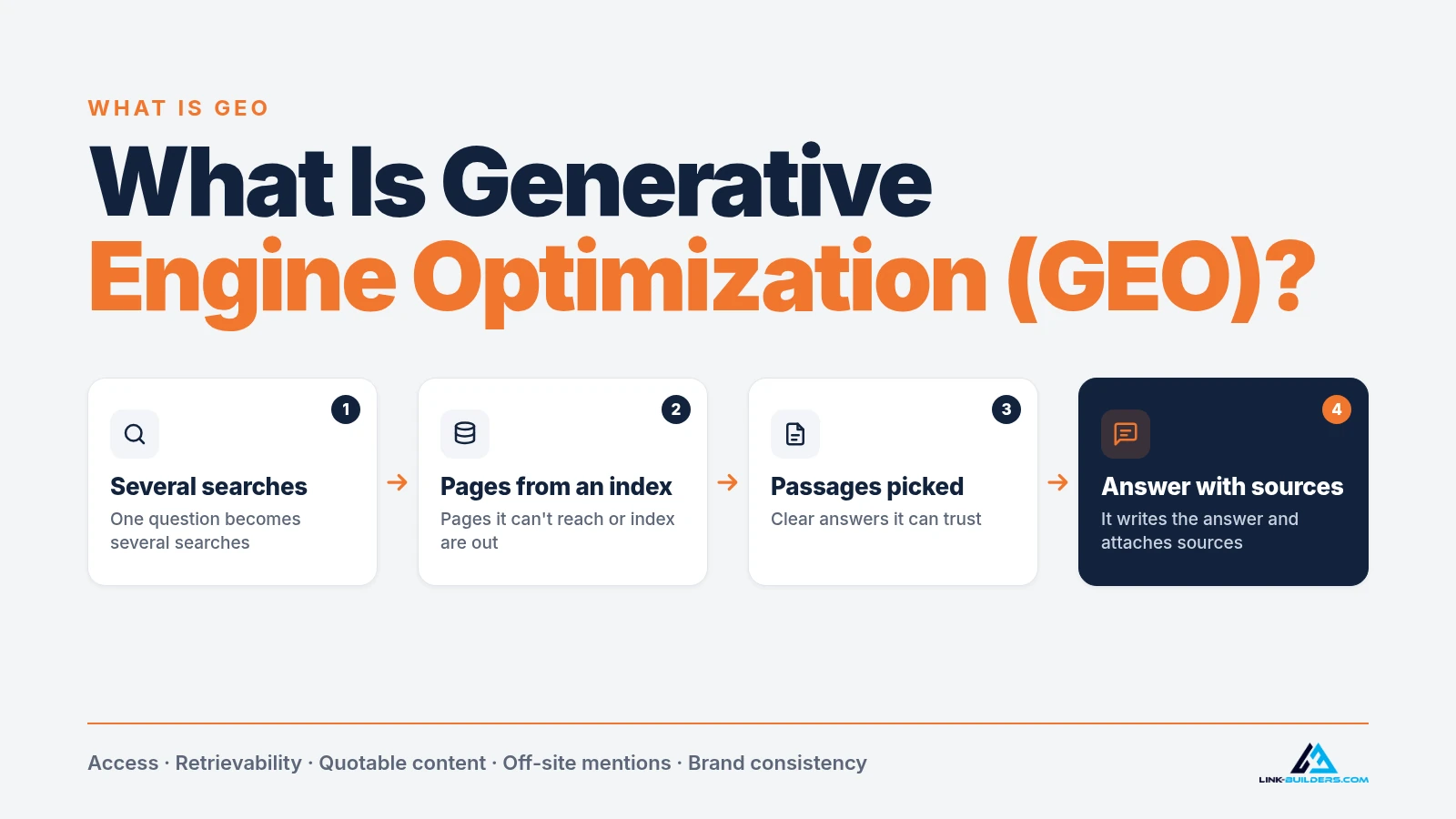
Not always. You can run the trace and fix identity and fit gaps yourself. Mentions are the hardest gap to close alone, because it takes outreach to sites you don’t control. If you’re weighing outside help, start with what GEO is and whether you need it, then read what GEO services include and cost and how to choose a GEO agency.
Get Named on the Sites AI Already Trusts
Your competitor isn’t winning because AI likes them better. They’re winning because AI can find more people vouching for them. That’s fixable, and it starts with the pages AI already reads.
That’s the work we do every day at Link Builders, with full transparency on every opportunity, contact and cost. Request a free sample of 20 vetted link opportunities for your site. To see the exact pages AI cites in your category, we use AnswerBuilders data, and those AI sources now go into every client’s backlink target list. If you want those pages contacted for you, the AnswerBuilders team runs AI citation outreach. If you run an agency and want an off-site partner for your clients, see our white-label link building service, and read The New Unit Economics of White-Label Link Building for how the numbers work.
Sources
- Search Engine Land, AI recommendation lists repeat less than 1% of the time (SparkToro and Gumshoe study), January 28, 2026
- Ahrefs, An Analysis of AI Overview Brand Visibility Factors (75K Brands Studied), May 26, 2025
- SOCi, 2026 Local Visibility Index press release, January 28, 2026
- Localogy, SOCi’s LVI Report Reveals How AI Is Rewriting Local Search Visibility, January 2026
- Search Engine Land, How entity confusion can hurt your brand’s AI visibility, October 15, 2026
- Beyond Knowledge-Graph Strength: How Category Coding Drives Brand Visibility in Generative AI (da Silva and Franco, Zenodo)
- OpenAI Help Center, Ads in ChatGPT
- Google Search Central, Spam policies for Google web search (updated August 28, 2026)
- FTC, Final rule banning fake reviews and testimonials, August 2024
- Google Search Console Help, generative AI performance report
- Link Builders, Do Backlinks Predict Google AI Overview Citations? (1,329 citations)
- Medellin Tours live tests in ChatGPT and Google, logged out: October 1 and October 18, 2026
About the author

Justin Davis is the founder of Link Builders, a white-label backlink agency, and has been building links since 2015 for more than 150 clients in law, healthcare, real estate, software and other industries. After years of doing prospecting research by hand, he built an AI agent link building system that handles each step, from finding link opportunities and vetting sites to finding contacts and preparing outreach. He now runs that system with the Link Builders team for agencies and in-house SEO teams, earning the links and mentions that help their clients show up in Google and in AI answers, and teaches it on YouTube. He also built AnswerBuilders, the AI visibility platform Link Builders uses to find the pages AI answers cite. Find Justin Davis on YouTube, LinkedIn and X.