What Is Generative Engine Optimization (GEO)?
Author: Justin Davis, Link Builders
Generative engine optimization (GEO) is the practice of making your brand and your pages more likely to be cited, mentioned or recommended in answers from AI engines like ChatGPT, Google’s AI Overviews and AI Mode, Perplexity, Gemini and Copilot. It combines content that AI can quote, technical access for AI crawlers and, most of all, a reputation on the independent websites those engines read.
That’s the short answer. This guide is the longer one: how AI engines pick their sources, what actually affects whether you get cited, how to start and how to measure it. I’ve built backlinks since 2015, and today I run every engagement myself with AI agents doing the research. The off-site side of GEO is the work I do as a GEO agency, so I’ll be clear about where that part fits and where it doesn’t.
What Is Generative Engine Optimization?
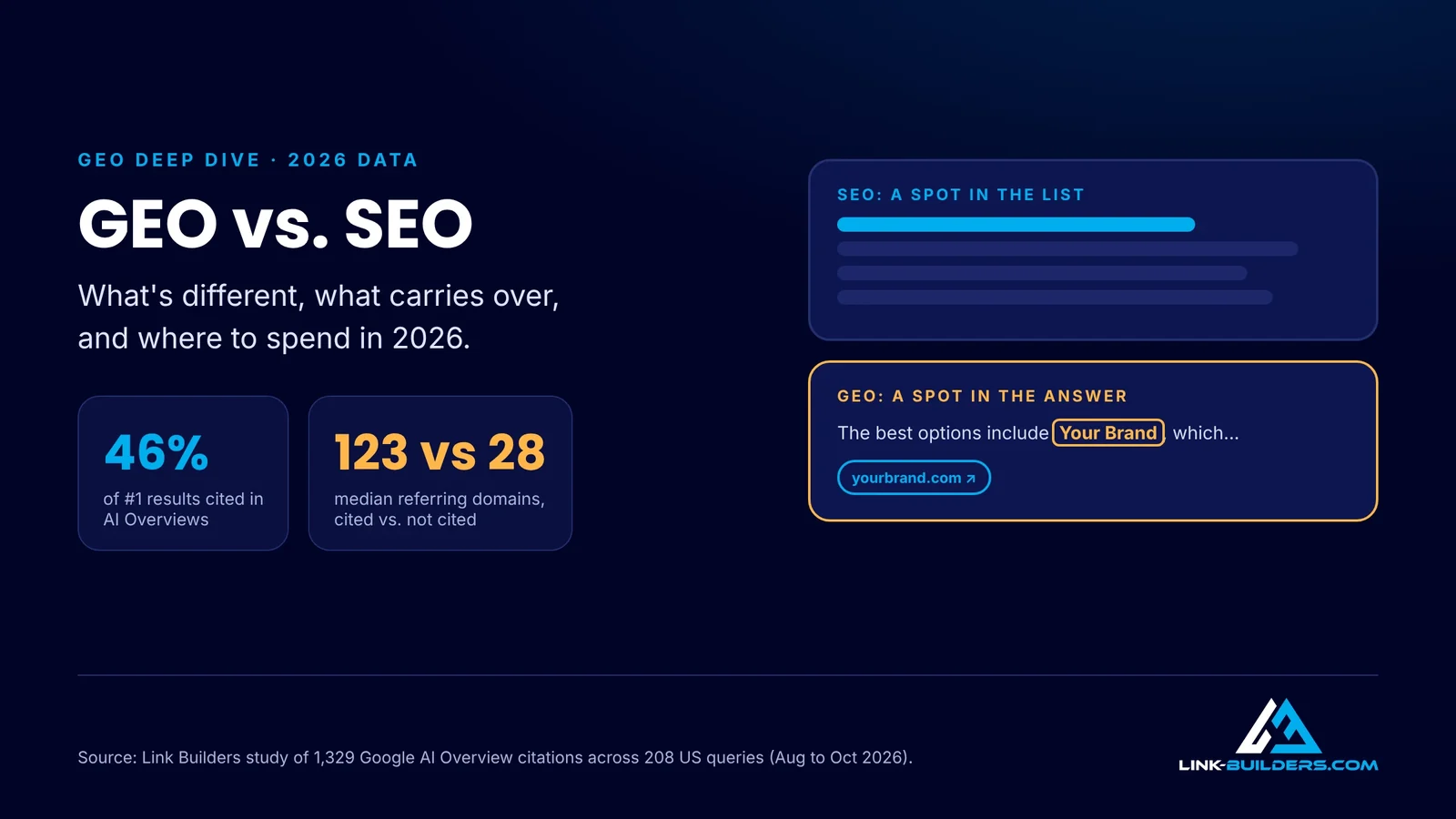
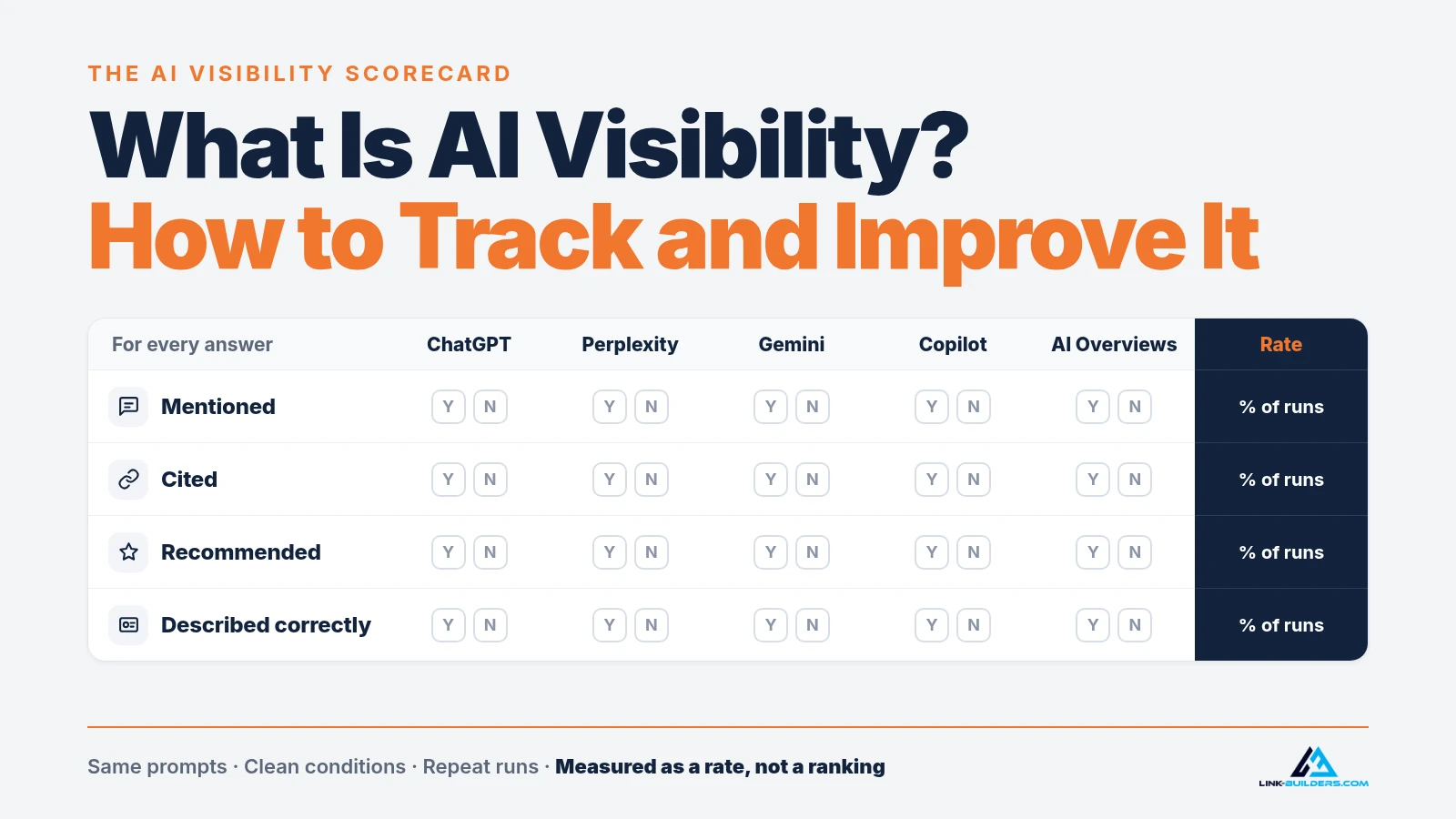
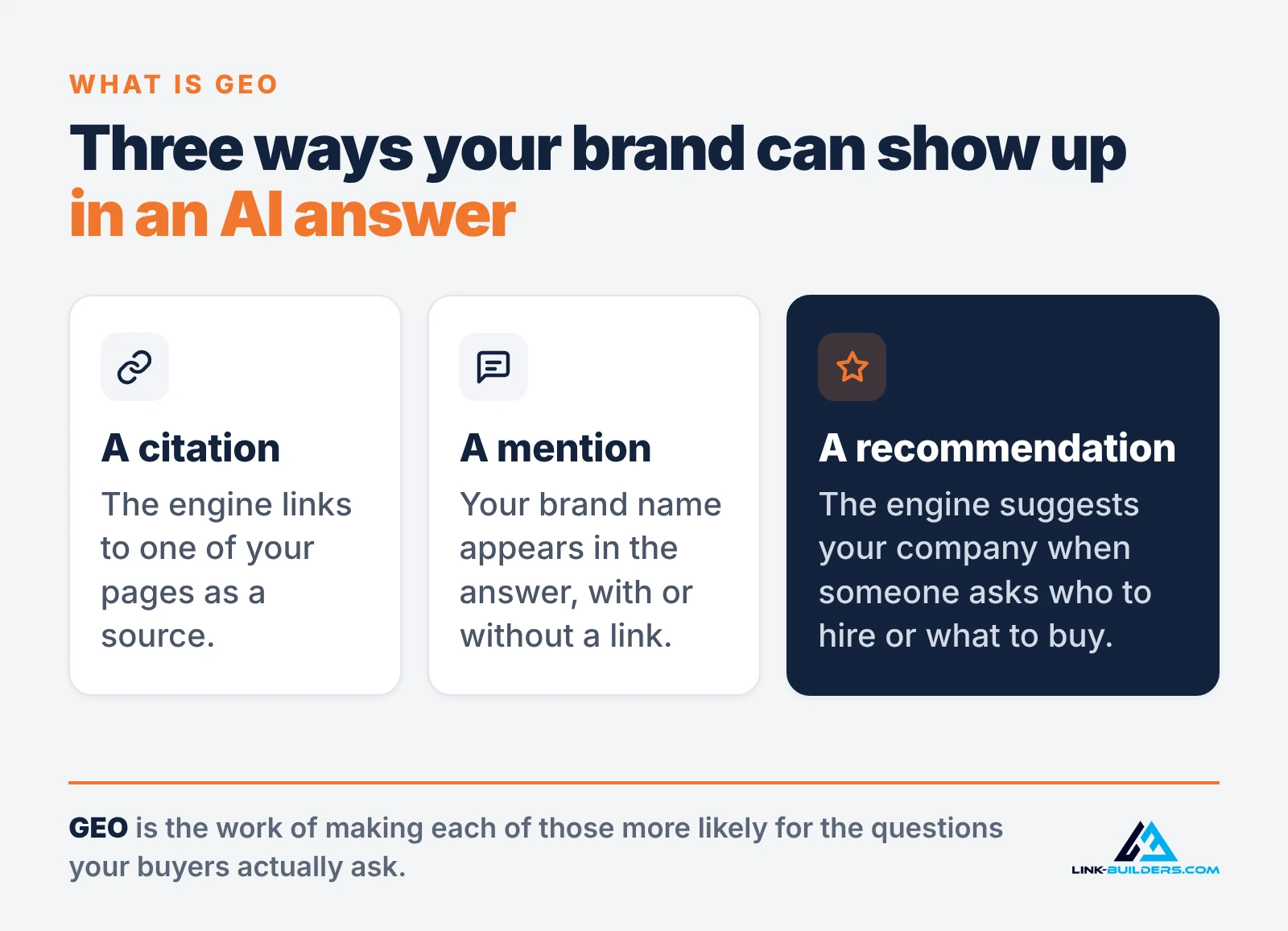
Traditional SEO tries to earn a spot in a list of links. GEO tries to earn a spot inside the answer. When someone asks an AI engine a question, there are three ways your brand can show up:
- A citation. The engine links to one of your pages as a source.
- A mention. Your brand name appears in the answer, with or without a link.
- A recommendation. The engine suggests your company when someone asks who to hire or what to buy.
GEO is the work of making each of those more likely for the questions your buyers actually ask.
The term comes from a research paper. In 2023, researchers from Princeton University, IIT Delhi and independent collaborators published “GEO: Generative Engine Optimization,” which was presented at the KDD 2024 conference. They defined a generative engine as a system that searches for sources and then uses a language model to write an answer grounded in them, with citations. Then they tested which changes to a page made it more visible in those answers. That framing still holds: GEO is about being one of the sources an engine chooses, and about how much of the answer your source ends up shaping.
How Does Generative Engine Optimization Work?
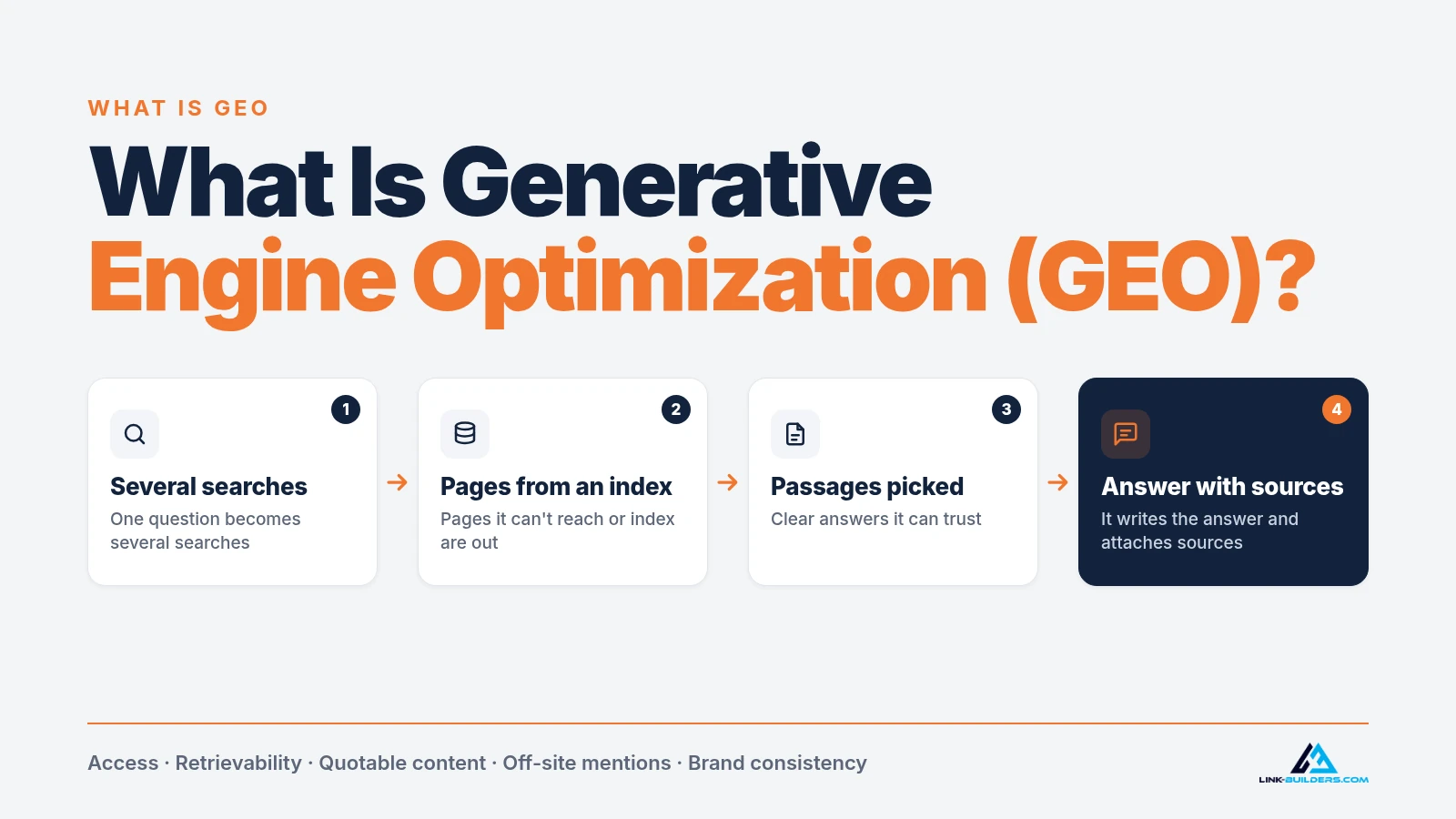
To understand GEO, it helps to know what happens between a question and an AI answer. The details differ by engine, but most answers that cite sources follow the same broad steps.
1. The engine turns one question into several searches
Google says AI Overviews and AI Mode may use a “query fan-out” technique, issuing multiple related searches across subtopics to build a response. The Princeton paper describes a similar pattern, where a model rewrites the question into simpler queries before anything is retrieved. So your page isn’t competing for one keyword. It’s competing for the smaller searches the engine runs behind the scenes.
2. It retrieves pages from an index
Those searches run against an index of the web. Google’s AI features use Google’s own index, and Google says a page must be indexed and eligible to show with a snippet to appear as a supporting link. ChatGPT’s search features use OpenAI’s crawler, OAI-SearchBot, to find websites, and OpenAI says sites that block it won’t be shown in ChatGPT search answers. If an engine can’t reach or index your page, nothing else in this guide matters.
3. It reads the pages and picks what to use
The engine doesn’t use everything it finds. It pulls the passages that answer the question clearly and that it can trust. A page that buries its answer under a long intro, hides key facts in images or contradicts other sources is easy to skip.
4. It writes the answer and attaches sources
Finally, the model writes a response and links some of the pages it used. Which brands get named depends heavily on what the retrieved pages say. If five review sites and two industry guides all name the same three companies, those three companies are very likely to be in the answer.
There’s a second path, too. Language models also answer from what they learned during training, without searching at all. You can’t edit that directly. But it’s built from the same public web, so the brands that get talked about widely online tend to be the ones a model “knows.”
The practical takeaway: AI engines mostly repeat what the web already says about you. GEO is partly about your own pages and largely about the pages that talk about you.
Why Is GEO Important?
For a growing share of searches, the first thing a buyer sees is a generated answer that names a handful of sources. The brands in that answer get the attention. Everyone else competes for what’s left, and being on page one of the classic results doesn’t guarantee a place in the answer.
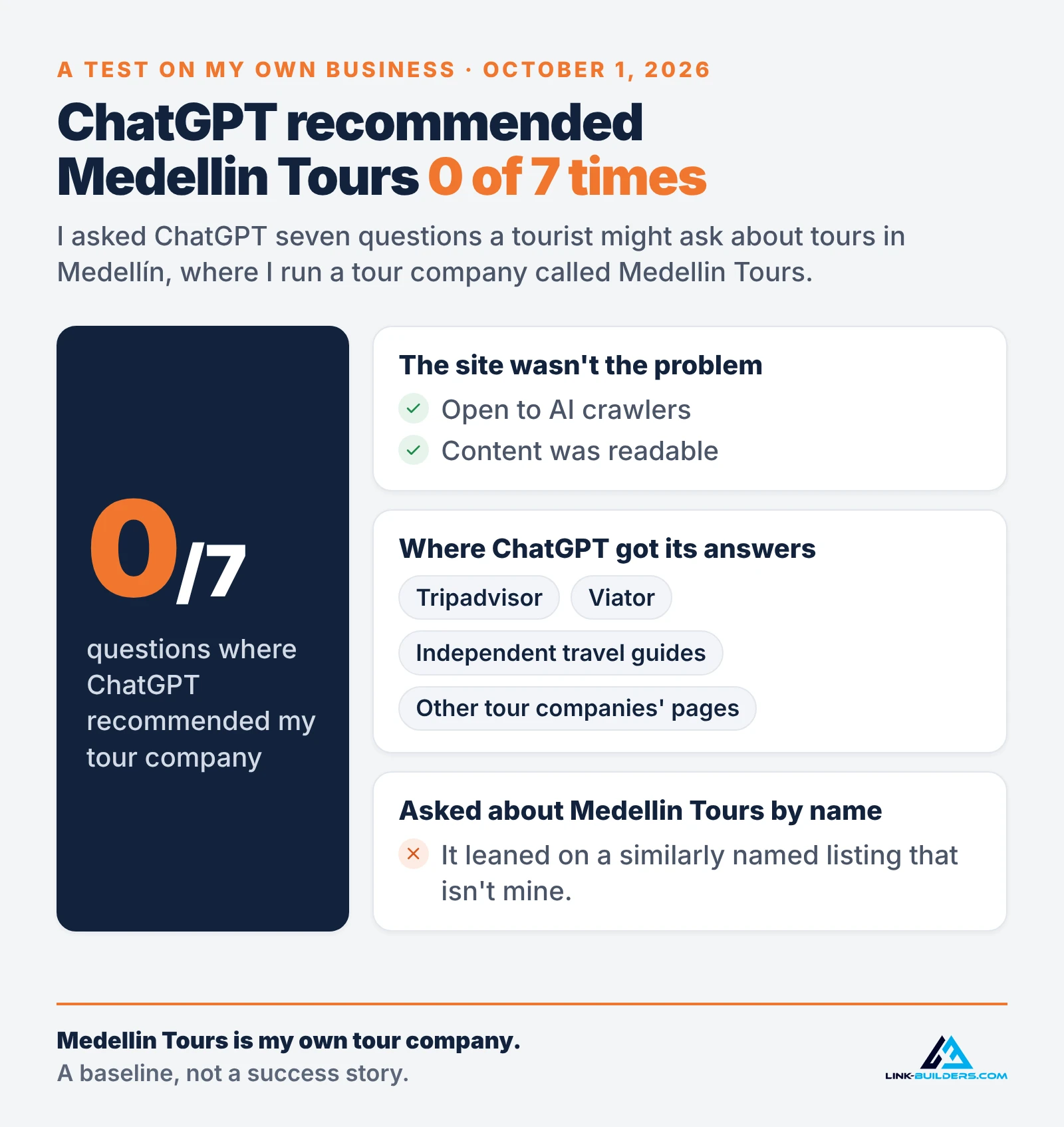
I tested this on my own business. On October 1, 2026, I asked ChatGPT seven questions a tourist might ask about tours in Medellín, where I run a tour company called Medellin Tours. It recommended Medellin Tours zero times out of seven. The site was open to AI crawlers and its content was readable. That wasn’t the problem.
The problem was where ChatGPT got its answers: review platforms like Tripadvisor and Viator, independent travel guides and other tour companies’ pages. Every company it recommended had a large volume of reviews on the big platforms. When I asked about Medellin Tours by name, it leaned on a similarly named listing that isn’t mine. That’s a baseline, not a success story, and it’s the clearest example I have of why GEO matters. A business can do the on-site basics right and still be invisible in AI answers, because the answer is built from other people’s websites.
The other reason GEO matters now is that you can finally see some of it. Google Search Console, Bing Webmaster Tools and Google Analytics all added AI-specific reporting in 2026, which I cover in the measurement section below.
GEO vs. AEO vs. AI Search Optimization vs. LLMO
You’ll see several names for this work:
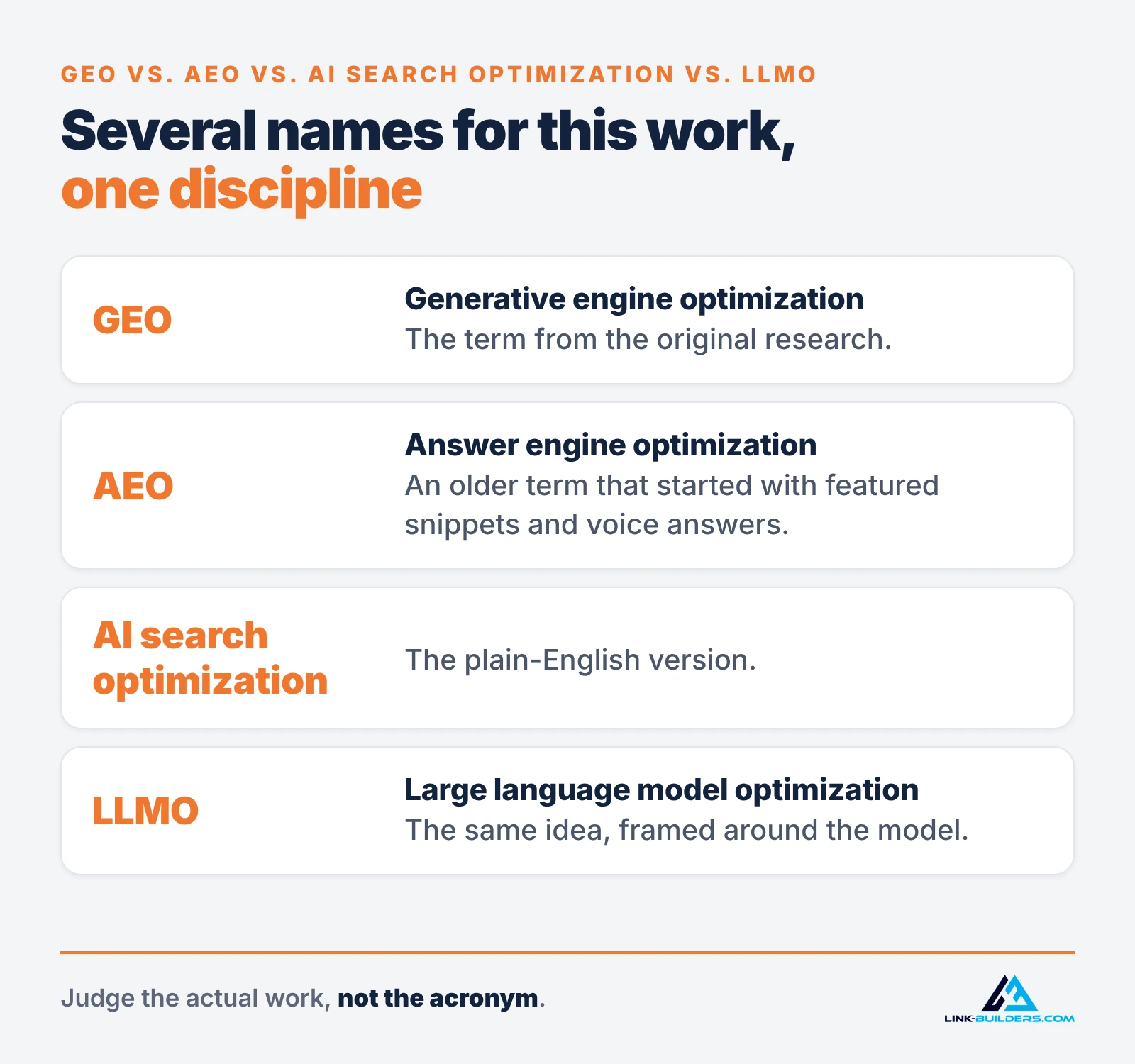
- GEO (generative engine optimization): the term from the original research, and the one I use.
- AEO (answer engine optimization): an older term that started with featured snippets and voice answers and now gets used for AI answers too.
- AI search optimization: the plain-English version.
- LLMO (large language model optimization): the same idea, framed around the model rather than the search product.
The labels overlap so much that I treat them as one discipline. When you compare providers or advice, judge the actual work, not the acronym. If you want to see how the work gets packaged and priced, my guide to what GEO services include and what they cost breaks it down.
What Affects Whether AI Cites You
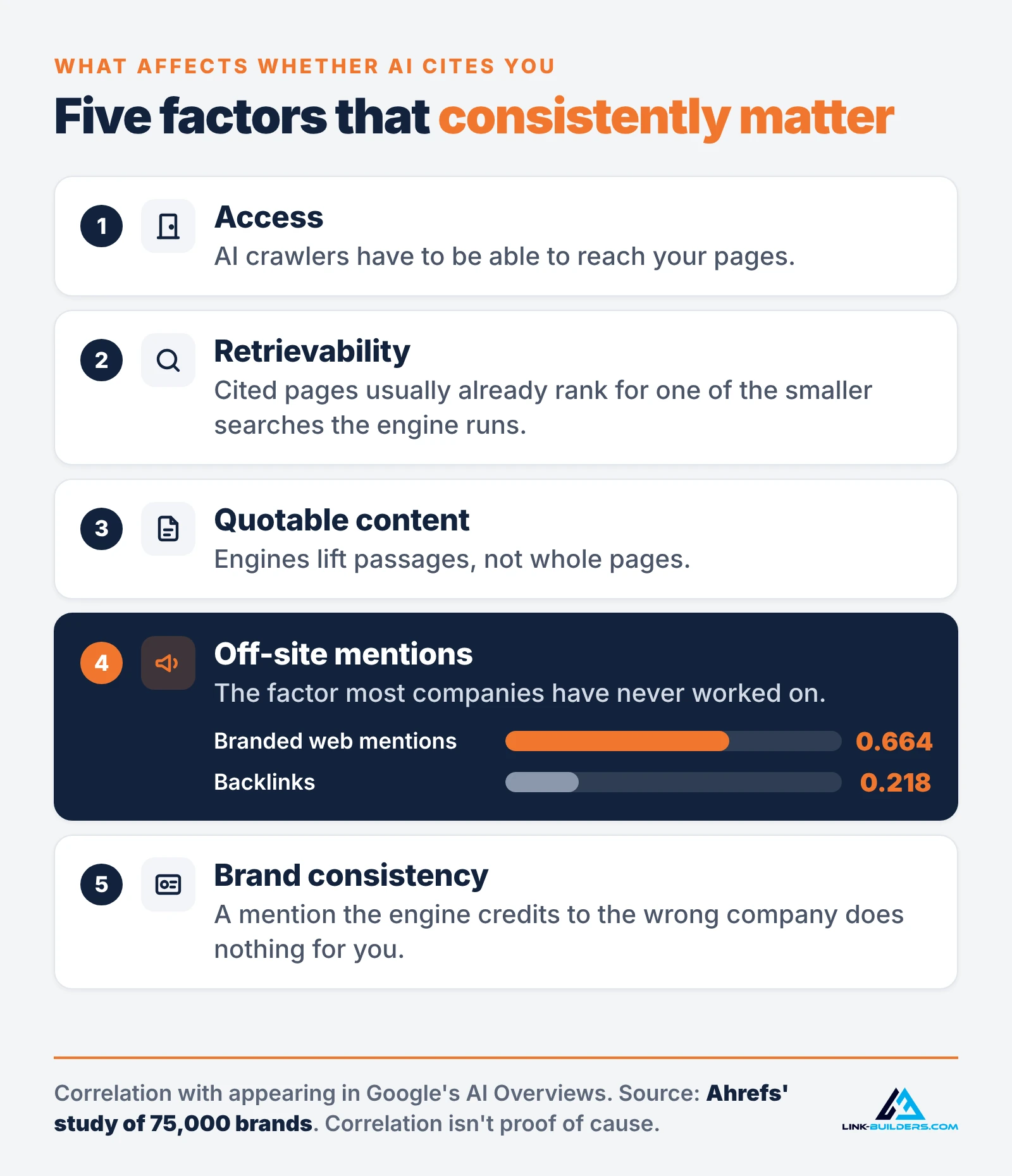
Nobody outside the AI companies knows the exact formula, and it changes with every model update. But the public documentation and the better studies point to five factors that consistently matter.
1. Access
AI crawlers have to be able to reach your pages. That means robots.txt rules, firewall and CDN bot settings, and content that’s in the page HTML rather than loaded in ways a crawler can’t see. Plenty of sites block AI search bots without knowing it. My AI crawler map lists which bots to allow and which settings to check.
2. Retrievability
Because engines run several searches per question, the pages that get cited are usually pages that already rank for one of those smaller searches. Normal SEO still does a lot of the work here. Google says plainly that there are no extra requirements or special optimizations needed for AI Overviews or AI Mode, and that SEO best practices still apply.
3. Quotable content
Engines lift passages, not whole pages. Sections that answer one question clearly, in text, near the top of the section, are easier to use. The Princeton researchers found that adding citations to credible sources, quotations and statistics raised a page’s visibility in generated answers by up to about 40% in their tests, while keyword stuffing did little or nothing. That was a controlled research setup, not a live test of ChatGPT or Google, so treat it as direction rather than a promise. I cover the writing side in what Microsoft and Google actually say about chunking content.
4. Off-site mentions
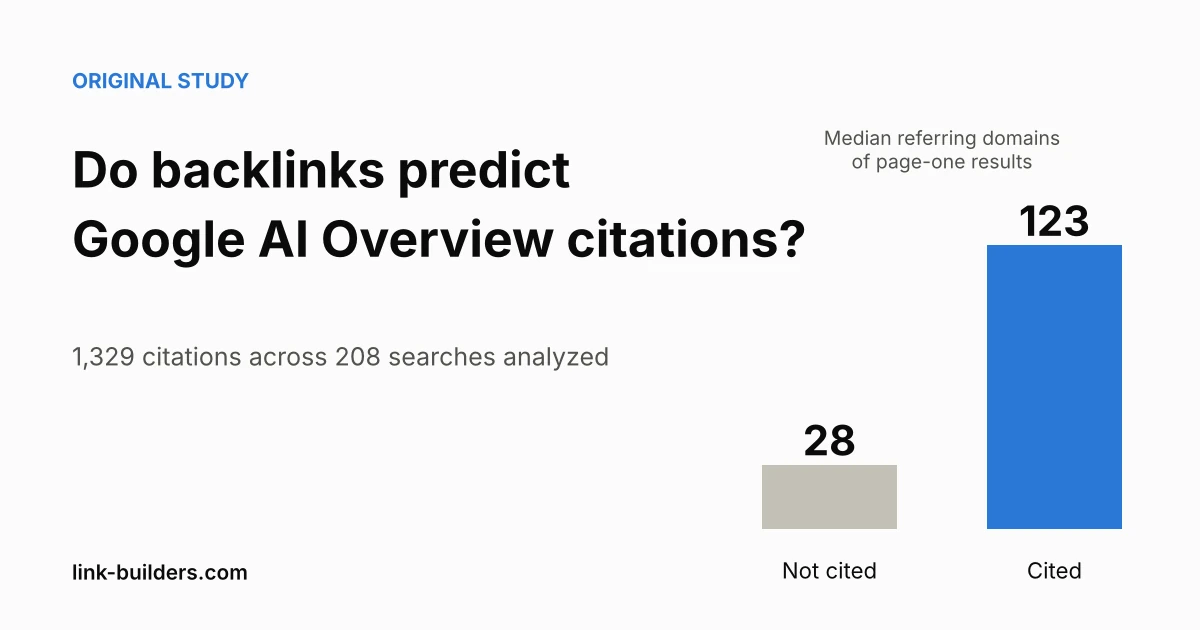
This is the factor most companies have never worked on. In Ahrefs’ study of 75,000 brands, branded web mentions had the strongest correlation with appearing in Google’s AI Overviews, at 0.664, compared with 0.218 for backlinks. Correlation isn’t proof of cause, but it matches how the engines work: they summarize what the web says, so brands that the web talks about get repeated. Links still help, in a narrower way, because they help the pages AI engines retrieve rank for those smaller searches. I break down the studies in brand mentions vs. backlinks for AI search.
5. Brand consistency
My Medellín test showed this one. A mention that the engine credits to the wrong company does nothing for you. Your business name, listings, About page and structured data need to match everywhere, so an engine can tell that every mention is about the same brand.
How to Do Generative Engine Optimization in 7 Steps
Here’s the order I’d work in for most businesses. Each step links to a deeper guide if you want the details.
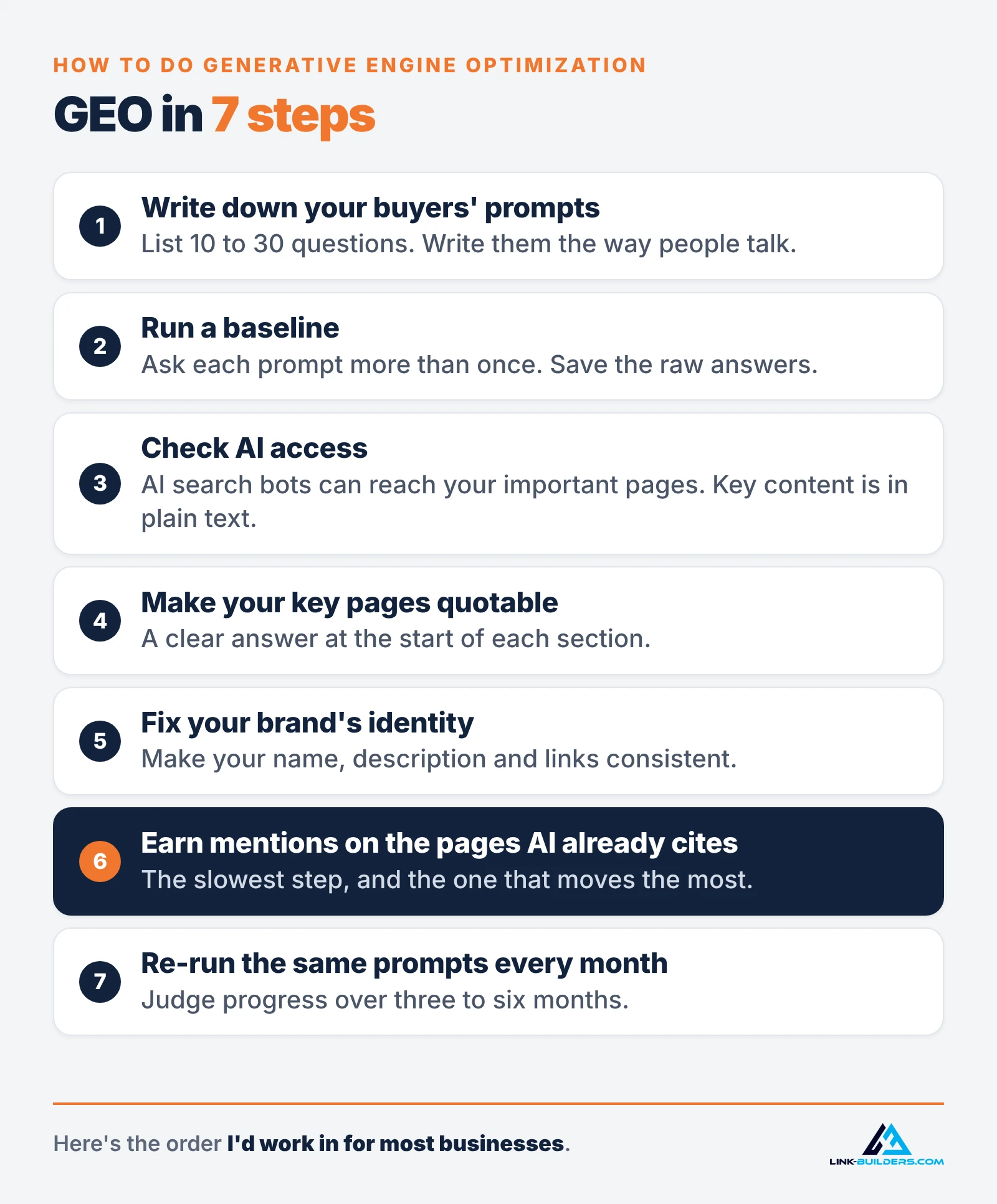
Step 1: Write down your buyers’ prompts
List 10 to 30 questions your customers would ask an AI assistant: problem questions, comparison questions and “who should I hire” questions. Write them the way people talk, not the way they type keywords.
Step 2: Run a baseline
Ask each prompt in ChatGPT, Perplexity, Gemini and Google, more than once, because answers vary. Record which brands get named and which URLs get cited. Save the raw answers. This is the step I ran for Medellin Tours, and it’s the one most companies skip.
Step 3: Check AI access
Confirm that the AI search bots can reach your important pages and that your key content is in plain text. The AI crawler map I linked above ends with a 15-minute checklist.
Step 4: Make your key pages quotable
Put a clear answer at the start of each section. Use specific facts and name your sources. Cut filler. Don’t publish a pile of thin pages aimed at prompts. That’s the kind of scaled content search engines already treat as spam.
Step 5: Fix your brand’s identity
Make your name, description and links consistent across your site, your listings and your profiles. If an engine confuses you with another business, fix that before you spend on anything else.
Step 6: Earn mentions on the pages AI already cites
Your baseline gives you a list of the pages AI engines use for your buyers’ questions. Those pages are your outreach list: review platforms, industry guides, comparison articles and resource pages. Earn a real mention, ideally with a link, by offering something worth including, like better data or a useful resource. This is the slowest step and the one that moves the most. My playbook on how to get your brand cited by AI goes deeper.
Step 7: Re-run the same prompts every month
Use the same prompt list each time so you’re comparing like with like. Judge progress over three to six months, not week to week.
How to Measure GEO
GEO is harder to measure than SEO because there’s no single ranking to check. Most of the time you need several sources, and each one has gaps.
| What to measure | Where | What it can’t tell you |
|---|---|---|
| Mentions and citations for your buyers’ prompts | Your own monthly prompt runs, with raw answers saved | Answers vary by wording, user and model version, so treat it as a sample |
| Impressions in AI Overviews and AI Mode | Search Console’s generative AI performance report | Clicks or queries. It shows impressions only. |
| Citations in Microsoft Copilot and Bing AI answers | AI Performance in Bing Webmaster Tools (public preview) | Where or how you appeared inside an answer |
| Visits from AI assistants | GA4’s AI Assistant channel | Visits from AI Overviews and AI Mode, which it excludes, or visits that arrive with no referrer |
Google’s report rolled out to all sites worldwide on August 31, 2026. It shows how often your URLs appeared in generative AI features in Search and Discover. Bing’s report counts how often your pages were cited as sources in Copilot and Bing’s AI answers. GA4 now puts traffic from assistants like ChatGPT, Gemini and Copilot into its own channel instead of mixing it into Referral. I walk through the Google side in how to read Search Console and GA4 data for SEO.
No tool can tell you when an AI recommended you to someone who never clicked. That’s why the monthly prompt runs stay at the center of any honest GEO report.
Is GEO Replacing SEO?
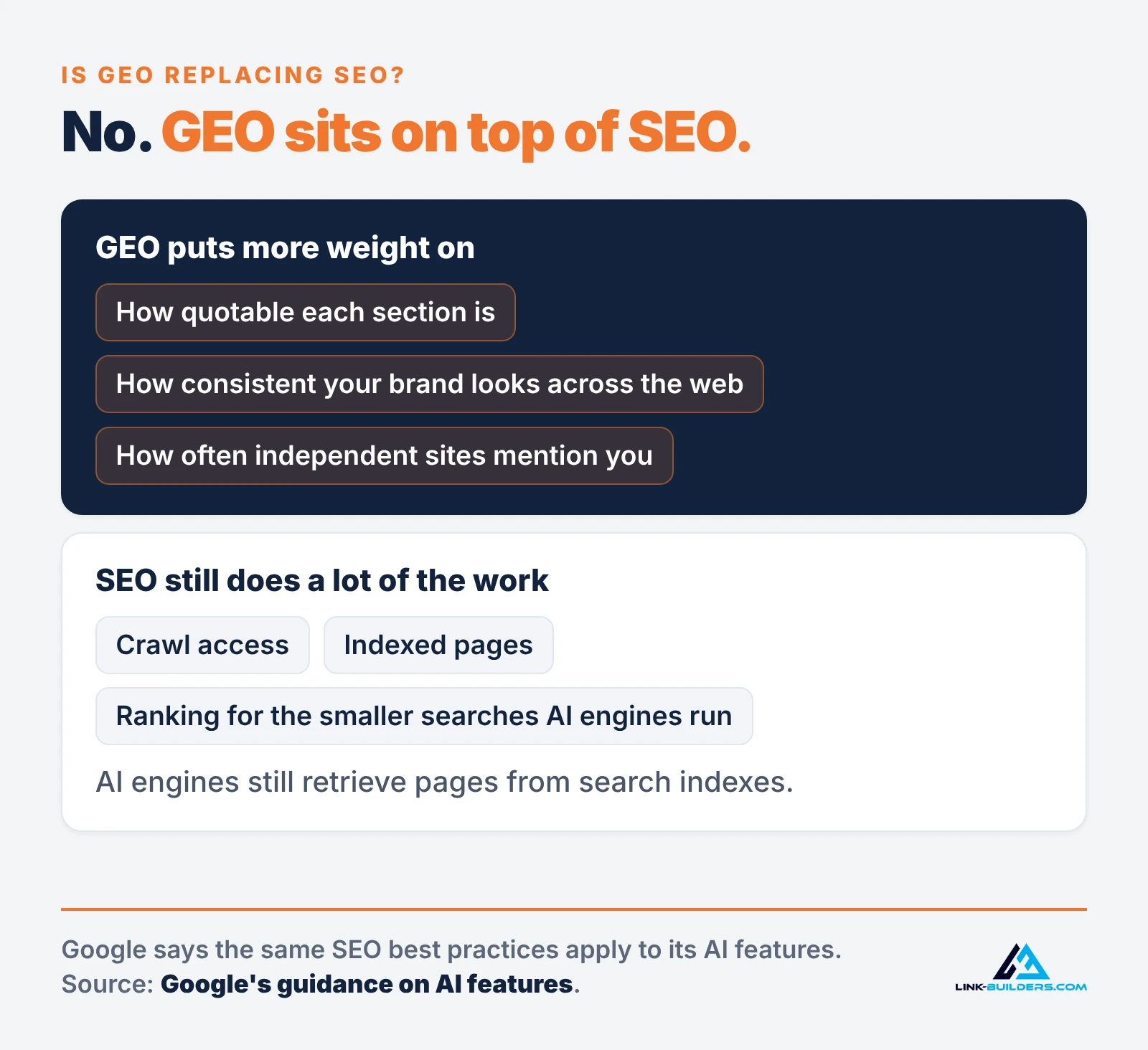
No. GEO sits on top of SEO. AI engines still retrieve pages from search indexes, and Google says the same SEO best practices apply to its AI features. A site with weak SEO gives AI engines very little to find. I compare the two side by side, with data, in GEO vs. SEO.
What changes is the weighting. GEO puts more weight on three things classic SEO often treated as extras: how quotable each section is, how consistent your brand looks across the web, and how often independent sites mention you. If you already do good SEO, GEO is mostly an extension of it. If you’ve relied on tricks, AI answers will expose that quickly. I wrote more about that shift in building backlinks in an age of AI.
GEO FAQ
How long does GEO take?
Technical fixes can show up within weeks in engines that search the live web. Off-site authority takes months, because earning real mentions on trusted pages is slow work. Track the same prompts monthly and judge progress over three to six months.
Can anyone guarantee my brand will appear in ChatGPT?
No. Answers change with the wording, the user and the model version, and no outside company controls them. Walk away from anyone who guarantees AI placements or a fixed number of citations.
Do I need llms.txt or special schema for AI search?
Not for Google. Its guidance on AI features says you don’t need new machine-readable files, AI text files or special schema markup to appear in AI Overviews or AI Mode. Structured data that matches your visible content is still good practice.
Do backlinks still matter for GEO?
Yes, in a narrower way. Links help the pages AI engines retrieve rank for the searches those engines run. Mentions on trusted pages are what get your brand named. The best placements do both.
Can I do GEO myself?
Much of it, yes. The baseline, the access check, page edits and brand consistency are all things an in-house team can do this month. The off-site work takes the most time, and it’s the part most businesses hand off.
How much does GEO cost?
It depends on the provider and the scope. My GEO services guide covers market price ranges. For my own work, the rate is $160 an hour, and most clients start with a prepaid 30-hour block for $4,800. Full details are on my pricing page.
Where to Go From Here
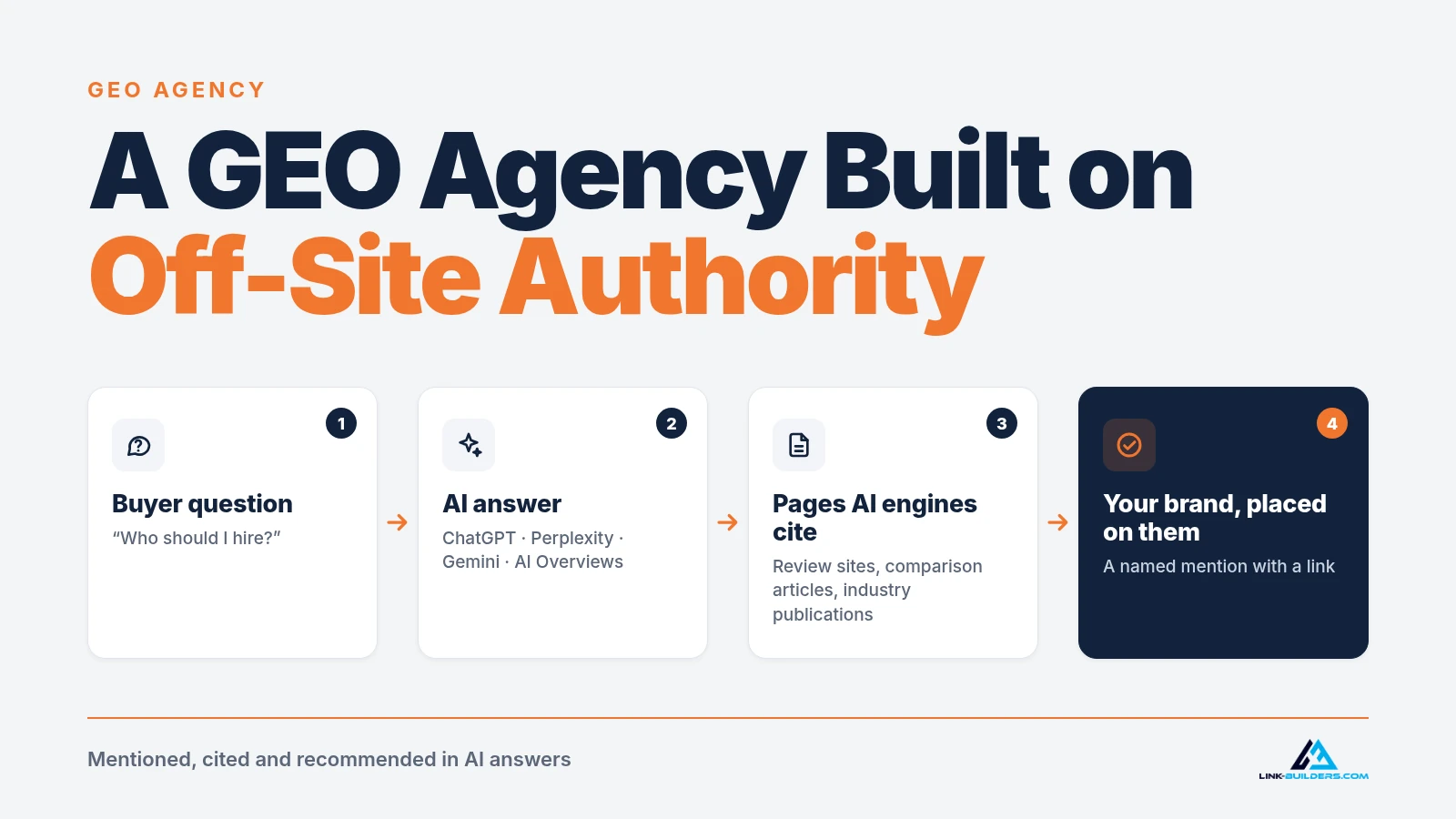
If you’re doing GEO yourself, start with the baseline and the access check, then use the guides linked above for each step. If you’d rather hand off the slowest part, finding the pages AI engines cite and earning your brand a place on them, that’s what I do as a GEO agency built on off-site authority.
Not ready to talk? Send me one URL and I’ll send back 20 hand-vetted link opportunities for it, free. It’s the same research GEO off-site work starts with.
About the author

Justin Davis is the founder of Link Builders, a white-label backlink agency, and has been building links since 2015 for more than 150 clients in law, healthcare, real estate, software and other industries. After years of doing prospecting research by hand, he built an AI agent link building system that handles each step, from finding link opportunities and vetting sites to finding contacts and preparing outreach. He now runs that system for agencies and in-house SEO teams, and teaches it on YouTube. Find Justin Davis on YouTube, LinkedIn and X.