How Many Backlinks Does a Law Firm Need to Show Up in Google and ChatGPT?
By Justin Davis · Updated November 2026
Every managing partner I talk to asks the same first question: “How many links do we need?” Lately there’s a second one right behind it: “Will that get us into ChatGPT?”
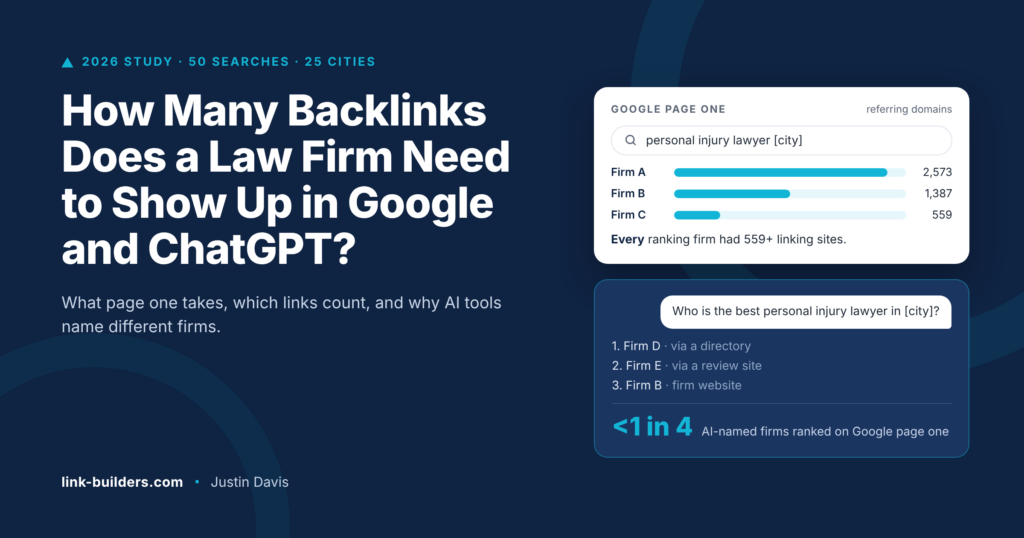
Here’s the short answer. In 50 Google searches across 25 U.S. cities, every law firm website on page one had at least 559 other websites linking to it. But a third of those sites had weak link profiles, and half of the city pages that ranked had 10 or fewer links of their own. Then I asked ChatGPT and Google’s AI Mode the same 50 questions. Fewer than 1 in 4 of the firms they recommended ranked on Google’s page one for that search.
So links get you in the door, but they aren’t the whole story. This article shows what the data says about how many links a law firm needs, which links count, how those links carry over into AI answers, what the bar’s ethics rules allow, and what a real campaign costs.
I founded Link Builders in 2015 and have built links for law firms ever since. You can read more about me and how I work here.
Key findings
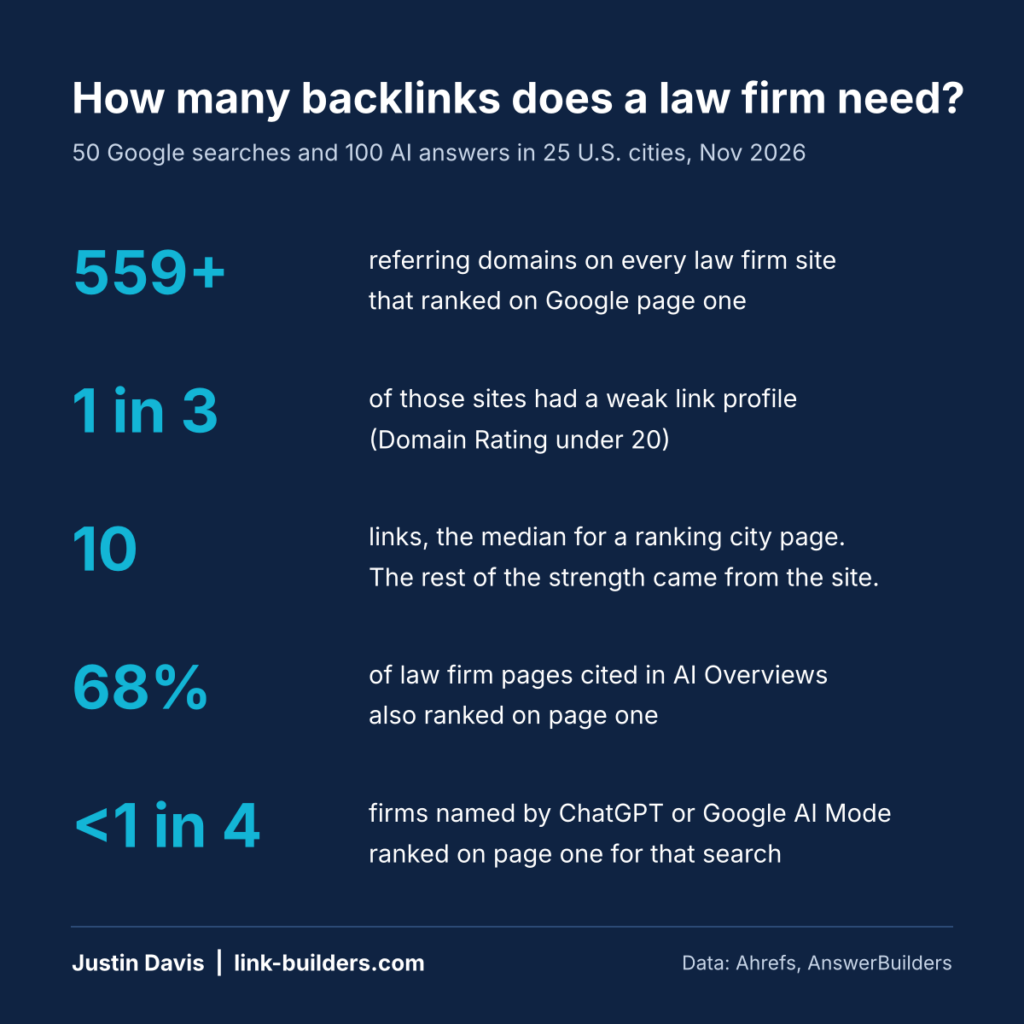
- In 50 Google searches across 25 cities, every law firm site on page one had at least 559 referring domains (median 1,387).
- Count isn’t quality: a third of those sites had a Domain Rating under 20.
- Half the city and practice pages that ranked had 10 or fewer links of their own. They ranked on the strength of the whole site.
- When Google showed an AI Overview, 68% of the law firm pages it cited also ranked on page one.
- Fewer than 1 in 4 law firms that ChatGPT or Google AI Mode named ranked on Google’s page one for the same search.
- 23 firms from my January 2024 study now rank on page one. The number of sites linking to them roughly doubled (median 1.9x) in under two years.
- ABA Model Rule 7.2 limits paying anyone “for recommending” a lawyer, and that changes how a law firm should get links.
Do Backlinks Help ChatGPT Find and Recommend Your Law Firm?
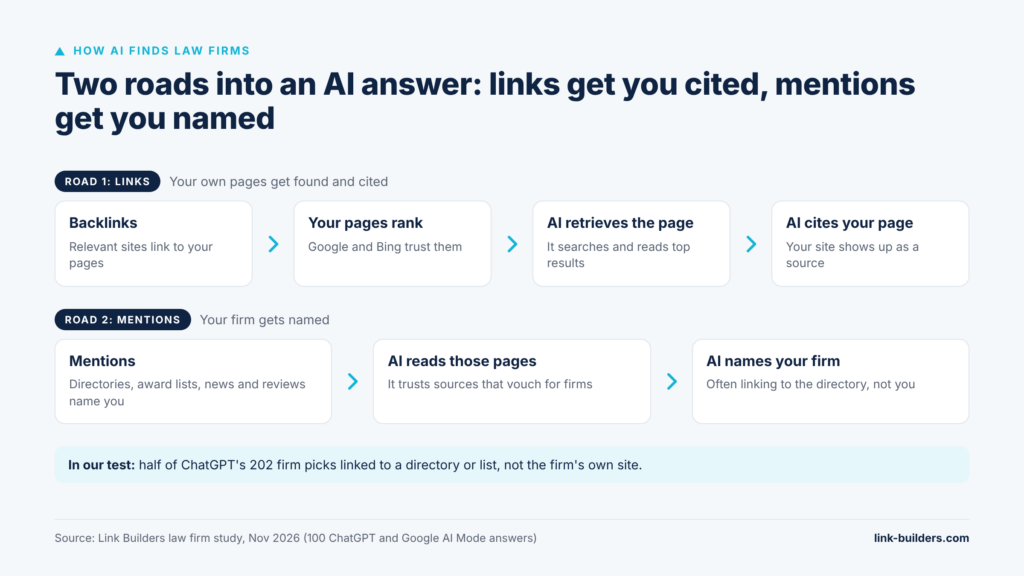
Yes, but mostly in an indirect way. Links help AI tools find and trust your pages. Mentions of your firm on other sites decide whether the AI names you. A law firm needs both.
How ChatGPT finds pages
When ChatGPT searches the web, it often sends your question to outside search providers and reads what comes back. OpenAI’s ChatGPT search help page says it partners with other search providers, and Bing is the one it names. OpenAI’s publisher FAQ says any public site can appear in ChatGPT search, as long as it doesn’t block OAI-SearchBot. The same help page also says plainly that no one can guarantee top placement.
The practical upshot: pages that rank well in the search indexes ChatGPT pulls from are easier for it to find. And links are still one of the biggest reasons a page ranks.
How Google’s AI finds pages
Google says its AI features are built on the same systems as regular search. Its guide to optimizing for generative AI features says they’re rooted in its core ranking and quality systems. Google’s ranking systems guide still lists PageRank, the link-based system, as one of those core systems.
The proof that links matter for AI
In my study of 1,329 AI Overview citations, cited pages had a median of 123 referring domains. Pages that weren’t cited had 28. A Semrush study with Kevin Indig found the same direction: authority, which is built mostly from links, lines up with AI mentions. Indig’s follow-up analysis adds a useful warning. Small link gains don’t move the needle much until a site climbs into a higher authority tier.
The honest counterpoint
Links aren’t the only signal, and it would be wrong to say they are. Ahrefs studied 75,000 brands and found that brand mentions across the web lined up with AI Overview visibility about three times more strongly than raw backlink counts (0.664 vs 0.218). Ahrefs also found that only about 12% of AI assistant citations rank in Google’s top 10.
My own law firm data, which you’ll see below, points the same way. So here’s how I’d put it: links get your own pages found and trusted. Mentions on the pages AI already reads get your firm named. I cover the difference in more depth in brand mentions vs backlinks for AI search and where ChatGPT gets its information.
The directory, review and mention side of this has its own playbook. I wrote it up as a 5-step guide to getting your law firm recommended by ChatGPT, so I won’t repeat it here. One technical item is worth checking first, though: make sure AI crawlers can reach your site.
Why this matters now: Clio’s Legal Trends research found that more than half of consumers have used AI for a legal question or would. Where the AI sends those people next is the prize.
How Many Backlinks Do Law Firms Actually Have?
Most law firms have very few, and the ones that win have far more. I’ve measured this twice before, and both studies show a gap, not a smooth curve.
The 1,000-firm study (2020 data)
In 2020 I pulled Ahrefs data on 1,000 personal injury and medical malpractice firm websites across 24 U.S. cities. The average site had 79 referring domains (other websites linking to it) and about 398 organic visitors a month.
The average hides the real story:
- The bottom half of firms had between 0 and 36 referring domains, and 55 or fewer organic visitors a month.
- The top 10% had at least 200 referring domains, and often 300 to 500.
- Sites with 4 or fewer referring domains averaged just 7 organic visits a month.
- 98 of the 1,000 sites had no estimated organic traffic at all.
Treat those numbers as history. They’re six years old, and you’ll see below how far the bar has moved since.
The 300-site study (January 2024)
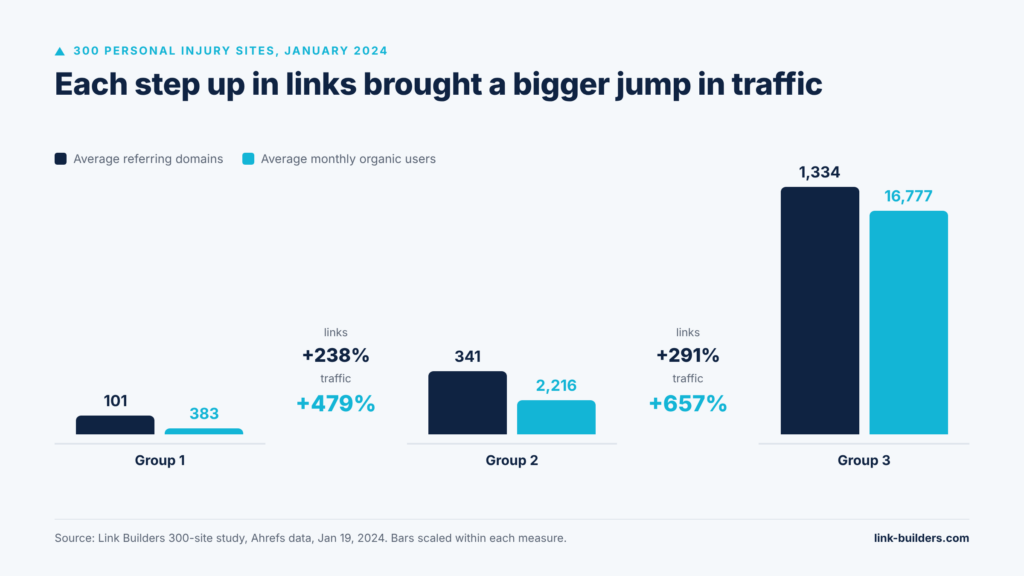
In January 2024 I sorted 300 personal injury websites into three groups by referring domains. The full list, with every site’s Ahrefs numbers, is in a public spreadsheet.
| Group | Average referring domains | Average monthly organic users |
|---|---|---|
| 1 | 101 | 383 |
| 2 | 341 | 2,216 |
| 3 | 1,334 | 16,777 |
The pattern compounds. From Group 1 to Group 2, referring domains rose 238% and traffic rose 479%. From Group 2 to Group 3, referring domains rose 291% and traffic rose 657%. Each step up in links came with a bigger jump in traffic than the step before.
What this means for your firm
These are averages across big, competitive markets. A family lawyer in a town of 40,000 isn’t competing with a Houston personal injury firm. In a small market, dozens of good links can be enough. In a major personal injury market, the leaders have hundreds or thousands.
The word “good” is doing a lot of work there. The next section shows why a raw link count can fool you. If you want the general method for any kind of site, I explain it in how many backlinks you need to rank.
We Checked 50 Law Firm Searches in 25 Cities. Here’s What Page One Takes.
Every law firm website on page one had at least 559 referring domains. But a third of them had weak links, and the AI tools mostly recommended different firms anyway. Here’s the full picture.
How the study worked. On November 15, 2026, I pulled Google’s page one for “personal injury lawyer [city]” and “car accident lawyer [city]” in 25 cities: 20 large metros and 5 mid-size ones (Boise, Des Moines, Knoxville, Spokane and Tulsa). That’s 50 searches, 389 organic results and 250 law firm websites. I used Ahrefs for link data and AI Overview citations. Then I ran the same 50 questions through ChatGPT and Google AI Mode with AnswerBuilders. Firms are anonymized. These numbers show who ranks and who gets named. They don’t prove what caused it. You can download the anonymized data for free (all 389 page-one results, 106 AI Overview citations and 442 AI recommendations).
Every firm on page one had hundreds of linking sites
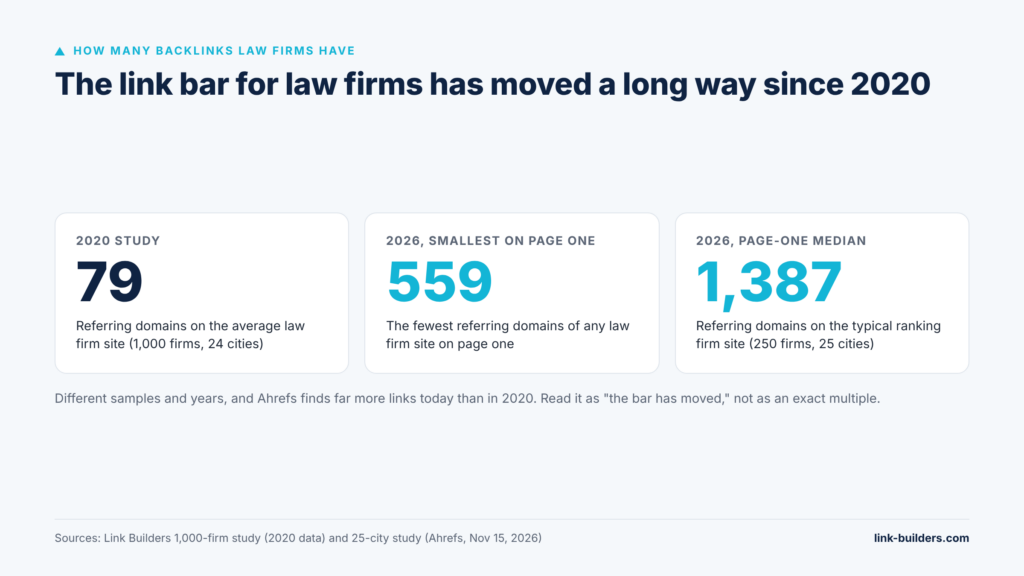
The smallest link profile on page one belonged to a firm with 559 referring domains. The median was 1,387, and 90% of ranking firms had 1,000 or more.
Compare that with my 2020 study, where the average firm had 79. The samples and years are different, and Ahrefs finds far more links today than it did then. So I won’t claim a precise multiple. But the bar has clearly moved.
The firms that rank today kept building
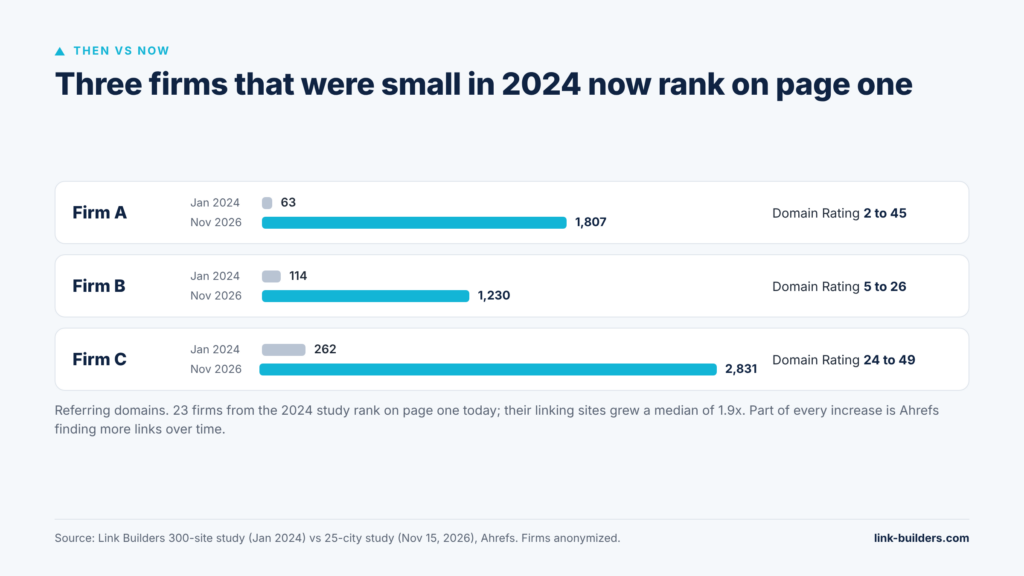
23 firms from my January 2024 spreadsheet rank on page one in this study. In about 22 months, their referring domains grew a median of 1.9x, and their median Domain Rating rose 3 points.
The biggest jumps came from firms that were small in 2024:
| Firm | Referring domains, Jan 2024 | Referring domains, Nov 2026 | Domain Rating change |
|---|---|---|---|
| Firm A | 63 | 1,807 | 2 to 45 |
| Firm B | 114 | 1,230 | 5 to 26 |
| Firm C | 262 | 2,831 | 24 to 49 |
Part of every increase is Ahrefs finding more links over time, not only new links being built. Even so, none of these firms sat still.
But many of those links aren’t worth much
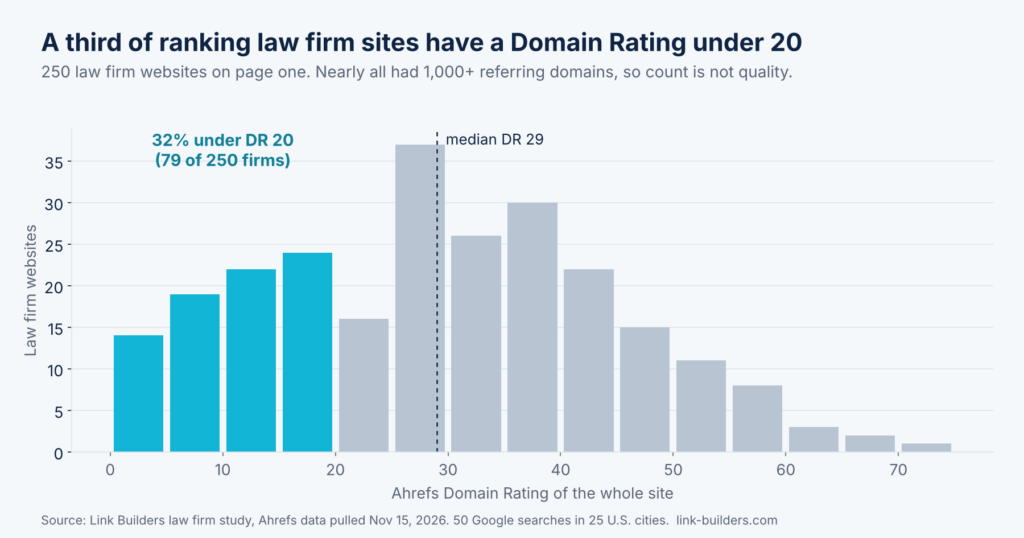
The median Domain Rating of the ranking firms was only 29. A third (32%) were under DR 20, and 13% were under DR 10. Domain Rating is Ahrefs’ 0 to 100 score for the strength of a site’s link profile. I explain it, with UR and referring domains, in this guide to common link building metrics.
Think about what that means. Nearly every one of those sites showed 1,000 or more referring domains, yet a third had a weak score. A big share of law firm links are low-value directory, scraper and spam links. Two firms can both show “1,200 referring domains” and be in completely different leagues. Don’t chase a number.
Two ways onto page one
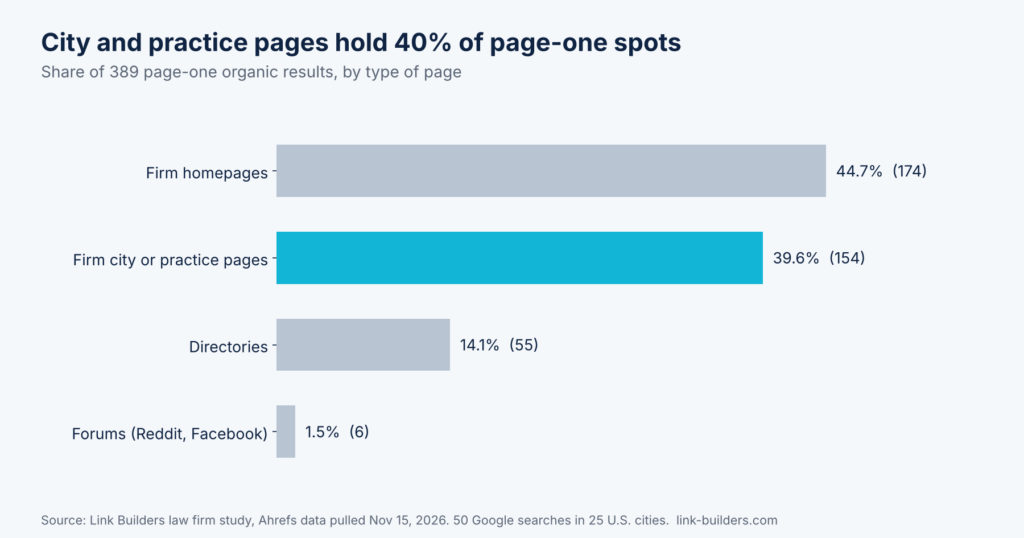
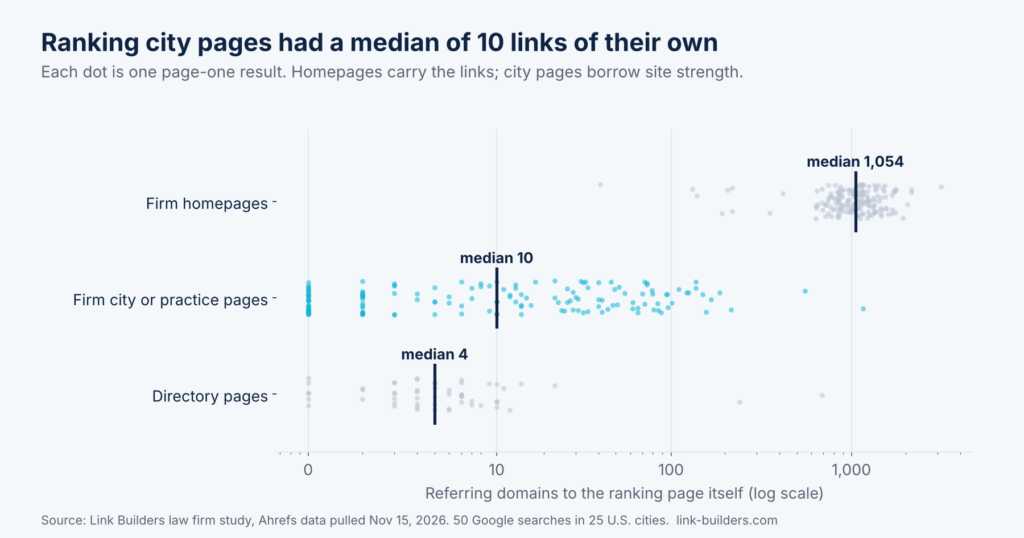
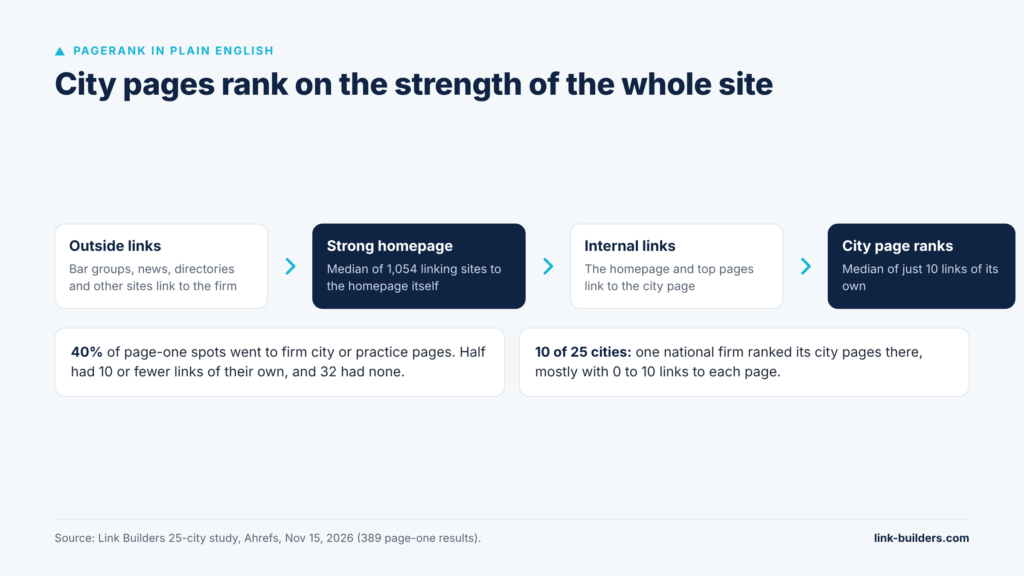
Firm homepages took 45% of page-one slots. Those homepages had a median of 1,054 referring domains pointing at the homepage itself.
Firm city and practice pages took another 40%. These pages had a median of just 10 links of their own. Half had 10 or fewer, and 32 had none at all. They ranked because the whole site was strong, and that strength flowed to them through internal links. The PageRank section below explains how.
Directories and national firms take seats too
Directories held 14% of all page-one results. Super Lawyers alone ranked in 37 of the 50 searches (74%). A Reddit or Facebook thread ranked in 6.
One national personal injury firm ranked city pages in 10 of the 25 cities. Most of those pages had 0 to 10 links of their own. That’s what whole-site strength does: a local firm is competing with the national firm’s entire domain, not just its city page.
What a local firm can do about both: get listed on the directories that rank (my 5-step guide covers which ones), and build the strength of your whole site so your city pages can compete. Local links help most here. See local link building for ideas.
Small markets vs big markets
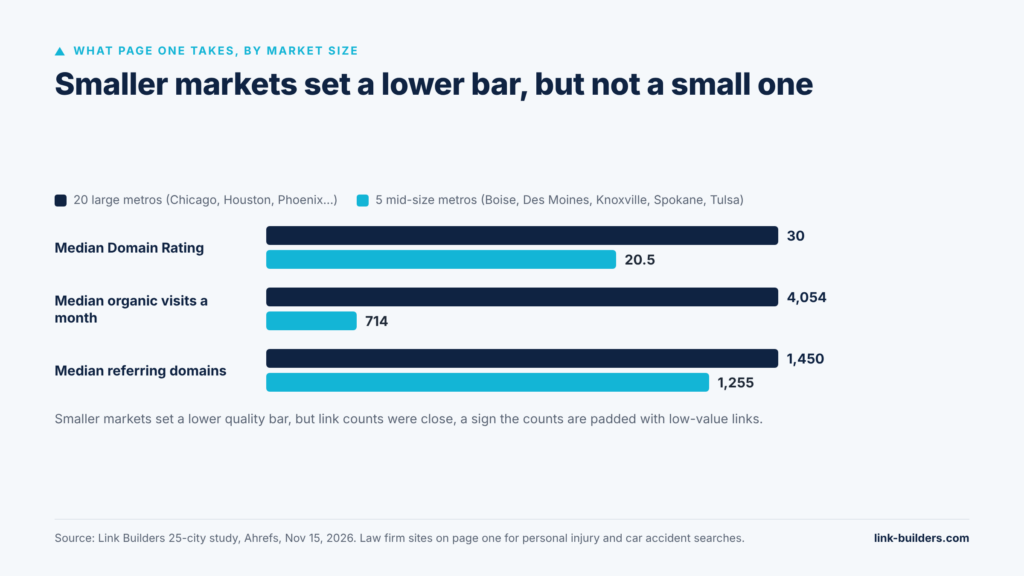
In the five mid-size metros, ranking firms had a median DR of 20.5 and about 714 organic visits a month. In the 20 large metros, the median DR was 30, with about 4,054 visits. A firm in Boise or Tulsa needs less strength than one in Chicago.
The raw link counts were close, though (1,255 vs 1,450 referring domains). That’s another sign the counts are padded with low-value links.
What Google’s AI Overviews picked
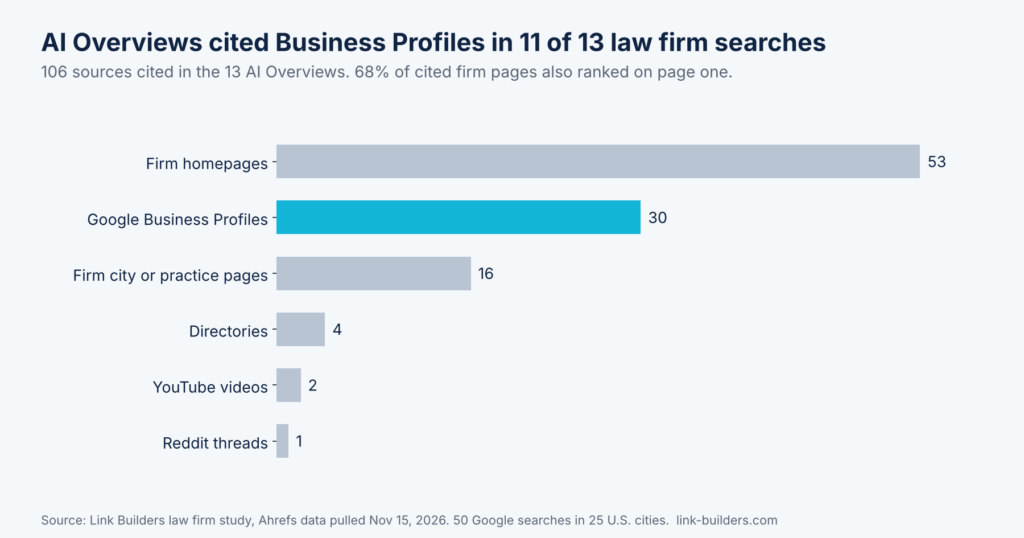
An AI Overview appeared on 13 of the 50 searches (26%). Here’s what it cited:
- 68% of the law firm pages it cited also ranked on page one for that search.
- 61% of the page-one firm results in those searches were cited.
- Directories ranked on page one 14 times in those searches but were cited only twice.
- Google Business Profiles were cited in 11 of the 13 AI Overviews.
Cited firms were only a little stronger than page-one firms that weren’t cited (median DR 33 vs 28.5). Getting onto page one was the main gate. That matches Ahrefs’ finding that 76% of AI Overview citations come from the top 10, although later data showed that share dropping. I found a similar pattern in my own AI Overview study.
Two examples stood out. In Atlanta, one firm’s self-published “top 10 best car accident lawyers” list ranked #8 but wasn’t cited. (Google has been looking harder at self-promotional lists like that.) In Seattle, the AI Overview cited two law firm blog posts about Washington accident law that didn’t rank in the top 10. Useful content can earn a citation on its own.
What ChatGPT and Google AI Mode named
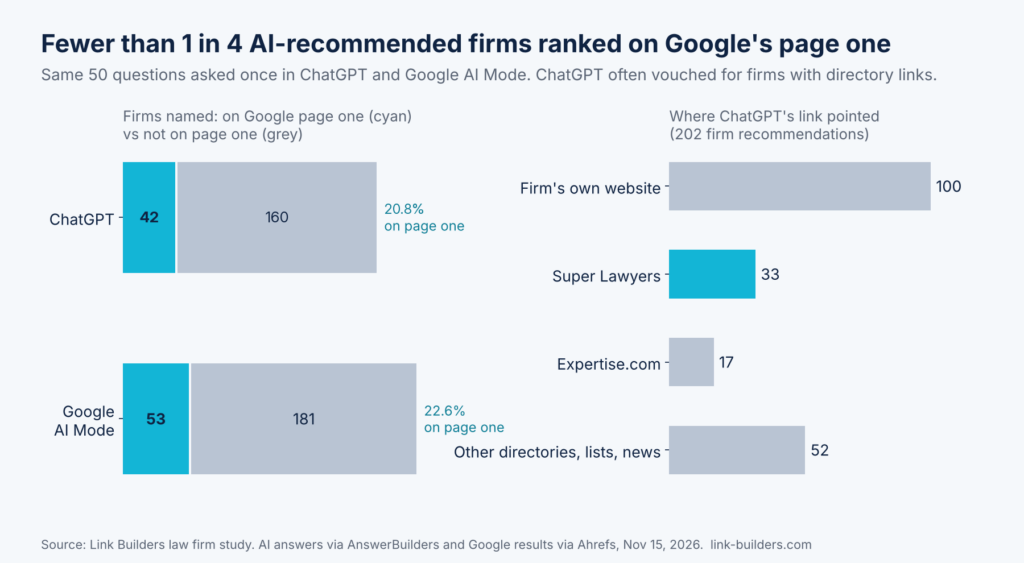
I asked both tools the same 50 questions, such as “Who is the best personal injury lawyer in Houston, TX?” ChatGPT named firms in 44 answers. In the other 6, it only asked follow-up questions, like whether I meant the city or the whole county. Google AI Mode named firms in all 50, mostly as Google Business Profile cards.
The headline: fewer than 1 in 4 named firms ranked on Google’s page one for the same search. That was 20.8% of ChatGPT’s picks and 22.6% of AI Mode’s. The AI Overviews cited 69 law firm pages from 63 distinct sites. In those same searches, ChatGPT named 12 of the cited firms and AI Mode named 20.
Links set a floor, but they didn’t pick the winners. The firms the AI tools named that weren’t on page one had about the same number of linking sites as page-one firms (a median of about 1,388 vs 1,387). But they got well under half the Google traffic (1,082 visits a month vs 2,853). Page-one firms that did get named were stronger than the ones that were skipped (median DR 36.5 vs 26).
So what decides who gets named? Other sites vouching for the firm. On half of ChatGPT’s firm recommendations (102 of 202), the link it gave was a directory or list, not the firm’s own website. Super Lawyers alone was the source on 1 in 6. AI Mode pulled nearly every pick from Google Business Profile cards, which run on reviews. That fits the Ahrefs brand-mentions study above, and it’s why I say links get you found while mentions get you named.
The two tools didn’t agree with each other much, either. In the 41 questions where both tools named firms we could match to a website, they shared at least one firm in only 27. A larger third-party study ran 3,200 prompts per platform and found that only 2.9% of 19,692 recommended law firms were named by all three AI tools it tested. If you check where your firm shows up, check more than one tool.
Study limits. One day, one data provider, one run of each AI question. AI answers change from run to run. Referring domain counts include spam. The page-one pull has no control group of firms that didn’t rank. Firm names in AI answers were matched to websites by link and by name, so a few may be missed.
How to Work Out How Many Backlinks Your Firm Needs
The number your firm needs is the gap between you and the firms that already show up for your searches. Here’s how to measure it in four steps.
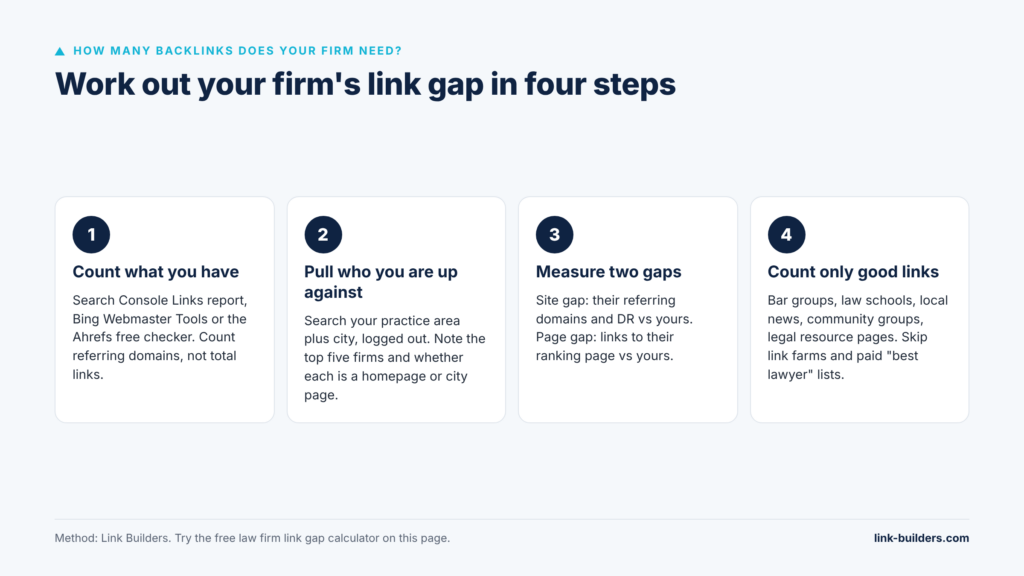
Step 1: Count what you have now
You can check how many backlinks your website has for free in three places:
- Google Search Console. The Links report shows your top linking sites and your most-linked pages. I walk through it in how to read Search Console and GA4 data.
- Bing Webmaster Tools. Bing Webmaster Tools has its own backlinks report. It’s worth a look because Bing is one of the search providers ChatGPT uses.
- The Ahrefs free backlink checker. Ahrefs’ free tool shows your referring domains and Domain Rating, so you can compare yourself with competitors on the same scale.
Count referring domains, not total backlinks. One directory can link to you from hundreds of pages, but it’s still one website.
Step 2: Pull the pages you’re actually up against
Search for your practice area plus your city while logged out of Google. Write down the top five law firm results and note whether each one is a homepage or a city or practice page.
Then do the same in AI. Ask ChatGPT “Who is the best [practice area] lawyer in [city]?” and ask which sources it used. My 5-step guide explains how to read the answer.
Finally, look at your Google Business Profile. AI Overviews cited Business Profiles in 11 of 13 law firm searches in my study, and Google AI Mode built almost every answer from them.
Step 3: Measure two gaps
- The domain gap. Compare your site’s referring domains and Domain Rating with those of the firms you wrote down. Compare DR as well as counts, because the study showed that counts are padded.
- The page gap. Compare the links pointing at your practice or city page with the links pointing at theirs. In the study, the typical ranking city page had only 10.
If the gap is mostly at the domain level, you need links to the whole site. If it’s mostly at the page level, you need links and internal links aimed at that one page. I explain the full method in how many backlinks you need to rank.
Try it: use the calculator below to work out your firm’s link gap. For an example, click “Load large-metro benchmark” and enter 300 referring domains for your site: the site-level gap comes out at 1,150.
Law Firm Link Gap Calculator
Compare your firm’s links with the firms that already rank for your search. It gives you a gap to close, not a promise of results.
1. Your firm
Get these from the free Ahrefs backlink checker or Google Search Console’s Links report.
2. The top firms for your search
Search your practice area plus your city, logged out, and enter the top three law firm results. Or load a benchmark from our 2026 study of 50 personal injury and car accident searches.
| Firm | Referring domains (site) | Domain Rating | Referring domains (ranking page) |
|---|
3. Your gap
What ranking firms looked like in our study
Medians for law firm sites on Google page one, November 2026. 50 searches in 25 U.S. cities.
| Market | Site referring domains | Domain Rating | Organic visits a month |
|---|---|---|---|
| Large metros (20 cities) | 1,450 | 30 | 4,054 |
| Mid-size metros (5 cities) | 1,255 | 20.5 | 714 |
| Ranking city or practice pages | median of 10 referring domains to the page itself | ||
Benchmarks come from personal injury and car accident searches, the most competitive in law. Most other practice areas and smaller towns set a lower bar. Referring domain counts include low-quality links, so compare Domain Rating too. See the full study data.
Built by Justin Davis at Link Builders. This tool estimates a gap from link data. It doesn’t predict rankings, traffic or AI recommendations. Want a list of real link opportunities for your firm? Get a free sample.
Step 4: Only count links that would pass a lawyer’s sniff test
A high-quality link for a law firm usually comes from a site with a real reason to point to you:
- State and local bar associations
- Law schools and alumni pages
- Local news and legal publications
- Chambers of commerce and community groups
- Nonprofits the firm actually supports
- Legal resource pages
I rank opportunities on a simple ladder: same niche first, then close neighbors, then the same place, then the same audience. Private blog networks, link farms, forum spam and sitewide footer links don’t count. I never build forum links. For more on what a healthy mix looks like, see types of backlinks and building a natural backlink profile.
PageRank in Plain English: Why One Link Isn’t Worth Another
There’s no fixed number of backlinks needed for PageRank, because PageRank weighs links by strength, not by count.
PageRank is the idea Google was built on. Larry Page and Sergey Brin described it in their original Stanford paper: every link is a vote, and a vote from a strong page counts for more than a vote from a weak one. Google’s ranking systems guide says PageRank has changed a lot since then but is still one of its core ranking systems.
That explains the city-page pattern in the study. A strong domain passes strength to its own city pages through internal links. That’s how one national firm ranked city pages in 10 cities when most of those pages had 0 to 10 links of their own.
Two Google patents add detail on which links count more:
- The Reasonable Surfer patent. A link a reader is likely to click, such as one in the body of an article, passes more value than a link buried in a footer. I break it down in why not every backlink counts the same.
- The Seed Site patent. Being only a few links away from trusted sites matters. That’s one reason a bar association or law school link is worth chasing. More in the seed site patent and link distance.
A related patent explains why networks of sites built only to link to each other tend to fail. See the PBN patent and node independence. I covered all of these in a LinkedIn article, What 7 Google Patents Taught Me After 11 Years Building Links.
The practical takeaway: link from your strongest pages to the practice and city pages you want to rank. Internal links cost nothing, and they move the strength you’ve already earned to where it counts.
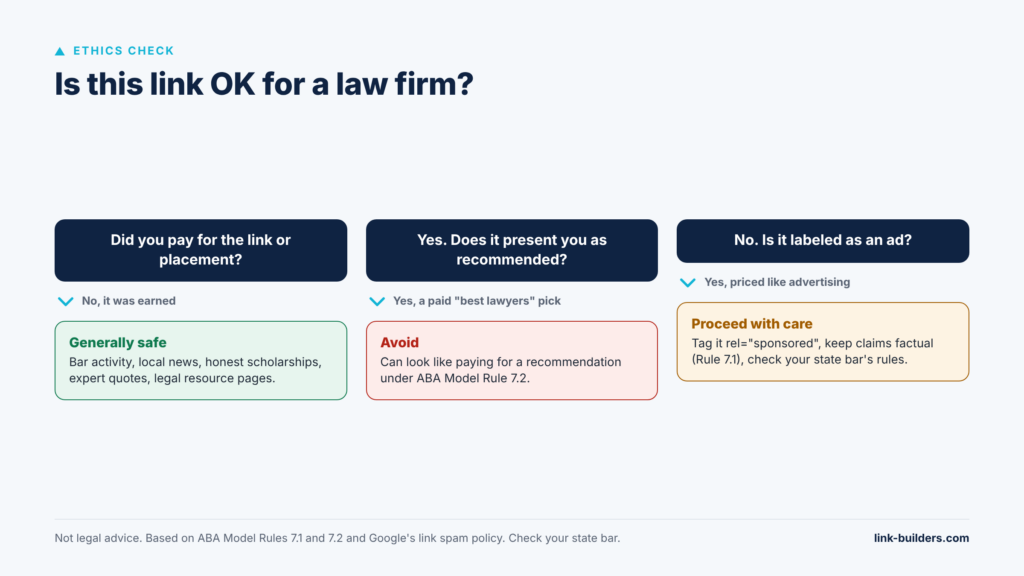
The Ethics Rule Most Link Builders Never Mention
Law firms can’t buy links the way an online store can, because the rules on paying for recommendations apply to lawyers. Most link building advice skips this. It shouldn’t.
I’m not a lawyer, and this isn’t legal advice. Rules differ by state, so check with your state bar’s ethics counsel before you pay for any placement.
What Rule 7.2 says
ABA Model Rule 7.2 says a lawyer can’t give anything of value to someone for recommending the lawyer’s services. It does allow paying the reasonable costs of advertising.
That line matters for links. A paid “best lawyers in Houston” listing, or a paid article that presents your firm as a top pick, can look like paying for a recommendation rather than paying for an ad.
How one state has applied it
New York’s bar has written about this more than most. In Ethics Opinion 1267, it found that lawyers paying to be listed on a site that recommended them broke New York’s version of Rule 7.2. Earlier opinions, 1131 and 1213, show where New York drew the line between allowed marketing services and paid recommendations. Your state may draw it differently.
Google’s side of the same problem
Google has its own rule. Its spam policies treat buying links that pass ranking credit as link spam. Google asks that paid placements be marked with rel=”sponsored”. I’ve written about how Google spots these links in its link spam detection patent and in my notes on the September 2026 spam update.
And don’t forget Rule 7.1, which bans false or misleading claims about a lawyer’s services. It covers anchor text and guest content too. “Best lawyer in Dallas” or made-up case results in a guest post can create a problem on their own.
What this means in practice
- Earned links are safest on both fronts. Bar activity, local news coverage, honest scholarship programs, expert commentary and legal resource pages carry no payment for a recommendation.
- Paid placements need care. If you pay for a placement, it should be clearly labeled as advertising, priced like advertising, tagged rel=”sponsored”, and checked against your state’s rules.
- Watch the words. Keep anchor text and guest content factual. No superlatives you can’t back up.
This is also why I’m wary of per-link pricing for law firms. I explain the reasons in should backlinks really cost hundreds of dollars each?
How AI Is Used for Backlink Analysis and Building (and Where It Fails)
AI is very good at the sorting and searching side of link building. It’s still poor at judgment, and judgment is where law firms get into trouble.
What AI does well
- Sorting a competitor’s backlinks in minutes. You can hand AI a list of a few thousand links and get back the ones worth a closer look. I show the process in how to use AI to analyze competitor backlinks 10x faster.
- Writing search strings. AI can write and test Boolean searches that turn up resource pages, local organizations and publications. See AI-powered Boolean search for link prospecting.
- Scoring relevance. With good examples, AI can rate whether a site fits your practice area and city. I explain how I train it in teaching AI to spot quality link opportunities in your niche.
- Finding contact routes and drafting notes. AI can find who runs a page and draft a one-line reason the page should link to you, for a human to check.
I rebuilt my own prospecting process as a chain of AI agents. You can read the full workflow or see how my link building AI agent works. I also wrote about what that output really looks like on LinkedIn: What 2,920 AI-Surfaced Link Prospects Actually Look Like.
What AI still gets wrong
- Telling real sites from link farms. A site can look fine to a model and still exist only to sell links.
- Ethics calls. AI won’t reliably flag that a paid “top lawyers” listing may raise a Rule 7.2 problem.
- Relationships. Editors and bar staff respond to people, not templates.
- The send. I write every outreach email myself and review every line AI drafts.
I go deeper on this in what AI SEO agents still get wrong in link building.
A simple way for a law firm to use AI
Use AI to build a link gap list from the top five firms in your city: the sites that link to two or more of them but not to you. Then have a person go through the list and remove anything that looks like a paid recommendation, a link farm or an irrelevant site. What’s left is your shortlist.
What a Good Law Firm Link Building Campaign Costs
A good campaign costs what it takes to close your gap, so the price should come from the gap, not from a package. Here’s what the market charges and how I price it.
What the market charges
BuzzStream, which makes outreach software and doesn’t sell links, studied prices across hundreds of thousands of guest post sites. It found that a guest post costs about $295 when bought directly from a site and about $461 through a vendor. Posts on high-quality sites averaged about $3,130. Those are averages across all industries, and they swing widely.
Legal sits at the expensive end. The search terms in this article cost $30 to $50 a click in Google Ads, which tells you how many firms want the same clients. Many of them are chasing the same publishers, too.
How I price it
This is my model, not an industry standard:
- $160 an hour. I bill for time, not per link. Per-link pricing gives the seller a reason to skip the best opportunities, because those take the most work.
- A 30-hour paid trial ($4,800). It’s enough time to show what’s possible for your firm before you commit to more.
- Publisher fees at cost. If a site charges a fee, you approve it first and pay what the site charges, with no markup.
- No guarantees. I don’t promise link counts, rankings or timelines. No honest link builder can. Here’s what realistic timelines look like.
More detail is on my backlink pricing page. If you’re weighing a hire against doing it yourself, see in-house vs outsourced link building. And if you get a lot of cold pitches offering cheap links, read what I learned from analyzing 1,000 backlink pitches before you reply to any of them.
Budget from the gap
Use the two-gap method above to size the work. A family law firm in a small town and a personal injury firm in Houston are different projects. Here’s what the ranking firms looked like by market size in my study:
| Market | Median Domain Rating of page-one firms | Median referring domains | Median organic visits a month |
|---|---|---|---|
| Large metro (20 cities) | 30 | 1,450 | 4,054 |
| Mid-size metro (5 cities) | 20.5 | 1,255 | 714 |
These are personal injury and car accident searches, the most competitive in law. Most other practice areas, and smaller towns, set a lower bar.
The cost of doing nothing
In my 2020 study, firms with 4 or fewer referring domains averaged 7 organic visits a month. That’s the market picture, not a forecast for your firm. But it shows where a site with almost no links usually ends up.
For agencies that serve law firms: I wrote about the economics of outsourcing link building in The New Unit Economics of White-Label Link Building.
Law Firm Backlinks FAQ
How do I get my law firm featured in ChatGPT?
Get your firm mentioned on the sites ChatGPT already trusts: legal directories, award lists, local news and review platforms. Keep your name, address and phone number the same everywhere, and build links so your own pages rank. My 5-step guide walks through each step.
How do I get my law firm in ChatGPT search results?
Don’t block OAI-SearchBot in your robots.txt file. Then rank well in the search indexes ChatGPT pulls from, including Bing, and earn mentions on the pages it cites. In my study, half of ChatGPT’s firm recommendations linked to a directory or list, so directory profiles matter a lot. This work is often called generative engine optimization.
Do backlinks help AI models reference my pages?
Yes, mostly by helping your pages rank and get retrieved. In my AI Overview study, cited pages had a median of 123 referring domains vs 28 for pages that weren’t cited. But brand mentions matter too, and in my law firm test, link counts alone didn’t decide which firms the AI named.
How many backlinks do I need to rank?
It depends on your market. Measure two numbers: the referring domains to your whole site, and the links to the page you want to rank. Compare both with the top five firms for your search. In big personal injury markets, every page-one firm had 559 or more referring domains, but ranking city pages often had 10 or fewer of their own.
How many backlinks are needed for PageRank?
There’s no fixed number. PageRank weighs links by the strength of the linking page, so one link from a strong, relevant site can be worth more than hundreds of weak ones. Internal links from your strongest pages also pass PageRank to your practice and city pages.
How many high-quality backlinks do I need?
In a small market, dozens of good links can be enough. In a major personal injury market, leading firms have hundreds of strong links at the domain level. Quality matters more than count: in my study, a third of ranking firms had weak profiles (DR under 20) despite high link counts.
How can AI be used for backlink analysis and building?
AI is useful for sorting competitor backlinks, writing search strings, scoring relevance and finding contacts. It’s weak at judging whether a site is real, catching ethics problems and building relationships. Use it to build the list, then have a person make the calls and write the emails.
How much does a good link building campaign cost?
BuzzStream’s data puts an average guest post at about $295 bought direct and $461 through a vendor, and much more on high-quality sites. Legal costs more than most industries. I bill $160 an hour, starting with a 30-hour trial, and pass publisher fees through at cost.
How many backlinks do I have on my website?
Check the Links report in Google Search Console, the backlinks report in Bing Webmaster Tools, or the Ahrefs free backlink checker. Count referring domains (unique linking websites), not total backlinks, because one site can link to you hundreds of times.
Can a law firm pay for backlinks?
Be careful. ABA Model Rule 7.2 bars paying anyone for recommending a lawyer, though paying the reasonable cost of advertising is allowed. Google also requires paid links to be tagged rel=”sponsored”. Check your state bar’s rules before paying for any placement. This isn’t legal advice.
Get Started
Want to see where your firm’s link gap is? Ask for a free sample: 20 vetted link opportunities for your firm’s website, delivered within 24 hours.
Curious which pages ChatGPT cites for your practice area and city? AnswerBuilders shows you.
If you’re an agency that serves law firms, I also offer white-label link building.
Sources
Study data: 50 Google searches pulled from Ahrefs on November 15, 2026, and 100 AI answers (ChatGPT and Google AI Mode) collected with AnswerBuilders the same day. Free anonymized dataset (Google Sheet)
- ABA Model Rule 7.2 and Rule 7.1
- NYSBA Ethics Opinions 1267, 1131 and 1213
- Google: AI optimization guide, ranking systems guide, spam policies, qualifying outbound links, Search Console Links report
- OpenAI: ChatGPT search help, publishers and developers FAQ
- Brin and Page, The Anatomy of a Large-Scale Hypertextual Web Search Engine (1998)
- Ahrefs: brand mentions and AI Overviews, AI Overview citations and rankings, AI search overlap
- Search Engine Journal on AI Overview citations
- Semrush and Kevin Indig, backlinks in AI search; Growth Memo, how AI weighs links
- BuzzStream, link building pricing
- Clio Legal Trends
About the author

Justin Davis is the founder of Link Builders, which offers link building services to companies and white label link building to agencies, and has been building links since 2015 for more than 150 clients in law, healthcare, real estate, software and other industries. After years of doing prospecting research by hand, he built an AI agent link building system that handles each step, from finding link opportunities and vetting sites to finding contacts and preparing outreach. He now works every project himself, running that system for agencies and in-house SEO teams, earning the links and mentions that help their clients show up in Google and in AI answers, and teaches it on YouTube. He also built AnswerBuilders, the AI visibility platform Link Builders uses to find the pages AI answers cite. Find Justin Davis on YouTube, LinkedIn and X.