Do Backlinks Predict Google AI Overview Citations? I Analyzed 1,329 Citations to Find Out
Key Findings
Yes, backlinks predict which pages Google’s AI Overviews cite. I studied 1,329 AI Overview citations across 208 search queries about SEO and AI search. Among pages ranking on page one, the ones with more referring domains were cited far more often, even when I compared pages at the same rank on the same search results page.
Here is what the data showed:
- Links track citations closely. Page-one results with zero referring domains were cited 8% of the time. Pages with more than 1,000 referring domains were cited 47% of the time.
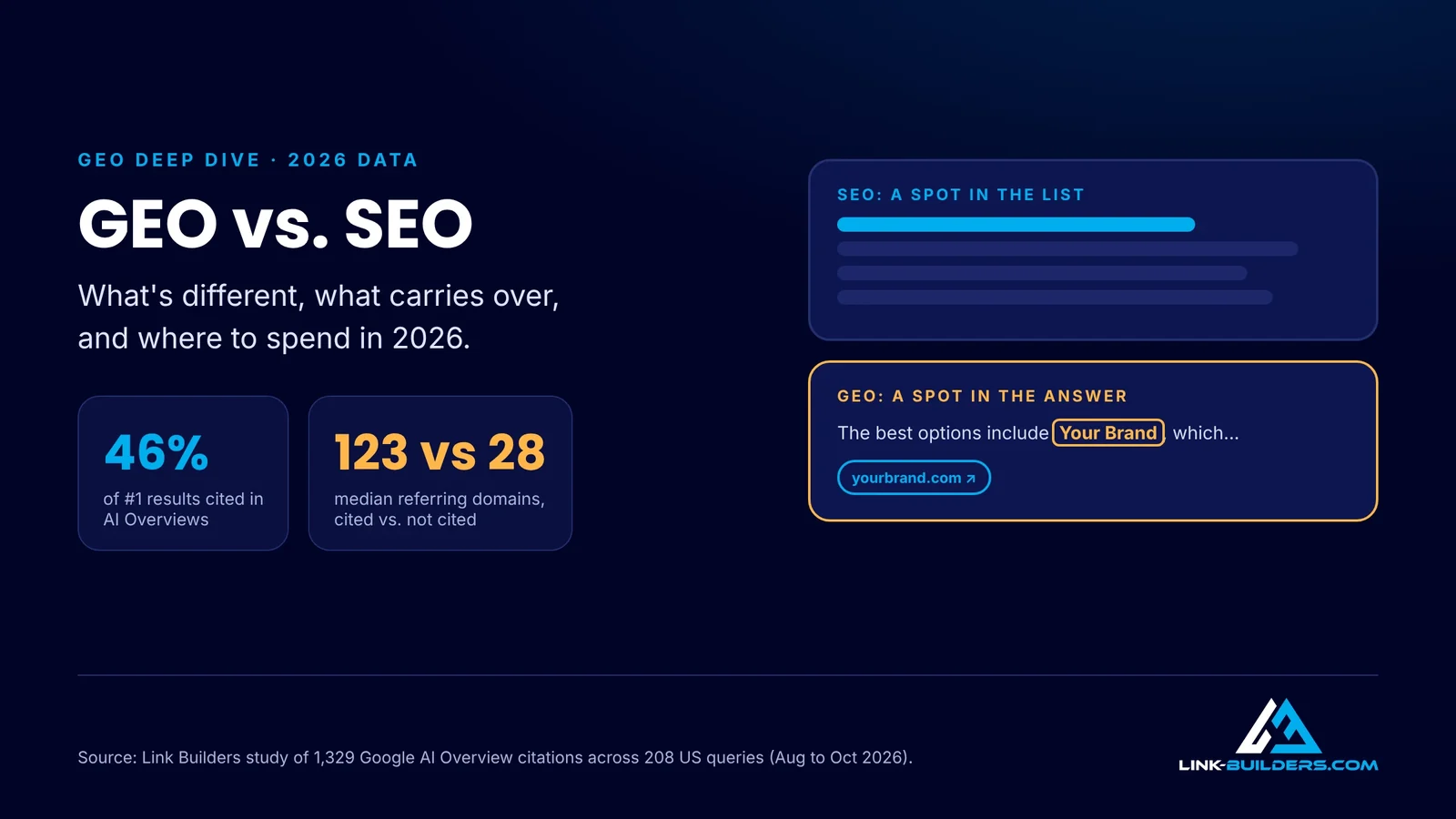
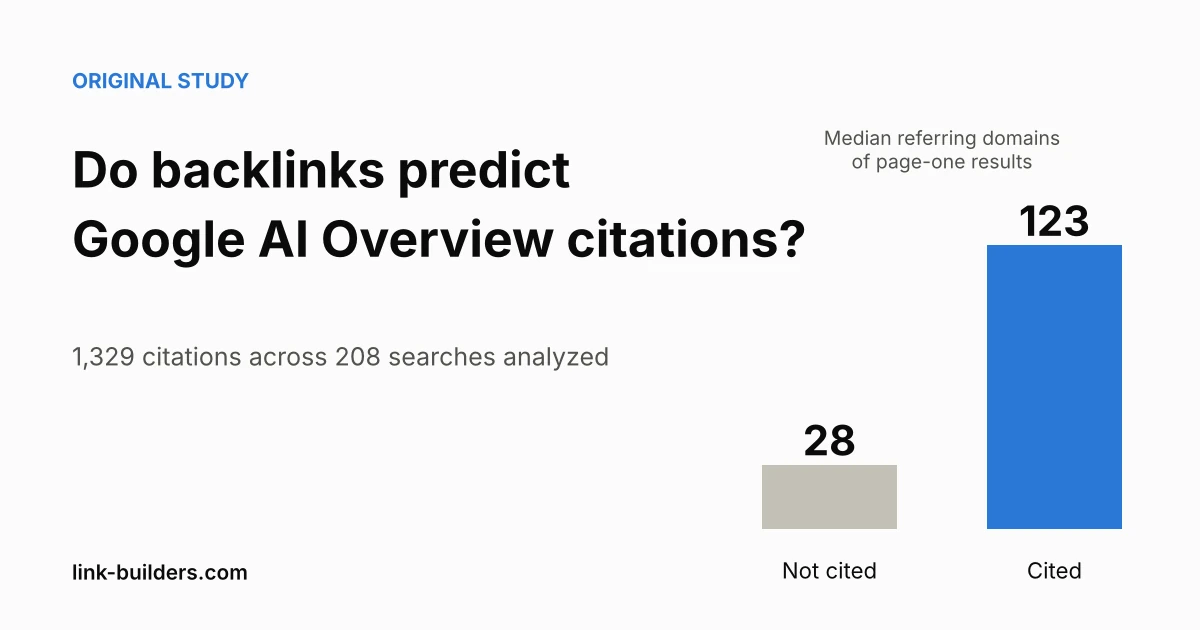
- Cited pages had about four times the links. The median cited page had 123 referring domains. The median page-one result that was not cited had 28.
- The pattern holds inside the same results. When I compared only pages that appeared together for the same query, 10 times more referring domains meant about 30% better odds of being cited, at the same rank and domain rating.
- Links to the page beat domain rating. Domain rating (DR) predicts citations on its own, but it adds almost nothing once you know how many sites link to the specific page.
- Rank still matters. The first organic result was cited 46% of the time. The eighth was cited 18% of the time.
- Most citations come from somewhere else. Only 36% of citations went to pages ranking on page one for that query. The rest went mostly to pages on strong domains, plus YouTube, Reddit and other platforms, which took 25% of all citations.
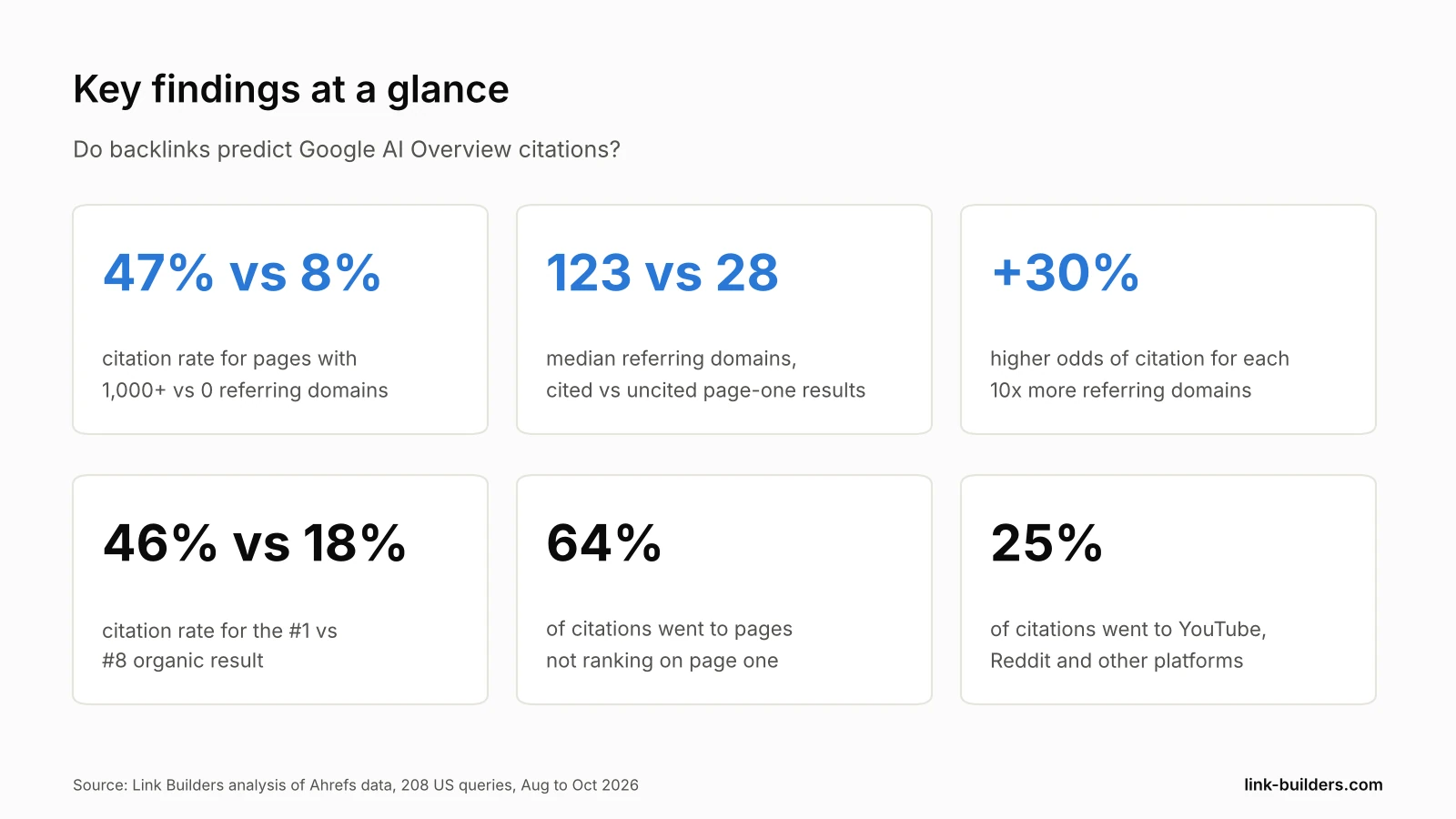
The study's six headline numbers.
Why I Ran This Study
Ask ten marketers whether backlinks still matter for AI search and you will get ten opinions. Some say links are fading and brand mentions have taken their place. Others say AI tools still lean on the same pages Google trusts. Very few of those claims come with data.
The pieces of evidence that do exist sit in separate places. Writesonic found that about 41% of AI Overview citations come from Google’s top 10 results. SE Ranking found that 92% of AI Overviews link to at least one top-10 domain. Ahrefs found that mentions on highly linked pages track with AI Overview citations. None of them asked the question I care about most: among pages that already rank, does a stronger link profile make a page more likely to be cited?
I’ve built backlinks since 2015, so I have a stake in the answer. That’s why I spelled out my method in full below, so you can check my work, run your own tests and decide for yourself.
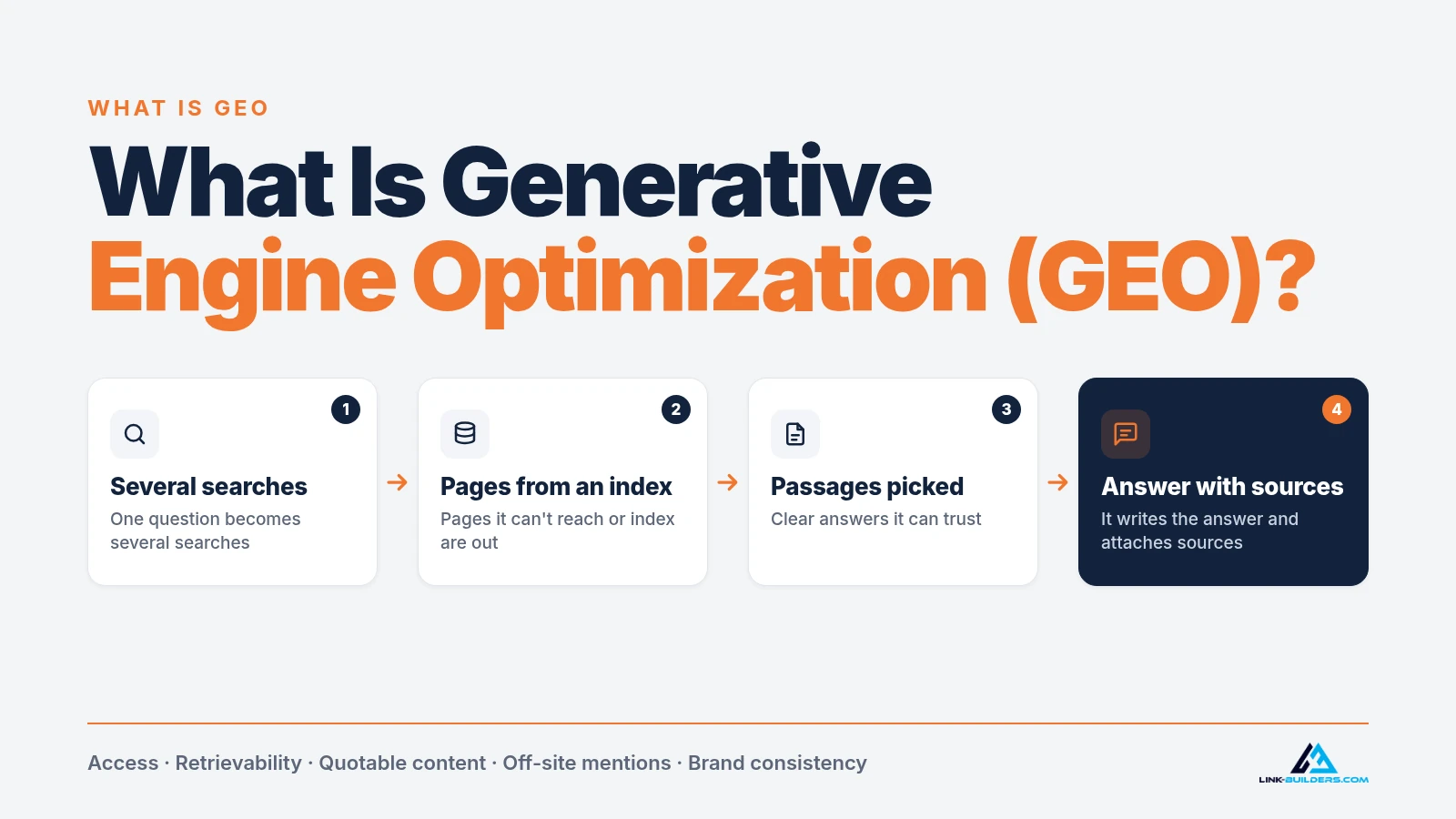
If you are new to the topic, start with my guide to what generative engine optimization is, then come back here.
How I Did It
I kept the method simple so anyone with an Ahrefs account can repeat it.
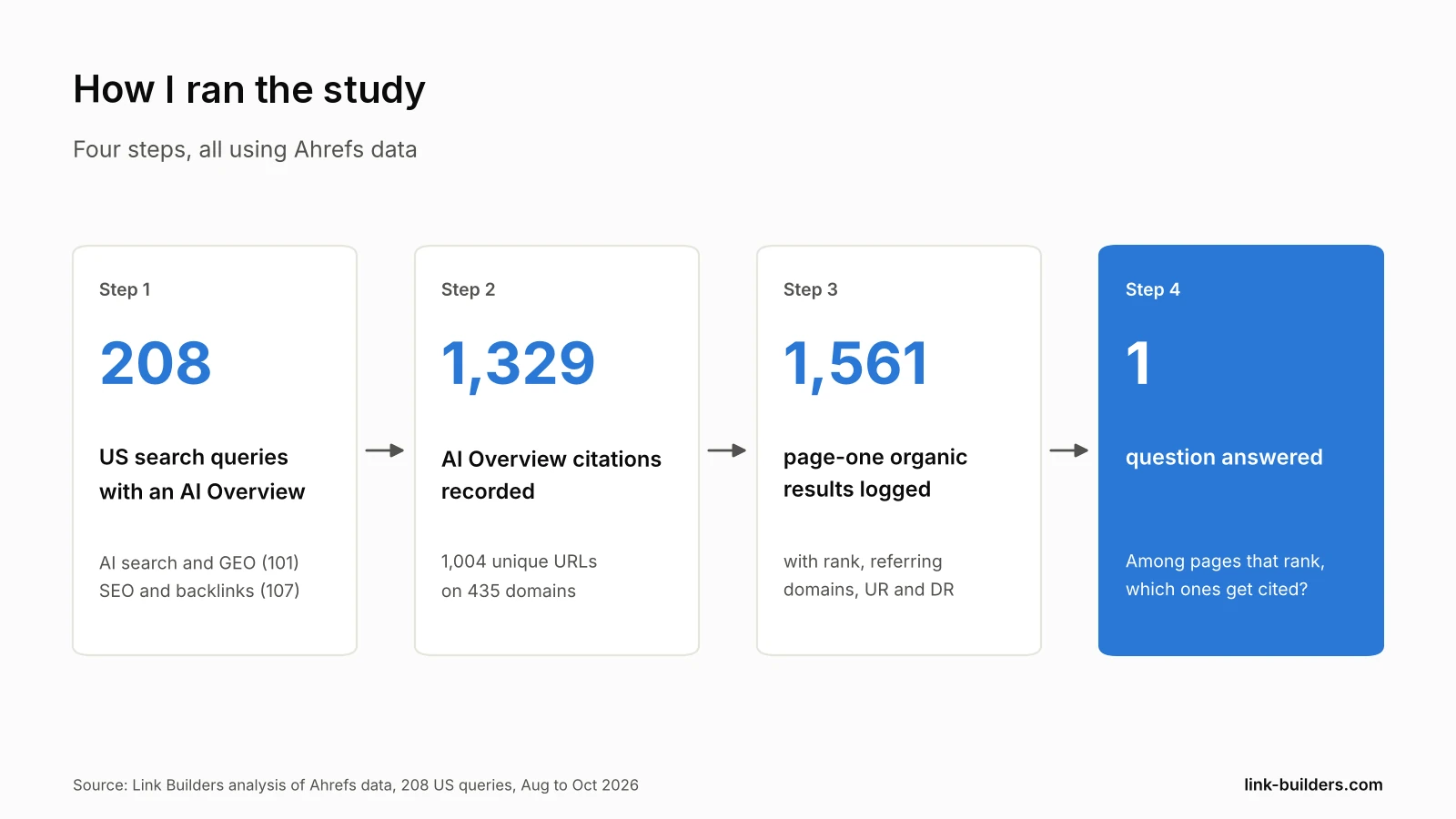
Four steps, all using Ahrefs data.
1. I picked the queries. I pulled US search queries from Ahrefs Keywords Explorer that currently show an AI Overview. I split them into two groups: 101 queries about AI search and GEO (such as “what is answer engine optimization” and “how to rank in ChatGPT”) and 107 queries about SEO and backlinks (such as “how to get backlinks” and “what is technical SEO”). I removed two queries where Google showed results about an unrelated company, and three that showed no AI Overview citations. That left 208 queries.
2. I recorded every citation. For each query I pulled Ahrefs’ snapshot of the Google results page. A page counts as cited when it appears as a source link inside the AI Overview. That gave me 1,329 citations pointing to 1,004 unique URLs on 435 domains.
3. I recorded every page-one result. I logged the organic results on page one for each query, along with their rank. Because AI Overviews and other features take up space, page one held about seven or eight organic results per query, for 1,561 results in total.
4. I measured each page’s links. For every page I recorded referring domains (the number of unique websites linking to that exact page), URL Rating and the site’s Domain Rating, all from Ahrefs.
5. I compared cited and uncited pages. The core test asks one question: among pages that rank on page one, which ones get cited? I set aside YouTube, Reddit, Quora, LinkedIn and similar platforms for this test, because Ahrefs counts almost no links to individual posts on those sites, which would skew the comparison. I cover them separately below.
All data comes from Ahrefs snapshots taken between August 23 and October 8, 2026. Nearly all of them (207 of 211) were taken in September or October.
Finding 1: AI Overviews Lean on Page One, but Most Citations Come From Elsewhere
The average AI Overview in my sample cited about six sources. In 77% of them, at least one source was a page already ranking on page one for that query. So if you rank on page one, you are usually in the running.
But only 36% of all citations went to page-one results. The other 64% went to pages that did not rank on page one for that exact query. Two groups made up most of them:
- Pages on strong domains. Among citations to regular websites that did not rank on page one, 65% sat on domains with a DR of 70 or higher. Google seems willing to reach past page one when the site itself is well established.
- Platforms. YouTube, Reddit, Quora, LinkedIn and similar sites took a quarter of all citations. I look at these in Finding 6.
Google says AI Overviews can run several related searches to build one answer, which I think explains part of this.
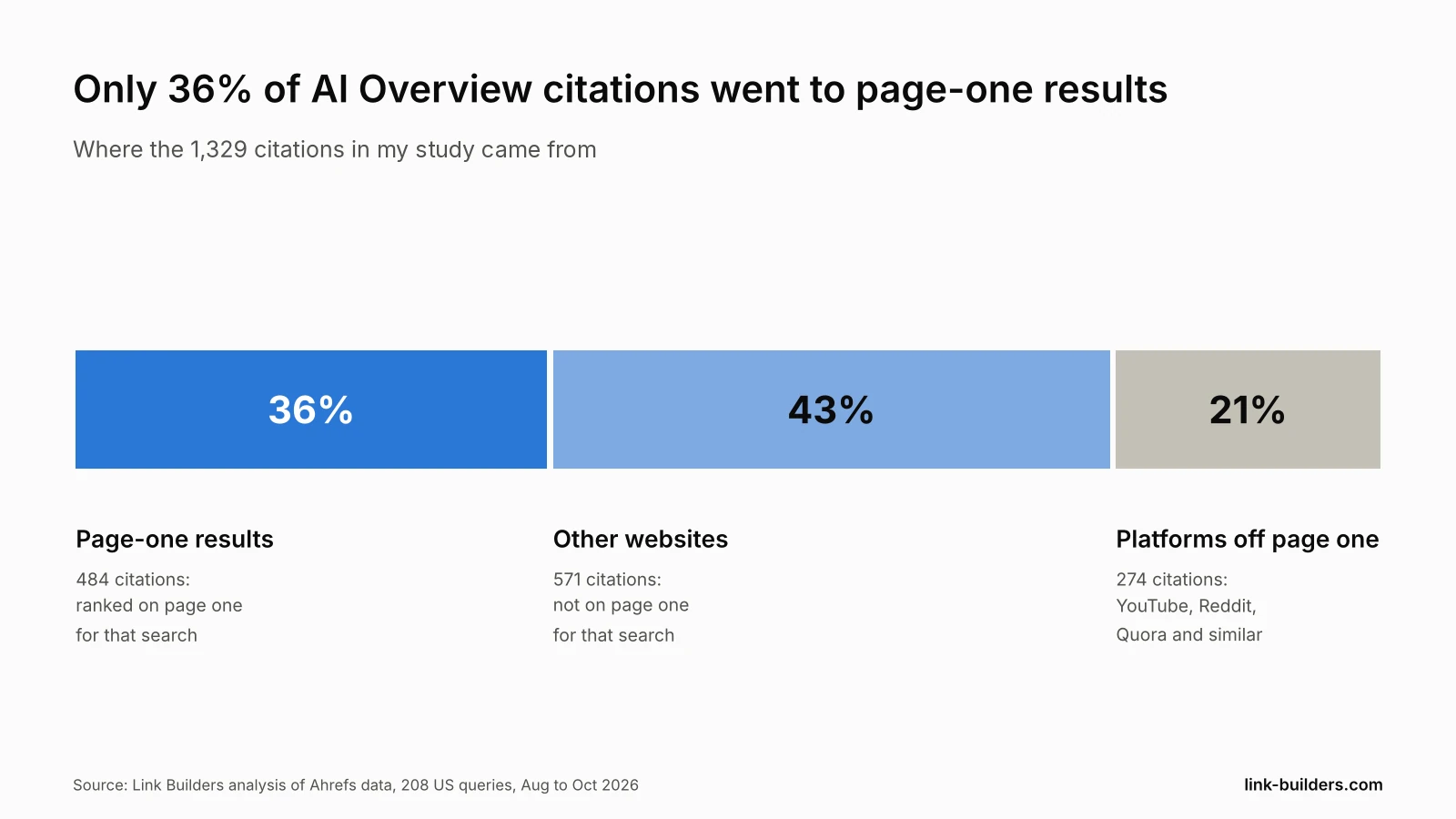
The 1,329 citations, split by where the cited page sat.
This matters for how you read the rest of the study. Ranking on page one is the most common way into an AI Overview, but it is not the only way. A site with broad authority can be cited for queries where it does not rank well.
Finding 2: More Referring Domains, More Citations
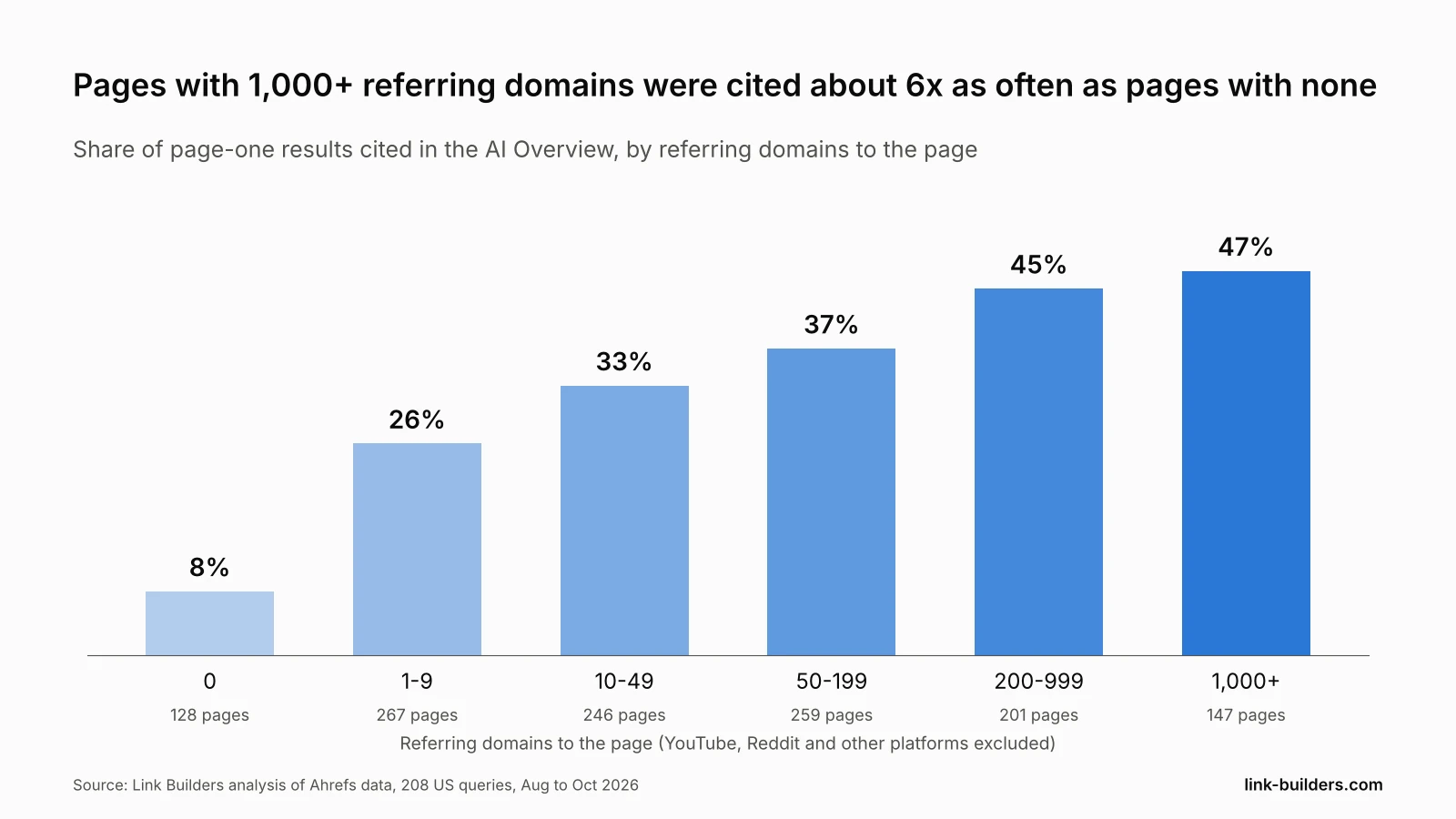
Link Builders analysis of Ahrefs data. 1,248 page-one results across 208 US queries, August to October 2026.
The more sites linked to a page, the more likely Google was to cite it. The median cited page-one result had 123 referring domains. The median page-one result that was not cited had 28.
The biggest jump came at the bottom. Going from zero referring domains to even a handful more than tripled the citation rate. After that, the gains kept coming but grew smaller, and they leveled off near the top.
The pattern was the same in both groups of queries. It held for questions about AI search and GEO, and it held for classic SEO questions.
Finding 3: The Effect Holds Inside the Same Search Results
A fair objection to Finding 2 is that some queries simply attract stronger pages. Maybe “what is SEO” is full of heavily linked pages and also has long AI Overviews, which would create a pattern that has nothing to do with links.
So I ran two stricter tests that compare pages only against the other pages on the same results page.
The head-to-head test. For each query, I compared the median referring domains of the cited page-one results with the uncited ones. In 94 of 151 queries, the cited pages had more referring domains. In 57 they had fewer. That split would happen by chance less than 1 time in 300.
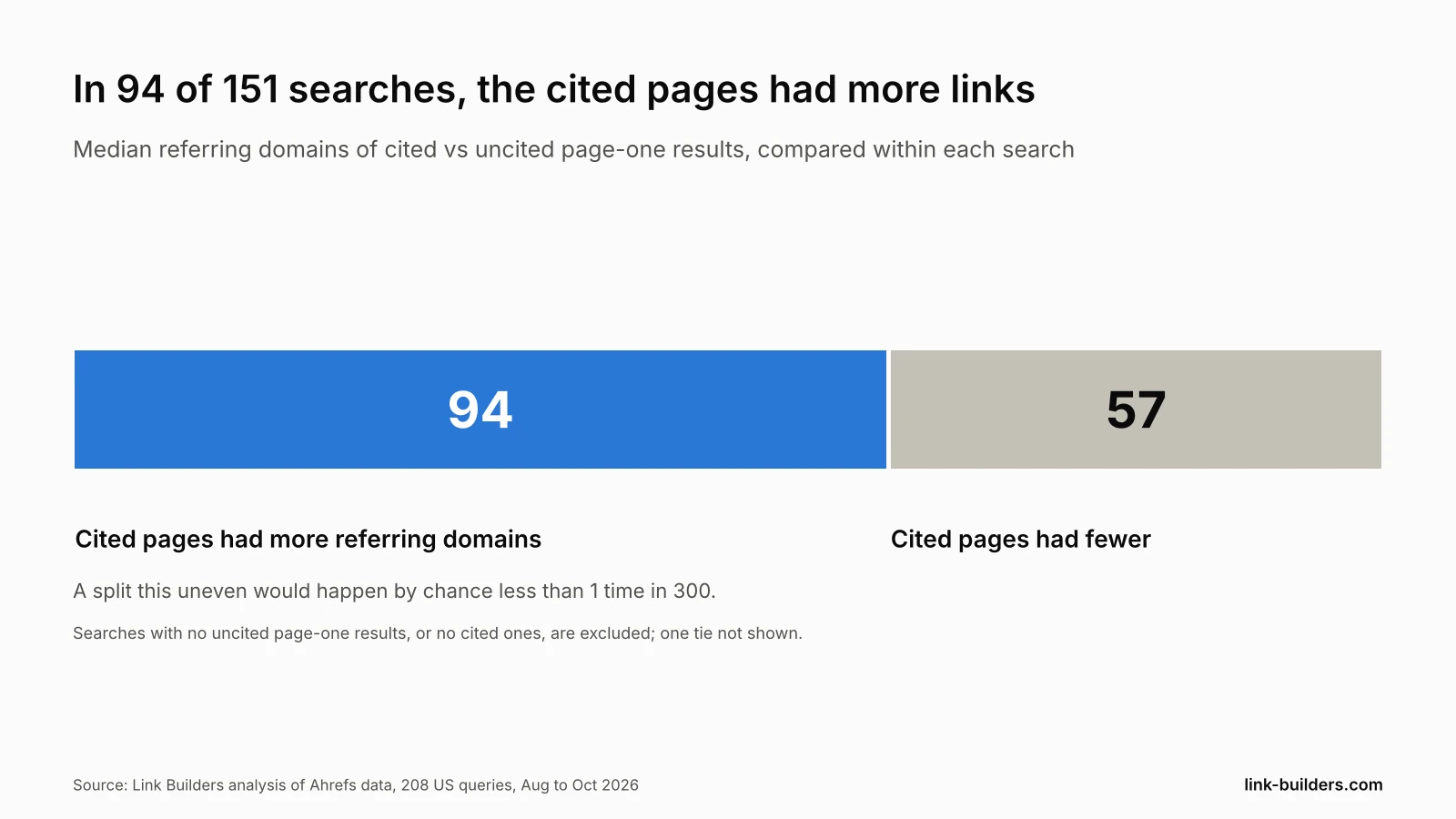
Each search compared on its own.
The model. I then ran a statistical model that predicts whether a page gets cited from three things: its rank, its referring domains and its site’s DR. I ran it two ways. Pooling all queries, every tenfold increase in referring domains raised the odds of a citation by about 47%. Comparing pages only within the same query, the increase was about 30%. Both results held at the same rank and the same DR, and both were statistically significant.
The within-query number is the one I would quote. It is smaller, but it removes the chance that some queries just happen to favor strong pages.
Finding 4: Links to the Page Matter More Than Domain Rating
On its own, domain rating looks like it matters. Page-one results on sites with a DR of 90 or higher were cited 44% of the time, compared with 22% for sites under DR 50.
But DR and page-level links tend to travel together. Big sites have more linked pages. When I put both into the same model, page-level referring domains kept their effect and DR lost almost all of it. In plain terms, a strong domain helps mostly because its pages tend to have more links, not because the domain name carries weight by itself.
That has a practical meaning. If you want a specific guide or service page to be cited, build links to that page. Links that only point to your homepage raise your DR but do less for the page you want Google to quote. For how links compare with unlinked mentions, see my guide to brand mentions vs. backlinks for AI search.
One caution: domain strength still showed up among cited pages that did not rank on page one (Finding 1). A strong domain seems to be what lets Google cite a page from outside the top results.
Finding 5: Higher Rank Still Helps
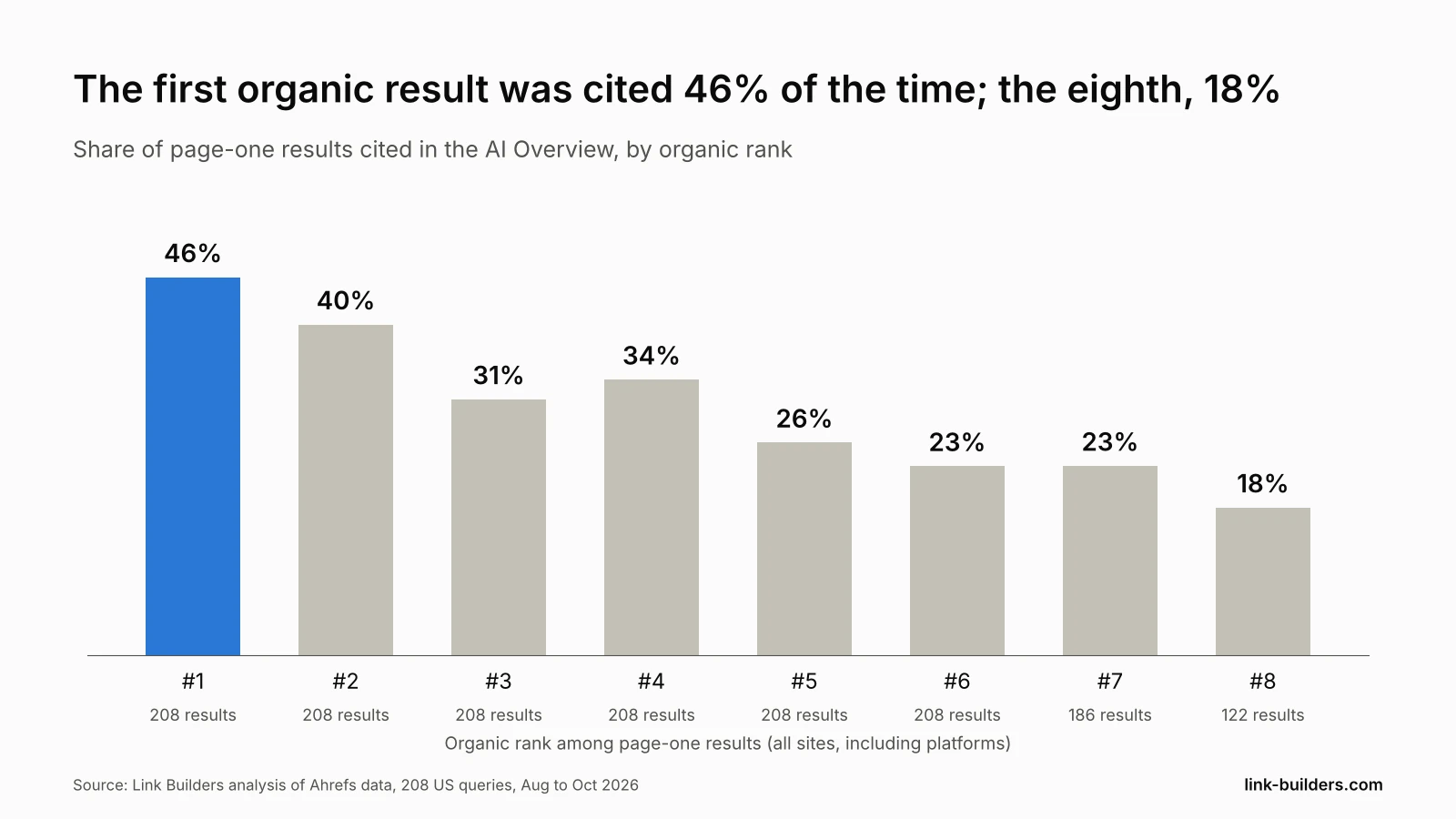
Link Builders analysis of Ahrefs data. 1,556 page-one results across 208 US queries, August to October 2026.
Rank and links both mattered, and they worked side by side. In my model, each step down the page lowered the odds of a citation by about 13%, even at the same number of referring domains.
That makes sense, since links are one of the main reasons a page ranks in the first place. Links seem to help twice: once by lifting the page up the results, and again by making it more likely to be cited once it is there.
Fewer queries had a seventh or eighth organic result on page one, because AI Overviews and other features take up space. Treat the last two bars as less certain than the first six.
Finding 6: A Quarter of Citations Go to YouTube, Reddit and Other Platforms
YouTube was the most cited domain in the entire study, with 224 of the 1,329 citations. That is about one in six. Reddit came next among platforms with 64, followed by LinkedIn with 19 and Quora with 17. Together with Instagram, Facebook, Medium and similar sites, platforms took 25% of all citations.
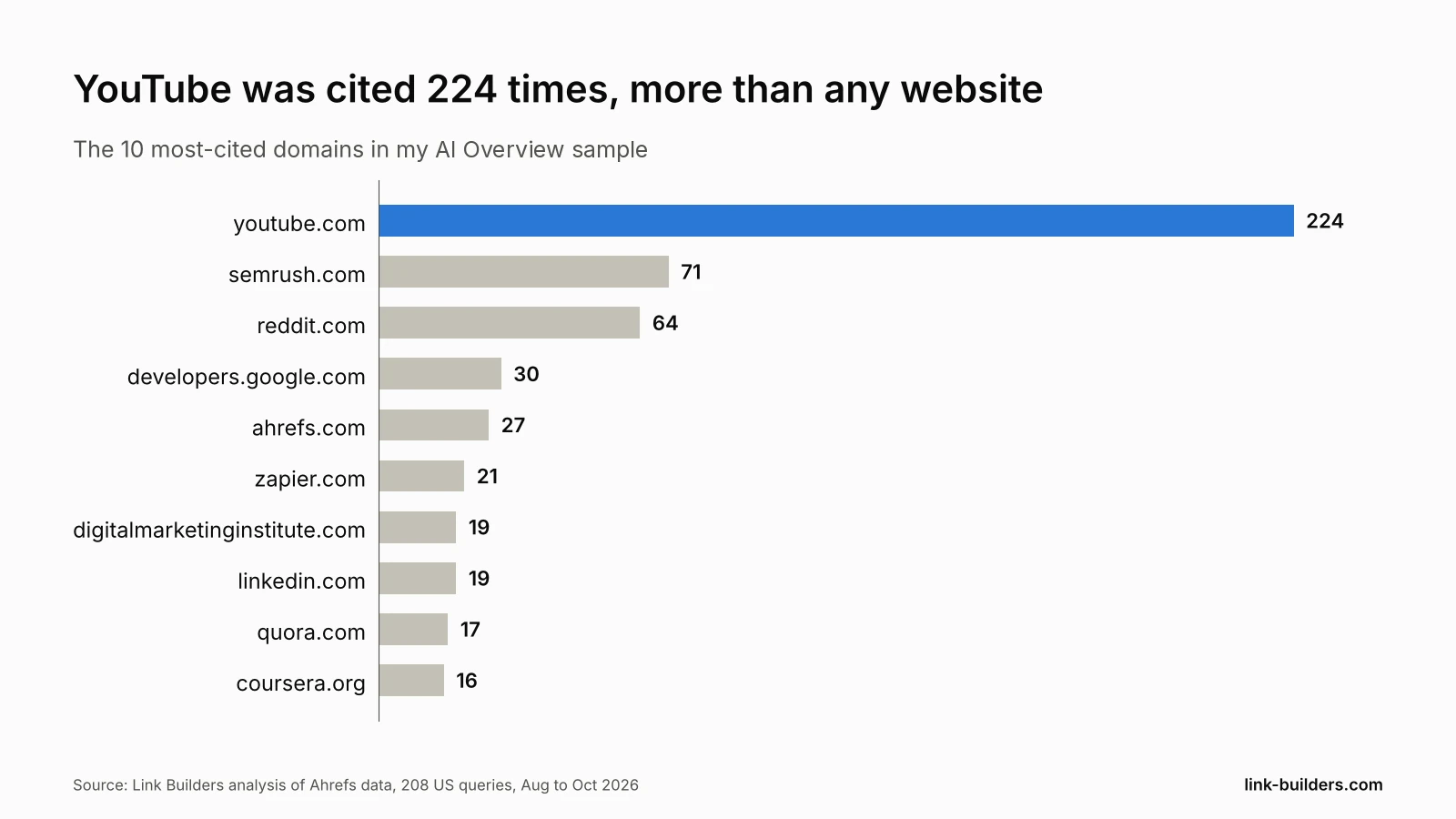
The 10 most-cited domains in the sample.
I left these pages out of the backlink comparison for a simple reason. Ahrefs records almost no links to individual YouTube videos or Reddit threads, so their link counts tell me little. A video can be cited with zero recorded referring domains because YouTube itself carries the trust.
The takeaway is that platforms are a separate path into AI Overviews. A useful video on your topic, or a helpful answer in the right community, can earn a citation that link building alone would not. For most businesses, though, these citations point to the platform rather than to their own site, so they build awareness more than traffic.
What This Means for Your SEO and GEO Plan
The data points to a plan that looks a lot like good SEO, with a sharper focus on the pages you want AI tools to quote. For the wider comparison, see GEO vs. SEO.
1. Get the page onto page one first
Three out of four AI Overviews cited at least one page-one result, and higher-ranking pages were cited more often. Ranking is still the main door. Google’s own guidance on AI features says the same thing: the systems behind AI Overviews are the same ones behind regular search.
2. Build links to the exact page you want cited
Page-level referring domains predicted citations better than domain rating did. Pick the pages that answer the questions your buyers ask, then earn links that point straight to them. Page-one results with 200 to 999 referring domains were cited 45% of the time; those with 1 to 9 were cited 26% of the time.
3. Build the domain, too
Most citations went to pages that did not rank on page one, and most of those sat on well-established domains. Broad authority is what lets Google reach past the top results to quote you.
4. Show up where Google already looks
YouTube and Reddit took a quarter of all citations. If your topic has a video gap or an active community, a useful contribution there can earn citations your site cannot.
5. Measure citations, not only rankings
Track which of your pages appear in AI Overviews for your key queries, and watch how that changes as new links land. My guide to reading Search Console and GA4 data covers the reporting side.
If you would rather hand off the link building part, my GEO agency page explains what I do and what it costs.
Limits of This Study
I want this data to be useful, which means being clear about what it cannot tell you.
- It shows a link, not a cause. Pages with more referring domains also tend to be older, better written and from better-known brands. Links may be doing the work, or they may be a sign of other qualities Google rewards. My within-query test rules out some explanations, not all of them.
- It covers one engine. I studied Google AI Overviews only. ChatGPT, Perplexity, Gemini and Google’s AI Mode choose sources in their own ways, and the pattern may differ there.
- It covers one niche and one country. All 208 queries were about SEO and AI search, in the US. Sites like Semrush and Ahrefs are strong in this space, which may not hold in other industries.
- It is a snapshot. AI Overviews change often. These results reflect Google between late August and early October 2026.
- Page one is about seven or eight results. AI Overviews and other features push organic results down, so “page one” here means the organic results that actually appeared, not a full ten.
- Two data sources. Link counts for page-one results came from Ahrefs’ results-page data. For cited pages that did not rank, they came from Ahrefs’ batch analysis tool. I avoided comparing the two groups directly.
- Some citations were spam. A few cited pages were spam posts placed on hacked university websites. I kept them in the data as Google showed them.
FAQ
Do backlinks help you get cited in Google AI Overviews?
In my data, yes. Among page-one results, pages with more referring domains were cited more often, and the pattern held when I compared pages at the same rank for the same query. I cannot prove the links caused the citations, but the link between them was strong and consistent.
Are backlinks still relevant in 2026?
For Google rankings and for AI Overviews, my data says they are. AI Overviews draw heavily on pages that rank, and among those pages, better-linked ones were cited more.
Can a page with no backlinks be cited in an AI Overview?
Yes, but it is rare. Page-one results with zero referring domains were cited 8% of the time, compared with 47% for pages with more than 1,000.
Does domain rating matter for AI Overviews?
DR predicted citations on its own, but links to the specific page predicted them better. Once I accounted for page-level links, DR added almost nothing for page-one results. DR did seem to matter for pages cited from outside page one.
How many backlinks do you need to get into an AI Overview?
There is no fixed number. In my data, the citation rate rose steadily from 26% for pages with 1 to 9 referring domains to 45% for pages with 200 to 999. Each step up helped, with smaller gains at the top.
Do brand mentions matter more than backlinks for AI search?
This study measured links, not unlinked mentions, so it cannot settle that question. I look at what other research says in my article on brand mentions vs. backlinks for AI search.
Methodology Details
For readers who want the statistics behind the findings:
- Sample: 208 US queries with an AI Overview and at least one cited source; 1,329 citations (1,004 unique URLs, 435 domains); 1,561 page-one organic results.
- Main comparison: page-one organic results, excluding YouTube, Reddit, Quora, LinkedIn, Instagram, Facebook, TikTok, X, Medium and Pinterest. A result counts as cited if the same URL appears as a source in that query’s AI Overview.
- Models: a logistic regression predicting citation from organic rank, the base-10 log of referring domains plus one, and Domain Rating, with standard errors clustered by query. I repeated it as a conditional logistic regression with query fixed effects, which compares pages only within the same query. Odds ratio per tenfold increase in referring domains: 1.47 (pooled, p < 0.0001) and 1.30 (within query, p = 0.005). Domain Rating was not significant in either model once referring domains were included.
- Head-to-head test: a sign test on the median referring domains of cited vs. uncited results within each query (94 vs. 57, p = 0.003).
You are welcome to use these findings and charts with a link back to this page.
Sources
- Ahrefs: How to Rank in AI Overviews
- SE Ranking: How to Optimize for AI Overviews
- Writesonic: GEO vs SEO
- Google Search Central: AI optimization guide
About the author

Justin Davis is the founder of Link Builders, a white-label backlink agency, and has been building links since 2015 for more than 150 clients in law, healthcare, real estate, software and other industries. After years of doing prospecting research by hand, he built an AI agent link building system that handles each step, from finding link opportunities and vetting sites to finding contacts and preparing outreach. He now runs that system for agencies and in-house SEO teams, and teaches it on YouTube. Find Justin Davis on YouTube, LinkedIn and X.