Google’s Reasonable Surfer Patent: Why Not Every Backlink Counts the Same
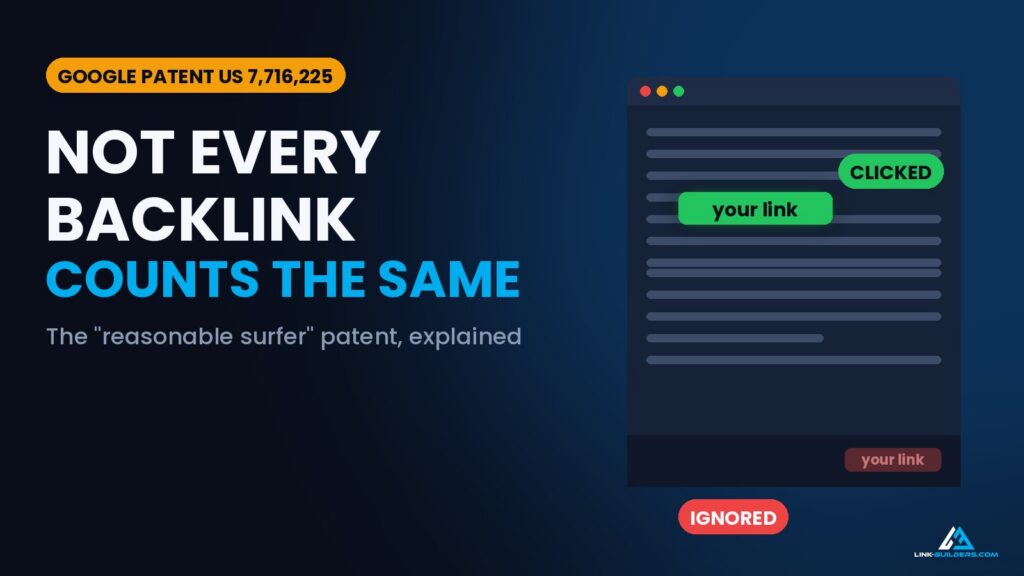
Picture two links on the same page of the same website. The site has the same Domain Rating either way. One link sits in the first paragraph of the article. The other sits in the footer. Most link reports would count them as equal.
This reasonable surfer model reflects the fact that not all of the links associated with a document are equally likely to be followed. Examples of unlikely followed links may include ‘Terms of Service’ links, banner advertisements, and links unrelated to the document.
— Google patent US 7,716,225, quoted by Paddy Moogan at Moz · Moz: The Anatomy of a Link
Google described a system that says they are not. In 2004, Google filed a patent that gives each link on a page its own weight, based on how likely a real person is to click it. SEOs call it the “reasonable surfer” patent, and it is one of the most useful patents a link builder can read.
In this article, I walk through what the patent says, how the system works, and what it means for the links you build. This is the first article in my Google Link Patents series. You can also watch the full video breakdown below.
The Patent at a Glance
The reasonable surfer patent is US 7,716,225, titled “Ranking documents based on user behavior and/or feature data.” Google filed it in June 2004 and was granted it in May 2010.
| Detail | Value |
|---|---|
| Patent number | US 7,716,225 |
| Filed | June 17, 2004 |
| Granted | May 11, 2010 |
| Inventors | Jeffrey A. Dean, Corin Anderson, Alexis Battle |
| Assignee | |
| Later versions | Continuations granted in 2012, 2016 and 2018 |
One name on the list stands out. Jeff Dean is one of the most senior engineers in Google’s history. When his name is on a ranking patent, it is worth reading closely.
From the Random Surfer to the Reasonable Surfer
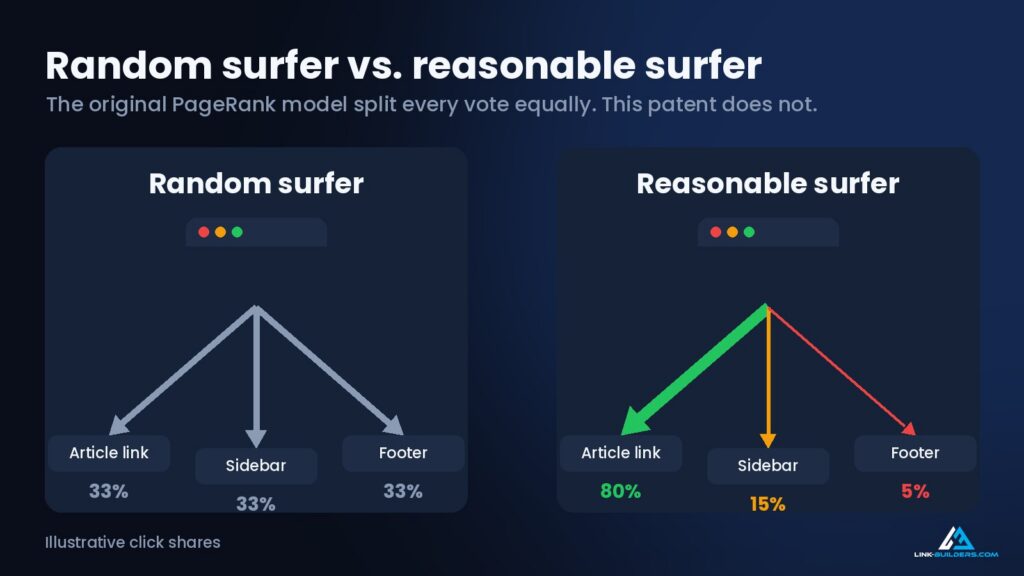
To understand this patent, you need to know what came before it. The original PageRank model, described in Google’s first research paper, imagined a “random surfer.” This imaginary person lands on a page and clicks any link on it at random. Every link on the page gets an equal share of the vote.
That was a good start, but real people do not browse that way. Nobody clicks a Terms of Service link as often as a link in the middle of the article they came to read.
The reasonable surfer patent replaces the random surfer with a more realistic one. A reasonable surfer follows some links much more often than others. The patent even names the kinds of links people rarely click: Terms of Service links, banner ads, and links that have nothing to do with the page they sit on.
That single change matters a lot. If links are weighted by how likely people are to click them, then where a link sits, and what surrounds it, can change how much value it passes.
How the System Works
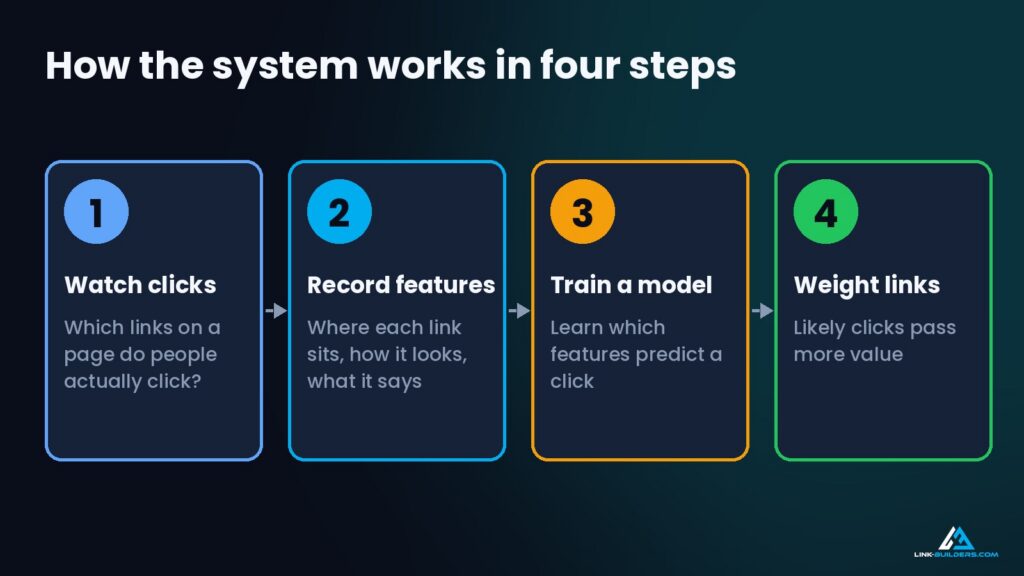
The patent describes a system that learns which links people click, then uses that to weight every link. It works in four steps.
- Watch what people actually click. The patent gives a simple example. A page, call it W, links to three pages: X, Y and Z. People click the link to X twice and the link to Z once, and nobody clicks Y. Each click counts as a positive example for that link, and each link that got passed over counts as a negative one.
- Record the features of each link. The system looks at where the link sits, what it looks like, and what it says. It also looks at the page the link is on and the page it points to.
- Train a model that predicts clicks. The patent names common machine learning methods for this, such as decision trees and logistic regression. The model learns which features make a link more or less likely to be clicked.
- Turn click probability into link weight. A link people are likely to click gets a high weight and passes more value. A link people ignore gets a low weight and passes less.
The patent also says the model is updated over time. That makes sense, because links come and go, and the way people browse keeps changing.
The Worked Example: Weight Changes the Outcome
The patent includes a small worked example with three pages, A, B and C, that link to each other. Each link gets a weight between zero and one, based on how likely people are to click it.
| Link | Weight |
|---|---|
| B to C | 0.9 |
| A to B | 0.6 |
| C to A | 0.5 |
| A to C | 0.4 |
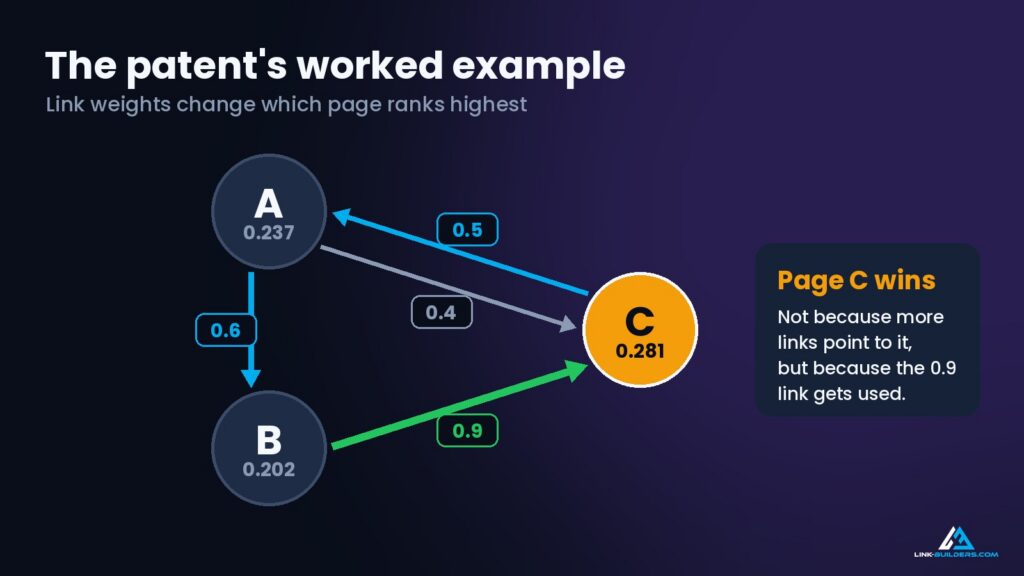
When you run the numbers, page C ends up with the highest rank of the three, at about 0.281, compared with 0.237 for A and 0.202 for B.
Page C does not win just because two links point to it. It wins because one of those links, the 0.9 link from B, is the kind people actually use. The weight changes the outcome, and that is the whole idea of the patent.
The Features Google Can Measure
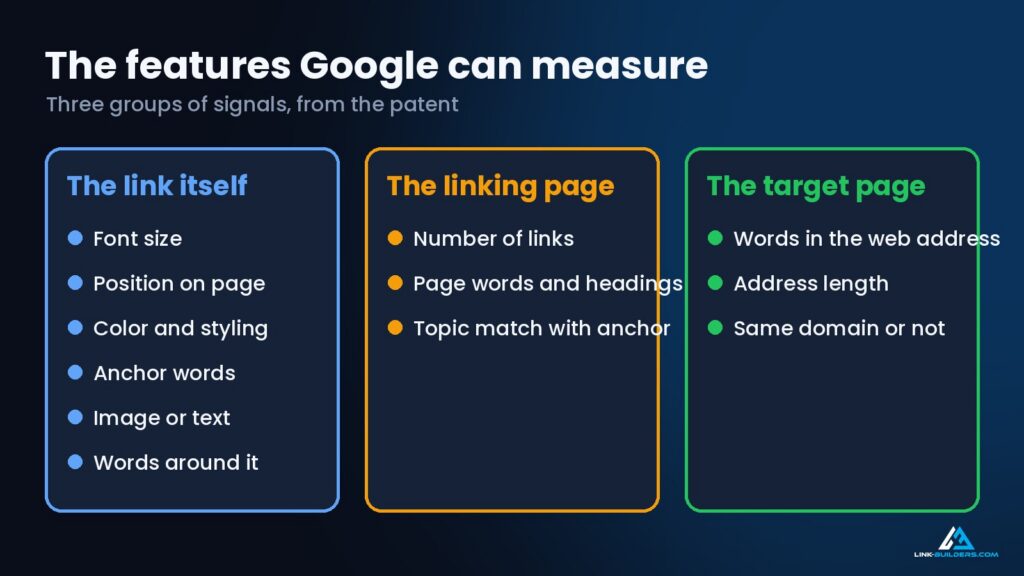
The patent lists many features the model can look at. They fall into three groups.
The link itself
The first group covers the link. It includes the font size of the anchor text and where the link sits: in the running text, in a list, in a sidebar, in the footer, or above or below the first screen. If the link is in a list, its position in that list counts too.
The model can also look at the link’s color and styling, including grey text or text the same color as the background. It can look at how many words are in the anchor text, which words they are, and how commercial they sound. It can tell an image link from a text link, read the few words right before and after the link, and check whether the link stays on the same site.
The page the link sits on
The second group covers the linking page. It includes how many links are on that page, the words in the page and its headings, and whether the page’s topic matches the topic of the anchor text.
The page being linked to
The third group covers the target page. It includes the words in its web address, how long that address is, and whether it is on the same domain as the page linking to it.
The Rules the Patent Spells Out
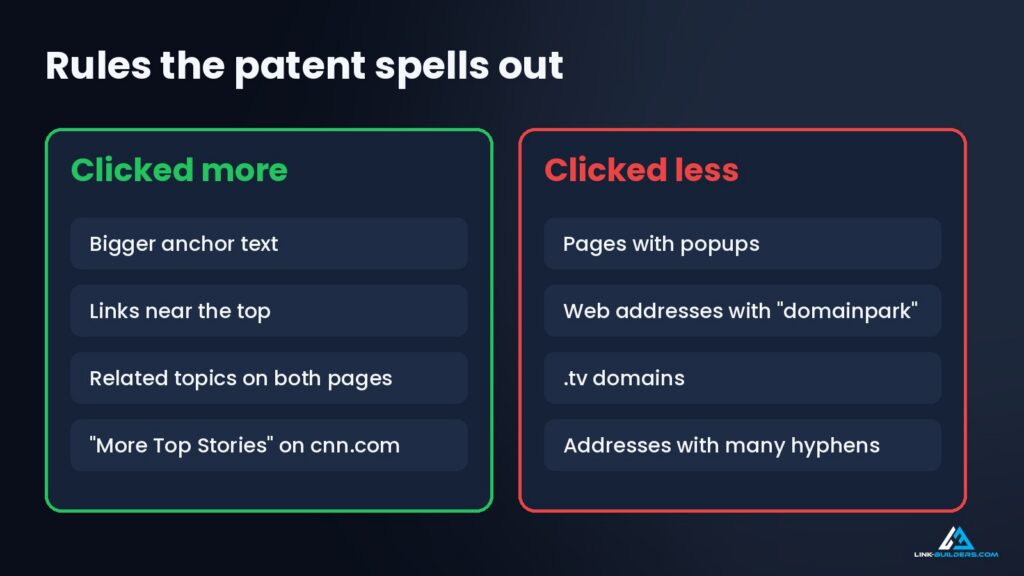
The patent gives examples of rules the model might learn. Some apply across the web, and some apply only to certain pages or sites.
General rules
- Links with bigger anchor text get clicked more than links with smaller text.
- Links near the top of a page get clicked more than links near the bottom.
- Links between pages on related topics get clicked more than links between unrelated pages.
Page-specific rules
- Links on pages with popups get clicked less.
- Links to web addresses containing the word “domainpark” get clicked less.
- Links to .tv domains get clicked less.
- Links to web addresses with several hyphens get clicked less.
- Links under the “More Top Stories” heading on cnn.com get clicked more.
The second list is the more interesting one. It shows the model is not locked into one fixed set of rules. It can learn how people behave on a single site, and even on one section of one page.
What This Means for Your Link Building
Here is what the patent suggests for anyone building links. None of these are guarantees, but each one follows directly from the features and rules above.
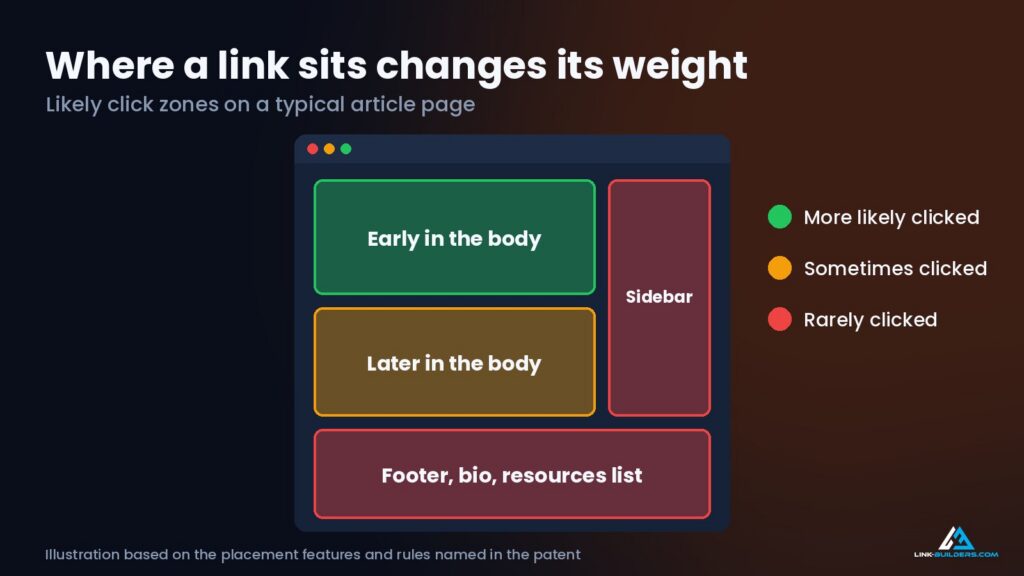
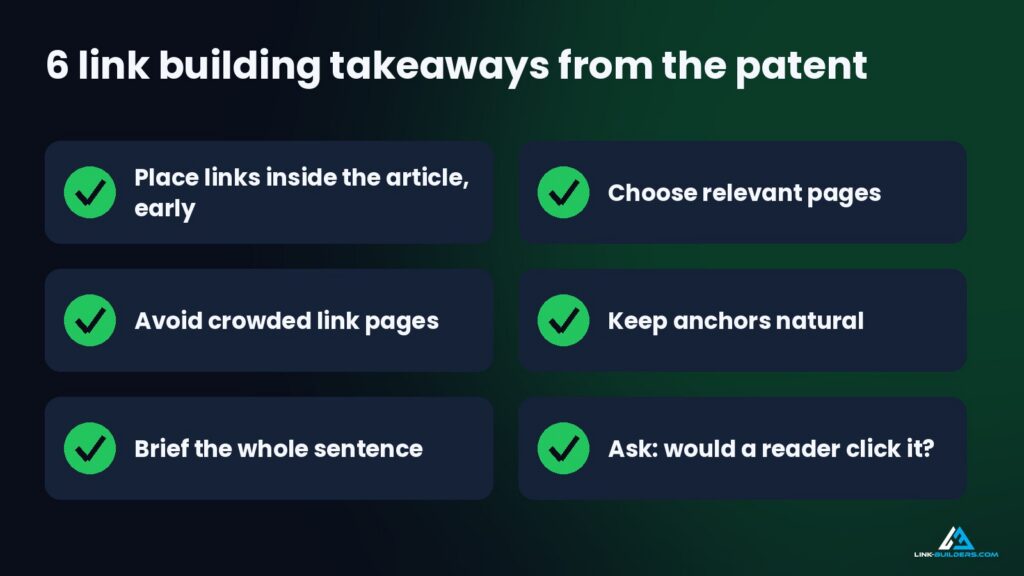
1. Aim for placement inside the article, and early
A link in the first few paragraphs of the body beats a link in the author bio, the sidebar, the footer, or a resources list at the very bottom. When you negotiate a placement, ask for a spot in the main content.
2. Relevance does double duty
A link on a page about the same topic makes sense to Google, and it is also more likely to get clicked by a real reader. That is one more reason to train your prospecting around relevance instead of raw metrics.
3. Watch how many links are on the page
A link sitting among 150 others has to fight for attention. A page with a handful of well-placed links gives yours a better chance of being noticed and clicked.
4. Keep your anchors natural
The patent measures how commercial the anchor text is. A descriptive phrase that fits the sentence reads better to people and looks better to search engines. I cover this in more depth in why anchor diversity still matters.
5. Pay attention to the sentence around your link
The words right before and after a link are one of the features the system can measure. If you brief a writer, brief them on the whole sentence, not just the anchor.
6. Use the simplest test of all
Ask whether a real reader would click the link. If the answer is no, assume it passes less value than its metrics suggest. Links that pass this test are also the foundation of a natural backlink profile.
The Honest Caveat
A patent shows what Google invented and chose to protect. It does not prove this exact system runs in Google’s algorithm today, and Google has never confirmed that it does.
Still, a few things are worth noting. Google kept filing versions of this idea for more than a decade, from the first filing in 2004 to the last continuation granted in 2018. And some of the patent’s ideas line up with Google’s public guidance. For example, Google’s spam policies name white text on a white background and links hidden behind a single character as hidden link abuse. The patent lists link color and background color as features a model can measure.
So treat the patent as a strong clue about how Google has thought about links, not as a rulebook.
Conclusion
The reasonable surfer patent comes down to one idea: not every link on a page counts the same. Google described a system that weights each link by how likely a real person is to click it, based on where it sits, how it looks, what it says, and what surrounds it.
For link builders, the lesson is simple. Build links that people would actually use. Put them in the body of the content, early, on relevant pages that are not crowded with other links, with anchor text that reads naturally.
Next in this series, I look at the Google patent that ranks pages by how close they sit to a set of trusted “seed” sites. If you want to go deeper on Google patents in the meantime, read my breakdown of the problem Google was solving with the spammer’s feedback loop, or start with the basics in Link Building 101.
Want links placed where real readers will click them? Talk to Link Builders about your next campaign.
Sources
- US 7,716,225: Ranking documents based on user behavior and/or feature data, Google Patents
- The Anatomy of a Large-Scale Hypertextual Web Search Engine, Sergey Brin and Lawrence Page, Stanford University
- Spam policies for Google web search, Google Search Central
About the author

Justin Davis has been building backlinks since 2015 and has built links for more than 150 clients across law, healthcare, real estate, software, and other industries. He built the first version after years of doing the research by hand, and now builds the same workflow for in-house teams. More on who Justin Davis is, on YouTube, on LinkedIn, or on X.