Training AI to Identify Quality Link Opportunities in Your Niche
Why I Built an AI Link Prospecting Tool From Scratch
By SEO link builder Justin Davis I’ve spent years building links for over 150 clients across mental health treatment, law firms, real estate, healthcare tech, and about a dozen other industries. Three months ago, I got fed up with the state of “AI-powered” link building tools and decided to build my own. Here’s the problem: every tool claiming to use AI for link prospecting is just a glorified placement broker. They’re not actually using AI to prospect, find contact information, or craft personalized outreach. They’re just connecting buyers and sellers of links, sometimes with a basic matching algorithm. Real AI link prospecting means teaching a system to think like an experienced link builder. After three months of development and two months of using it with real clients, I’ve learned more about training AI for link building than I did in years of manual prospecting. This article breaks down exactly how I taught AI to replicate the pattern recognition I’ve built across 150+ clients.What Real AI Link Prospecting Actually Looks Like
The typical “AI link building tool” works like this: you pay for access to a database of sites that accept guest posts. Maybe there’s some basic filtering. You still manually review every prospect, find contact information separately, and write your own outreach emails. What I built does this: you input your niche and target parameters. The system searches the web using advanced boolean operators. It evaluates each potential prospect against quality criteria I’ve trained it on. It extracts contact information automatically. It analyzes the prospect’s content and generates a personalized outreach email. The entire process from search to ready-to-send email happens without manual intervention.Understanding Quality vs Spam Through Pattern Recognition
Teaching AI to distinguish quality prospects from spam required me to explicitly document knowledge I’d previously kept in my head.What Makes a Quality Link Opportunity
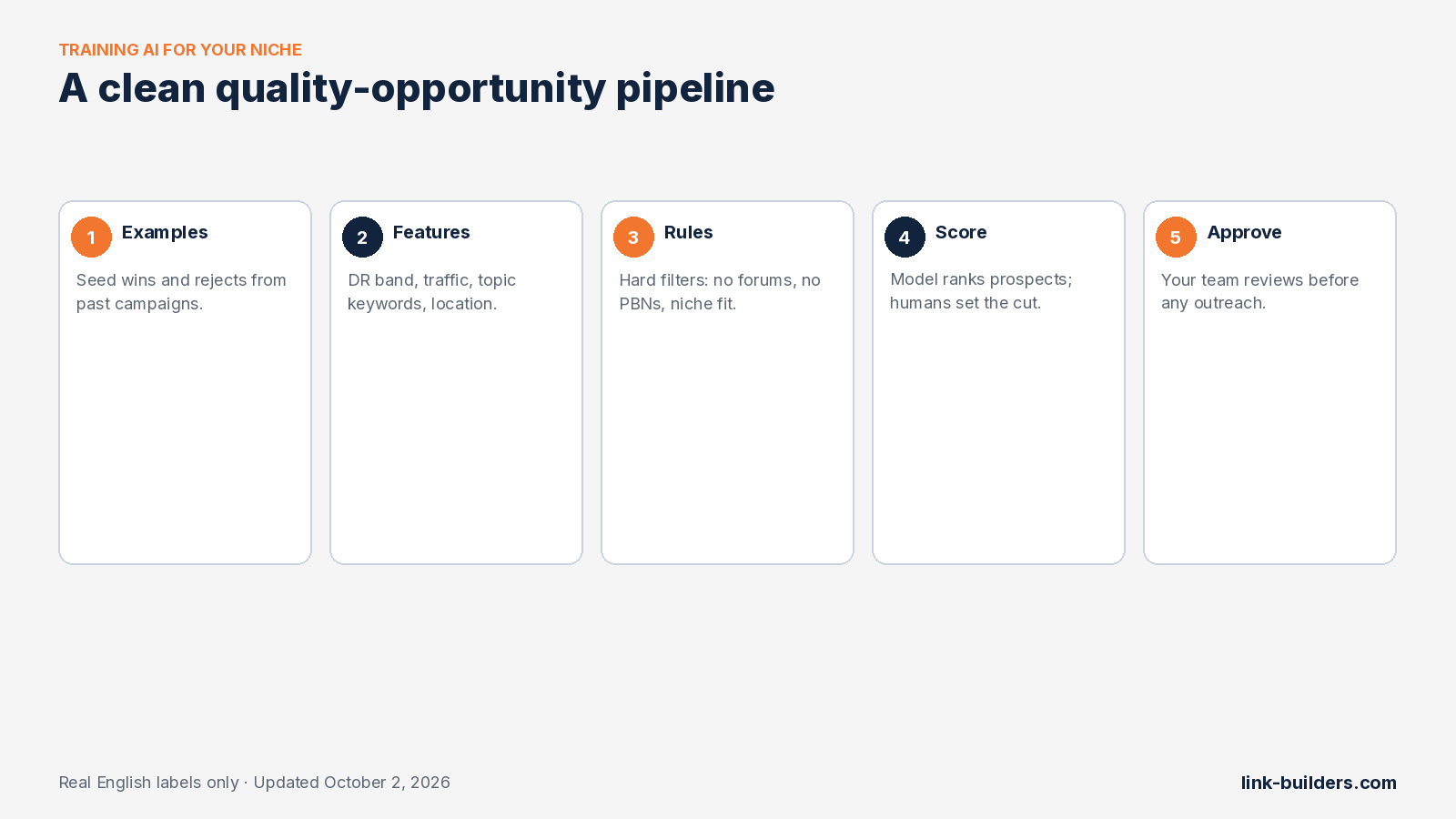
When training AI, I had to break down what editorial standards actually look like in code. I taught the system to check for consistent author bylines, regular publication schedules, and content with clear editorial voices. Sites where every article reads like it was written by different random freelancers get filtered out. Topical relevance matters more than raw metrics, but teaching AI to evaluate relevance was surprisingly complex. DR scores are easy to check. Understanding whether a site is genuinely embedded in an industry required training the system on hundreds of examples from each niche I work in. I trained the system to evaluate comment quality by analyzing comment length, whether site owners respond, and whether discussions happen in threads. Link equity indicators required teaching AI to analyze backlink profiles contextually—checking who’s linking to a prospect, not just how many links exist.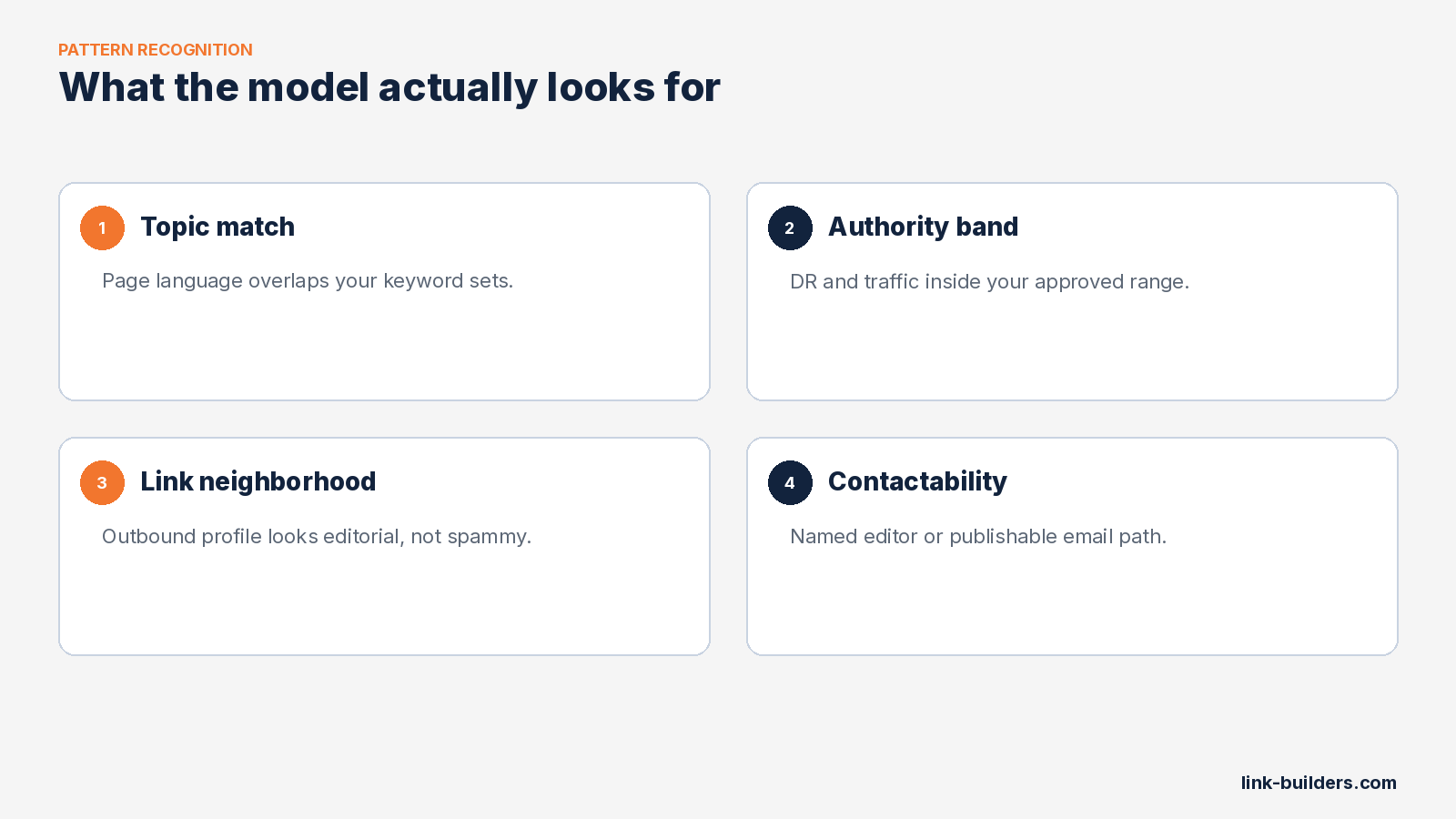
The Anatomy of Spam Prospects
Training AI to spot spam was actually easier than training it to spot quality, because spam follows more predictable patterns. I created a database of spam footprints from thousands of sites I’ve manually rejected over the years. Sites accepting links from wildly different niches, footer and sidebar link widgets, multiple guest authors linking back to unrelated industries. These patterns became explicit rules in the system. The AI checks for thin content by analyzing word count, readability scores, and content structure. Some spam is sophisticated enough that it required more nuanced training. I fed the system examples of sites with decent DR scores and clean designs that were still link schemes.The Gray Area That Required Human Judgment
Local news sites that are barely maintained might still be perfect for local business clients. Personal blogs with low traffic could be valuable if the blogger is genuinely influential. I built exception rules into the system for these edge cases, but I also maintained human review for borderline prospects. AI handles the clear yes and clear no decisions. Humans handle the maybe decisions.Building My Training Dataset
Auditing Two Years of Successful Placements
I pulled every successful link placement from the last two years and coded them for common attributes. For each successful placement, I documented 20+ attributes: domain authority, content quality scores, site structure characteristics, author credibility markers, and dozens of other factors. The cross-industry analysis revealed universal signals. Sites that cite sources tend to be higher quality across all industries. Sites with clear author bylines are usually more legitimate. Sites that update old content show they care about accuracy. But I also identified major differences between industries that required separate training modules. Real estate prospects need hyperlocal focus. Healthcare prospects need credibility markers like medical credentials. Legal prospects need geographic relevance and bar association signals.Documenting Every Failed Prospect
I created a database of every prospect that failed and why. I categorized failures: ignored outreach, wanted unreasonable payment, published but nofollowed the link, removed link after three months, and about twenty other categories. Over time, patterns emerged. Sites with certain CMS configurations tended to nofollow links. Sites listed in specific directories were almost always link farms. This negative training data became just as valuable as the positive examples.The 150-Client Advantage
Working across 150 clients in different industries gave me training data that would be impossible to replicate from a single niche. Each industry had its own quality signals, but I could also identify universal patterns that transcended niches. Sites with active social media presence tended to be real regardless of industry. Sites with clear contact information were safer bets than anonymous sites.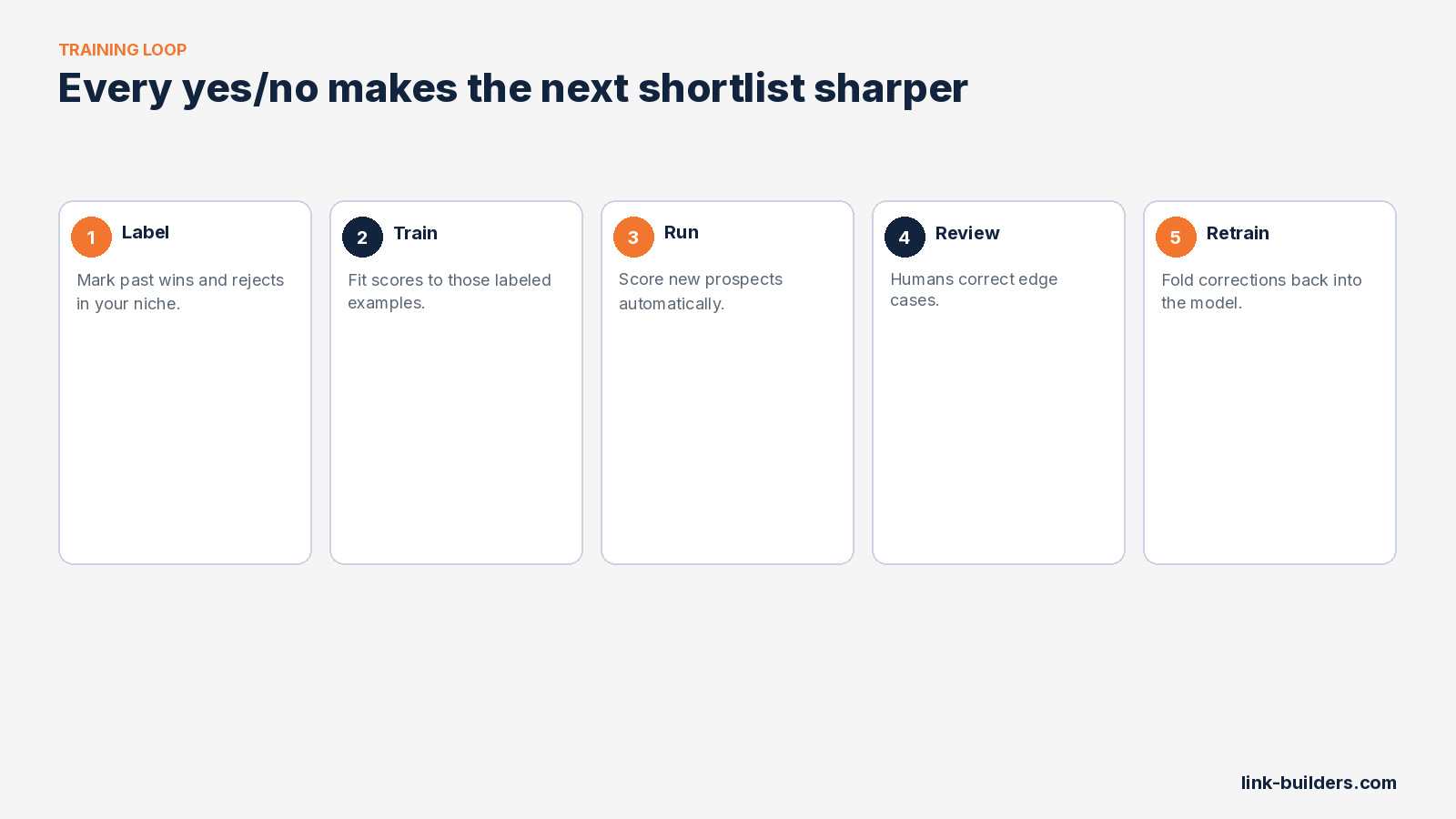
The Technical Training Process
Starting With Boolean Search Operators
I’ve always relied on advanced search strings to find prospects. These became the first layer of the AI system because they’re explicit rules that code easily. For healthcare clients: “write for us” + healthcare + (mental OR physical OR wellness) + -casino -CBD -cryptocurrency For legal clients: “submit article” + law + (state name) + -lawyer-directory -find-attorney Real estate gets hyperlocal: “guest post” + (city name) + (neighborhood OR community OR homes) + -Zillow -Realtor.com I programmed dozens of these search strings into the system, along with logic for when to use each variation.Teaching Quality Recognition
I broke down site structure into measurable elements. The AI analyzes HTML structure, navigation depth, and content organization to score these factors. Content depth required natural language processing. The system analyzes article length, section structure, use of specific examples, presence of citations, and vocabulary sophistication. Author credibility became a multi-factor analysis. Consistent bylines, author pages with credentials, regular publication frequency, and professional headshots all factor into the scoring. Link profile analysis required integration with SEO data providers. The system pulls backlink data and analyzes the quality of linking domains, not just the quantity.Building the Negative Pattern Database
Spam footprints became regular expressions and pattern matching rules. Over-optimization patterns look for unnatural exact-match anchor text and keyword stuffing. Link scheme indicators required more sophisticated analysis—sidebar widgets with commercial anchors, resource pages where every entry uses exact-match keywords, author bios where everyone links to unrelated industries.Creating the Feedback Loop
Every prospect the AI recommends gets scored after outreach. Did they respond? Did they accept our content? Did they publish a quality link? This outcome data feeds back into the training. After two months of live use, I can already see improvement. The system’s initial recommendations had about a 60% success rate. Now they’re closer to 75%. The AI learned which initial signals correlated with successful placements and adjusted its weighting accordingly.Industry-Specific Training Modules
Healthcare and Medical Niches
The system checks for medical credentials in author bios, citations to peer-reviewed research, and careful disclaimers about medical advice. Sites making exaggerated treatment claims get filtered out. Authority markers include affiliations with medical institutions and content reviewed by healthcare professionals.Legal Industry
The system checks for bar association memberships and verifies legal directory presence. Geographic relevance gets weighted heavily. A link from a Miami legal blog does nothing for a Dallas law firm. The AI learned to match prospect locations with client locations and prioritize local and state-specific resources.Real Estate Markets
The system learned to evaluate geographic specificity. A prospect covering Houston neighborhoods is perfect for a Houston realtor but useless for a Dallas agent. Resource authority signals include publication of market data, neighborhood guides, and local development news.SaaS and B2B Tech
Industry publication recognition matters more than general business press. The system learned to identify trade publications specific to software categories. Technical depth indicators required NLP analysis—the AI looks for code examples, API documentation references, and discussions of implementation challenges.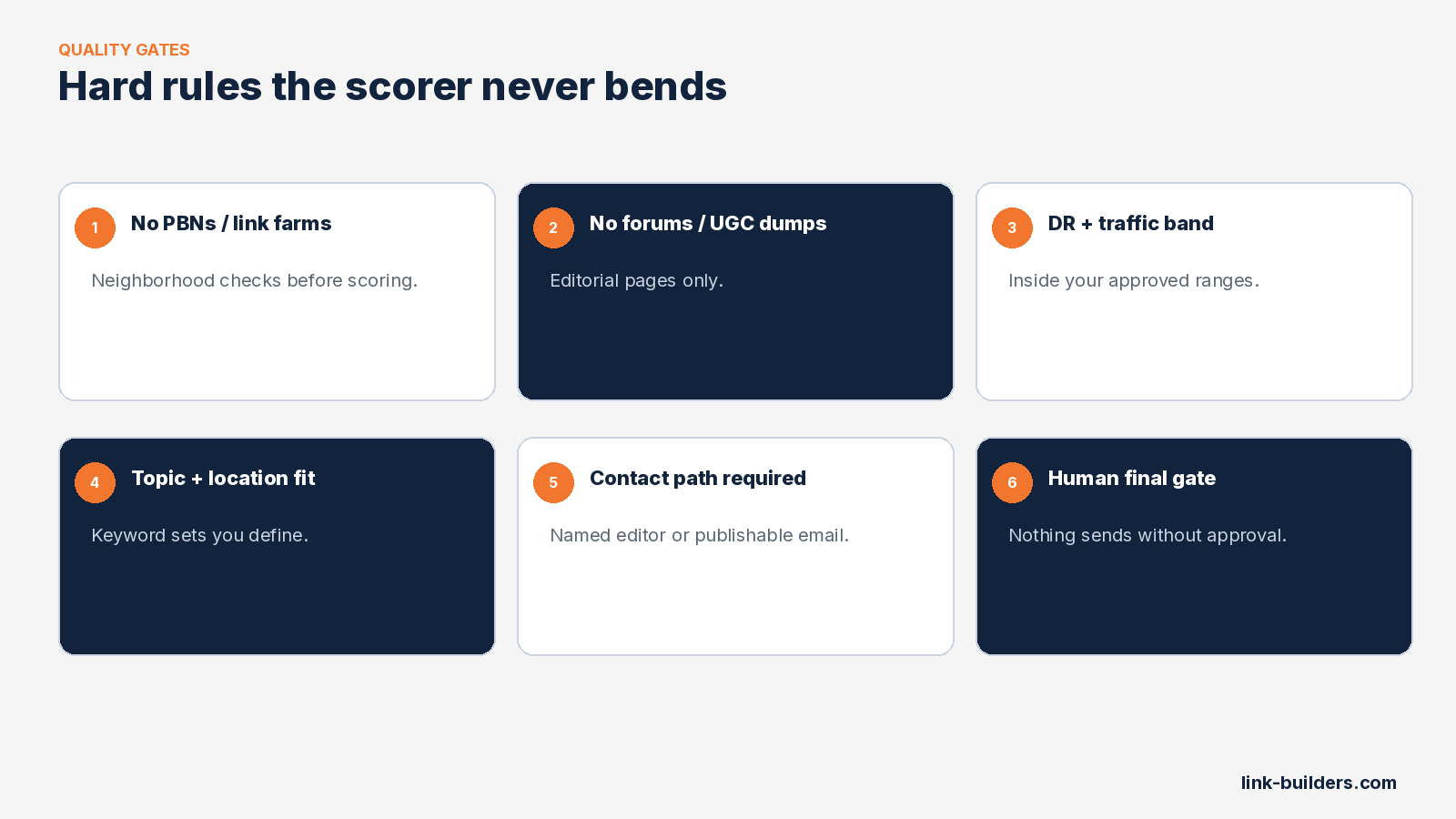
What I Learned in Two Months of Live Use
Surprising Successes
The AI found prospects I would have missed. Sites that looked marginal on surface metrics but had engaged niche audiences. The contact extraction proved more reliable than expected—about 85% accuracy. The personalized email generation exceeded my expectations, with response rates matching or exceeding my manually-written emails.Unexpected Challenges
Some industries proved harder to train than others. Niche B2B services with small online footprints don’t have enough training examples. The gray area prospects remain difficult—borderline cases still require human judgment. Spam techniques evolved even in two months, requiring regular updates to negative examples.Results That Validated the Approach
The efficiency gains are real. What used to take me 4-5 hours of manual prospecting now takes 30 minutes of AI processing and 30 minutes of human review. Quality metrics held steady—my placement success rate with AI-found prospects matches my historical success rate with manual prospecting.Common Pitfalls I Had to Solve
My first iteration produced 200 prospects per search, but 40% were still marginal quality. Better to have 50 great prospects than 200 mixed-quality prospects. I initially focused on teaching the AI what good prospects look like without enough emphasis on what bad prospects look like. This created a system that couldn’t spot sophisticated spam. I tried using mostly universal quality signals, which worked okay for some industries and poorly for others. Healthcare needs different evaluation criteria than real estate. I had to build industry-specific training modules. Industries evolve and spam techniques change, so I built in monthly training updates and continuous learning from live campaign results.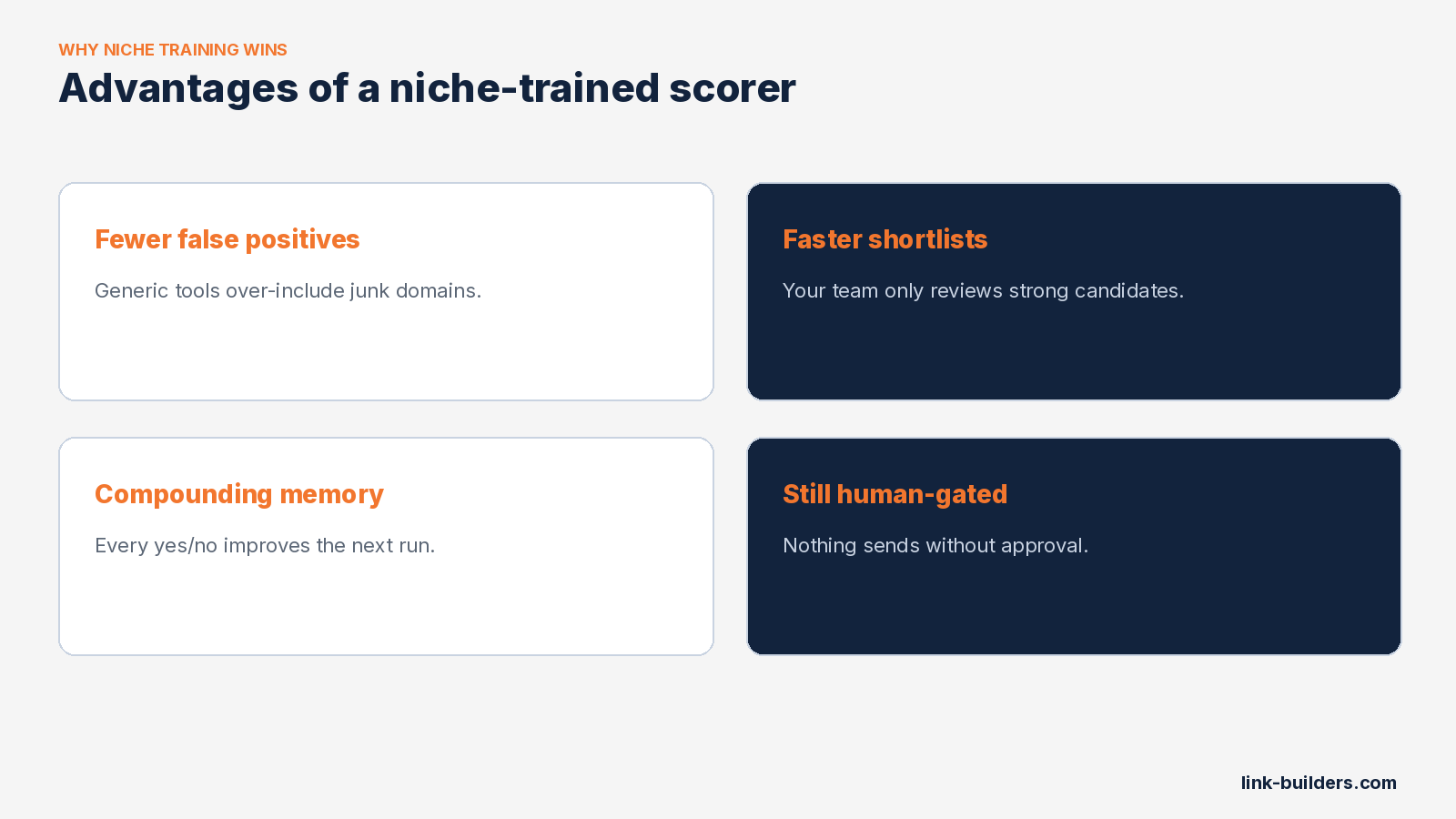
The Competitive Advantage of Building Your Own
You can’t just plug a language model into a database and call it AI link building. You need deep expertise in link building to train the system properly. You need hundreds of examples across multiple industries. You need to understand the subtle patterns that distinguish quality from spam. Most companies claiming to offer AI link building don’t have this expertise. They’re marketplaces connecting buyers and sellers, with maybe some basic automation. They’re not teaching AI to think like an experienced link builder. My 150 clients across different industries gave me training data that generic AI systems can’t replicate. Your expertise in your specific niches gives you similar advantages, even if you work in fewer industries.Where This Goes Next
The system needs more training data from successful campaigns. Every placement provides new examples of what works. Every failure provides examples of what to avoid. The longer I use it, the smarter it gets. The competitive advantages of having real AI link prospecting will compound over time. Link builders using marketplaces will fall further behind as this technology improves. If you’re serious about link building long-term, start documenting your successful placements now. Start categorizing your failed prospects. Start identifying the patterns you use to evaluate quality. This documentation becomes your training data when you’re ready to build or use real AI prospecting tools. The link building industry is about to change significantly. The winners will be those who combine deep link building expertise with the ability to train AI systems. Everyone else will be stuck with placement inventories pretending to be AI.About the author

Justin Davis is the founder of Link Builders, a white-label backlink agency, and has been building links since 2015 for more than 150 clients in law, healthcare, real estate, software and other industries. After years of doing prospecting research by hand, he built an AI agent link building system that handles each step, from finding link opportunities and vetting sites to finding contacts and preparing outreach. He now runs that system for agencies and in-house SEO teams, and teaches it on YouTube. Find Justin Davis on YouTube, LinkedIn and X.