Local Link Building in 2026: How to Win the Map Pack and Get Named by ChatGPT
By Justin Davis · November 6, 2026
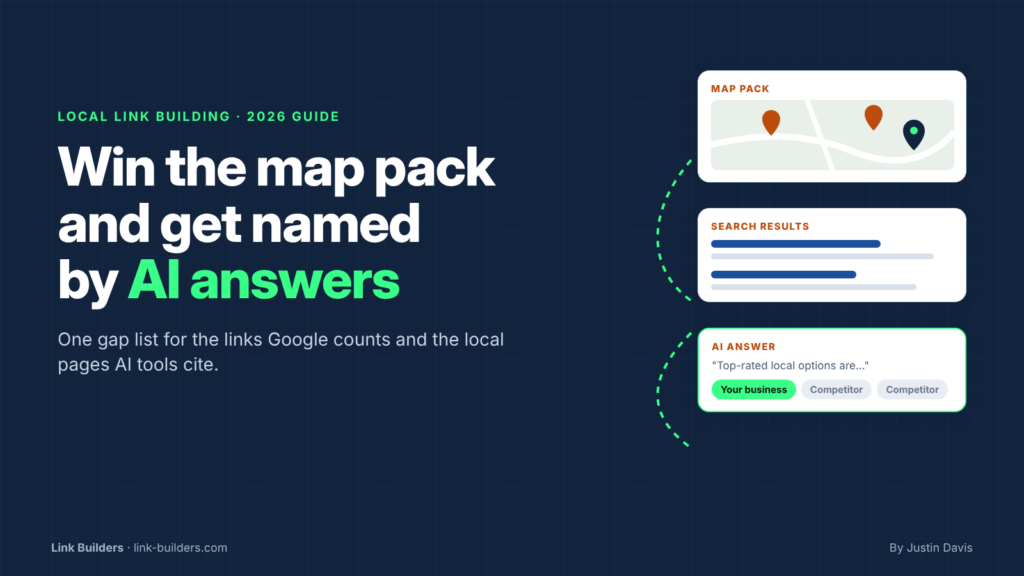
The short version: Local link building in 2026 has to work in three places at once: the Google map pack, the regular search results, and the AI answers that name a few local businesses. They overlap, but they don’t share one target list. When we checked Phoenix HVAC, only 22 of 229 contractors were named by ChatGPT, Perplexity or Google’s AI. Local “best of” lists and directories were the most common sources after contractors’ own websites. Build one gap list that covers both the links Google counts and the pages AI cites, then work it with approvals and honest outreach.
This guide is for agencies and in-house teams that look after local businesses: contractors, dentists, med spas, law firms, real estate agents. I’ve done link building for 11 years, both for my own clients and as a white-label partner for agencies. The process below is the one I use when a local client asks two questions in the same breath: “Why aren’t we in the map pack?” and “Why does ChatGPT recommend the other guy?”
What Local Links Do in 2026
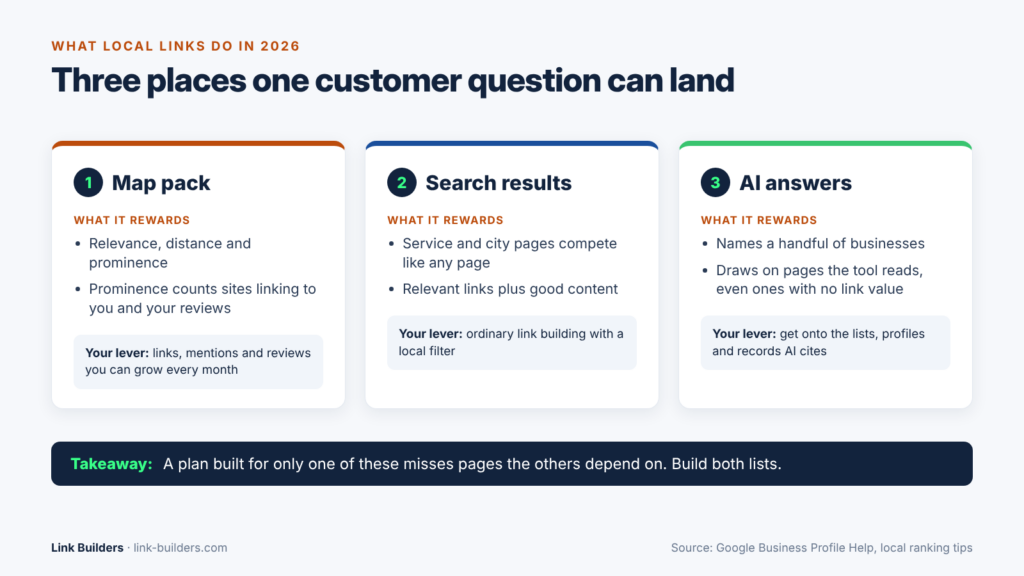
A local business can show up in three different places for the same customer question. Each one rewards slightly different work.
1. The map pack and Google Maps
Google says local results are based mainly on relevance, distance and prominence. On prominence, its Business Profile help page is unusually direct:
“This factor’s also based on info like how many websites link to your business and how many reviews you have.”
Source: Tips to improve your local ranking on Google, Google Business Profile Help
You can’t change distance. Relevance mostly comes from the Business Profile and the website. Prominence is where links, mentions and reviews come in, and it’s the part an agency can grow month after month.
2. The regular search results
Under the map pack, local service pages compete like any other page. Links to the service page and the city page still help it rank, along with good content. That’s ordinary link building with a local filter, and the basics in Link Building 101 still apply.
3. AI answers
More customers now ask an AI tool who to call. The answer names a handful of businesses, and those names come from the pages the tool reads. A page can matter here even when its link passes no value in Google. A Yelp-style profile or a state license lookup is a good example. I compare the two kinds of signal in Brand Mentions vs. Backlinks for AI Search, and GEO vs. SEO covers what carries over.
The practical point for agencies is that a link plan built only for Google will miss some of the pages AI tools rely on. A plan built only for AI will miss the links that move the map pack. You need both lists.
What AI Cites for Local Businesses: The Phoenix HVAC Data
On November 5, 2026, we asked ChatGPT, Perplexity and Google’s AI Overviews and AI Mode five questions a Phoenix homeowner would ask about air conditioning. Then we checked every answer against 229 Phoenix-area HVAC contractors from Google Maps. The full write-up is Which Phoenix HVAC Companies Does AI Recommend? These are the findings that matter for local link building:
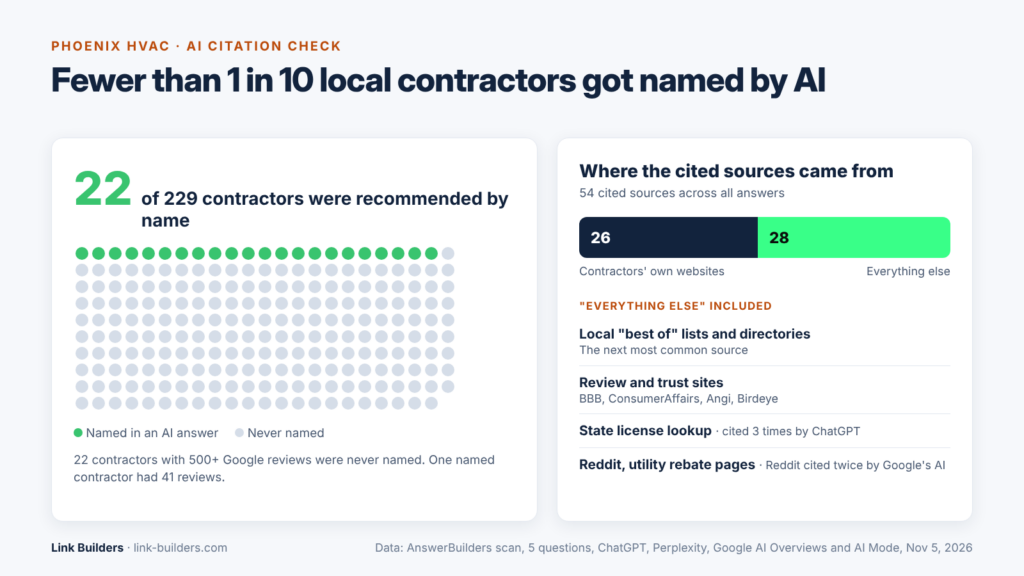
- Few businesses get named. Only 22 of the 229 contractors, fewer than 1 in 10, were recommended by name.
- The names cluster. The AI tools named 37 different contractors, but only 8 appeared in more than one answer.
- Reviews help, but they don’t decide it. Contractors with more Google reviews were named more often. Still, 22 contractors with 500 or more reviews were never named, and one named contractor had just 41 reviews.
- Own websites came first, lists second. Nearly half of the cited sources, 26 of 54, were contractors’ own websites. Local “best of” lists and directories were the next most common.
- The rest was trust and local context. The answers cited BBB, ConsumerAffairs, Angi and Birdeye. ChatGPT cited the Arizona Registrar of Contractors license lookup three times. Google’s AI cited Reddit threads twice. Answers also linked to utility rebate pages from SRP and APS.
Two things follow from that. First, a local “best of” list recommends several companies at once, so a single listing can put a business in front of the AI for many questions. Those lists belong at the top of any local target list. Second, many of the cited pages aren’t link opportunities in the usual sense. A license record or a review profile won’t move rankings much, but it can still decide whether an AI tool trusts the business enough to name it.
That was one day and one set of questions in one market. AI answers change with wording, location and time. Treat the data as a pattern to check in each client’s market, not a rule.
The Local Link Stack
Here is how I sort local opportunities. The Google and AI columns are judgment calls, based on what I see in campaigns and in the AI citation checks above, not on a published formula.
| Source type | Helps in Google | Helps in AI answers | How you usually get on it |
|---|---|---|---|
| Local “best of” lists and city guides | Sometimes, depending on how the link is marked | Often. Second most cited source in Phoenix | Submission form, editor outreach, sometimes a listing fee |
| Trade and niche directories | Some | Often, and the right ones change by industry | Claim the profile and complete it |
| Review platforms (BBB, Angi, Birdeye and others) | Little link value | Yes. Cited in Phoenix | Claim the profile, then ask customers for detailed reviews |
| License, bar and registration records | Little | Yes. The state license lookup was cited three times in Phoenix | Keep the record active and show the number on the website |
| Local news and community sites | Strong when the link is editorial | Yes, when the story is about the topic being asked | Pitch a useful local angle, data, or expert comment |
| Associations, chambers and supplier dealer pages | Good, relevant local links | Sometimes | Membership, certification, partner programs |
| Sponsorships (teams, events, charities) | Must be marked rel=”sponsored” | Sometimes, as a mention | Pay or donate, then ask for a properly marked link |
| Local resource pages and niche blogs | Strong when on topic | Sometimes | Classic outreach with a genuinely useful page to link to |
| Local forums and Reddit | Little | Sometimes. Cited twice in Phoenix | Honest participation by a real person. Never planted posts |
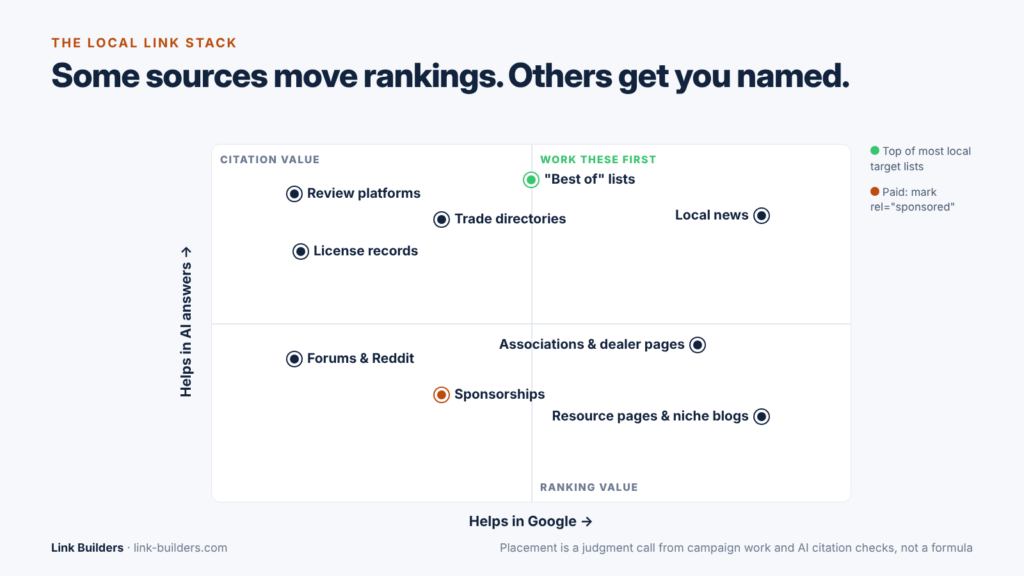
Two notes on that table. If a client pays for a sponsorship or a listing, Google’s guidance is to mark paid links with rel=”sponsored”. A paid link that pretends to be editorial falls under Google’s link spam policy. Paid placement can still be a sensible business decision when the page matters for AI answers or referral traffic. Just label it the way the site requires.
Second, the client’s own website is the link target, and it’s a citation source in its own right. In Phoenix, 26 of the 54 cited sources were contractors’ own pages. Service pages that state the license, service area, emergency hours and price ranges give both Google and AI tools something specific to rank or quote. Links work better when they point at pages like that.
How to Find a Client’s Local Link Gaps
This is the part I’d hand to a junior team member last, because the list you build decides everything that follows. I build two lists and then merge them.
List A: what the businesses that win in Google have
- Pick the right competitors. Use the businesses in the map pack and the top organic results for the client’s main service and city, not the competitors the client complains about.
- Pull every competitor backlink profile. Keep the local and industry-relevant domains. Drop the scraper sites and directories nobody visits.
- Run Boolean searches for the city and trade. Look for “best [service] [city]”, “[city] resources”, “[industry] association [state]” and sponsorship pages. My guide to Boolean search operators for prospecting has the operator patterns.
- Remove duplicates and sites already contacted. Nothing burns goodwill with a local editor faster than two pitches for the same client.
List B: what the AI tools read
- Write 10 to 20 buyer questions. Mix “best [service] in [city]” with problem questions like “who do I call for 24 hour AC repair in [city]” and cost questions.
- Run them in ChatGPT, Perplexity and Google’s AI features. Use the search-enabled versions, and record every business named and every page cited. Our HVAC guide shows the simple manual version: ask for the best company, then ask the tool for its sources.
- Note who wins and why. If a competitor keeps getting named, open the pages that cite it. Why does AI recommend my competitor? walks through the usual reasons.
- Record which cited pages already mention the client. Those are wins to protect. The rest are gaps.
Doing this by hand works for one client in one city. Across many clients it gets slow, which is why I built AnswerBuilders. It runs the buyer questions across the AI engines and ranks the pages they cite where competitors appear and the client doesn’t. Every Link Builders target list now includes those AI sources next to the traditional link opportunities.
Merge and rank
Put both lists in one sheet with these columns: URL, source type, on List A, on List B, which AI tools cited it, whether the client is already there, the action needed, and status. Then rank it:
- Top: pages on both lists, like a local “best of” list that competitors link from and AI cites.
- Next: pages AI cites in several answers, even if the link value is low.
- Then: strong, relevant local links that only help in Google.
- Last: everything else. Many of these never get worked, and that’s fine.
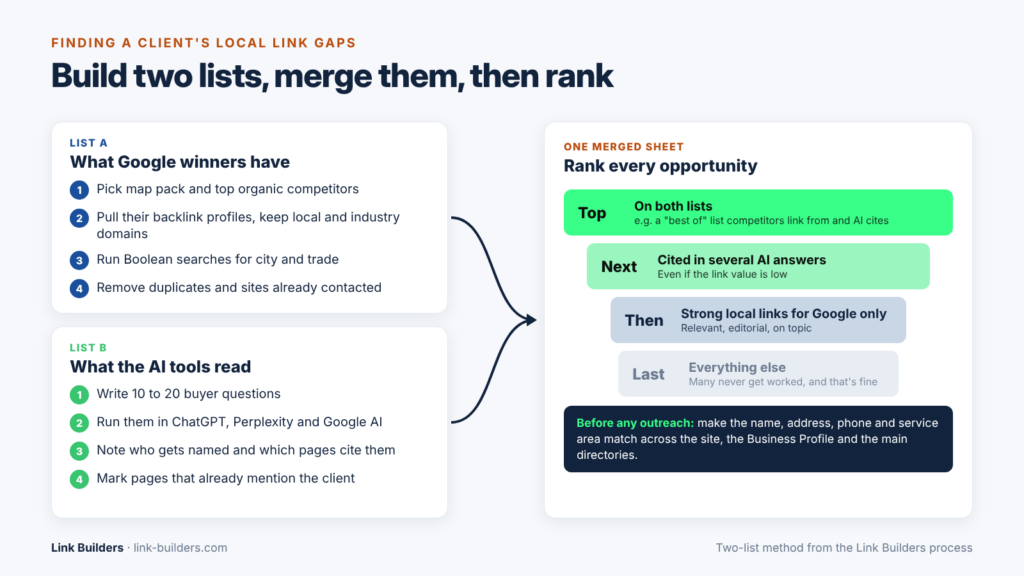
Before any outreach, fix the basics. Check that the client’s name, address, phone number and service area match across the website, the Business Profile and the main directories. A listing with the wrong phone number is a lost lead in Google and confusing evidence for an AI tool.
Outreach That Works for Local Businesses
Local outreach is the same craft as any outreach, with less room for error. The pool of relevant sites in one city is small, and the people who run them talk to each other.
Expect a price, and decide in advance
In my own campaigns, a “yes” usually comes with a rate card. Across six campaigns we contacted 6,657 prospects, and response rates ranged from 5.4% to 27.6% by campaign. Of the 681 positive replies, 86% included a price, and the median quote was $125. The full breakdown is in 681 Webmasters Said Yes. Here’s What They Actually Asked For. Those campaigns weren’t all local, but local list sites work the same way: some charge to add a business, and the Phoenix write-up notes the same thing.
So agree on rules with the client before anyone is contacted: which fees they’ll consider, the most they’ll pay, and how paid placements get labeled. Then nobody is surprised when the replies arrive.
Lead with something a local editor can use
- For “best of” lists and directories: a correct, complete submission, plus a short note on what makes the business different, such as licensing, warranties, emergency hours or service area.
- For local news: a seasonal angle the reporter needs anyway. In Phoenix that might be keeping an AC running through a heat wave, or the utility rebates the AI answers kept pointing to.
- For associations and suppliers: the membership or certification the client already has, and a request to be listed on the member or dealer page.
- For resource pages: a client page that genuinely belongs there, such as a local cost guide, a checklist, or a license verification explainer.
Keep the client in control
Local clients are often recognizable in their community, so every site and every piece of content should be approved before it goes out. In my link building process the client approves the prospect list before anyone is contacted and approves content before it’s published. For agencies reselling the work, that approval step is also what keeps your client relationship safe.
Anchor Text, Pace and Spam Risk
Local sites are easy targets for shortcuts that look cheap and end badly: city-named blog networks, mass directory blasts, and anchor text stuffed with “[service] [city]”.
- Keep most anchors branded. Natural local links usually use the business name, the web address, or the name plus the city. In my anchor text ratio guide, I put branded anchors, naked URLs included, at about 50 to 70% of a natural profile, and keyword-rich anchors at about 10 to 20%. Benchmark the client’s market before treating those as targets.
- Grow at a believable pace. A small local business that suddenly gains dozens of links in a month looks odd. My write-up on Google’s historical data patent explains why link timing matters.
- Avoid networks. Google’s September 2026 spam update was the fourth spam update of the year, and its recovery guidance is slow by design. A “local” site that publishes for anyone in any city is a liability, not an asset.
- Don’t publish fake “best of” lists. A “best [service] in [city]” article on the client’s own site with the client at number one isn’t the same as being chosen by an independent list. We looked at that tactic in Is Google Targeting Self-Promo Listicles?
For a deeper look at what a healthy profile looks like, see Building a “Natural” Backlink Profile.
Playbooks by Industry
The method doesn’t change, but the sources AI reads differ a lot by industry. These are the patterns from our industry checks, with the full step-by-step guides linked.
- HVAC: license records, BBB, local contractor lists and utility rebate pages. In Phoenix the AI also leaned on regional contractor ranking sites and a local news story. See How to Get Your HVAC Company Recommended by ChatGPT and the Phoenix HVAC study.
- Roofing: in Atlanta, each list had a different number one, and the AI repeated whichever list it read. At least one cited list says it checks roofers against BBB, license and manufacturer records, so certifications feed the lists directly. See How to Get Your Roofing Company Recommended by ChatGPT.
- Dental: in Houston, the AI leaned on dentist ranking sites, “best dentists” roundups and a city magazine’s Top Dentists list. Insurance details kept coming up. See How to Get Your Dental Practice Recommended by ChatGPT.
- Med spas: in Dallas, the AI used med spa directories, two of which rank by Google rating and review volume, so reviews feed the lists directly. See How to Get Your Med Spa Recommended by ChatGPT.
- Law firms: legal directories, state and county bar profiles, and local newspaper “best lawyers” lists. In Houston, Perplexity cited a Houston Chronicle list. See How to Get Your Law Firm Recommended by ChatGPT.
- Real estate: consistent citations, Google Business Profile reviews, localized listing pages, and local links still do most of the work. Details are in the realtor playbook below.
Real estate and realtor sites
The process on this page is the same for realtor and brokerage sites. What changes is where the reviews, citations, and schema live. The notes below are the parts of our older realtor guide that are still useful and are not already covered above. Link Builders’ core work remains white-hat outreach hours, not a realtor SEO retainer or a per-link package.
Reviews after a closing
Review volume and quality still influence the local map. For real estate, the practical sequence is to stay in touch with the client a few times during the first three months after a sale, then ask for a Google Business Profile review in a later message that explains exactly how to leave it. A review request in the first contact, before loose ends are closed, is easier to ignore. Many agents use a review-request tool to send that ask by text or email; the tool matters less than the timing and the clear instructions.
NAP+W citations
Name, address, phone, and website should appear in the same format on the Google Business Profile, the website, and the authoritative directories that still get used. Consistency matters more than submitting the business to every obscure listing site. Skip the old “submit once to a data aggregator and forget it” approach from early local-SEO guides; keep the profile and the main listings accurate yourself, and only pursue extra citations that are real and relevant. Reverse-engineering a competitor’s citations with a local SEO tool can surface gaps, but unclaimed or junk listings are not worth copying.
Structured data for real estate pages
Schema does not replace reviews or links. It only helps crawlers read what is already on the page, and it has to be accurate. A developer or specialist should implement it. Types that often fit realtor or brokerage pages include RealEstateAgent, PostalAddress, Place, Residence, Offer, and, when the page is actually about a rental, RentAction. See the RealEstateAgent type on schema.org for the current properties. Do not mark up details the business does not really offer.
Localized listing and blog pages
Useful local pages on a realtor site still look like area guides and listing explainers, written for people, with natural mentions of searches such as “[city] homes for sale” or “[city] realtors.” Do not over-optimize those phrases. Use new posts to point to the relevant local listing pages on the same site. The local links that still make sense are the ones already in the stack above: local news, associations, sponsorships with a properly marked link, and relevant niche pages — earned from businesses and organizations in the same area, not from generic directories.
What to measure
For a realtor SEO effort, the useful scoreboard is map-pack positions for the target area-and-service searches, organic queries and clicks in Search Console, organic users in GA4, citation and link progress, and leads or contacts that came from those pages. A local rank tracker is the straightforward way to watch the map pack. Treat third-party traffic estimates as estimates. Title and description changes belong on queries that already have impressions and a weak click-through rate, not as a way to invent demand.
Part of this realtor playbook started as a guide first published on the realtor.com Hub as “Local Real Estate SEO Tactics.” The current realtor.com URL for that resource, as of November 10, 2026, is realtor.com’s local real estate SEO tactics page. Naming on this page uses Google Business Profile, which replaced the older “Google My Business” label.
For any other trade, start with the general guide to getting your business recommended by ChatGPT, then build the two lists above.
In-House or White-Label?
Most agencies can run the audit side, meaning the Business Profile, directory cleanup and prompt checks. Outreach is where local link building usually stalls. It’s slow, it needs judgment on every reply, and it’s hard to staff for a handful of local clients.
If you outsource it, ask any provider for four things:
- Approval before contact. You see every site before anyone pitches it.
- No networks or recycled lists. Targets should be real local and niche sites, found fresh for each client.
- Reports your client can read. What was contacted, what responded, what was placed and what changed, under your brand.
- Honest promises. Nobody controls the map pack or what an AI answer says. A provider that guarantees either is guessing.
That’s how I run white label link building for agencies. I do the outreach myself, every client stays confidential, and the reports carry your brand. If you’d rather resell it as your own offer, the link building reseller program covers packaging. For clients who mainly need to get onto the pages AI cites, AI citation outreach runs on AnswerBuilders, and agencies can offer it at wholesale.
Get a free local gap list for one client
Send me one local client’s URL. Within 24 hours I’ll send back 20 hand-vetted link opportunities in a shared sheet, each with a contact and a one-line reason it fits. For a local business, I weight the list toward local and industry sources, including the kind of “best of” lists and directories AI answers cite. If you’d rather keep the client private, send a competitor in the same city instead. No call required.
FAQ
What is local link building?
Local link building is earning links and mentions from websites tied to a business’s city, region or industry: local news, associations, directories, “best of” lists, suppliers and community organizations. In 2026 it also means getting onto the local pages AI tools cite when customers ask who to hire.
Do backlinks help local map pack rankings?
Yes. Google’s Business Profile help says prominence is based partly on “how many websites link to your business and how many reviews you have.” Relevance and distance matter too, and no amount of links will overcome a business being far from the searcher.
Are citations the same as backlinks?
No. A citation is a mention of the business name, address and phone number, often on a directory or review site, and it may carry no link at all. A backlink is a link to the website. Both help, in different ways. Citations matter more for consistency and for AI tools that check several sources. Editorial links matter more for rankings.
Should a local business pay for a listing or sponsorship?
Sometimes. It’s a business decision. Some “best of” lists that AI tools cite charge to include a business. If you pay, the link should be marked rel=”sponsored” as Google recommends, and the listing itself should be accurate.
How long does local link building take to work?
There’s no fixed timeline. Google says spam recovery happens over months, and ranking gains from new links usually build gradually too. AI answers change when the tools refresh the pages they read. That’s why you should re-run the same buyer questions monthly and keep the wording the same.
Can I get a business recommended by ChatGPT with links alone?
Not reliably. In our Phoenix HVAC check, AI tools cited contractors’ own websites, local lists and directories, review platforms, the state license lookup and Reddit. Links help, but so do accurate listings, reviews on more than one platform, and clear service pages.
Does this local link building process apply to real estate agents?
Yes. Realtor and brokerage sites compete in the map pack, in the regular results, and in AI answers the same way other local businesses do. The extra emphasis is on Google Business Profile reviews after a closing, consistent NAP+W citations, accurate real-estate schema, and localized listing or area pages. The outreach method, the link stack, and the approval rules on this page do not change. Nobody can guarantee a map-pack position or an AI mention.
Sources
- Which Phoenix HVAC Companies Does AI Recommend? (AnswerBuilders scan, 5 questions across ChatGPT, Perplexity and Google AI Overviews / AI Mode, November 5, 2026)
- 681 Webmasters Said Yes. Here’s What They Actually Asked For (Link Builders campaign data, October 3, 2026)
- Tips to improve your local ranking on Google, Google Business Profile Help (checked November 6, 2026)
- Qualify your outbound links to Google, Google Search Central
- Spam policies for Google web search, Google Search Central
About the author

Justin Davis is the founder of Link Builders, which offers link building services to companies and white label link building to agencies, and has been building links since 2015 for more than 150 clients in law, healthcare, real estate, software and other industries. After years of doing prospecting research by hand, he built an AI agent link building system that handles each step, from finding link opportunities and vetting sites to finding contacts and preparing outreach. He now works every project himself, running that system for agencies and in-house SEO teams, earning the links and mentions that help their clients show up in Google and in AI answers, and teaches it on YouTube. He also built AnswerBuilders, the AI visibility platform Link Builders uses to find the pages AI answers cite. Find Justin Davis on YouTube, LinkedIn and X.