Who Owns the Gin? What a 1793 Invention Teaches Business Owners About AI and SEO
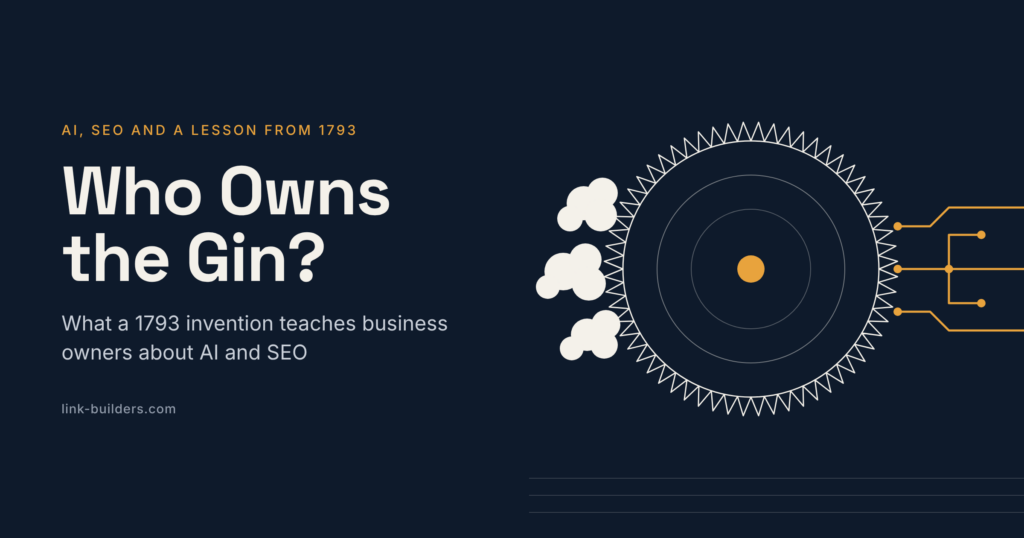
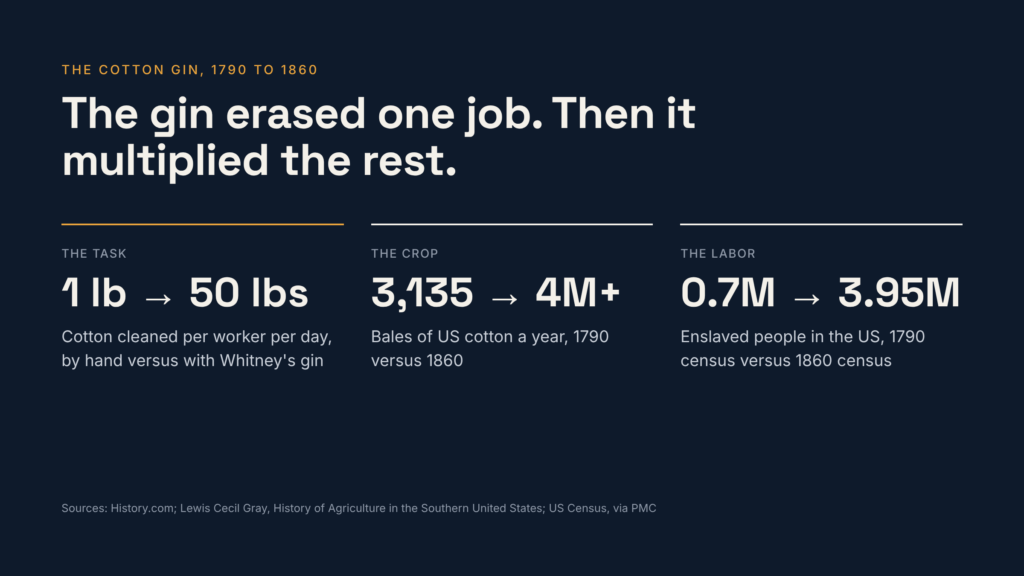
Before 1793, cleaning cotton was slow, miserable work. The seeds of short-staple cotton cling to the fiber, and a worker picking them out by hand could clean about one pound a day. Then Eli Whitney built a machine that could clean around 50 pounds a day, and larger versions ran on horsepower. Whitney wrote to his father that “one man and a horse will do more than fifty men with the old machines” (History.com).
Fifty jobs, gone. That is the obvious reading. Yet within a generation, the American South needed millions more workers, not fewer.
Generative AI is doing to search marketing what the horse-powered gin did to seed cleaning. If you own a business, that raises a practical question. When a machine makes one task nearly free, who ends up owning the field, and who ends up working it for a share?
One Job Lost, Millions Created
The gin did not shrink the workforce
The gin removed one bottleneck, but it could not pick cotton. Once cleaning was cheap, growing cotton became far more profitable, and planters pushed it across the Deep South. Output rose from about 3,135 bales in 1790 to more than 4 million bales a year by 1860. Over the same years, the enslaved population grew from 697,624 to 3,953,760 (PMC). The people whose hand-ginning work disappeared were not freed. They were moved to the fields, the one step the machine could not do.
The money flowed to landowners, merchants and textile mills. Even Whitney earned little, because his patent was widely copied (Mississippi History Now).
The sharecropper’s share
After the Civil War, many freed people and poor white farmers worked land they did not own. The sharecropper supplied the labor and kept roughly one-third to one-half of the crop. Food and supplies came on credit against the next harvest, and unpaid debt rolled into the following year (Encyclopedia of Alabama). Sharecroppers owned their skill. The landowner owned the land and set the share.
Then the machine took the field
In 1944, a mechanical cotton picker on a Mississippi plantation did the work of about fifty people (WKNO). Farm jobs vanished, which helped push millions of Black Southerners north in the Great Migration. The long shadow is still visible. Mississippi had the lowest median household income in the country in 2024 (EPI), and researchers have linked a county’s 1860 reliance on slavery to its inequality today (Pacific Standard).
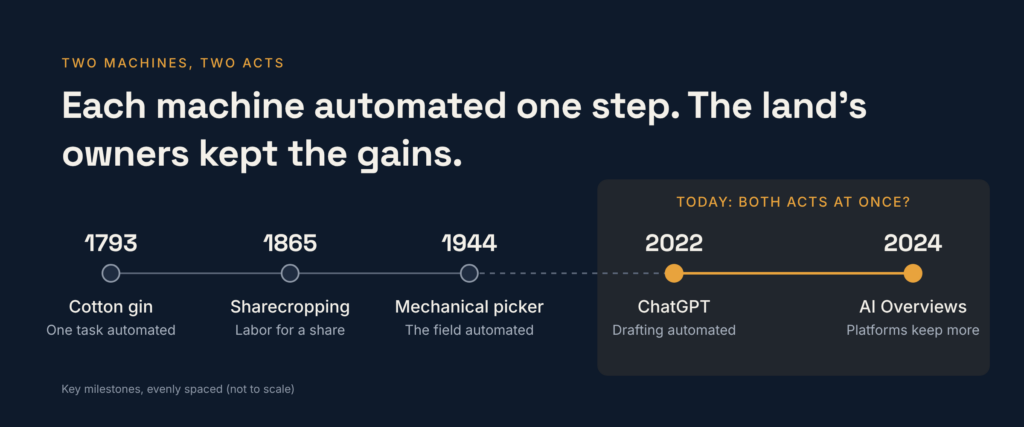
The cotton story played out in two acts across 150 years. AI may be running both acts at once.
AI Is SEO’s Cotton Gin
AI is very good at the seed cleaning of search marketing: first drafts, meta descriptions, keyword lists and routine reports. Tasks that once took a freelancer a full day now take minutes.
The tasks AI erased
The effect is already showing up in the freelance market. In the months after ChatGPT launched, writing freelancers on Upwork saw about 2% fewer monthly jobs and 5.2% lower monthly earnings, according to economists at Washington University and NYU (VoxEU). Higher earners were hit harder, not spared. SEO job listings have fallen too. A study of about 80,000 listings by the job board SEOJobs.com found SEO openings down 37% in the first quarter of 2024 compared with a year earlier (Search Engine Journal). In the 2025 State of SEO Jobs report from SEOJobs.com and Previsible, content-related SEO roles fell 28% year over year (SEOJobs.com).
The work that grew
Just as cotton output exploded after the gin, so has content. When anyone can publish a 1,500-word article in a minute, the web fills up with them, and the articles themselves become cheap. What gains value is everything AI does poorly: deciding what to publish and why, checking facts, earning links and mentions from real publications, and getting your brand named when a customer asks an AI assistant for a recommendation.
Who captures the value
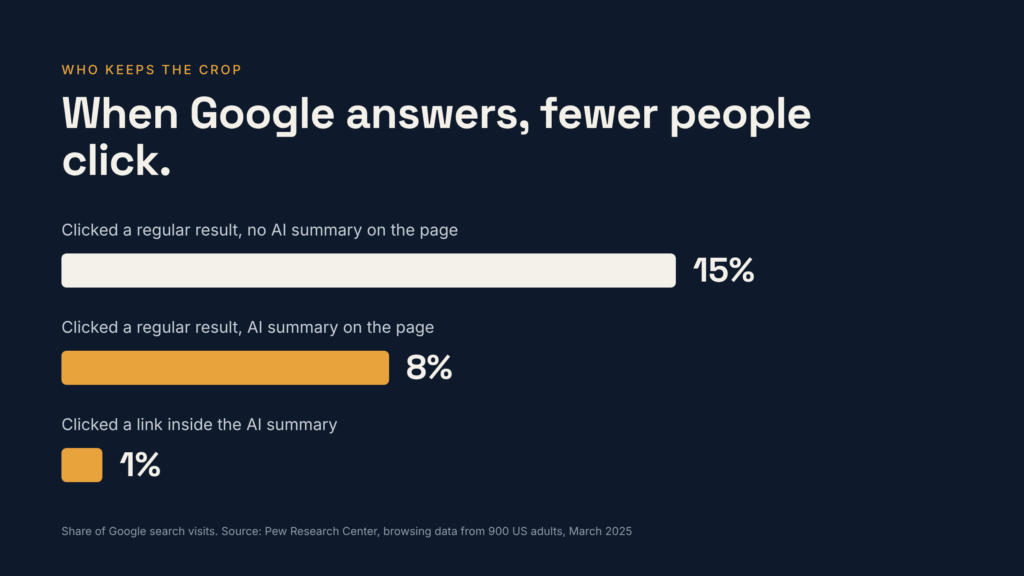
Then there is the field itself, and Google and AI platforms own it. A Pew Research Center study found that when Google showed an AI Overview, users clicked a traditional result in 8% of visits, compared with 15% when no summary appeared. Only 1% clicked a link inside the summary (Pew Research Center). Your content still feeds the answer. The platform keeps more of the crop.
Are You Farming Someone Else’s Land?
In 2006, the writer Nicholas Carr coined the term “digital sharecropping” for the way web platforms let users produce the value while the platform keeps the economic reward (P2P Foundation summary). AI makes his point sharper for any business that depends on search.
| The cotton South | Search in the AI era |
|---|---|
| The landowner owns the field | Google and AI platforms own the results page and the answer box |
| The cropper keeps one-third to one-half of the crop | Your site gets whatever clicks the platform passes back |
| One cash crop, no backup | One traffic source, often organic Google |
| Prices set by distant markets | Rates set by cheap AI-generated output |
Two groups are most exposed. The first is businesses that rely on a single source of customers. The second is SEO providers that sell output by the unit, such as articles or link packages by volume, on channels they do not control. If you are paying for the second to protect the first, you are farming on shares.
One caveat matters. This comparison is about economic position, not suffering. Sharecroppers were held in place by debt laws, a racial caste system and the threat of violence. A business owner can change strategy, change vendors or walk away. That freedom is the reason this story can end differently.
How to Own the Gin and the Land
The good news is that demand is moving up, not disappearing. In an analysis of 946 SEO job postings from December 2025 through March 2026, published in Search Engine Journal, growth advisor Kevin Indig found that roles with AI in the title had a median salary of $113,625, compared with $89,438 for roles without it (Search Engine Journal). Businesses are paying more for people who can steer and less for people who only produce.
What I am seeing from clients
In more than 11 years of building links, I have watched demand shift in three clear ways.
First, fewer businesses are hiring help. Many owners are trying to handle SEO themselves with AI tools. That works for the seed cleaning. A tool can draft a post or suggest keywords, but it cannot earn a mention in a respected trade publication.
Second, many clients are unsure who to call for AI search. They want to show up when customers ask ChatGPT, Gemini or Google’s AI Mode for a recommendation, a practice often called generative engine optimization (GEO). Because the field is new, owners often do not know whether it belongs with their SEO provider, their PR firm or someone else.
Third, companies are moving onto social media. More businesses now ask every employee to post regularly on LinkedIn and other platforms. It is a smart instinct, but social platforms are someone else’s land too.
Five moves for business owners
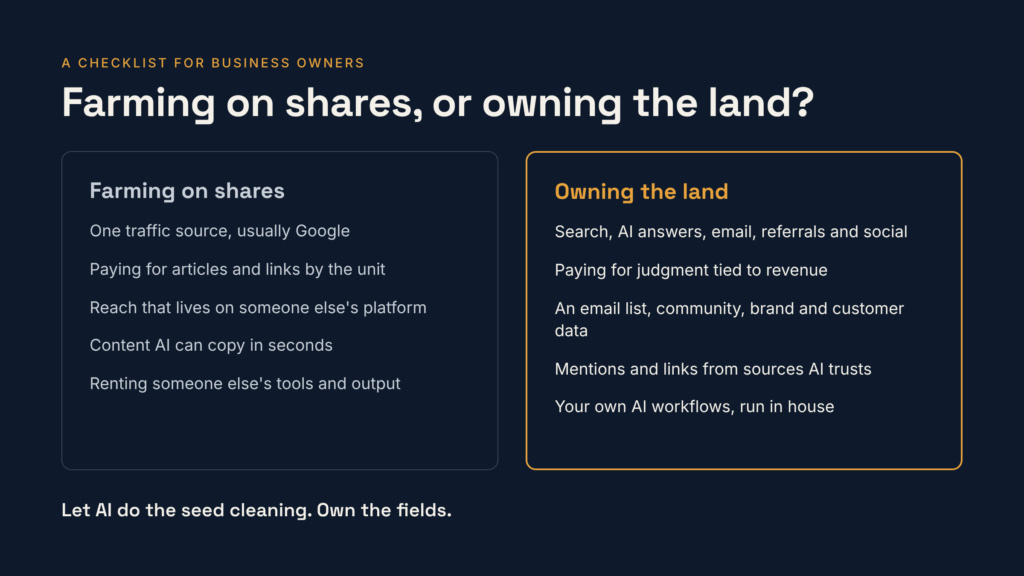
Own your land. Build assets no platform can take away: an email list, a customer community, a recognizable brand and your own customer data. Treat Google and social media as places to plant, not places to live.
Own the gin. Use AI in house for the routine work. Let it draft, summarize and sort. Then spend your budget, and your team’s time, on what AI cannot do.
Hire for judgment, not volume. When you hire an SEO, ask what decisions they will make and how those decisions tie to revenue, not how many articles or links they will deliver. A provider who can only promise volume is selling you cheap cotton.
Plant for the new field. AI answers lean on sources they trust: respected publications, reviews, active communities and sites that others cite. Earning genuine mentions and links from those sources is how your brand ends up in the answer. It is the work my team focuses on at Link Builders, because it is one step AI cannot fake.
Diversify the crop. Do not let one channel carry your business. Organic search, AI answers, email, referrals and social media should each carry part of the load. Employee posting fits here, as long as it sends people back to land you own.
The Gin Never Decided Who Prospered
Whitney was right that one man and a horse could replace fifty men at the gin. He was wrong about what came next. The machine did not decide who prospered. Ownership did.
AI is the new gin, and it will keep making routine marketing work cheaper. The question for every business owner is whether you will own a piece of the field or rent it on shares. Unlike the sharecroppers of 1900, you get to choose, and the tools to build your own land have never been cheaper.
Sources
- The Cotton Gin and Eli Whitney, History.com
- Estimates of the slave population, PMC
- Cotton in a Global Economy, Mississippi History Now
- Sharecropping and Tenant Farming in Alabama, Encyclopedia of Alabama
- International Harvester cotton picker, WKNO
- 2024 state income and poverty data, Economic Policy Institute
- Slavery’s legacy and inequality, Pacific Standard
- Short-term effects of generative AI on employment, VoxEU
- SEO Job Listings Reportedly Down 37% Year-Over-Year, Search Engine Journal
- 2025 SEO Job Report, SEOJobs.com and Previsible
- The AI Skills Salary Premium, Search Engine Journal
- Google users and AI summaries, Pew Research Center
- Digital Sharecropping, P2P Foundation
About the author

Justin Davis is the founder of Link Builders, which offers link building services to companies and white label link building to agencies, and has been building links since 2015 for more than 150 clients in law, healthcare, real estate, software and other industries. After years of doing prospecting research by hand, he built an AI agent link building system that handles each step, from finding link opportunities and vetting sites to finding contacts and preparing outreach. He now works every project himself, running that system for agencies and in-house SEO teams, earning the links and mentions that help their clients show up in Google and in AI answers, and teaches it on YouTube. He also built AnswerBuilders, the AI visibility platform Link Builders uses to find the pages AI answers cite. Find Justin Davis on YouTube, LinkedIn and X.