Link building 101
Updated October 2, 2026 · Originally published December 22, 2020
By Justin Davis, Link Builders (founded 2015). As of 2026, I’ve been building links for 11 years.
Link building is still one of the strongest off-page levers in SEO — but it’s not “collect as many URLs as possible.” Done white-hat, it’s relationship-driven outreach that earns editorial links from relevant sites with real audiences.
This is the 101 I wish clients got on day one.
What link building actually is
On-page SEO is what you control on your own site: content, structure, technical health, intent match.
Off-page SEO is mostly how the rest of the web points to you. The core of that is backlinks — other sites linking to yours — plus local signals when that matters for the business.
A useful mental model: a link can act like a vote of confidence. Votes from trusted, relevant sites tend to matter more than raw count. That’s why we obsess over niche fit, traffic quality, and editorial standards — not vanity Domain Rating alone.
KPIs worth tracking (without worshipping them)
- Keywords ranking in Google (breadth + meaningful positions)
- Rankings for target terms (movement on the queries that pay the bills)
- Authority / trust proxies (DR/DA and, more importantly, the shape of the referring domains)
- Organic traffic with the right intent (the real business outcome)
Links can take weeks to months to influence rankings. One link rarely “fixes” a competitive SERP. Anyone promising a fixed number of rankings or a fixed number of links for a fixed price is selling certainty they don’t have.
A short history (so the old advice makes sense)
Before Google’s Penguin updates, a lot of “SEO” was industrial spam: private blog networks, reciprocal schemes, comment spam, and directories built only to pass links. Big brands got burned too. Penguin and later quality systems shifted the game toward quality and relevance.
That history still matters because the junk tactics never fully died — they just got better at looking clean in a spreadsheet. White-hat work is slower up front and more durable over time.
How we judge a prospect today
When I qualify a potential linking site, I start with:
- Relevance to the client’s industry and audience
- Real organic traffic (not just a high DR with empty pages)
- Clean-enough backlink neighborhood (toxicity / spam signals)
- Editorial sniff test: does this site look like it publishes for readers, or for link buyers?
Tools (Ahrefs, Semrush, etc.) help. They don’t replace opening the page.
Link types that still show up in real campaigns
These aren’t “packages.” They’re patterns we pursue with outreach hours:
- Resource / links pages — curated lists on industry or .edu-adjacent sites
- Sponsored / contributed content — when a publisher charges a placement fee (we pass publisher fees at cost; you approve before anything goes live)
- Content upgrades / insertions — adding a genuinely useful link to an existing article
- Listicles / “best of” features — earned inclusion where you belong
- Selective industry directories — rare; only when the directory is actually authoritative in-niche
- Unlinked mentions — brand already mentioned; ask for the citation link
- Broken-link replacements — help a webmaster fix a dead citation with your better page
- Guest posts — useful content on a real site, with transparent attribution
Patterns we generally avoid
- Reciprocal link schemes and link-exchange directories as a ranking strategy
- Forum profile / signature spam
- Blog comment spam
- Off-topic placements that make no sense to a human reader
- Anything that only exists to sell links at scale with no editorial process
Relevance isn’t optional. A random lifestyle blog linking to an unrelated local service usually doesn’t help the way people hope.
White hat vs black hat (plain English)
Black hat tries to manipulate systems: fake sites, purchased networks, negative SEO, scaled spam. Short-term spikes; long-term risk.
White hat stays inside how search engines want the web to work: useful content, real outreach, sites you’d be proud to show a client. Growth is steadier because you’re not building on sand.
At Link Builders, white-hat isn’t a slogan on a sales page — it’s the constraint that shapes every prospect list and every email.
Where AI fits (and where it doesn’t)
As of 2026, after 11 years of manual outreach, I built AI into our prospecting stack so Boolean search, filtering, and first-pass personalization don’t eat entire days. What used to take an eight-hour grind can compress into a focused cycle — which is exactly why our Buy the Machine offer includes onboarding plus a full 8-hour prospecting cycle.
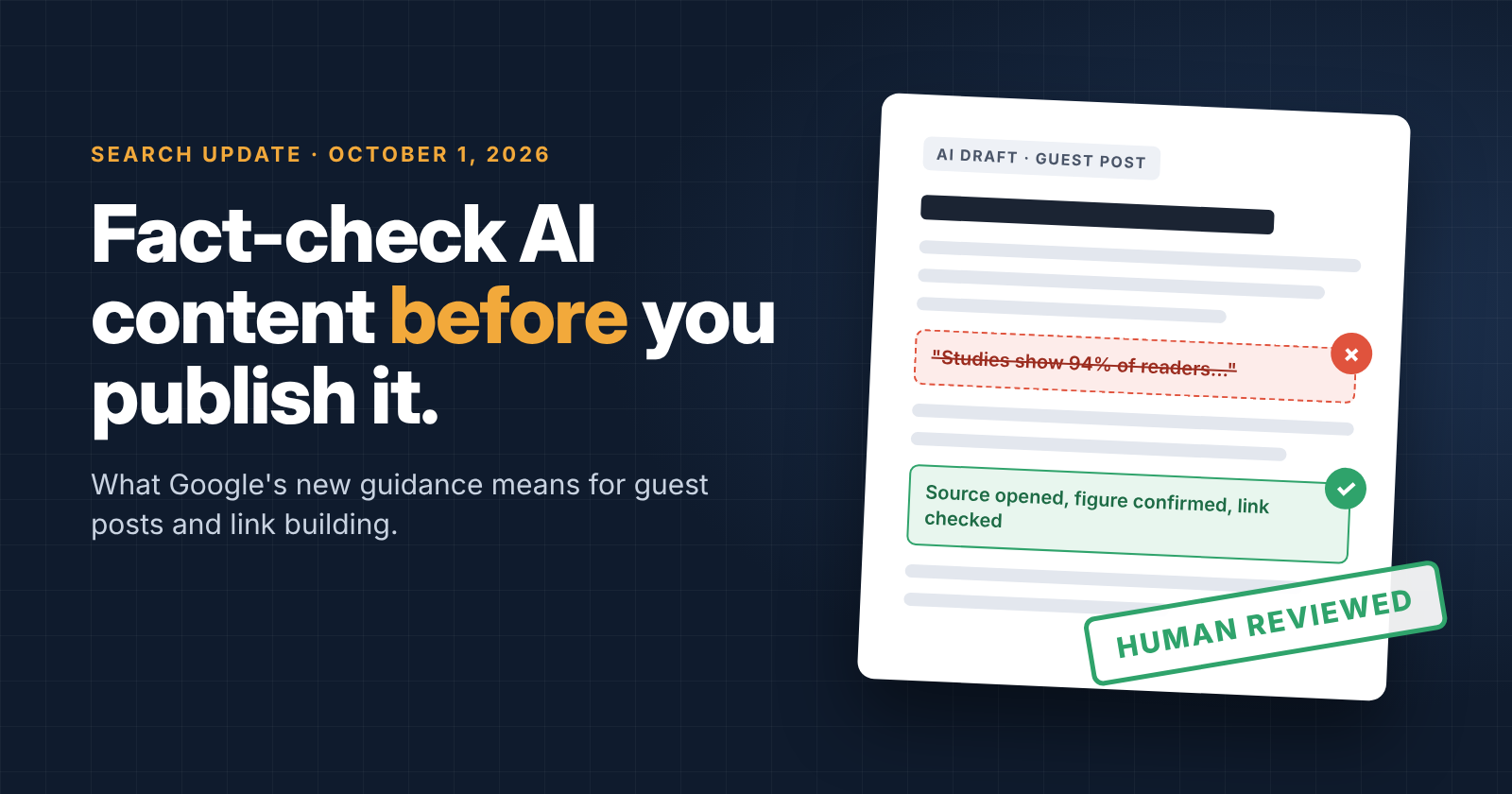
What AI does not get to do unsupervised: final site approval, final email send, or pretending a campaign has a guaranteed link count. Humans still stamp the work. That’s how you protect the brand.
What Link Builders sells (so the 101 matches the invoice)
We don’t sell “10 links.” We sell hours and a process:
- $160/hour
- Justin’s Machine: 30 hours prepaid for $4,800
- Buy the Machine: $9,600 one-time (includes onboarding + a full 8-hour prospecting cycle)
Publisher fees are separate and passed through at cost. You approve sites and content. We do not guarantee rankings, traffic, or a fixed number of links — because honest operators can’t.
How a campaign typically moves
- Scope the niche, competitors, and constraints
- Prospect and qualify (AI-assisted, human-approved)
- Outreach and relationship work
- Content / placement when a site says yes
- Reporting on work done — hours, activity, outcomes — without theater
Details live on our link building process page.
Getting started
If you’re DIY-ing, start with one or two tactics from our 14 proven tactics guide and stay ruthless about quality.
If you’d rather buy focused outreach time instead of hoping a per-link vendor’s spreadsheet is clean, see current backlink pricing or contact us.
Related: How many backlinks do I need?.
About the author

Justin Davis has been building backlinks since 2015 and has built links for more than 150 clients across law, healthcare, real estate, software, and other industries. He built the first version after years of doing the research by hand, and now builds the same workflow for in-house teams. More on who Justin Davis is, on YouTube, on LinkedIn, or on X.