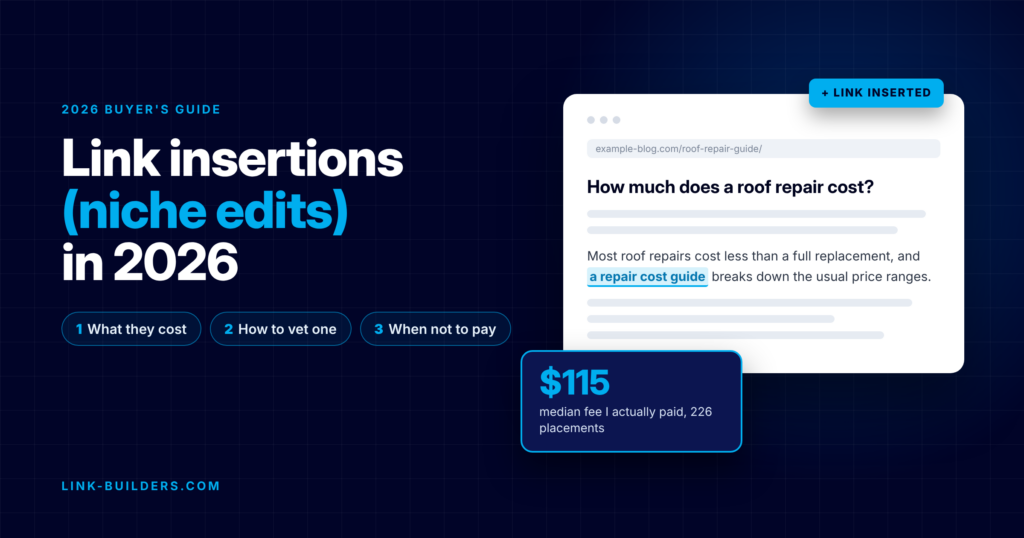
Link Insertions (Niche Edits) in 2026: What They Cost, How to Vet One, and When Not to Pay
By Justin Davis · November 24, 2026
A link insertion is a paid or requested link added to an article that already exists. Some people call it a niche edit. I’ve built links for clients since 2015, and the questions I hear most about insertions are the same three: what should it cost, how do I know the page is any good, and when should I walk away?
This guide answers all three with my own campaign data, not listing prices, plus what Google’s policy says and a free quote checker you can copy.
The short version
- A link insertion (niche edit) is a link added to a page that is already published. No new article is written.
- Published prices disagree because they measure different things: listing prices, quotes, and fees actually paid.
- In six of my campaigns, 86% of 681 positive replies came with a price. The median quote was $125 and the median fee I actually paid was $115. Those figures combine paid link inserts and sponsored posts.
- Google treats links bought for ranking as link spam unless they carry rel=”sponsored” or rel=”nofollow”.
- Judge the page, not the domain. Use my free quote checker, or send me one URL for a free sample.
What a link insertion is (and what it isn’t)
A link insertion is a link placed inside an existing article on someone else’s site. The article is already published, already indexed and, ideally, already getting visitors. The site owner edits a sentence, or adds one, so it points to your page.
You’ll see several names for the same thing: niche edit, curated link, contextual link insertion, and link placement. Sellers tend to say “niche edit.” Publishers tend to say “link insert.” I use both in this guide because people search for both.
A before and after example
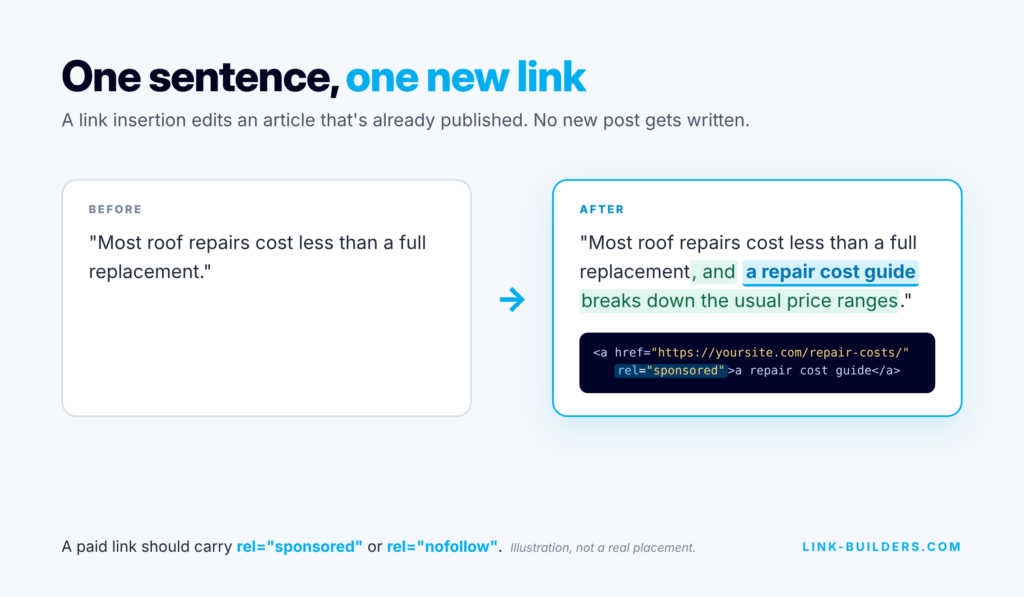
Here is a made-up example. The original sentence on a home improvement blog reads: “Most roof repairs cost less than a full replacement.” After a link insertion it reads: “Most roof repairs cost less than a full replacement, and [a repair cost guide] breaks down the usual price ranges.” In the HTML, a paid version should look like <a href="..." rel="sponsored">.
What it isn’t
It isn’t a guest post, because no new article gets written. It isn’t a directory listing or a link from a network built only to sell links. And it isn’t always paid.
How a link insertion works, step by step
Every insertion I place follows the same path:
- Pick the page on your site that deserves the link.
- Find existing articles that already cover that topic.
- Vet each page (the checklist is below).
- Contact the site owner, or a seller who works with that owner.
- Agree in writing on the sentence, the anchor text, the target URL, the rel attribute, and the price if there is one.
- The owner edits the article and sends you the live URL.
- Check the link and keep tracking it.
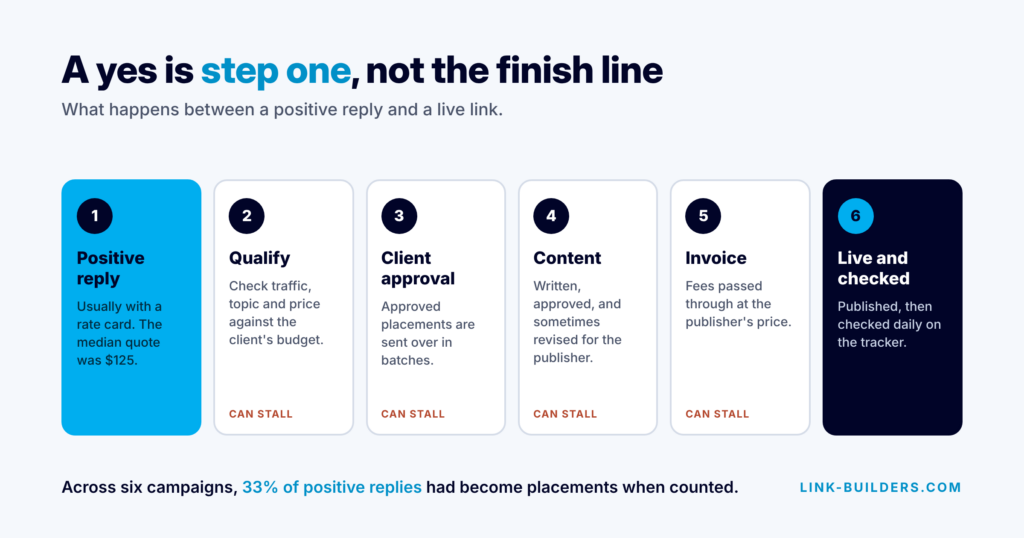
Steps 5 and 6 are where most links stall. In my campaigns the gap between “yes” and a live link came from client approvals, content revisions, invoices going back and forth, and publishers changing their price partway through. About two out of every three positive replies had not become a link when I counted.
Link insertions vs guest posts vs other link types
The right format depends on the page you want to link to and the articles that already exist. Here’s how the common types of backlinks compare.
| Link type | New content needed? | Who controls the context | Price pattern | Best when |
|---|---|---|---|---|
| Link insertion | No | The existing article and its owner | Often a fee; sometimes free | A relevant article already ranks and gets traffic |
| Guest post or sponsored post | Yes, a full article | You write it, the editor approves | Usually a fee plus writing time | Your page needs explaining, or no fitting article exists |
| Resource page link | No | The page owner | Often free | You have a genuinely useful guide or tool |
| Broken link replacement | No | The page owner | Often free | A dead link points to content like yours |
| Unlinked mention | No | The page owner | Usually free | The site already names your brand |
| Digital PR | Yes, a story or data | Journalists | Campaign cost, no per-link fee | You have news or original data |
Pros and cons of insertions
The upside: the page already has age, links and sometimes traffic, so you can see what you’re getting before you pay, and there’s no article to write. The downside: you don’t control the surrounding text, and much of the inventory sold as “niche edits” sits on sites with no real traffic.
Are insertions cheaper than guest posts?
It depends on whose numbers you read. Ahrefs asked 450 sites to sell a link in existing or new content. The average paid niche edit came to $361.44. Guest posts pitched to 180 sites averaged $77.80, based on the fees owners sent back (Ahrefs; an older study with two different samples). A 2026 marketplace study found the opposite: insertions averaged $179 against $461 for guest posts (BuzzStream). The next section explains why both can be true.
What a link insertion costs in 2026
Prices you’ll find online run from $50 to over $1,000. The spread makes sense once you see what each number measures.
Why published prices disagree
| Source | What it measures | Sample | Figure |
|---|---|---|---|
| Marketplace study (BuzzStream, updated Aug 18, 2026) | Listing prices set by sellers | 421,259 sites; insertions offered on 62,916 (14.9%) | $179 average |
| Ahrefs outreach test (older) | Quotes from sites asked to sell a link | 450 sites; 12.6% willing to sell | $361.44 average |
| My campaigns (counted Oct 3, 2026) | Quotes after a positive reply | 576 replies with a clear dollar figure | $125 median |
| My campaigns (counted Oct 3, 2026) | Fees actually paid | 226 tracked placements | $115 median |
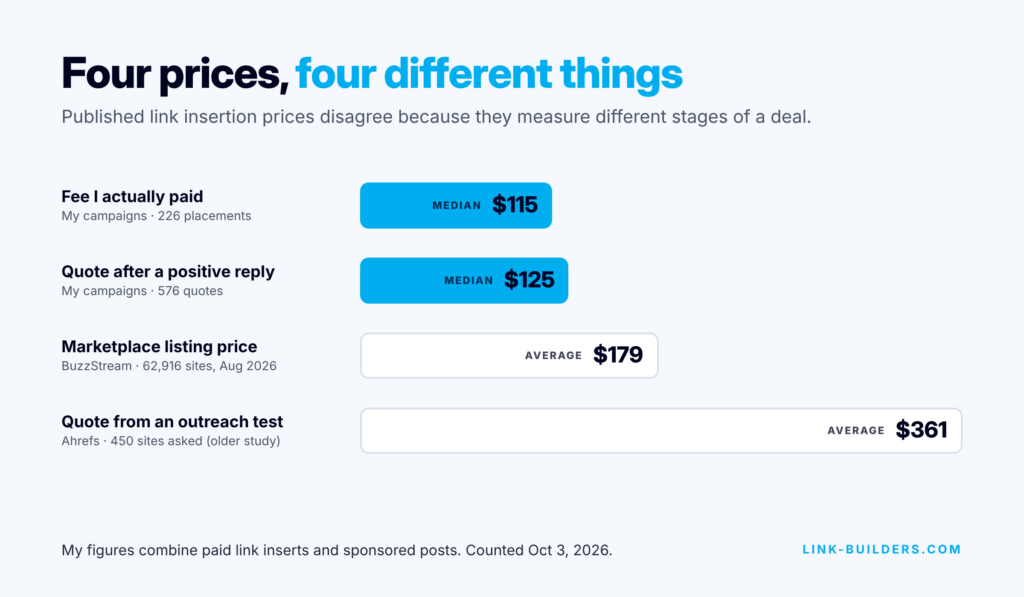
A listing price is what a seller hopes to get. A quote is what an owner asks when someone reaches out. A fee paid is what a buyer agreed to after vetting and, sometimes, negotiating. I think the fee paid is the most useful number for budgeting, and it’s the one almost no public source shows.
What my 681 positive replies asked for
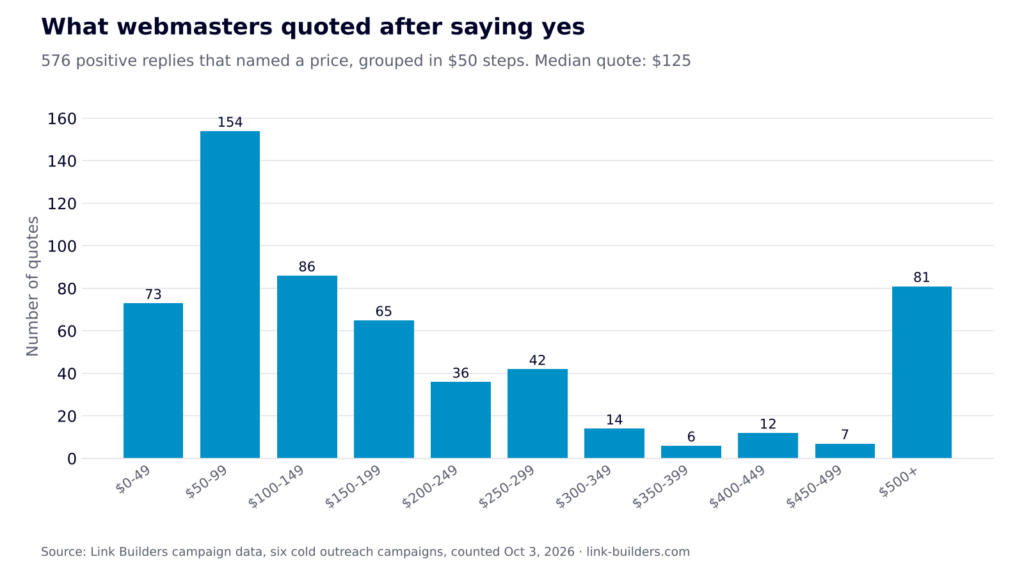
Across six cold outreach campaigns in six industries, 681 site owners replied with interest. 86% of those replies came with a price. Of the 576 replies with a clear dollar figure:
- The median quote was $125.
- A quarter came in under about $67, and a quarter came in above $250.
- 81 quotes, about one in seven, were $500 or more. 41 were $1,000 or more.
The fee I actually paid was lower. Across 226 tracked placements, the median fee paid was $115, and the middle half of fees fell between $75 and $156. Part of the gap is that cheaper yeses close more often. Part of it is negotiation: when a quote is higher than the link is worth, I ask whether there’s room on the price, and sometimes there is.
One campaign shows how much price matters. Its median quote was $695, and only 14% of its positive replies became placements. The links that did close cost around $150 at the median. The expensive yeses stayed in the spreadsheet.
Price by authority and traffic
The marketplace study breaks listing prices down by Domain Rating (DR) and by site traffic. Prices climb with both, but not as fast as you might expect.
| DR band | Average listing price | Monthly site traffic | Average listing price |
|---|---|---|---|
| 0 to 9 | $113 | 0 to 100 | $137 |
| 20 to 29 | $188 | 1.1k to 10k | $259 |
| 40 to 49 | $197 | 10k to 50k | $332 |
| 70 to 79 | $411 | 50k to 100k | $419 |
| 80+ | $461 | 100k+ | $510 |
The same study found 97.5% of sites selling insertions were low quality by its definition. Only 143 sites (0.34%) were high quality and sold one. That matches what I see.
What moves the price
- Traffic to the exact page, not just the site
- How closely the article matches your topic
- How many outbound links the page already carries
- Whether the owner adds new text or only a link
- Whether the link is marked sponsored or nofollow
- Whether you deal with the owner directly or pay a reseller’s markup
How my 226 placements closed
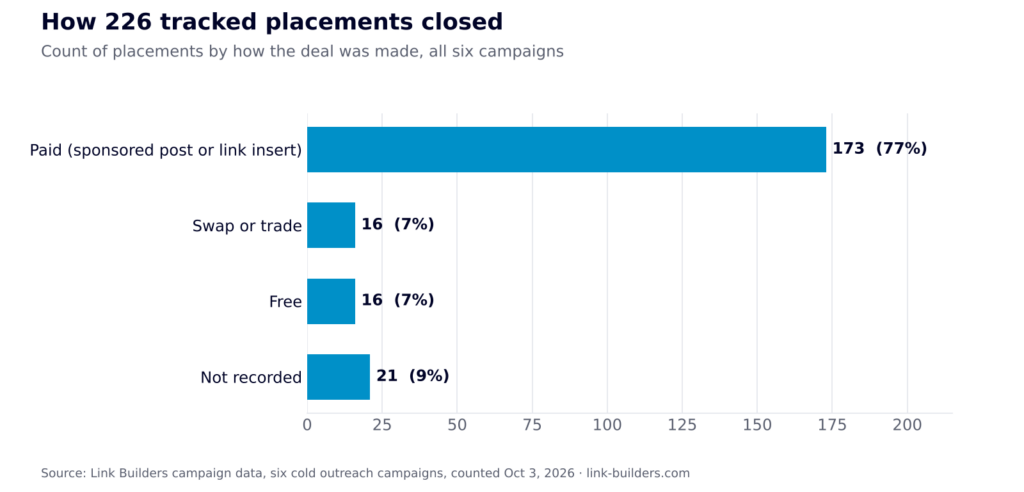
About 77% involved a fee, mostly sponsored posts and paid link inserts. About 7% were swaps or trades, about 7% were free, and about 9% don’t record how they closed. I don’t split insertions from sponsored posts in this data, because my spreadsheets record both as placements and I won’t guess at a split.
How I charge
I don’t sell links one by one. Clients rent my time: 30 hours at $160 an hour, paid up front. Publisher fees are separate and passed through at cost with no markup, and every quote sits in a shared spreadsheet so the client decides what to buy.
Honest limits of my numbers
These are past results from six campaigns. They are not a forecast, and they don’t promise anything about rankings or traffic. A script sorted the replies, so treat the figures as close counts. Not every tracked placement has been confirmed live. The full method is in 681 Webmasters Said Yes.
Is buying a link insertion safe? What Google says
Google’s spam policies define link spam as “creating links to or from a site primarily for the purpose of manipulating search rankings.” The first example on the list is “Buying or selling links for ranking purposes,” which includes “Exchanging money for links, or posts that contain links” and “Exchanging goods or services for links.”
The same page also says: “Google does understand that buying and selling links is a normal part of the economy of the web for advertising and sponsorship purposes. It’s not a violation of our policies to have such links as long as they are qualified with a rel=”nofollow” or rel=”sponsored” attribute value to the <a> tag.” (Google spam policies)
Google’s guide to qualifying outbound links asks sites to mark “advertisements or paid placements” with rel=”sponsored,” and notes that nofollow “is still an acceptable way to flag them, though sponsored is preferred.” Since 2019, Google has treated sponsored, ugc and nofollow as hints rather than strict rules (Search Central blog).
What this means in practice
The publisher controls how its own links are marked, not the buyer. I accept sponsored and nofollow links as part of a natural mix, and I don’t treat a link as worthless because it carries one of those labels. The safest placements are the ones a site would be comfortable explaining to its own readers: a relevant site with real traffic and content that helps the people who read it. If a placement only makes sense because of the link, I skip it.
What I won’t claim
No one can promise that a paid link will help rankings, or that it won’t cause trouble. I won’t. If you want the background on how Google spots link patterns, I covered it in my article on the link spam detection patent and my breakdown of the September 2026 spam update.
How to vet a link insertion before you pay
The most common mistake I see is a buyer who checked the domain and never looked at the page. Check these 10 things before money moves:
- The exact URL is indexed. Search Google for site: plus the URL. If it doesn’t show up, stop.
- The page has organic traffic of its own. Look up the page, not the domain, in Ahrefs or a similar tool.
- The article is really about your topic. Would its readers click your link because it helps them?
- The page looks maintained. Recent updates and a working layout are good signs.
- Outbound links are reasonable. A page stuffed with links gives each one less attention.
- The rel attribute is stated in writing. Ask whether it will be sponsored, nofollow, or unmarked.
- You saw the exact page before paying. Never pay for a “DR 50 site” you haven’t seen.
- The sentence and anchor are agreed. Natural wording, and no repeated exact-match anchors.
- You’ll get the live URL. Then check it yourself.
- Removal terms are in writing. How long the link stays, and what happens if it goes.
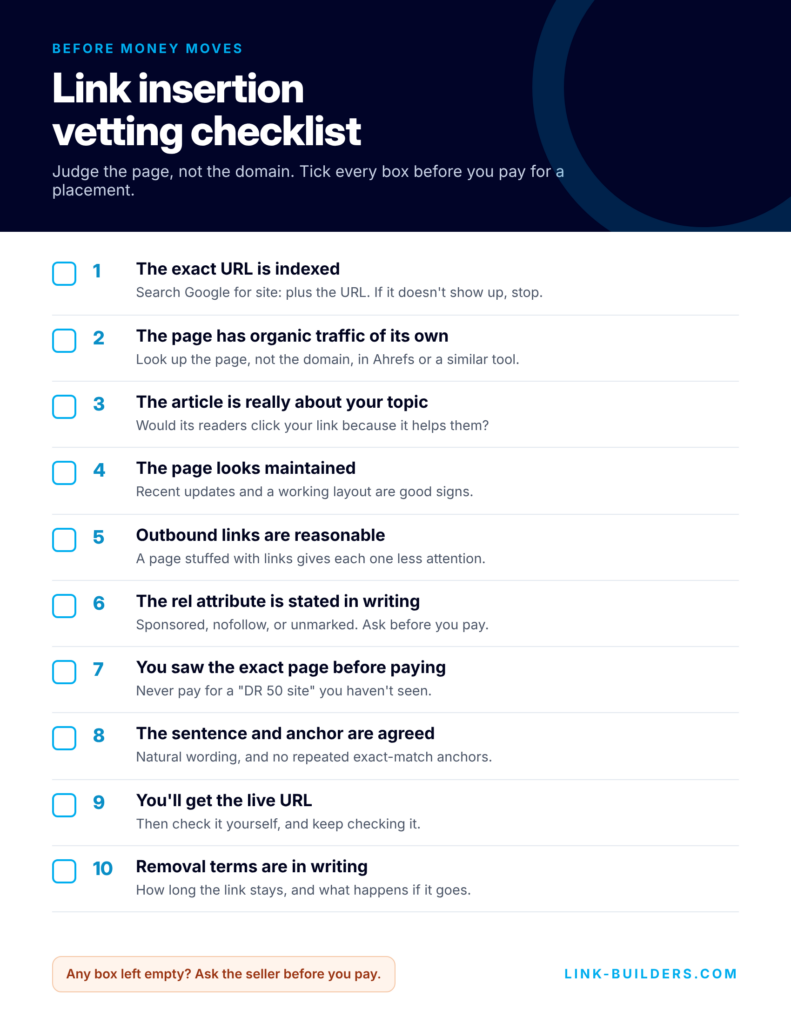
Download the printable checklist (PDF)
Page metrics first, domain metrics second
DR tells you about the site. It tells you nothing about whether the article you’re buying into gets read. I look at page traffic and topic first, and I treat DR as a tiebreaker. A modest site with a well-read article on your exact topic usually beats a famous domain with an orphaned page.
Seller red flags
- Won’t show the sites before payment
- Quotes DR and nothing else
- Promises rankings
- Can’t say how the link will be marked
- Sells bundles with no per-page price
- Reports without live URLs
The free link insertion quote checker
I built a Google Sheet that does the arithmetic for you. Paste in a quote, the link type, DR, page traffic, outbound links and the rel attribute, then answer the 10 vetting questions. It shows where the price sits against the fees I paid, against the quotes I received, and against the marketplace averages for that DR and traffic band. It also lists plain-language flags, such as a missing rel attribute or a page with no traffic.
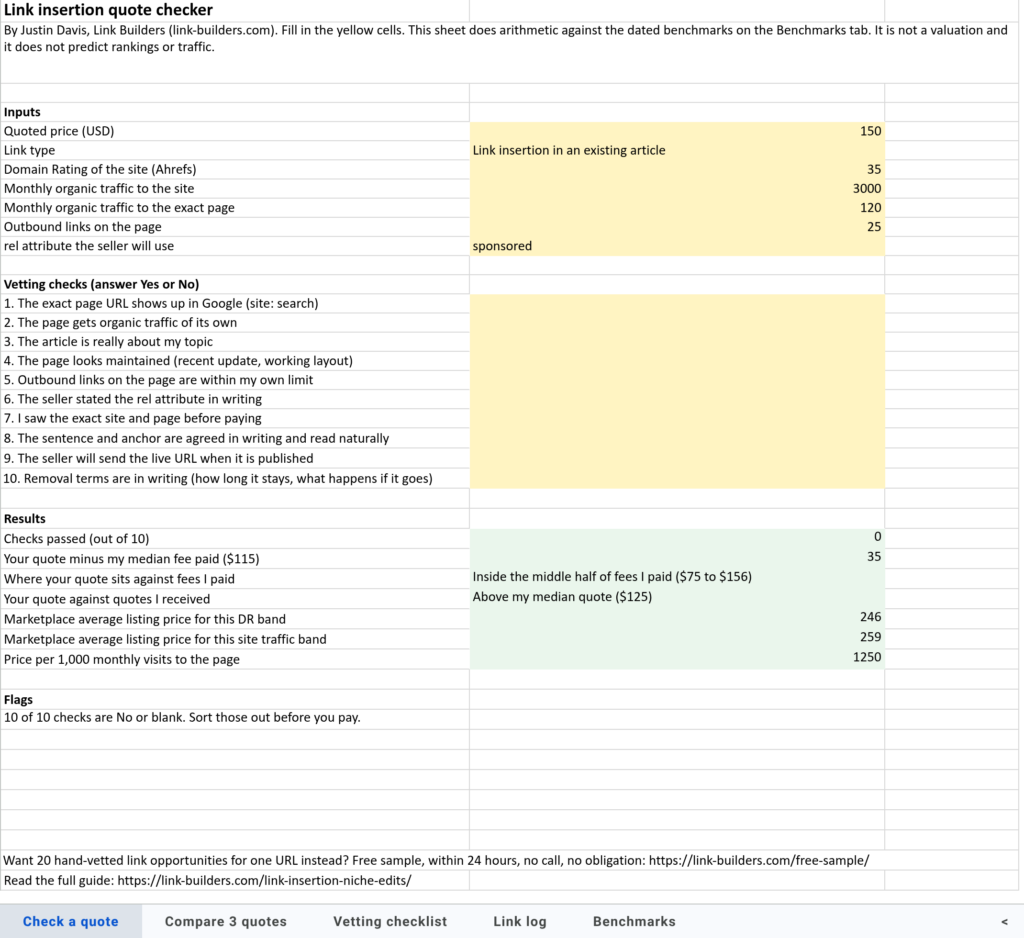
Make your own copy of the quote checker. No email needed. It’s arithmetic against dated, sourced benchmarks, not a valuation. Other quote tools exist. This one is built on fees a buyer actually paid and pairs the price with a vetting score.
Can you get a link insertion for free?
Sometimes. About 7% of my 226 tracked placements were free. They came from resource pages, from broken links we pointed out, and from owners who added a link on their own after reading our email. The free ones came from the most topical targets almost every time. The closer the match, the less you have to pay for the yes.
The four free routes I use most:
- The missing source. The article makes a claim your page supports with better detail.
- The dead link. The page links to something that no longer exists, and your page covers it. My 15 tactics post walks through broken link and resource page outreach.
- The resource page. A list of guides on your topic that genuinely helps its readers.
- The unlinked mention. The site already names your brand without a link.
When something other than money closes the deal
One campaign could offer things besides cash, because the client sold physical products. Only 56% of its positive replies came with a price, the lowest in the set, and it turned 64% of its replies into placements, the best rate I saw. Some owners linked in exchange for store credit or a gift card they could use. Others had several sites of their own and wanted to set up link exchanges. Of its 48 placements, 15 were swaps or trades and 5 were free.
Google’s list of link spam includes “Exchanging goods or services for links,” so a trade is held to the same standard as a payment. It still needs to be relevant and useful to readers.
The ABC link swap: when money isn’t the point
Some site owners won’t take money for a link. A $100 fee doesn’t move them. What they care about is results for their own website, and what they want is a link back. For those owners, a trade is sometimes the only option.
A direct swap, where site A links to you and you link back to site A, is a pattern search engines can spot easily. So I set it up differently. I find a third site in the same industry, site C, where I can secure a link, usually for around $100 or less. Site C links to the owner’s site A. In return, site A links to my client. Nothing points straight back and forth.
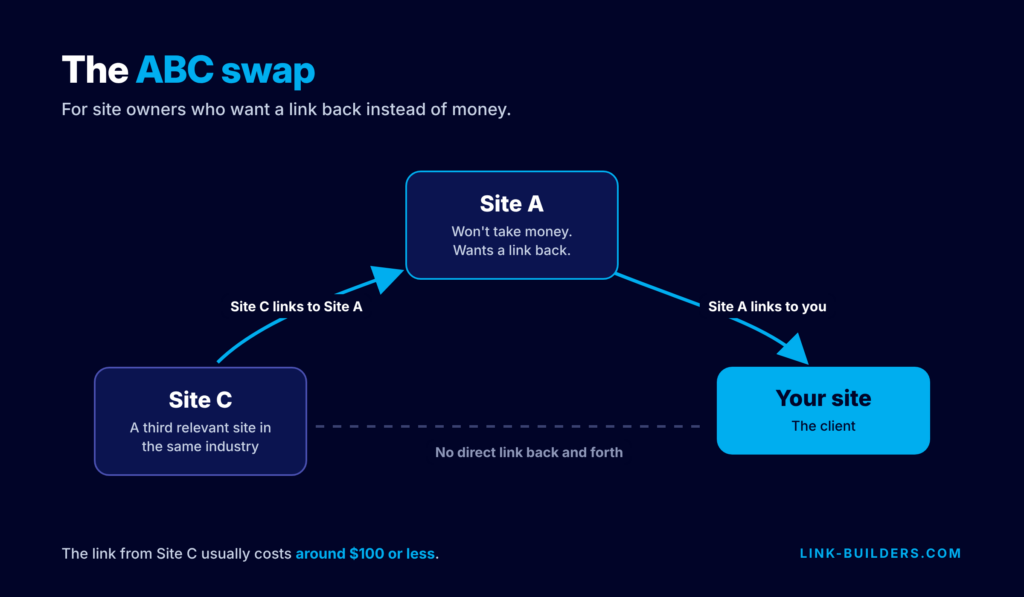
It takes more coordination than paying a fee, but it opens doors money doesn’t. In my campaigns it lands links every week with site owners who would never answer a rate-card email.
What Google says about link exchanges
Google’s spam policy lists “Excessive link exchanges (“Link to me and I’ll link to you”) or partner pages exclusively for the sake of cross-linking” as an example of link spam. Changing the shape of a swap doesn’t change the question Google asks: was the link created mainly to manipulate rankings? So I won’t tell you an ABC swap is safe. Here is how I keep it defensible:
- Relevance first. All three sites belong in the same industry, and each link helps the reader of the page it sits on.
- Not excessive. It’s one tool among many, used for owners who won’t take money, not a link scheme run at volume.
- Never a direct A-to-B swap. No reciprocal links between the two sites making the deal.
- Real pages. Site C must pass the same 10 checks as any paid placement.
How to find pages worth a link insertion
The best targets are articles that already rank for your topic. I find them with:
- Search operators, such as your topic plus “guide” or “best,” limited by intitle: or inurl:. My guide to boolean search operators has the full list, and my free backlink builder tool writes the queries for you.
- Pages linking to competing resources, pulled from Ahrefs.
- “Best of” lists that leave you out.
- Pages that AI answers already cite for your topic. I explain how to find those in my post on AI citation outreach.
How to ask for a link insertion (two templates)
Point to the exact article and the exact sentence, and say why the link helps that page’s readers. Here are two short templates I’ve written for this guide. Change every bracket.
Template 1: the free ask
Subject: A source for your [topic] article
Hi [name],
I read your article “[title]” and liked the section on [specific point]. Where you mention [claim], readers might want [what your page adds, in one line]. I put that together here: [URL].
If it fits, it could sit after the sentence “[exact sentence].” Either way, thanks for a useful piece.
[Your name]
Template 2: the price-aware ask
Subject: Adding a source to “[title]”
Hi [name],
Your article “[title]” covers [topic] well, and I think [your page] would help readers at the part about [specific point]. Would you consider adding a link there? If you offer paid placements or advertising options, please send your rates and tell me how the link would be marked.
[Your name]
When the reply is a rate card
Ask for the exact page URL, the rel attribute, who writes the sentence, and the delivery date. Then run it through the quote checker. If the owner goes quiet after saying yes, follow up, but I stop after about three tries over two months.
For context on how many people answer at all, my response rates ranged from 5.4% to 27.6% across 6,657 prospects.
Marketplace, agency, or do it yourself?
| Route | Your effort | See the page before paying? | Price transparency | Best for |
|---|---|---|---|---|
| Marketplace | Medium: you filter and vet | Usually | List price shown, quality varies | Buyers who vet well and need volume |
| Agency or link builder | Low | Depends on the provider | Varies; ask for fees at cost | Teams that want someone else to find, vet and negotiate |
| Do it yourself | High | Yes | Full | Small numbers of precise links |
Hiring someone works when they show you every site, quote and placement. Before you hire anyone, read my four questions to ask a link builder and my comparison of in-house vs outsourced link building.
How I work
I find the pages, vet them, and handle the outreach and negotiation myself. Every client gets a shared spreadsheet with every site, every reply, every quoted price and every placement. I qualify replies in batches and send over the placements I’d actually recommend, so the client can compare them side by side. I check every live link daily, and if one disappears I email the site owner to ask why. I don’t promise replacements, rankings or traffic. Agencies can resell the same work through white label link building.
Which one should you choose?
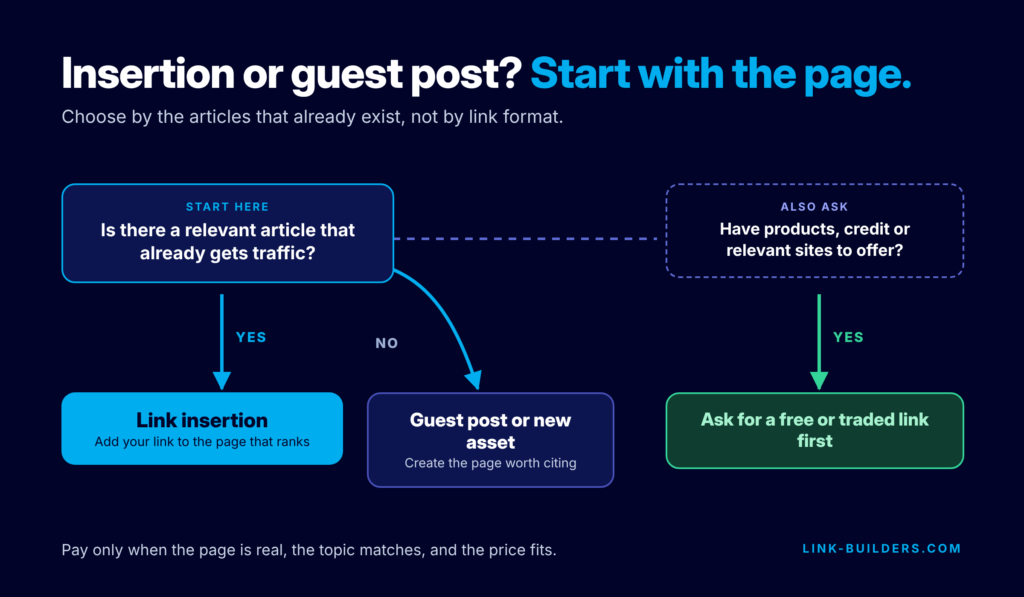
Choose by the page you want to rank and the articles that already exist, not by format. Ask three questions:
- Is there an existing article on your topic that gets traffic? If yes, an insertion fits. If no, a guest post or a new asset fits better.
- Does your page need explaining, or just a pointer? Explaining favors a guest post.
- Do you have something besides money to offer? Products, credit or relevant sites open free and traded links.
| Situation | What usually fits |
|---|---|
| SaaS or B2B | Insertions in comparison and how-to articles that already rank |
| Local business | Local resource pages and local news, plus insertions on regional sites (local link building) |
| Law firm | Relevant legal and local sites, with extra care because of lawyer advertising rules (law firm backlinks) |
| Agency reselling | A provider who shows every site and passes fees through at cost |
| In-house team | Insertions for precise pages, outsourced prospecting for volume |
Budget, timing, tracking, and lost links
Set the budget from the page you need to move, not from a link count. As an illustration with round numbers, not market data, a $1,500 fee budget at $125 a placement buys about 12.
Timing depends on approvals, content, invoicing and price changes, so I don’t promise turnaround or ranking dates.
Track every placement: live URL, date live, anchor, rel attribute, price, page traffic at purchase, and the last date you checked it. The quote checker has a link log tab for this. If a link disappears, ask the site owner why. Get removal terms in writing from any seller before you pay.
Measure referral visits and how your target page moves over time. A link can’t guarantee either.
Link insertions and AI search
AI answers pull from pages that are already strong. In my study of 1,329 Google AI Overview citations across 208 queries, page-one results with zero referring domains were cited 8% of the time, while pages with more than 1,000 referring domains were cited 47% of the time. Only 36% of citations went to pages ranking on page one for that query (full study).
So look for insertion targets among pages AI answers already cite for your topic. I can’t say an insertion will cause a citation, but it’s a sensible place to start. More in how to get cited by AI, or see how I run off-site GEO work.
Mistakes that waste money
- Buying on DR alone
- Skipping the site: check on the exact URL
- Accepting a placement without knowing the rel attribute
- Repeating exact-match anchors
- Paying a high quote for a loosely related page when a closer match costs less
- Treating a positive reply as a link
- Never checking the link again after it goes live
When not to buy a link insertion
- Your target page isn’t worth linking to yet. Fix the page first.
- No relevant article exists. Use a guest post or create something worth citing.
- The seller won’t show the exact page.
- The only reason the placement makes sense is the link.
- The money would do more as a free outreach campaign to the most topical sites.
My take
Link insertions work when the page is real, the topic matches, and the price fits what the page delivers. Much of the market sells cheap placements on sites nobody reads. Vet the page, know what fees actually look like, and use trades when money isn’t the point.
That’s the work I do every day as part of my link building services. If you want to see how I’d approach your site, send me one URL. Within 24 hours I’ll send back 20 hand-vetted link opportunities for it, with the right contact and why each one fits. No call, no obligation. Or copy the quote checker, see how I price my time, or contact me.
Link insertion FAQ
What is a link insertion?
A link added to an article that is already published on another site. The owner edits or adds a sentence so it points to your page. It’s also called a niche edit.
Are link insertions and niche edits the same thing?
Yes. Sellers usually say “niche edit” and publishers usually say “link insert.” Both mean a link placed in existing content.
How much does a link insertion cost?
In my campaigns the median quote was $125 and the median fee I paid was $115, combining paid link inserts and sponsored posts. A 2026 marketplace study put the average listing price at $179. Price rises with traffic, relevance and authority.
Is buying backlinks illegal?
No. It’s a search engine policy issue, not a legal one. Google’s spam policy treats links bought for ranking as link spam, and says paid links are fine when marked rel=”sponsored” or rel=”nofollow.”
Is a link insertion safe for SEO?
No one can promise that. Google asks sites to mark paid links as sponsored or nofollow. I lower risk by choosing relevant sites with real traffic, and I skip any placement that only makes sense because of the link.
Link insertion or guest post: which is better?
Neither is better in general. An insertion fits when a relevant article already ranks. A guest post fits when your page needs explaining or no fitting article exists. Choose by the page, not the format.
Is it worth buying backlinks?
Sometimes. A placement on a relevant, well-read page can be. A cheap link on a site with no traffic usually isn’t.
How do I tell if a link insertion is good?
Check that the exact page is indexed, gets its own organic traffic, matches your topic, and isn’t stuffed with links. Get the sentence, anchor, rel attribute and removal terms in writing.
Should a paid link insertion be sponsored or nofollow?
Google prefers rel=”sponsored” for paid placements and still accepts rel=”nofollow.” The publisher decides how its links are marked. I accept both as part of a natural mix.
Can I get a link insertion for free?
Yes, sometimes. About 7% of my tracked placements were free, mostly from resource pages, broken links I pointed out, and owners who added a link after reading my email.
How long does a link insertion take to go live?
It depends on the owner’s approvals, content changes and invoicing. Agree on a delivery date in writing.
What happens if the link is removed?
Ask the site owner why. That’s why removal terms in writing matter. I check client links daily and email the owner when one disappears, but I don’t promise replacements.
Are backlinks still relevant in 2026?
Yes. In my study of 1,329 AI Overview citations, pages with more referring domains were cited far more often.
Do link insertions help with ChatGPT and Google AI answers?
Not directly, and I can’t promise a citation. But AI answers favor pages that are already strong, and a link from a page AI tools already cite is a sensible target.
How many link insertions do I need?
There’s no fixed number. Compare your target page with the pages that rank above it, then budget from the gap.
Sources and method
My figures come from six cold outreach campaigns, counted with a script on October 3, 2026, and published in 681 Webmasters Said Yes. Paid link inserts and sponsored posts are combined. Third-party figures come from BuzzStream’s link insertion cost study (updated August 18, 2026) and Ahrefs’ study on buying backlinks (an older study). Google quotes come from its spam policies, its guide to qualifying outbound links, and its 2019 post on link attributes, all checked November 23, 2026.
About the author

Justin Davis is the founder of Link Builders, which offers link building services to companies and white label link building to agencies, and has been building links since 2015 for more than 150 clients in law, healthcare, real estate, software and other industries. After years of doing prospecting research by hand, he built an AI agent link building system that handles each step, from finding link opportunities and vetting sites to finding contacts and preparing outreach. He now works every project himself, running that system for agencies and in-house SEO teams, earning the links and mentions that help their clients show up in Google and in AI answers, and teaches it on YouTube. He also built AnswerBuilders, the AI visibility platform Link Builders uses to find the pages AI answers cite. Find Justin Davis on YouTube, LinkedIn and X.