15 Proven Tactics to Get More Backlinks
Updated on · Originally published
By Justin Davis, Link Builders
Backlink building can look complicated, but it isn’t rocket science. Anyone can learn it, and the best place to start is with tactics that have worked for years. Pick one or two, learn how they work, then add more. Here are 15 ways to get more backlinks, from the easiest wins to the ones that take real effort.
A note on tools: most of these use Ahrefs, because it’s the tool Link Builders relies on most for prospecting. The main reports below (Link opportunities, Link Intersect, Content Explorer and Best by links) were checked against Ahrefs’ own help pages in October 2026. If you use Semrush instead, most steps have an equivalent. Here’s how the two compare in Semrush vs Ahrefs for link building.
1. Internal links
SEOs often neglect this one, and that’s a big oversight. Linking to a page from other pages on your own site can boost the pages that should be getting more traffic. You also have full control over these links, which you never have with external ones.
Start with pages ranking in positions 2 to 4 for their target keyword. They have the most room to gain. In Ahrefs, find them in the Organic keywords report in Site Explorer and filter by position. Then open the Link opportunities report in Site Audit, set the search mode to Target page, and paste in the page’s URL. You’ll see pages on your site that mention the page’s keywords but don’t link to it yet.
2. Pitch link roundups
A link roundup is a curated list of the best new content in an industry from the last week or month. If your content would fit one, all you need is an author willing to feature it. To find roundups, search your topic in Google along with these Google search operators:
intitle:"roundup" OR intitle:"round up"
Then open Tools under the search bar and set the date range to the past month or past year. That keeps the results current without hard-coding a year into the query. Pitch the roundups that are still published regularly and fit your topic.
3. Use existing memberships
This is one of the easiest ways to build backlinks. If you belong to a club, community or organization, there’s a good chance it will mention you, and link to you from a member, team or advisory board page, if you ask. Write down every group you’re part of: a law association, a local charity, a school parent advisory board. If they have a relevant page, this search will find it: site:theirwebsite.com intitle:team OR advisory. If a link there would bring your target audience to your site, ask for it.
4. Pursue link gaps
A link gap analysis shows you sites that link to your competitors but not to you. Those links are often easy to replicate, because a site that links to two of your competitors may well link to you too.
In Ahrefs, open Link Intersect under Competitive Analysis. Choose referring domains, enter your site, and add up to 10 competitors. Then click “Show link opportunities.” Sites that link to several of your competitors are the strongest leads. For example, you might find a podcast that has interviewed two of your competitors but not you. You fit the show’s theme, so you could pitch yourself as a guest.
5. Unlinked mentions
This is more low-hanging fruit. An unlinked mention is a page that has already mentioned your brand but doesn’t link to your site. The writer is already comfortable talking about you, so half the work is done. All that’s left is to get in touch and ask for the link.
In Ahrefs Content Explorer, search your brand name and add -site:yourwebsite.com so your own pages don’t fill the results. Turn on “One page per domain,” then enter your domain under “Highlight unlinked domains.” Sites that have never linked to you are highlighted. Export the list with “Only pages with highlighted domains” ticked. The highlight works at the domain level, so open each page and check it before you email. Content Explorer is on Ahrefs’ Standard plan and up.
Unlinked mentions matter even when they stay unlinked. AI tools read text, so a page that names your brand next to your topic still helps AI answers connect the two.
6. Podcast interviews
The interview itself will probably take about an hour, but the episode isn’t the point. The host should also link to your site and social profiles from the episode page. To find podcasts to pitch, search Google for the most popular podcasts in your industry. Listicles help, and Google often shows a podcast carousel above the regular results. Skip any show that doesn’t consistently link to its guests.
Prolific guests can point you to the best shows. If you keep seeing someone’s name as a podcast guest, paste their homepage into Ahrefs’ Site Explorer, choose “Exact URL” mode, and open the Backlinks report. Filter the referring page title for “episode,” and you’ll have a list of shows to work through.
7. Guest blogging
If you pick the right websites, a guest post with proper attribution can earn a link that sends readers to your site. The site has to be one that publishes for its readers, not one that exists to sell posts. Ahrefs’ Content Explorer can help you find sites that accept guest posts. Enter a keyword in your area of expertise and search in titles. Then narrow the results with filters like these:
- Domain Rating of 30 or more
- Website traffic of 5,000 or more
- Published within the last 90 days
Turn on “One page per domain” so you don’t contact the same site twice.
8. HARO, Connectively and other journalist requests
HARO (Help a Reporter Out) connects journalists with expert sources. It can earn high-quality links, because the journalists ask for the responses. You’re not pitching cold. HARO has been through a lot since 2024, so here’s where things stand:
- December 9, 2024: Cision permanently discontinued Connectively, the platform HARO had been rebranded into.
- April 2025: Featured.com bought HARO and brought back the free email service. Emails restarted on April 22, 2025, and it stays free for journalists and sources.
- May 2026: Featured revived Connectively as a separate platform for finding and answering journalist requests. HARO still runs alongside it.
If you’d rather get requests by email, sign up for HARO as a source. Most requests won’t fit your expertise, so set up an email filter that only keeps the topics you can speak to. If you’d rather search and filter requests in one place, use Connectively. Either way, only answer requests you’re genuinely qualified for, and answer the question the journalist actually asked.
9. Pitch “Best X in Y” listicles
“Best X in Y” listicles name the leading businesses in an industry or area. Any list that doesn’t include you is an opportunity. This search will get you started: Best BUSINESS TYPE in LOCATION -"YOUR BUSINESS NAME". Don’t pitch in the first email. Introduce your business and invite the author to get to know it. Once you have a working relationship, make the ask.
10. 301 redirect link building
Some pages still get links to URLs that now redirect somewhere irrelevant. If you can offer a fitting replacement, it’s an easy sell. Nobody wants to send readers to what is basically a dead page. To find these in Ahrefs, enter a niche site in Site Explorer, open the Best by links report, and set the HTTP code filter to 301. The irrelevant redirects are usually obvious from the list, but open the pages to confirm. Some of them still have plenty of referring domains, so they’re a good place to start.
11. Broken link building
Broken link building works much like the last tactic, and it helps both you and the sites linking to dead pages. Find a dead page that still has links, publish a page on the same topic, and pitch your page to the sites linking to the dead one. They fix a broken link, and you get a backlink.
In Ahrefs, there are two ways to find them. In Content Explorer, search a topic, show only broken pages, and set a minimum number of referring domains, such as 10. Or enter a competitor in Site Explorer, open Best by links, and set the HTTP code filter to 404. The Backlinks report then shows who links to each dead page. Those are the sites to pitch once your replacement is live.
12. Resource page link building
Some pages exist to list helpful resources on a topic. If your page belongs on one, getting backlinks from it can be as simple as bringing your page to the owner’s attention.
To find resource pages, run one of these Google searches with a phrase related to your topic:
intitle:resources inurl:links.htmlintitle:resources inurl:resources.html
Ahrefs’ SEO Toolbar can export the results and show metrics like estimated search traffic and Domain Rating (DR), so you can sort them. Then check that each result really is a resource page that links to outside sites, find the right contact, and pitch your resource.
13. The Reverse Skyscraper Technique
Here’s how it works. Pick a strong piece of content you already have. Find similar but weaker content with lots of backlinks. Then contact the sites linking to the weaker page and ask if they’d like to link to yours instead.
To find opportunities, enter keywords related to your best content into Ahrefs’ Keywords Explorer and sort by Keyword Difficulty (KD), high to low. The SERP overview shows similar pages and how many links they have. If you can make a convincing case that your page is better, that’s your pitch to the sites linking to theirs.
14. The Skyscraper Technique
This is like the reverse version, except you create the content for the purpose. To make the pitch convincing, your page should do at least one of these better than the pages it’s competing with:
- Explain the topic more clearly
- Cover it in more depth
- Correct misleading or inaccurate claims
Search related phrases in Ahrefs’ Content Explorer and set the referring domains filter to at least 50. That shows pages with links from 50 or more sites, which is plenty to start with.
15. Get onto the pages AI answers cite
This one is new, and it’s growing fast. When ChatGPT, Perplexity or Google’s AI Mode answers a question, it cites a handful of pages. If your brand is named and linked on those pages, you have a better chance of showing up in the answer. Those cited pages are often not the ones ranking at the top of Google. Ahrefs found that only about 7% to 12% of the pages ChatGPT cites rank in Google’s top 10 for the same question. Here’s the full breakdown of the pages ChatGPT cites.
To use this tactic:
- Write down the questions your buyers ask before they choose a business like yours.
- Ask them in ChatGPT, Perplexity and Google’s AI Mode, and record every page cited. Ask each question more than once, because answers change from run to run.
- Keep the pages that are independent, editorial, on topic and still live. Drop pay-to-play pages and anything that exists only to sell links.
- Pitch those pages the same way you’d pitch a listicle or resource page. Make sure your brand name appears in the sentence around the link, not just in the anchor.
Here’s the longer playbook on how to get cited by AI.
The takeaway
Link building takes a while to learn, and longer to pay off for your site. Start with the easy wins: internal links, memberships and unlinked mentions. Then work up to the tactics that take more effort. If prospecting is where you get stuck, AI-assisted Boolean search can speed up the list-building part.
If you’d rather hand the hours to an SEO link builder, see how Link Builders runs campaigns in our link building process, and check current backlink pricing. Link Builders sells hours and process, not a guaranteed link count, and publisher fees pass through at cost. If you also want to show up in AI answers, the same work covers AI search optimization.
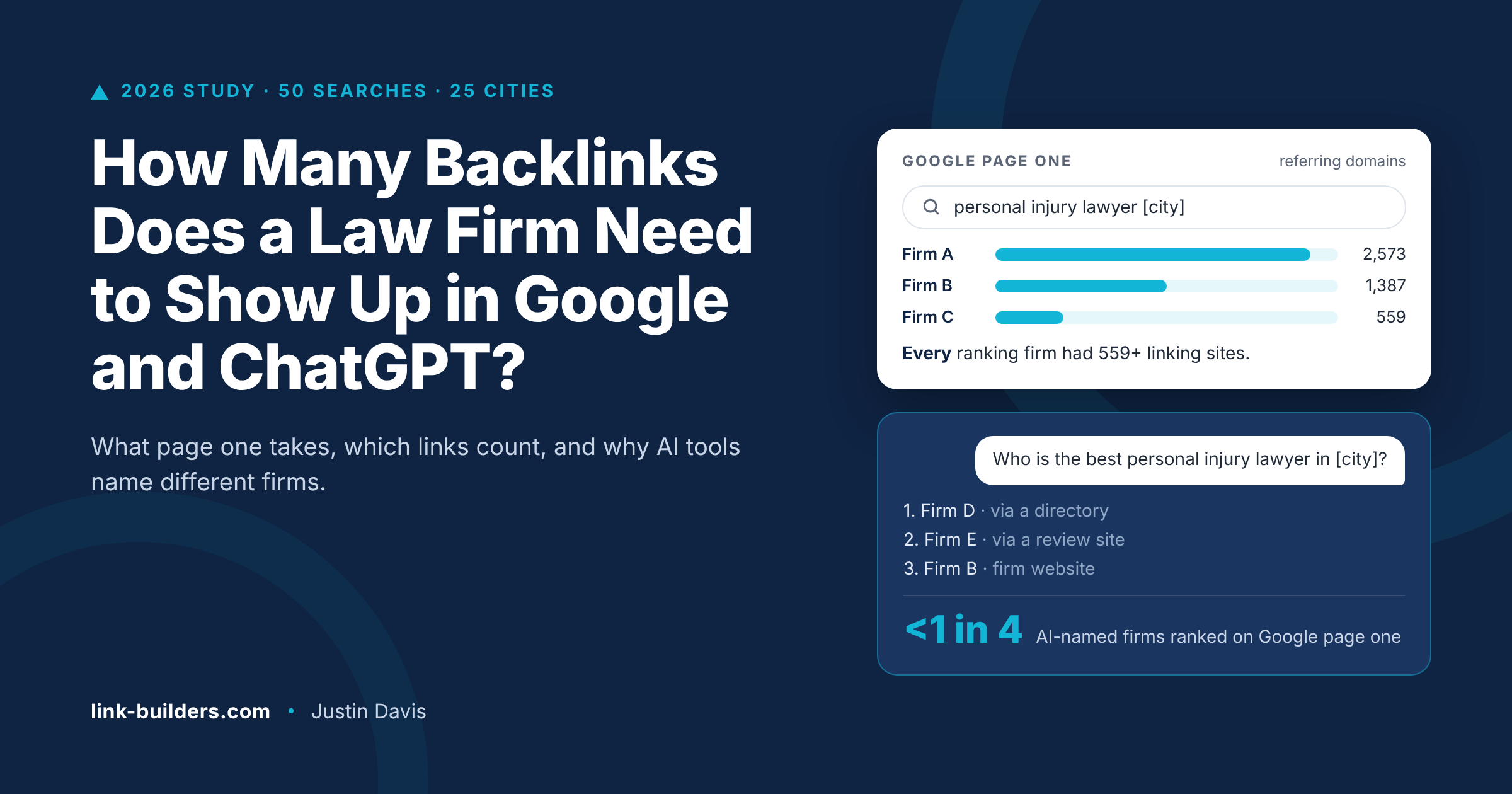
Related: How many backlinks do I need? For law firms, I also measured what page one and ChatGPT required in 50 searches.
About the author

Justin Davis is the founder of Link Builders, which offers link building services to companies and white label link building to agencies, and has been building links since 2015 for more than 150 clients in law, healthcare, real estate, software and other industries. After years of doing prospecting research by hand, he built an AI agent link building system that handles each step, from finding link opportunities and vetting sites to finding contacts and preparing outreach. He now works every project himself, running that system for agencies and in-house SEO teams, earning the links and mentions that help their clients show up in Google and in AI answers, and teaches it on YouTube. He also built AnswerBuilders, the AI visibility platform Link Builders uses to find the pages AI answers cite. Find Justin Davis on YouTube, LinkedIn and X.