How to Get Your Brand Cited by AI: A Link Builder’s Playbook for 2026
SparkToro and Gumshoe asked the same AI questions nearly 3,000 times. Fewer than 1 in 100 runs returned the same list of brands. There is no fixed number-one slot to chase, so most of the “rank in ChatGPT” advice aims at the wrong target.
What does move AI visibility looks familiar if you already do link building well. Get talked about on the sites AI trusts, make your pages easy to quote, and make sure AI systems can reach them.
I spent a 10-part video series walking through the research from Google, Microsoft, OpenAI, Anthropic, and independent studies. This post is the condensed playbook.
TL;DR
- Ignore the noise. Crawlability, clarity, and citability beat shortcuts like llms.txt and schema-as-AI-hack.
- Earn mentions where AI already looks. Branded mentions and YouTube talk beat raw backlink counts.
- Build for query fan-out. Cover the sub-questions Google’s AI splits off your main query.
- Write pages AI wants to quote. Lead with answers, real stats, expert quotes, and sources.
- Make your brand easy to recognize. One name, clear About and author pages, consistent facts in visible text.
- Measure visibility, not rankings. Track how often you show up across runs, then check access so one robots setting does not undo the rest.
Start Here: Most GEO Advice Is Noise
The AI companies do not publish a secret formula. Across their public guidance, they keep pointing back to three things: be crawlable, be clear, and be worth citing.
What Google, Microsoft, OpenAI and Anthropic actually say
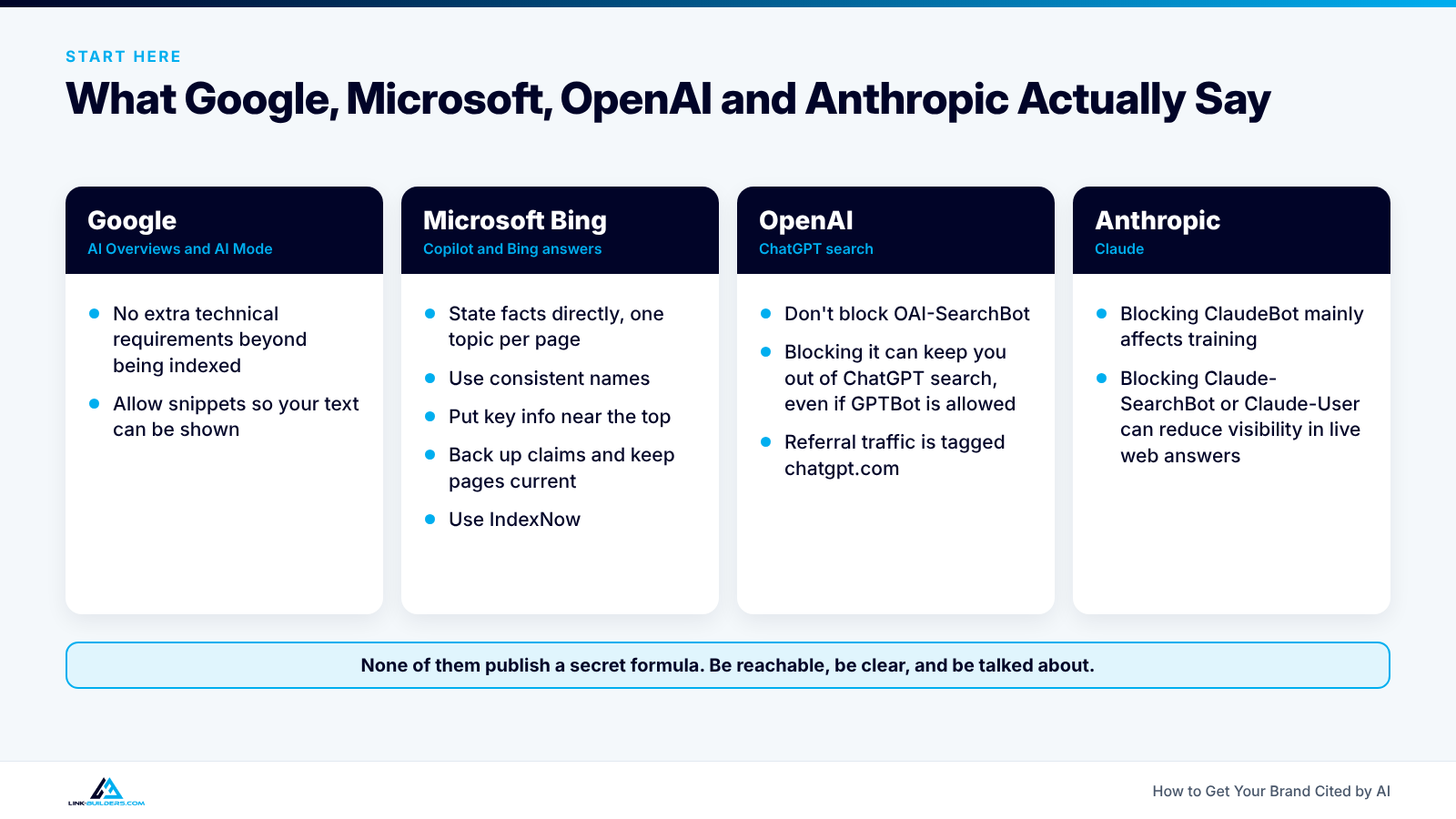
Google Search Central is blunt: there are no extra technical requirements for AI Overviews or AI Mode beyond being indexed and allowed to show a snippet. The same people-first practices that help Search still apply. That is what Google means by people-first content.
Bing has been the most specific. Its public AI guidance tells publishers to state facts directly, use consistent names, keep one topic per page, put key information near the top, back up claims, keep pages current, and use IndexNow so updates reach Bing and Copilot faster. Bing’s AI Performance report is also the clearest free look at how often your URLs get cited in Microsoft’s AI answers.
OpenAI’s publisher guidance is practical: do not block OAI-SearchBot if you want to appear in ChatGPT search. Visit traffic from ChatGPT often arrives tagged as chatgpt.com, which you can see in analytics. See OpenAI’s crawler overview and publishers FAQ.
Anthropic separates training from search. Blocking ClaudeBot mainly affects training. Blocking Claude-SearchBot or Claude-User can reduce visibility when Claude is answering with live web results. Check Anthropic’s current bot documentation before you change robots.txt.
The myths, with the data that tested them
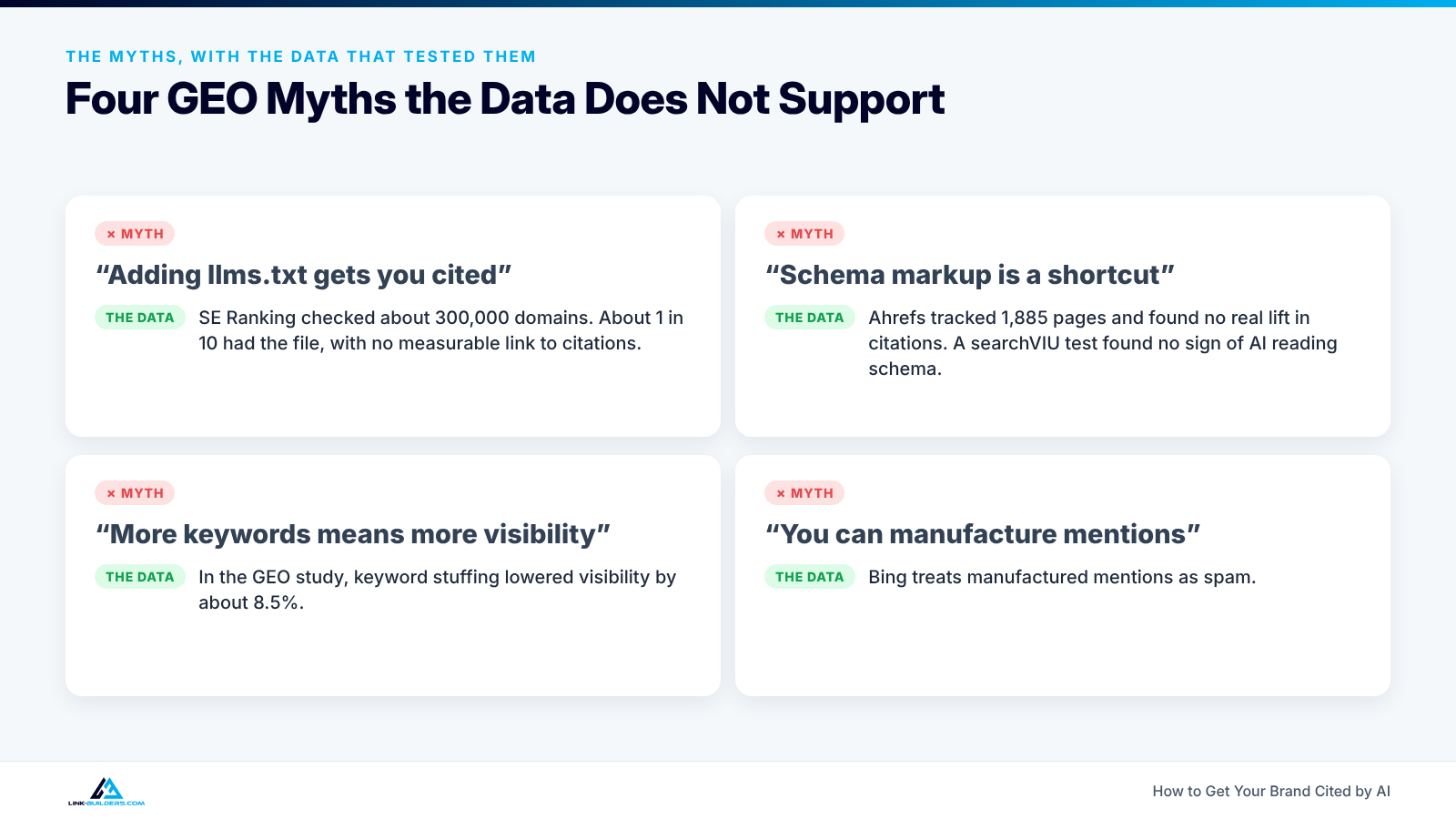
llms.txt. Google has said Search does not use it. SE Ranking checked about 300,000 domains; about 1 in 10 had the file, and there was no measurable link to AI citations.
Schema as an AI shortcut. Ahrefs tracked 1,885 pages that added schema and found no real lift in AI citations (Ahrefs schema study). In a live test from searchVIU, none of five AI assistants read the schema code on the page. Schema can still help search features and identity. It is not a GEO cheat code.
Keyword stuffing. In the original GEO paper, stuffing lowered visibility by about 8.5%.
Manufactured mentions. Bing treats manipulation as spam. Artificial “mention farms” are the opposite of earned media.
If you want the longer view on how AI changes link work without inventing new spam tactics, read building backlinks in an age of AI.
Step 1: Earn Mentions Where AI Already Looks
AI visibility follows what other people say about you. This is where link building does the most work.
Mentions beat raw backlinks, but the best links do both
In Ahrefs’ May 2025 study of 75,000 brands (AI Overview brand visibility factors), branded web mentions correlated at about 0.66 with AI Overview visibility. Branded anchors sat around 0.53, branded search around 0.39, and raw backlink count around 0.22.
The December 2025 follow-up across ChatGPT, AI Mode, and AI Overviews (brand visibility correlations) put YouTube mentions at about 0.74 on all three platforms. How often a brand was mentioned mattered more than how many views those videos got.
The gap is large. Brands in the top quarter by mentions averaged about 169 AI Overview mentions, against about 14 for the next quarter.
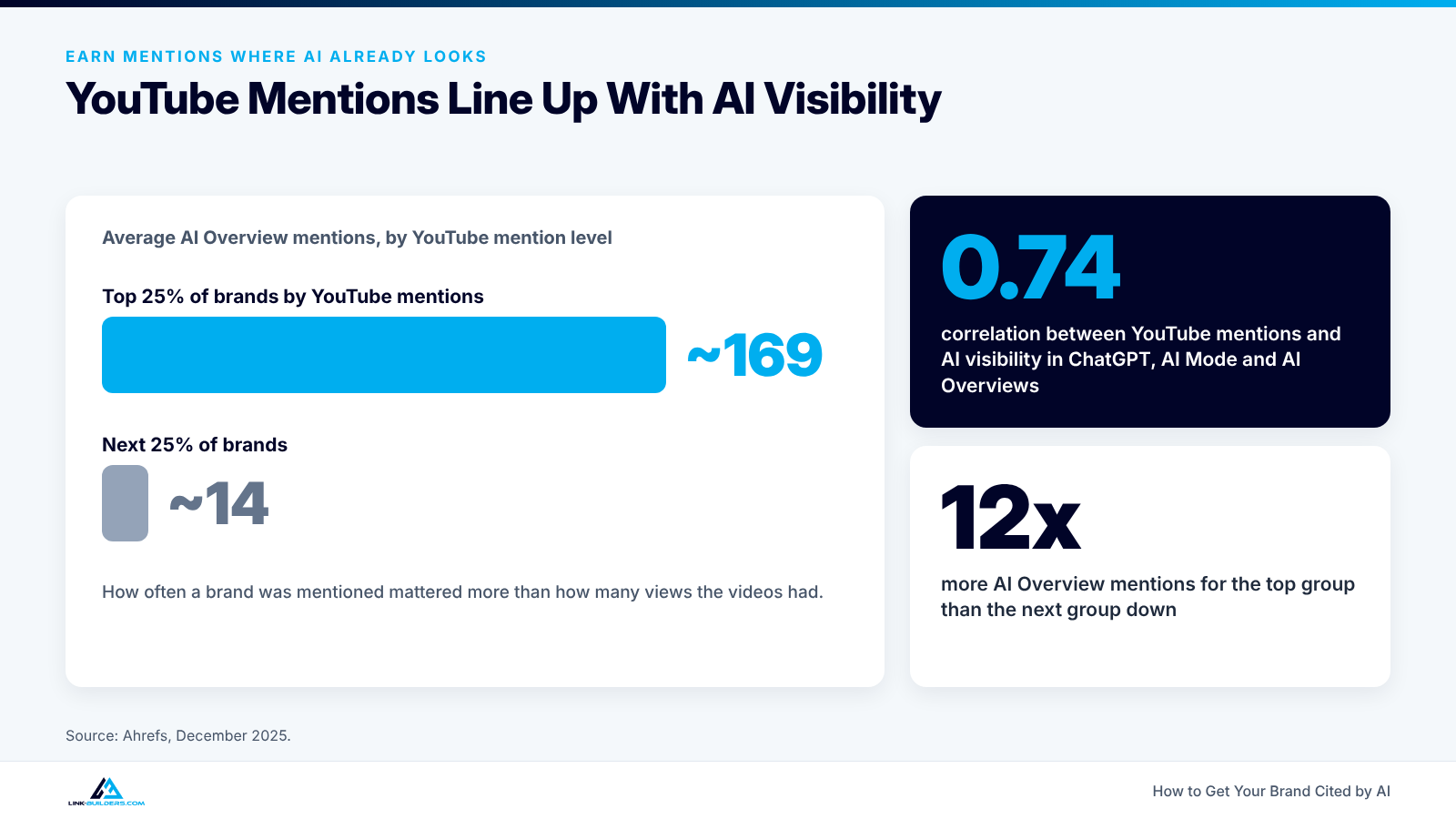
These are correlations, not proof of cause. Still, the pattern is consistent: talk about the brand beats link volume alone.
Action: name the brand in the sentence around every placement. Chase unlinked mentions. Get talked about on YouTube, not only linked from blogs. Strong branded anchors sit at the intersection of mention and link.
AI search series
Which signals line up with AI visibility?
Correlation with how often AI mentions a brand (0 = none, 1 = perfect). Hover a bar for what it means.
Show data table
Correlation, not causation. Sources: Ahrefs, 75K brands (May 2025) and Ahrefs, ChatGPT, AI Mode and AI Overviews (Dec 2025). YouTube values are approximate.
AI search runs on earned media
A University of Toronto team studied about 1,000 buying questions in Generative Engine Optimization: How to Dominate AI Search. AI search pulled roughly 70 to 90% of sources from earned media. For U.S. cars it was about 82%, against about 45% in Google’s regular results. Social sources dropped toward zero.
Brand sites matter most at the buying stage, when shoppers compare options. For local services, AI and Google barely agree. Home cleaning overlapped on about 1 in 5 sources. IT support almost none.
Language matters too. ChatGPT switches toward local-language sources, so international brands need earned coverage in each market, not only English translations of their own site.
AI search series
Who gets cited: Google vs. AI search
Share of sources for buying questions, by type of site. Hover a segment for details.
Show data table
Source: Chen, Wang, Chen and Koudas, University of Toronto (Sept 2025), 1,000 buying questions.
Get onto other people’s best-of lists, not your own
Late in 2025, “best X” lists made up about 43.8% of pages ChatGPT cited for buying questions. Then came pushback. In Google AI Overviews, self-promotional lists were cited but left the brand out of the recommendation about 69% of the time (Lily Ray’s June 2026 analysis). In ChatGPT, listicle citations fell from about 15.8% to about 7.8% around a summer update (Peec AI data).
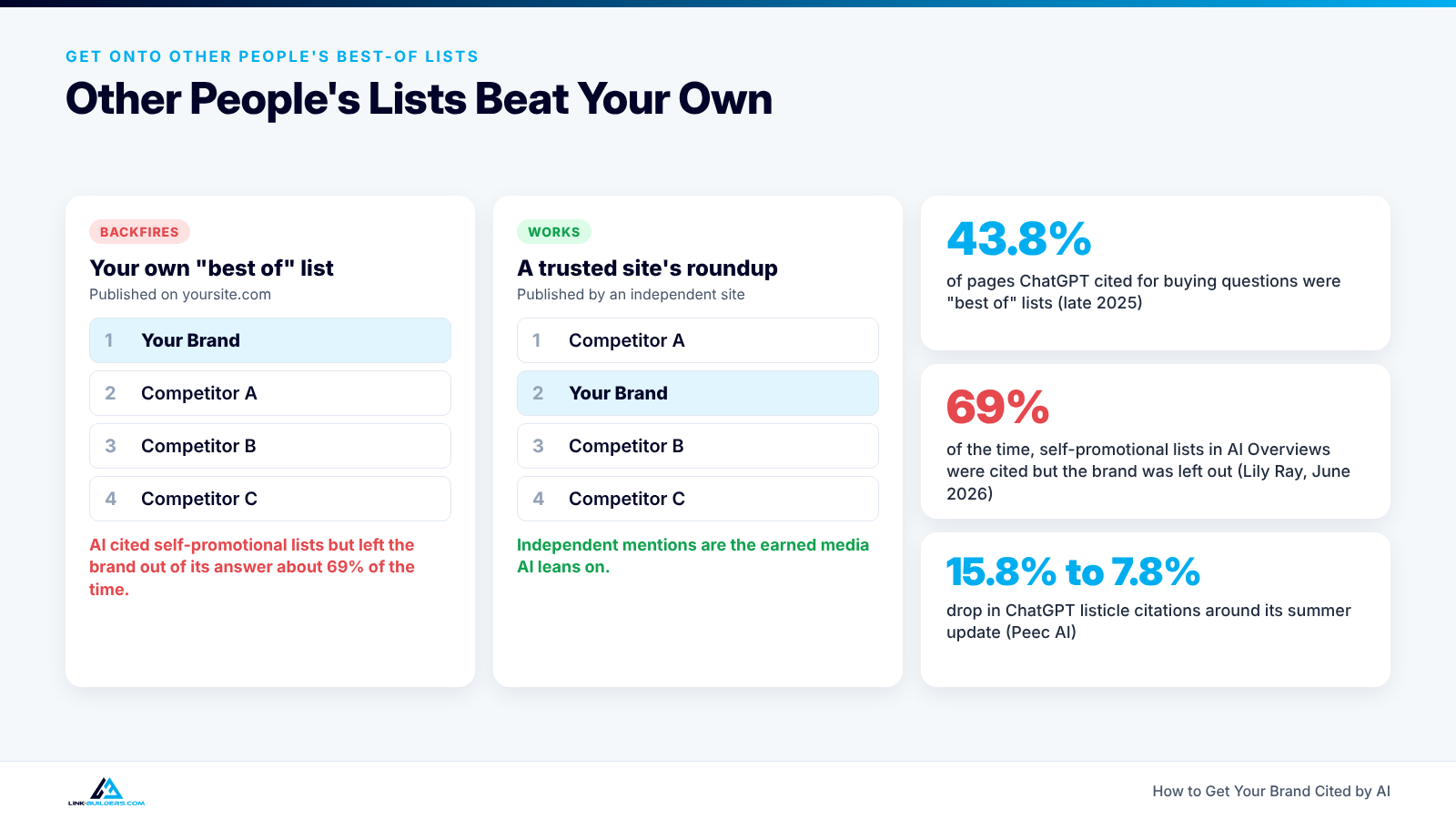
Someone else’s list with you on it is earned media and a brand mention at the same time. Your own “best tools including us” page is the pattern Google has been cooling on. See our note on self-promotional listicles.
Think of list inclusion as a product of proof, not persuasion alone. Editors need a clear category fit, a reason their readers care this quarter, and assets they can verify without a long call. When we pitch list updates for clients, the wins usually come from shipping a short brief: who you serve, what changed since the last roundup, and one data point the editor can quote.
Action, four steps:
- Find the lists AI already cites for your category.
- Search for the rest with Boolean operators (how to find prospects).
- Make it easy to add you: fresh proof, clear differentiators, and a short pitch to the editor (personalization that helps outreach).
- Fix outdated mentions and see which lists competitors already sit on.
Pick your platforms by what AI cites in your category
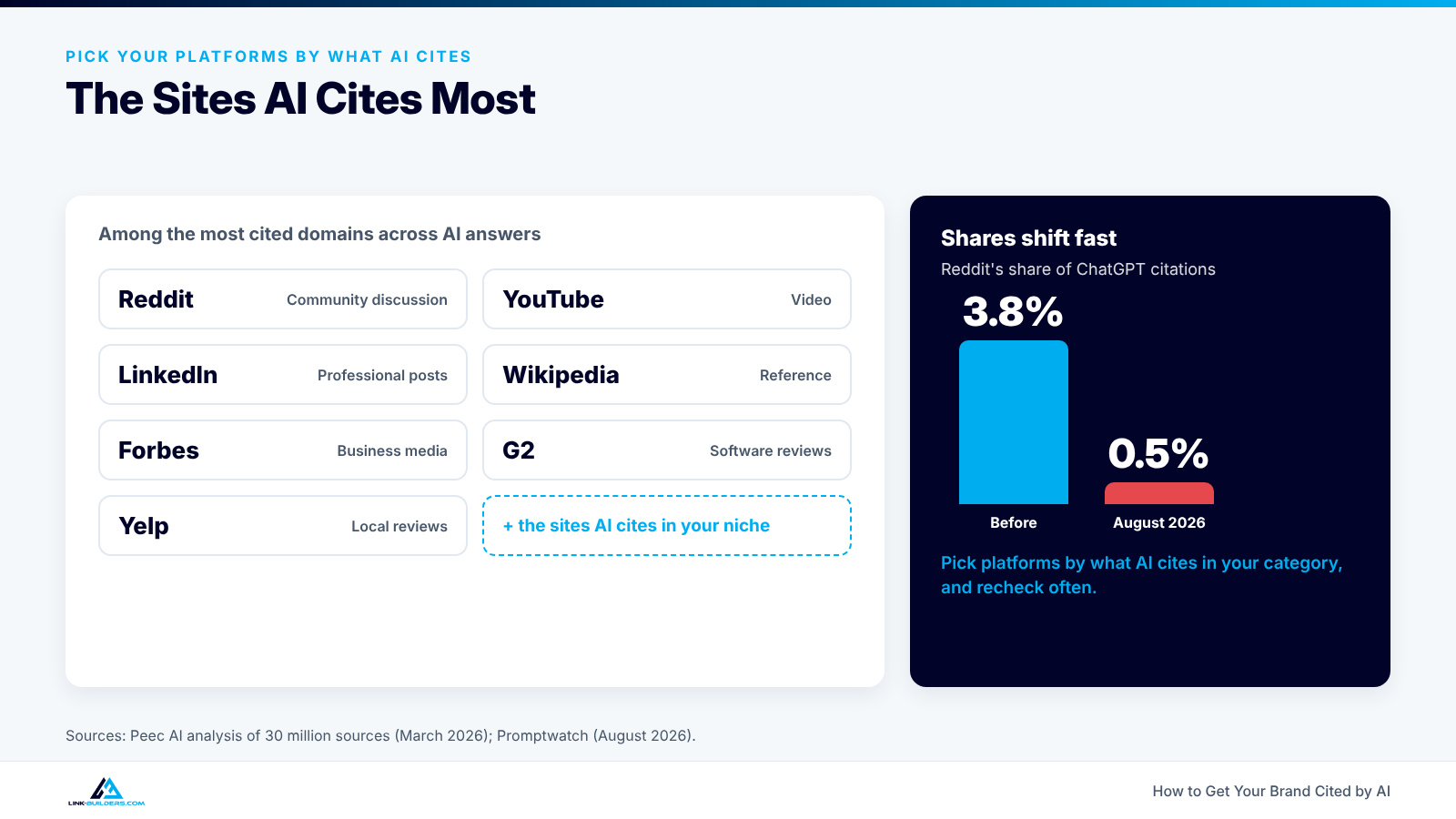
Peec AI has reported top cited domains across tens of millions of sources: Reddit, YouTube, LinkedIn, Wikipedia, Forbes, G2, Yelp, and similar hubs. Each tool has favorites. Wikipedia shows up heavily in ChatGPT. YouTube shows up heavily in Google’s AI surfaces.
Reddit’s share of ChatGPT citations fell from about 3.8% to about 0.5% in August 2026 (Promptwatch and related reporting), while AI Overviews barely moved. ChatGPT can still read Reddit and simply cite it less.
Show up the right way: helpful Reddit answers without spam, real YouTube mentions (reviews, roundups, interviews), accurate review-site profiles, and Wikipedia only when you meet notability and conflict-of-interest rules.
Platform choice should follow citation share in your niche, not vanity. A SaaS brand may need G2 and LinkedIn coverage more than Yelp. A local service brand may need YouTube explainers and local news more than a national Forbes hit. Pull a sample of AI answers in your category, list the domains that appear, and put outreach energy on the domains that already feed those answers.
AI search series
What each AI tool cites most
Most cited domains across 30 million AI sources. Pick a tool, then tap a site for how to show up there.
Tap a site to see how to show up there.
Reddit’s share of ChatGPT citations fell in August 2026
Google’s AI Overviews barely moved. Hover the dots.
Sources: Peec AI, 30M sources (March 2026); Promptwatch (Aug 2026): July 18 to Aug 7 vs. Aug 14 to 17.
Step 2: Build for Query Fan-Out, Not One Keyword
Google’s AI often splits one question into many smaller searches and cites the best page for each branch. Ranking number one for the main keyword is no longer enough.
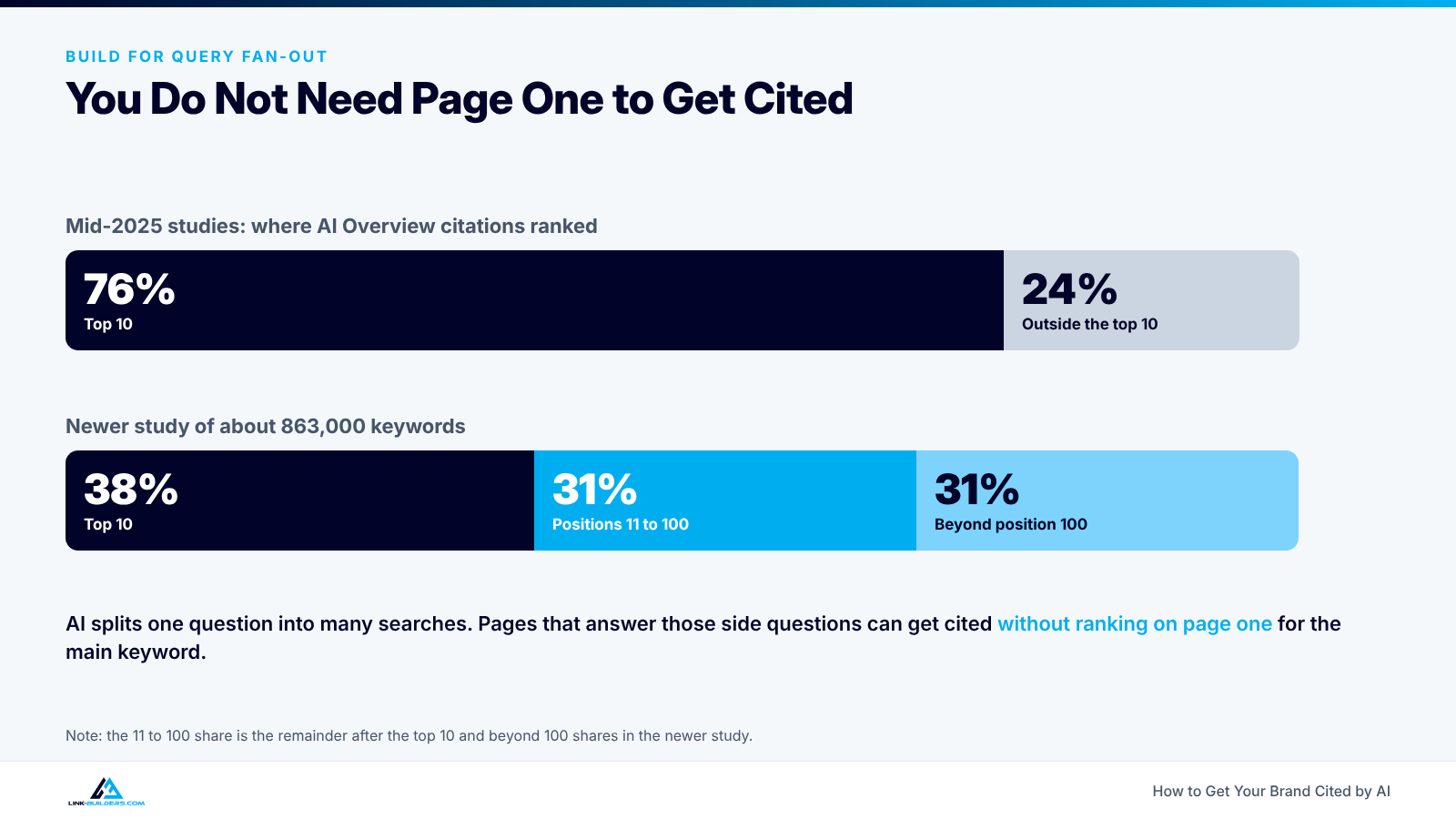
Mid-2025 Ahrefs research found about 76% of AI Overview citations ranked in the top 10. A newer Ahrefs study of about 863,000 keywords put that closer to 38%, with about 31% ranking beyond position 100. Part of the drop comes from better tracking, so treat the exact percentages carefully. The practical point stands: pages outside the classic top 10 still get cited, and YouTube made up about 18% of cited pages that ranked beyond position 100.
Action, five changes to a link campaign:
- Map the branches with People Also Ask, AI Mode citations, and Bing’s grounding queries report.
- Answer each sub-question on a dedicated or clearly sectioned page.
- Spread links across supporting pages, not only the money URL (how we plan link targets).
- Get mentioned on pages that already rank for the branches.
- Do not ignore video, especially for branches where YouTube wins.
If you are sizing effort per URL, how many links a page needs still matters. Fan-out just means that effort should not all pile onto one keyword page.
A practical planning habit: for each money query, write the five sub-questions you would ask a salesperson, then assign each to a URL you already have or plan to build. Your link list should include targets that rank for those branches, not only targets that match the head term. That is how fan-out changes prospecting without inventing a new discipline.
AI search series
Query fan-out: one question, many searches
Google’s AI splits a question into smaller searches and cites the best page for each. Click the question to fan it out.
Click a branch to see the page that wins it and the link building move.
Example branches for illustration. Google doesn’t publish its exact list. How it works: Google, AI Mode (May 2025).
Step 3: Write Pages AI Wants to Quote
Small edits make a page easier to quote, and they are the same things that earn links.
The GEO study presented at KDD 2024 (arXiv 2311.09735) tested nine rewrite methods across about 10,000 queries. Adding quotations raised visibility about 41%. Statistics about 30%. Citing sources about 27%. Keyword stuffing hurt about 8.5%.
Caveats matter. The tests used an older model. Gains on a live engine were closer to 22%. Results varied by topic. Treat 40% as a ceiling, not a promise. Pages that started lower gained the most. Citing sources more than doubled visibility for a page sitting in fifth place.
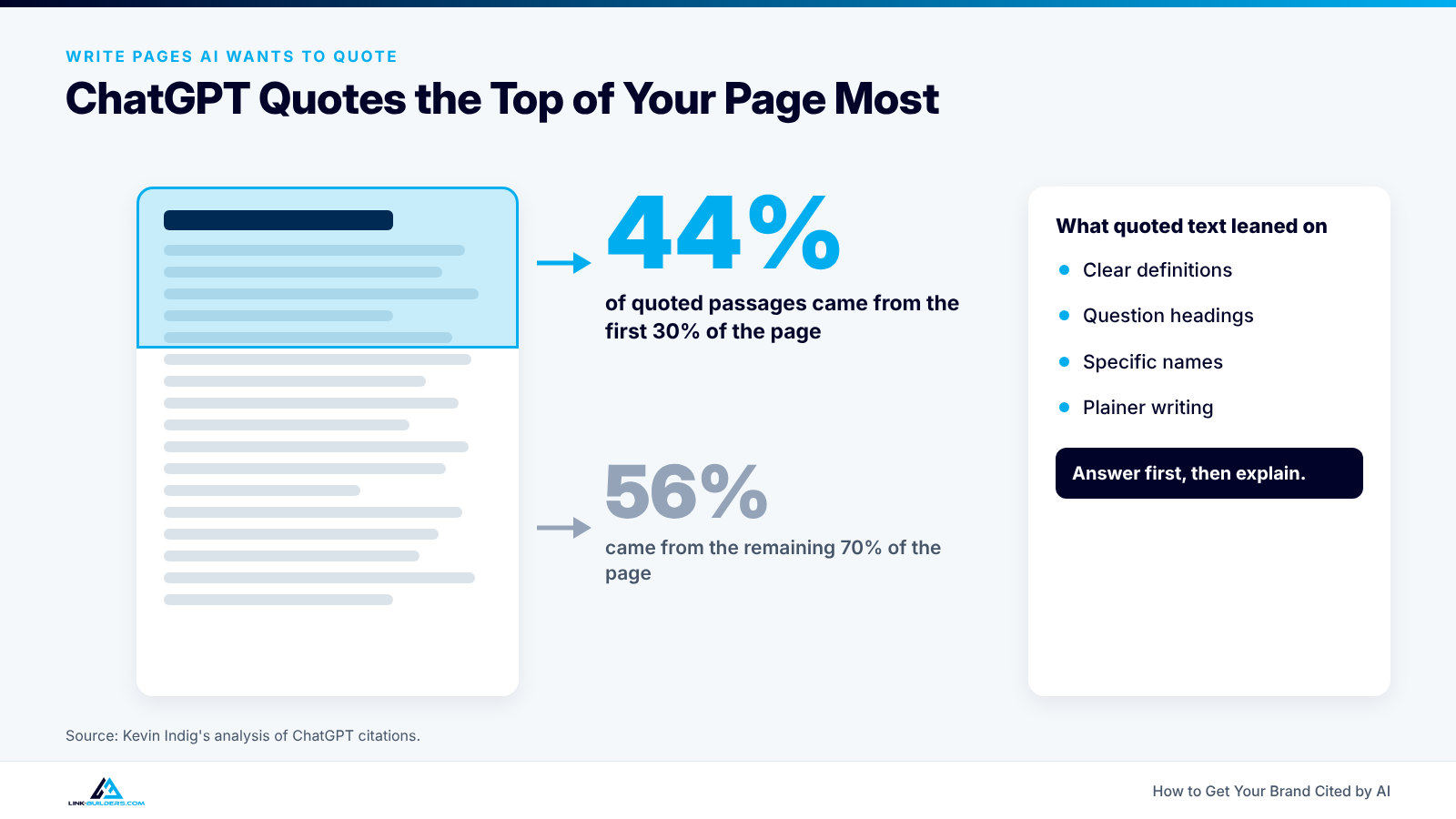
Kevin Indig’s analysis of ChatGPT citations found about 44% of quoted passages came from the first 30% of the page. Quoted text leaned on clear definitions, question headings, specific names, and plainer writing.
Action, six steps:
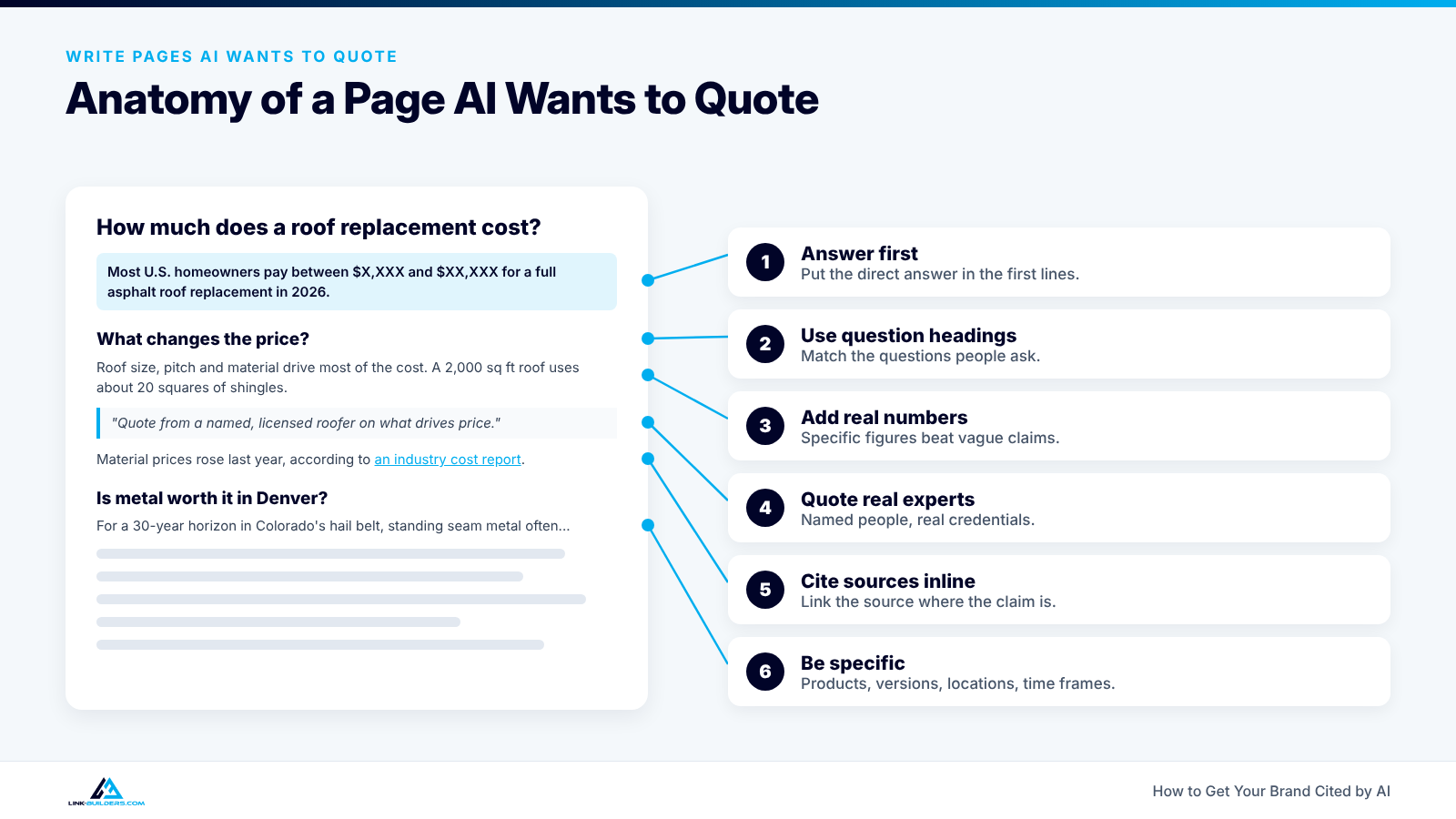
- Answer first.
- Use question headings.
- Add real numbers. Original data is best.
- Quote real experts. Never invent quotes.
- Cite sources inline.
- Be specific about products, versions, locations, and time frames.
Original data and expert quotes are linkable assets. One strong page can earn links, mentions, and AI citations together.
When you revise an older guide, do not only swap the year in the title. Move the direct answer higher, add a dated statistic with a source, and add one named expert line you can stand behind. Those three edits match what the GEO rewrite tests and the ChatGPT quote-location research both reward, and they give reporters a reason to cite you instead of a competitor.
AI search series
What small edits do to AI visibility
Researchers rewrote the same pages one change at a time and measured how much of each page showed up in AI answers.
One change at a time, on a research setup with an older model. On a live AI engine, gains were about 22%. Don’t add the numbers together. Source: Aggarwal et al., GEO, KDD 2024 (position-adjusted word count, 10,000 queries).
Step 4: Make Your Brand Easy for AI to Recognize
An entity, in one sentence, is how AI systems recognize your brand as a distinct thing in the world, not a random string of words.
Schema is not the shortcut we already covered, but organization schema that connects your official profiles still helps with identity. Facts belong in visible text, because assistants read what users can read.
Action, five steps:
- Use one brand name everywhere (site, profiles, press, YouTube).
- Build a real About page with plain facts (About Link Builders is the pattern we use ourselves).
- Connect official profiles with organization schema.
- Give your people author pages (example author page).
- Get mentioned next to your topic on third-party sites. That last step is classic link building and digital PR.
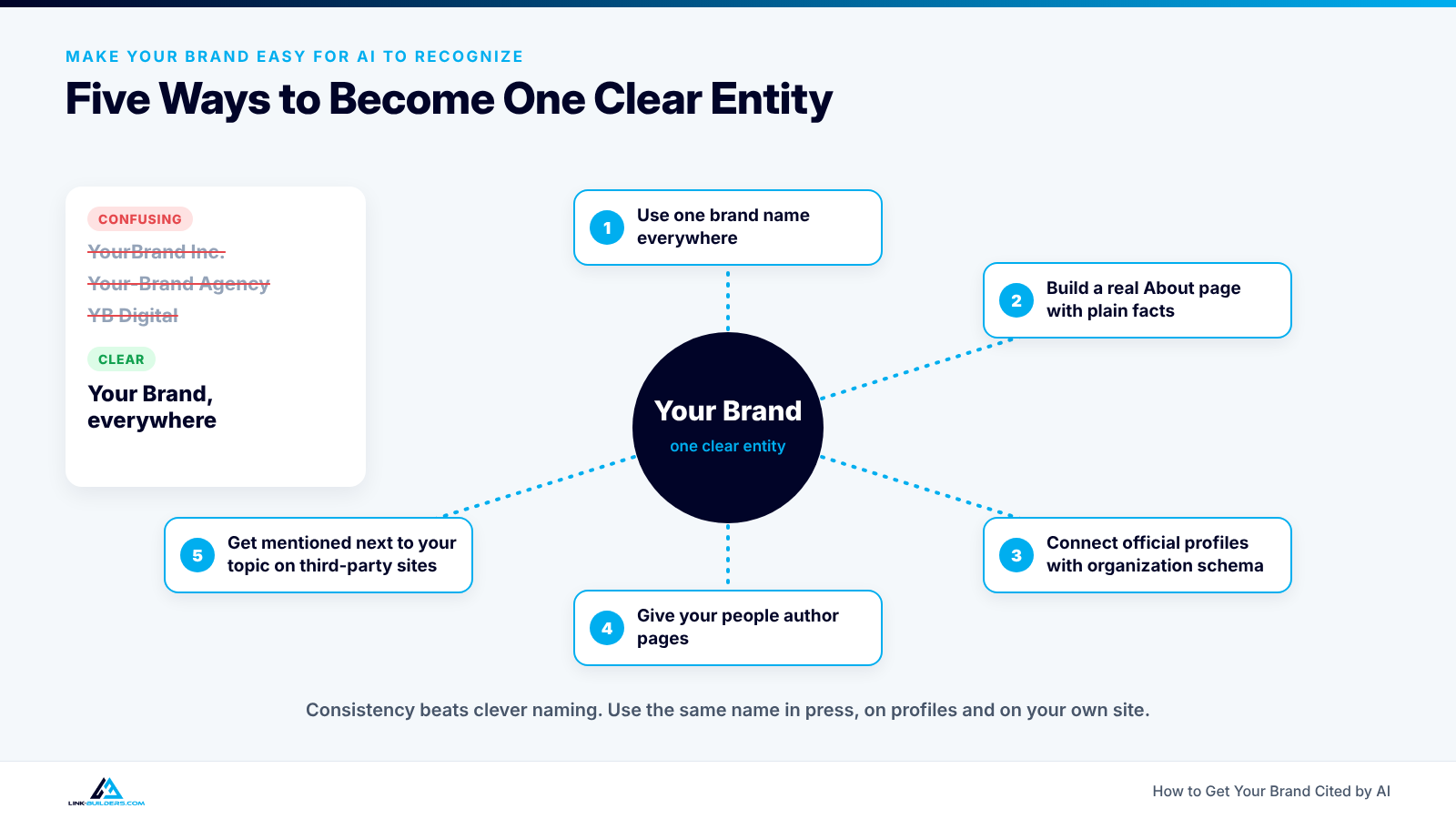
Consistency beats clever naming. If press calls you one thing, your homepage another, and your YouTube channel a third, AI has a harder time tying those mentions to one entity. Pick the public name, put it in the first sentence of your About page, and reuse it in bylines and bios.
Step 5: Make Sure AI Can Reach Your Site
One setting can undo all the work above.
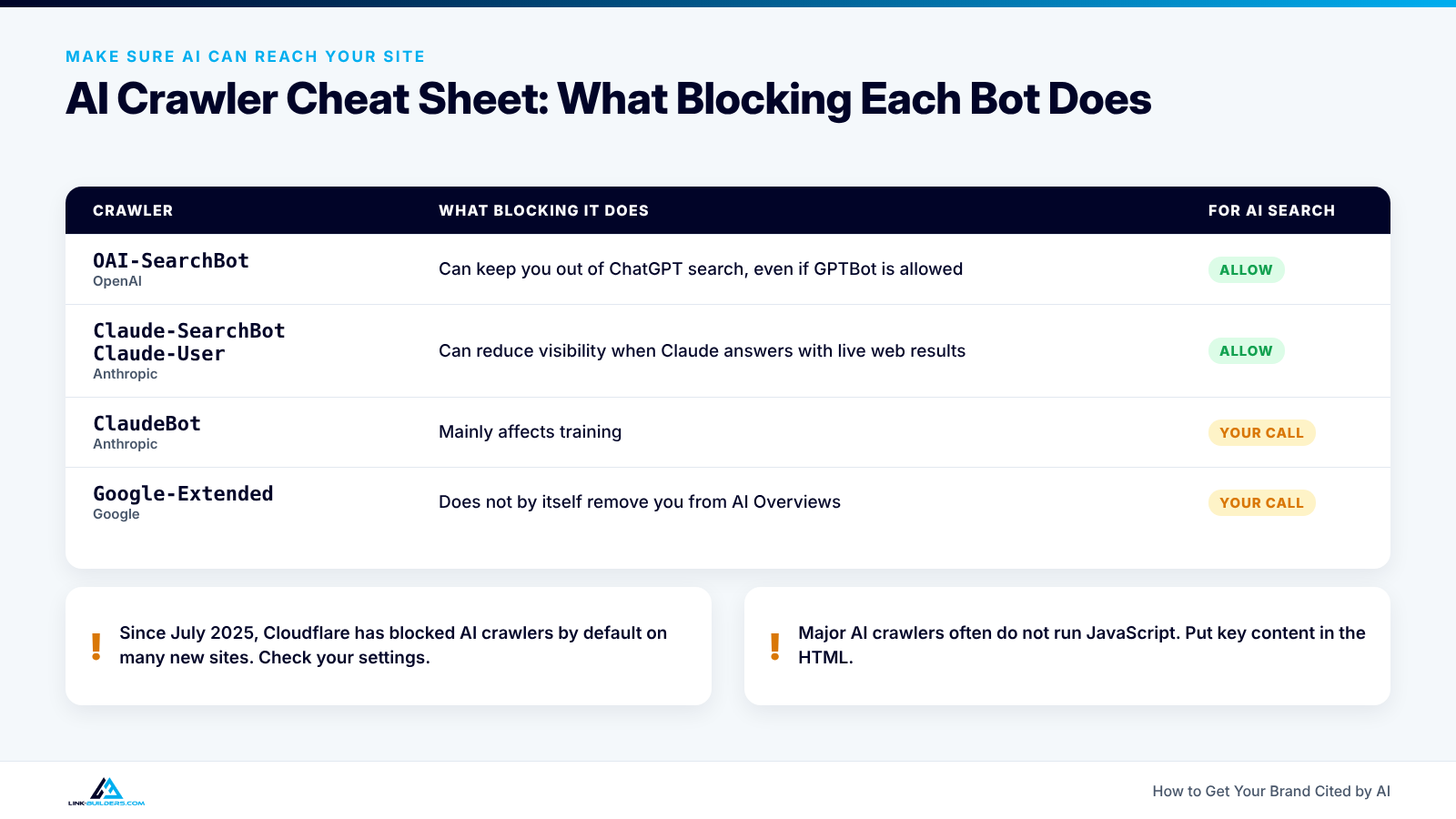
Since July 2025, Cloudflare has blocked AI crawlers by default on many new sites (Cloudflare announcement, covering roughly one in five websites on their network). If you never reviewed the toggle, you may be invisible to the bots you care about.
| Bot type | Role | What blocking usually does |
|---|---|---|
| Search bots (Googlebot, Bingbot, OAI-SearchBot, Claude-SearchBot) | Discovery and live answers | Can remove or reduce AI search visibility |
| Training bots (GPTBot, Google-Extended, ClaudeBot) | Model training | Affects training, not always live search |
Blocking Google-Extended does not by itself remove you from AI Overviews. Blocking OAI-SearchBot can keep you out of ChatGPT search even if GPTBot is allowed.
Major AI crawlers often do not run JavaScript (Vercel on AI crawlers). Use the view-source test: if the answer text is missing from the raw HTML, many AI bots will not see it.
Freshness still helps. Ahrefs found AI-cited pages were about 25.7% fresher than regular Google results across millions of citations. ChatGPT leans newest. AI Overviews lean least. Cited pages are still about three years old on average, so pages need to be current, not brand new.
Action: run a 10-minute access check (indexed, snippet allowed, AI search bots allowed, content in the source HTML), then keep five freshness habits: update stats, refresh dates only when content changed, fix broken claims, resubmit via IndexNow or Search Console, and prune dead URLs.
AI search series
The 10-minute AI access check
Answer for one of your key pages. Any “no” shows the fix.
Answer all four questions to see your result.
30-second test for question 4: open the page, right-click and choose View page source, then press Ctrl+F and search for a sentence from the page. If it isn’t there, many AI crawlers can’t see it either.
Based on Google’s AI features guide, Cloudflare (July 2025) and Vercel and MERJ (Dec 2024).
For a refresher on the metrics teams confuse during audits, see common SEO metrics for link building.
Step 6: Measure Visibility, Not Rankings
AI answers change every run, so track how often you show up.
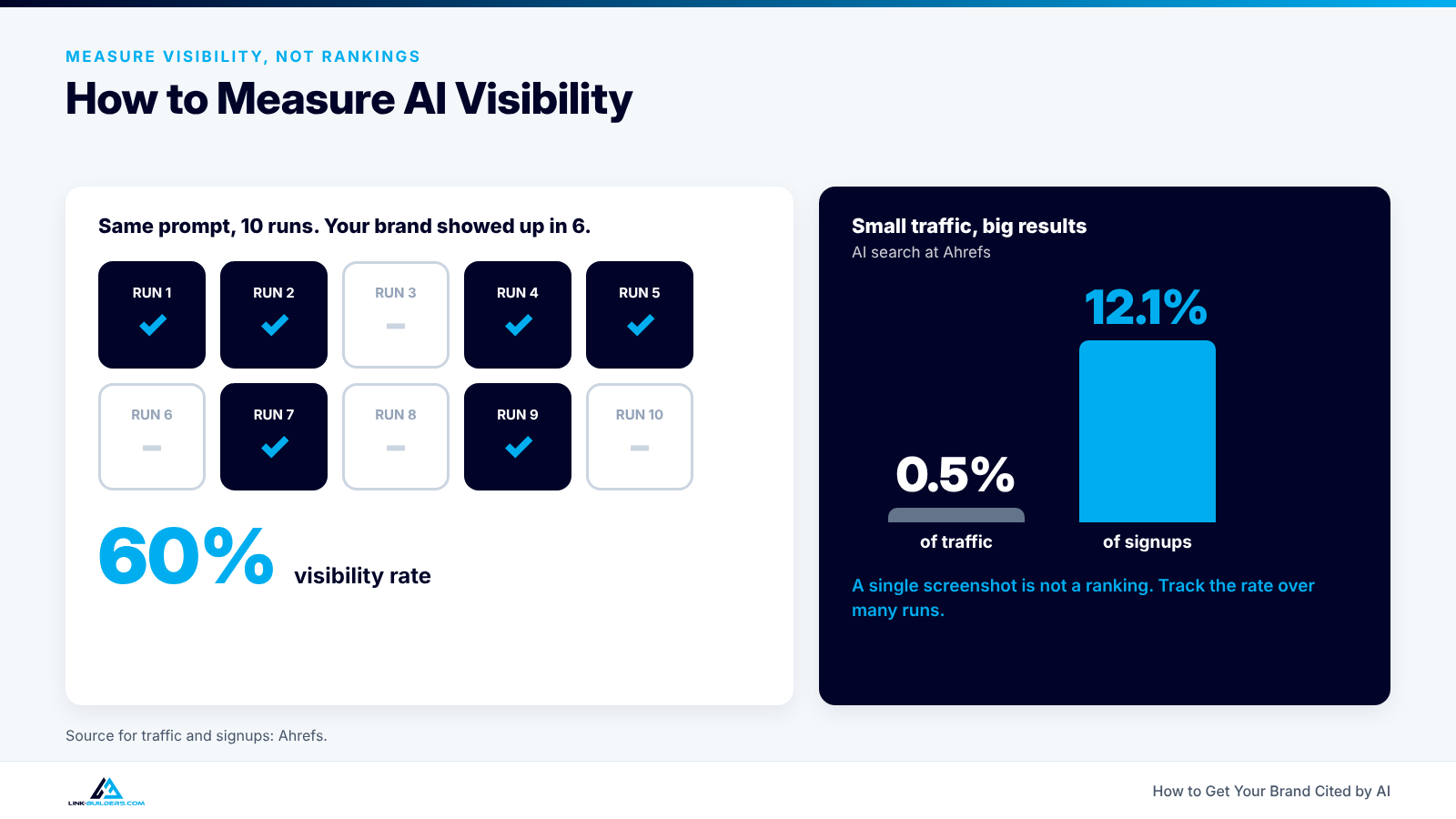
That is the SparkToro and Gumshoe finding again (SparkToro write-up). A single ChatGPT screenshot is not a ranking. Visibility rate is. If your brand appears in 6 of 10 runs for a prompt, your visibility rate is 60%. Share of voice is your mentions divided by all brand mentions across those runs.
Free data is getting better. Google Search Console's generative AI report (impressions, rolled out broadly by August 31, 2026) shows how often Google's AI surfaces your pages. Bing's AI Performance report shows citations and grounding queries in Microsoft's ecosystem. Analytics still catches AI referral traffic, including chatgpt.com.
Small traffic can still matter. Ahrefs has reported AI search as about 0.5% of traffic but about 12.1% of signups in their own data. Measure quality, not only sessions.
Build the report so a non-SEO stakeholder can read it. Lead with visibility rate and share of voice for your top prompts, then show which earned placements and pages moved. That framing keeps the team from treating a lucky single answer as a breakthrough or a bad single answer as a crisis.
Action: a five-step monthly AI report
- Pick 10 to 20 prompts that match real buyer questions.
- Run each prompt multiple times per platform (enough for a stable rate, not one screenshot).
- Log brand mentioned, linked, position-ish order, and competitors.
- Pull Search Console generative AI impressions and Bing AI citations.
- Compare month over month and set realistic expectations for how fast earned mentions move.
What This Means for Link Building
The through line is simple. AI trusts earned mentions, so the job looks more like digital PR and relationship-driven link building than ever.
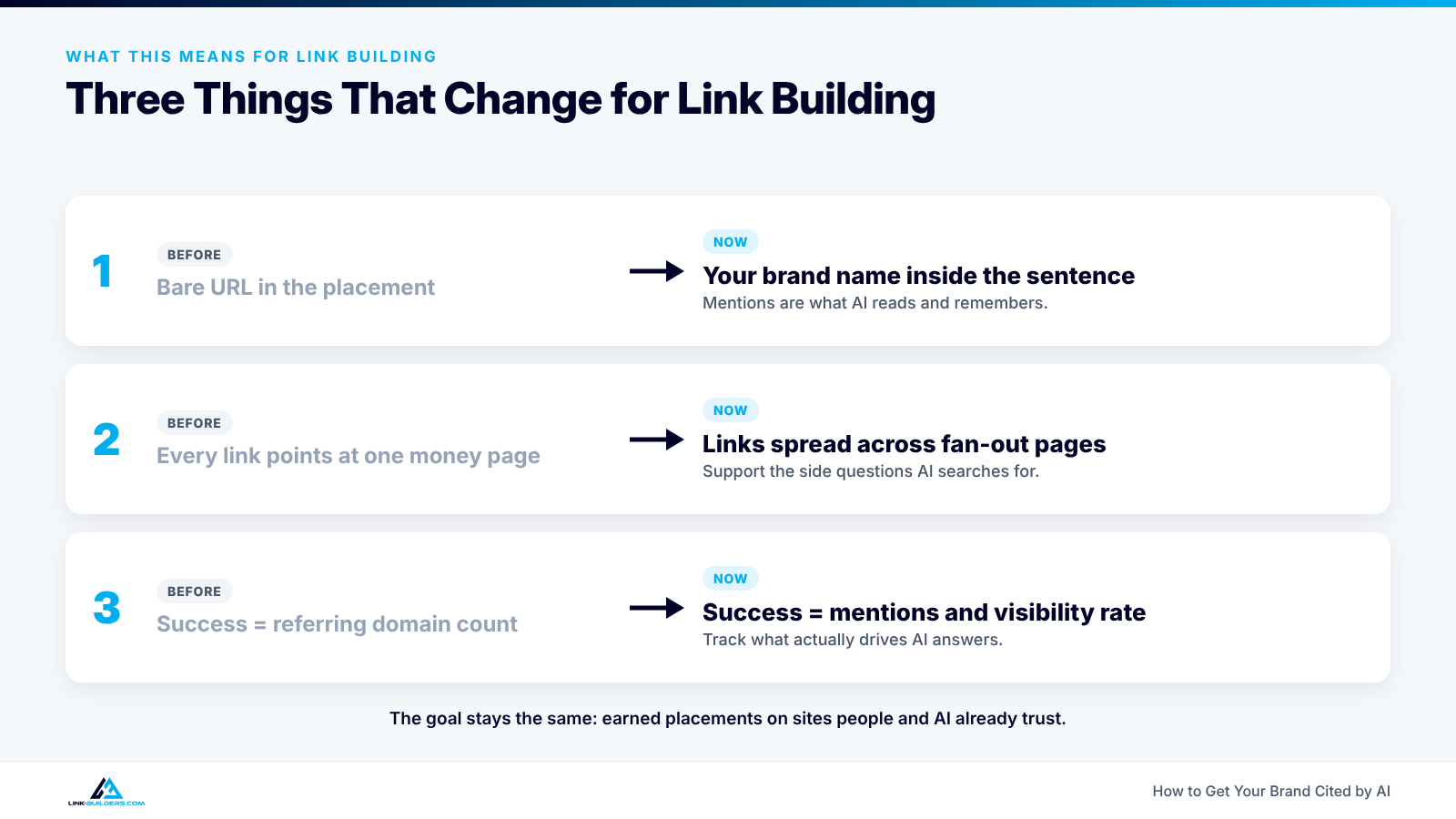
Three things change:
- The brand gets named in the placement sentence, not buried in a bare URL.
- Links are spread across supporting pages that answer fan-out branches.
- Success includes mentions and AI visibility rate, not only referring-domain count.
One thing does not change: you still have to find the right sites and give editors a reason to say yes. That is still our process. Agencies that need this done under their own brand can look at white-label link building.
FAQ
Do backlinks still matter for AI search?
Yes, but mostly when they also create branded mentions and land on sources AI already trusts. Raw link count is a weak correlate compared with mentions and YouTube talk. The best placements do both: a named mention and a link.
Does llms.txt help you get cited by ChatGPT?
There is no strong public evidence that it does. Google says Search does not use it, and large domain checks have not shown a citation lift. Do not block useful crawlers while you experiment with optional files.
Does schema markup help AI citations?
Not as a shortcut. Controlled tests adding schema did not produce meaningful citation gains, and some assistants do not read the schema code. Use schema for identity and rich results, not as your GEO plan.
How long does it take to show up in AI answers?
There is no reliable timeline in the research. Mentions and crawl access can take weeks to months to show up in visibility tracking, and answers stay inconsistent run to run. Measure rates over time instead of waiting for a single "rank."
How do I check whether ChatGPT mentions my brand?
Run the same buyer prompts many times, log mentions, and compute a visibility rate. Supplement with referral traffic tagged from chatgpt.com, third-party AI trackers if you use them, and platform reports from Google and Bing for their own AI surfaces.
Closing
Earn mentions where AI looks, cover fan-out questions, write quotable pages, keep your brand identity clear, confirm AI can reach you, and measure visibility across runs. If you want help earning those mentions on the sites AI already cites, start with our link building process or get in touch.
About the author
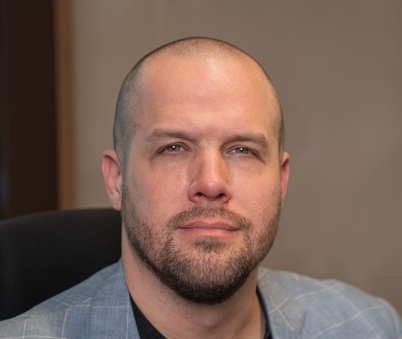
Justin Davis has been building backlinks since 2015 and has built links for more than 150 clients across law, healthcare, real estate, software, and other industries. He built the first version after years of doing the research by hand, and now builds the same workflow for in-house teams. More on who Justin Davis is, on YouTube, on LinkedIn, or on X.