The Problem Google Was Solving: The Spammer’s Feedback Loop
How rank testing worked in 2005
In the mid-2000s, getting feedback on a ranking change was simple. You added some links or stuffed a few keywords into a page. Then you waited a few days for Google to recrawl it and checked where you landed. If the page moved up, you did more of the same. If it moved down, you undid the change.
Why fast feedback was the spammer’s best tool
That quick loop let people test the algorithm the way a scientist tests a hypothesis. Change one thing, measure the result, repeat. Over enough cycles, a determined spammer could work out which signals mattered and how much. The faster and clearer the feedback, the easier the algorithm was to game.
Google’s answer: break the loop
The patent tackles this problem at its root. Instead of trying to catch every trick directly, it makes the results of a change harder to read. If a change shows no clear result, or shows the opposite of what you expected, the loop stops working. Cause and effect disappear from view.
What the Patent Counts as Spam
The patent calls its target “rank-modifying spamming techniques” and lists six of them:
- Keyword stuffing: repeating the same words over and over on a page.
- Invisible text: keywords set in the same color as the background.
- Tiny text: keywords in type too small to read.
- Page redirects: a page that sends visitors to a second, unrelated page.
- META tag stuffing: loading meta tags with keywords that have nothing to do with the content.
- Link-based manipulation: creating links to a page mainly to raise its rank, with link farms given as the example.
The first five are on-page tricks that stopped working years ago. The sixth is link building. That is why a patent first filed in 2005 still matters to anyone building links today. Google’s current spam policies still define link spam as creating links “primarily for manipulating search rankings,” which is the same line this patent draws. If you want a refresher on where that line sits, our guide to Link Building 101 covers white hat and black hat methods.
The Core Idea: Three Ranks Instead of One
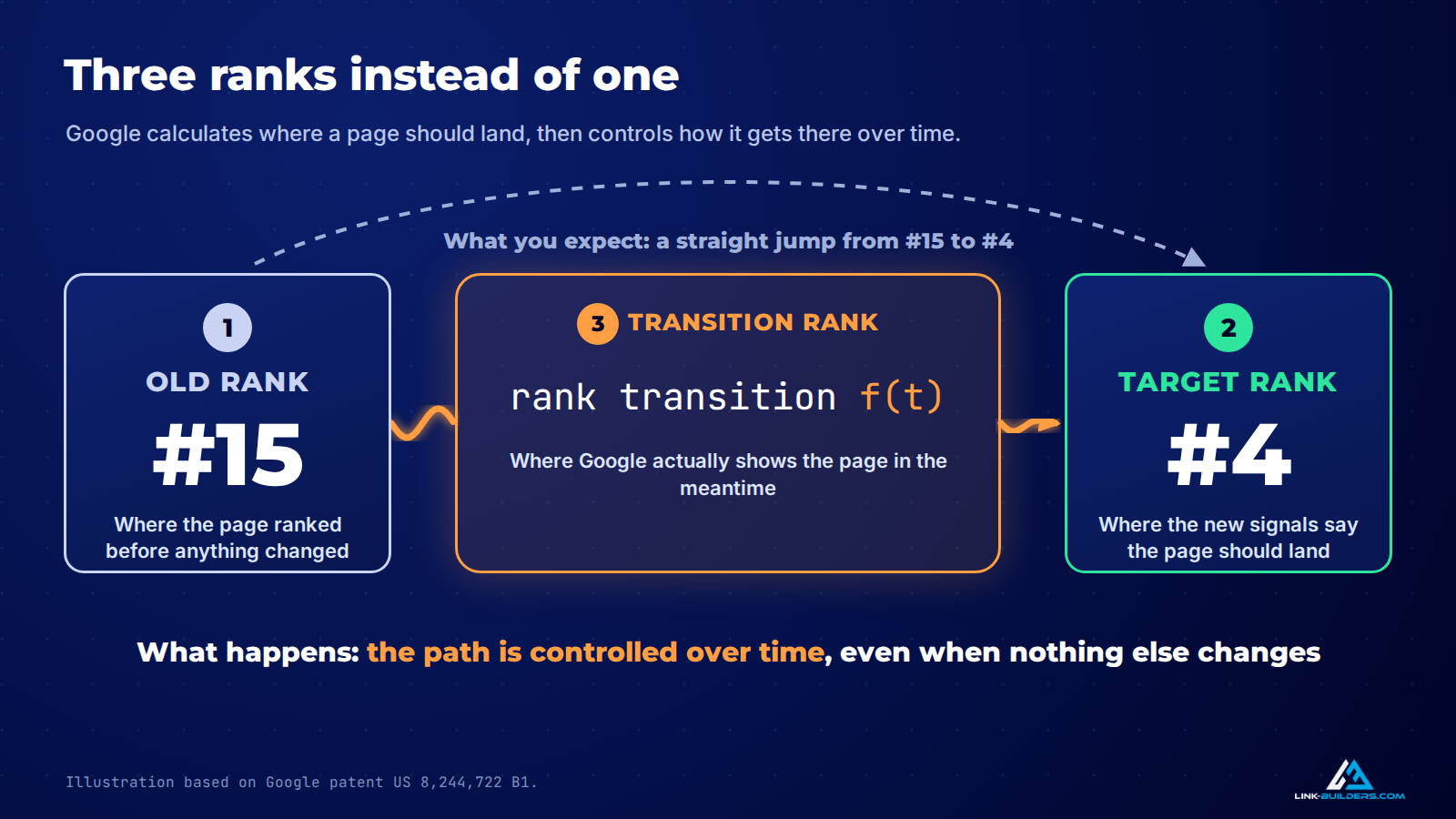
The whole patent rests on three numbers. Once they make sense, the rest of the system falls into place.
Old rank
This is where the page ranked before anything changed. For our example, say it sits at position 15.
Target rank
New links go live, and Google recalculates. Based on the new signals, it decides the page now deserves position 4. That is the target rank, where the page should land.
Transition rank
This is the key idea. The transition rank is where Google actually shows the page while it moves from old to target. You might expect the page to jump straight to position 4. Under this patent, a formula called a rank transition function sits in the middle and controls the path over time.
The patent says this function changes the rank over time “without any change in ranking factors.” In plain terms, your rankings can move on a day when you did nothing at all. The movement comes from the transition function, not from anything you changed.
The Five Shapes of a Rank Transition
The patent describes several shapes the transition can take. Picture each one as a line on a chart, with time running left to right and rank running up and down.
Immediate response (the old way)
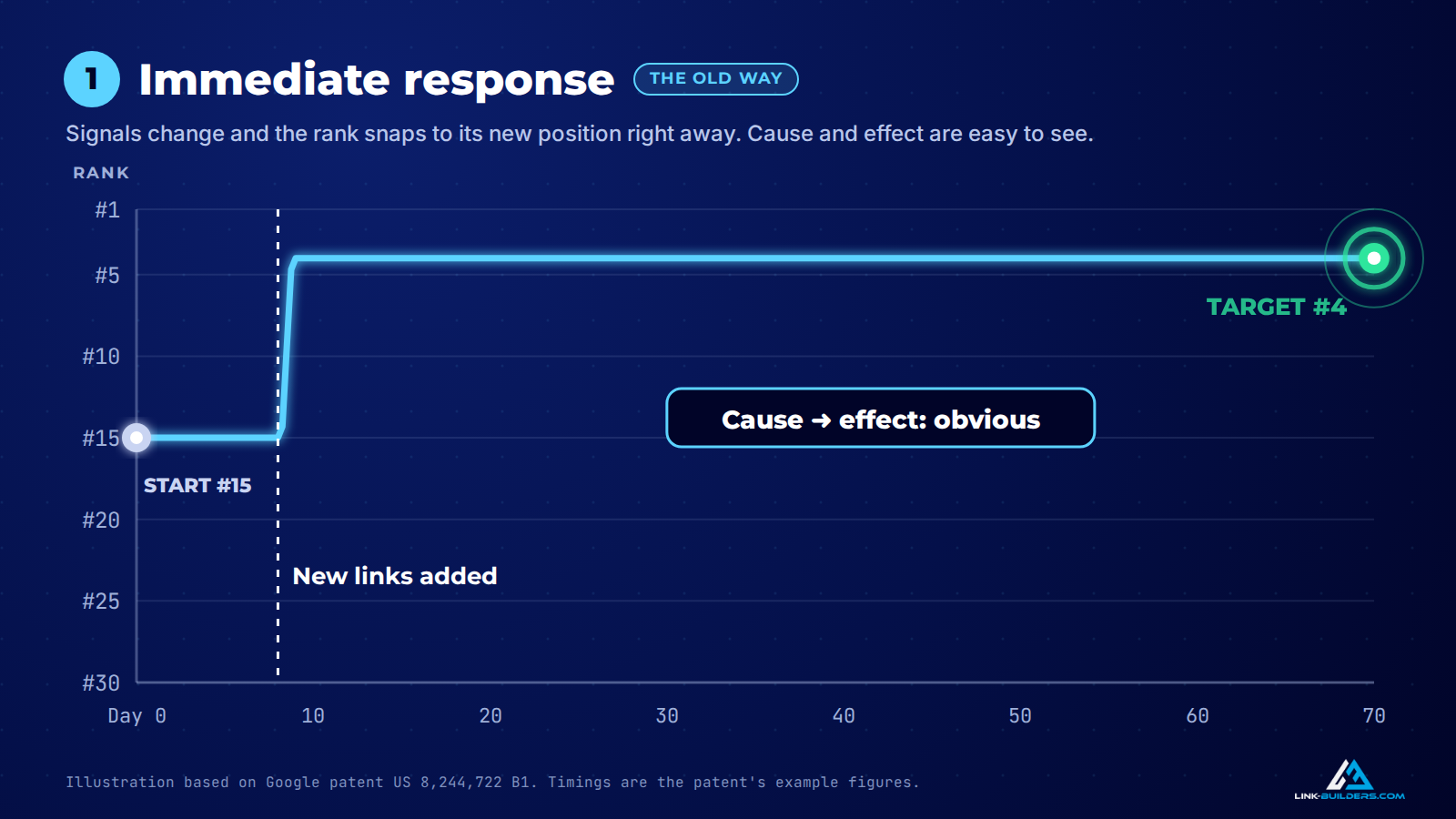
Your signals change, and the rank snaps to the target right away. This is the behavior the patent replaces. It is also the behavior spammers loved, because cause and effect were easy to see.
Damped response
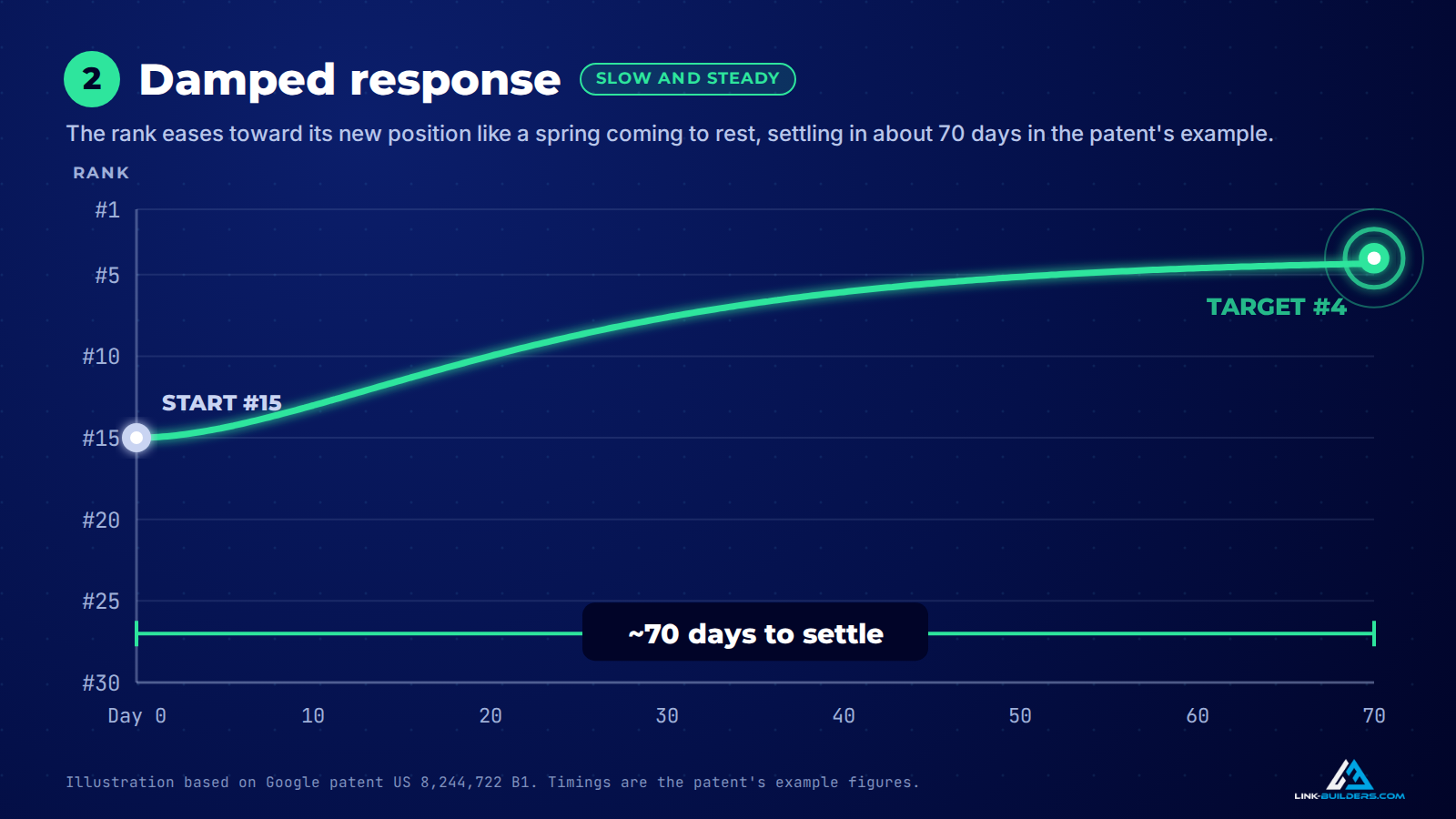
Instead of jumping, the rank moves slowly and settles into place. In the patent’s example, it takes about 70 days for a change in link-based information to bring the page to its new target. The math behind it is the same kind used to describe a spring coming to rest. The page drifts toward where it belongs rather than leaping there.
Initially-inverse response
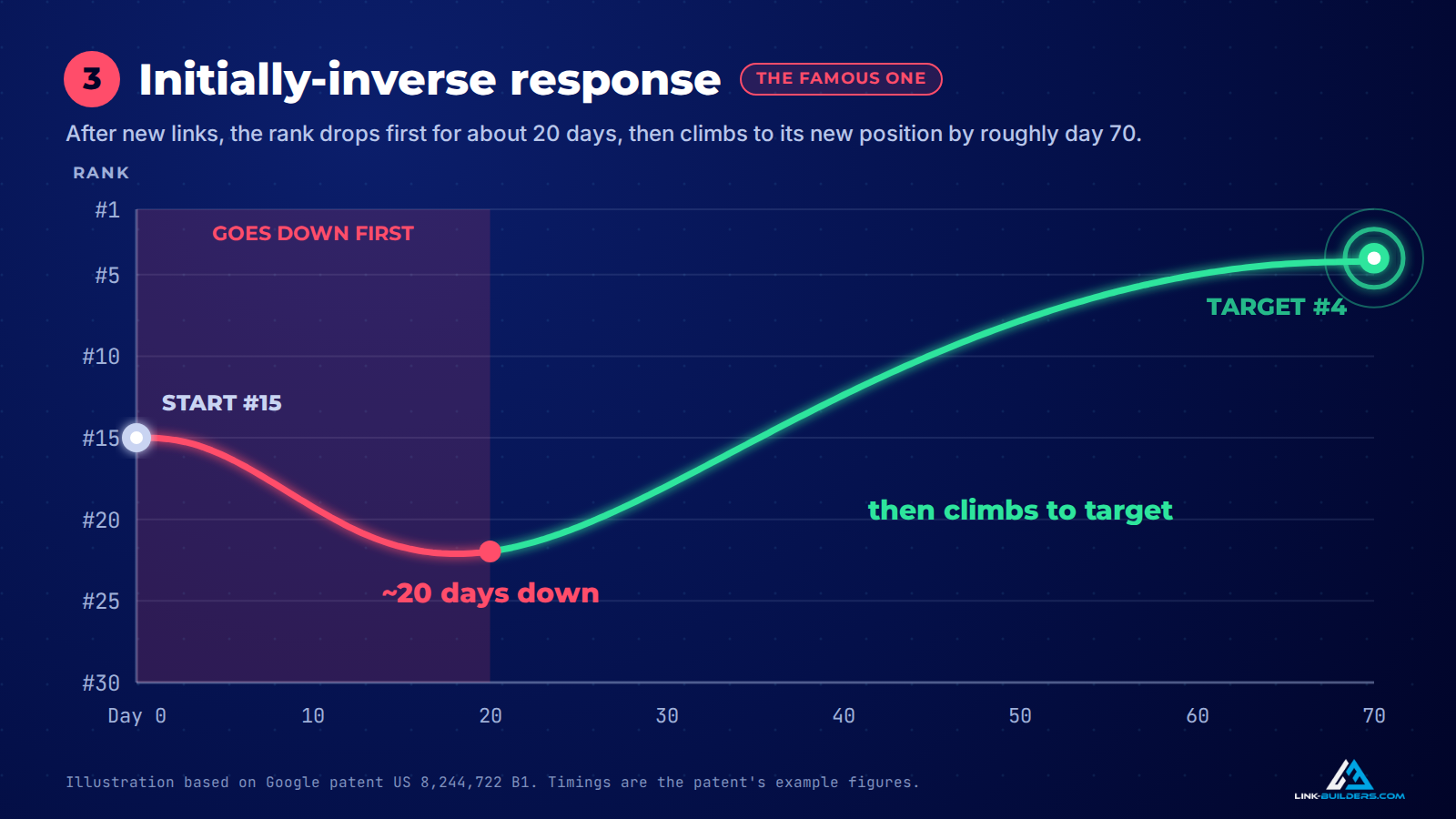
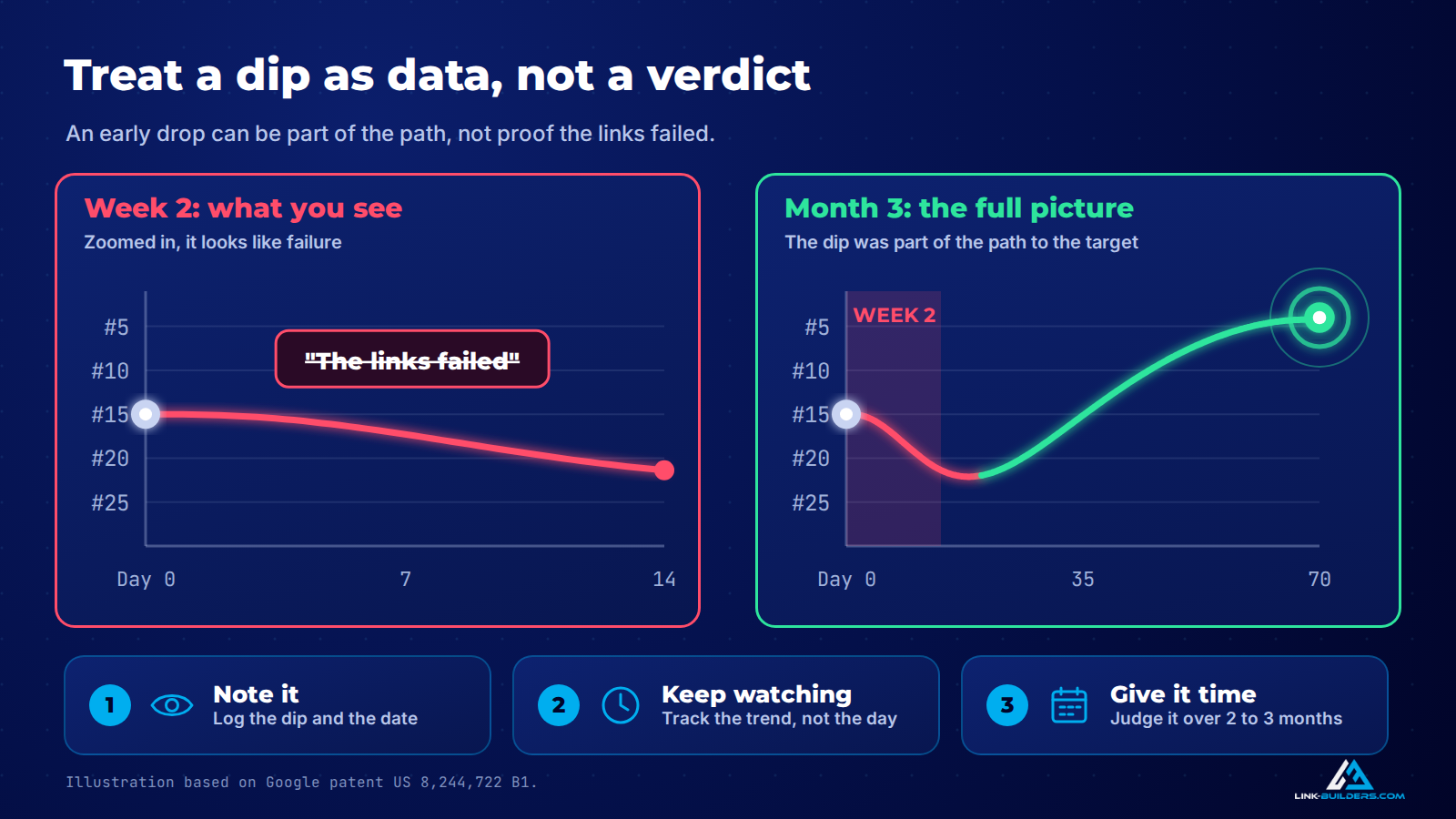
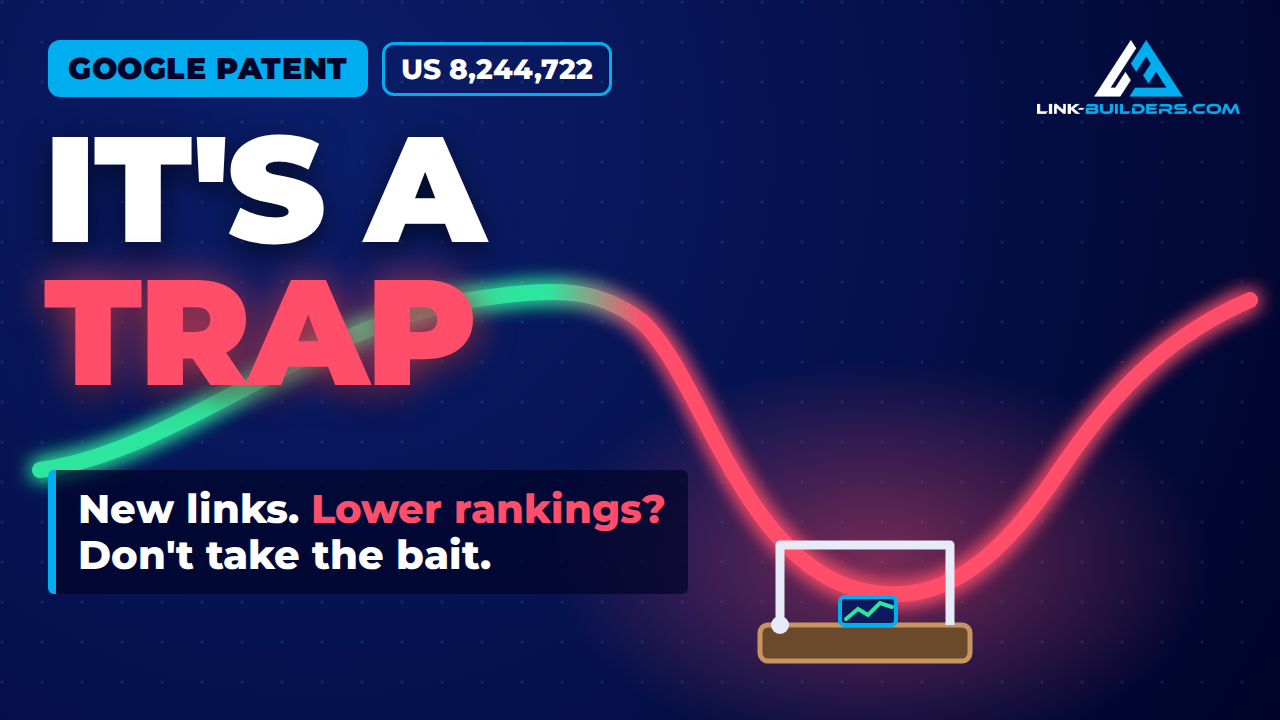
This is the shape that gets the most attention. After a positive change, such as new links, the rank goes down first. In the patent’s example, it falls for about 20 days, then turns around and climbs to the target by roughly day 70.
Think of turning a steering wheel and feeling the car lurch the wrong way for a moment before it heads where you pointed it. From the outside, the early dip looks like failure. It is actually part of the path to the new position.
Time delays and pre-computed patterns
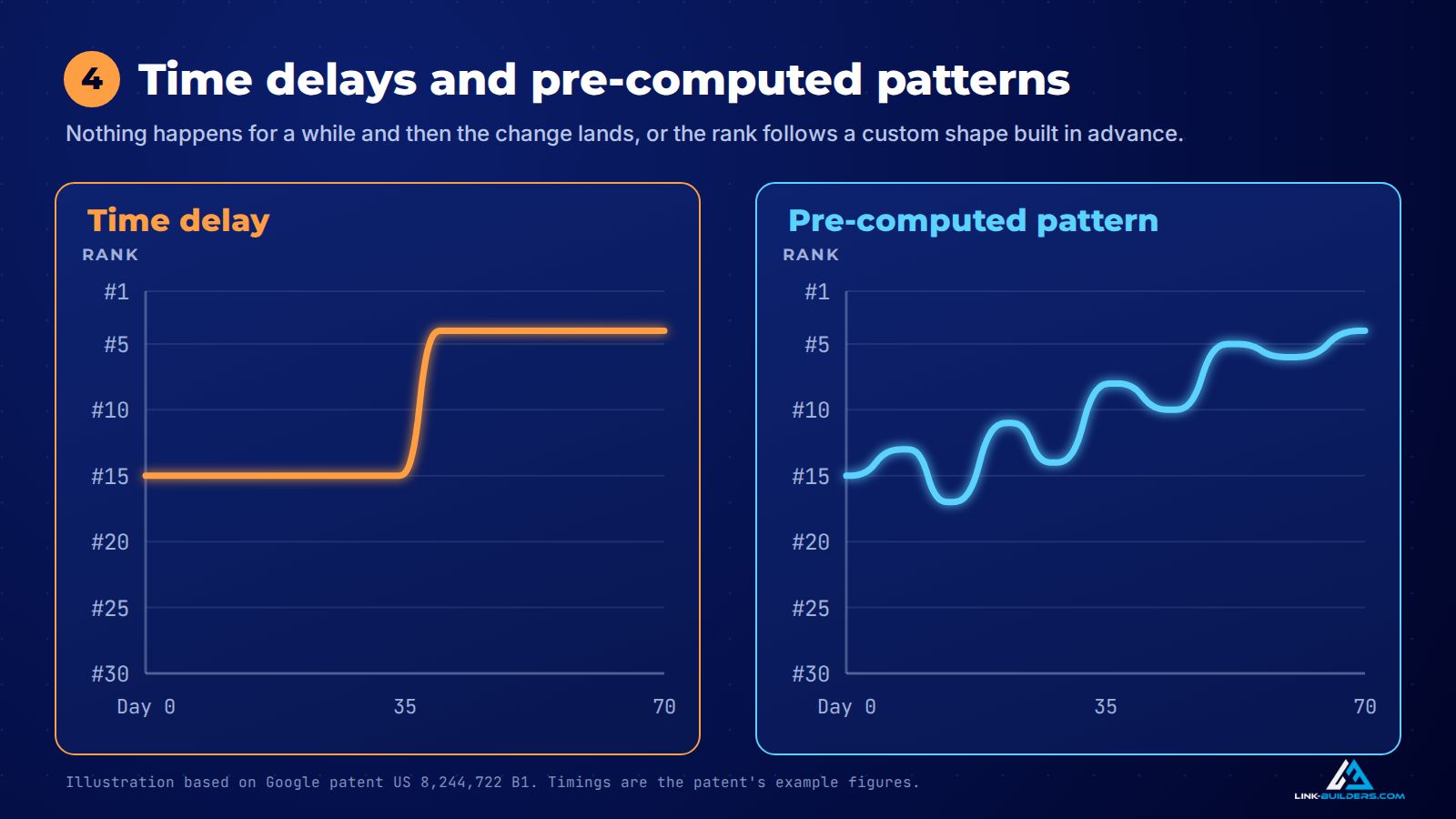
The patent also mentions simpler options. A time delay means nothing happens for a while, then the change lands. A pre-computed pattern is a custom shape built in advance, which can wander up and down before settling.
Unpredictable on purpose
The patent even describes a process that looks at the time since a change and shows no effect, a positive effect or a negative effect. The response is designed to be hard to read.
Why Google picks from several functions
The first claim of the patent describes selecting a rank transition function “from a plurality of rank transition functions.” That detail is important. A page does not always get the same treatment. If the shape were fixed, spammers would learn it and plan around it. By choosing from several, Google keeps the feedback loop broken.
The Trap: How Reactions Reveal Manipulation
This is where the patent gets clever. The transition functions are not only there to slow spammers down. They are there to provoke a reaction.
The two reactions the patent predicts
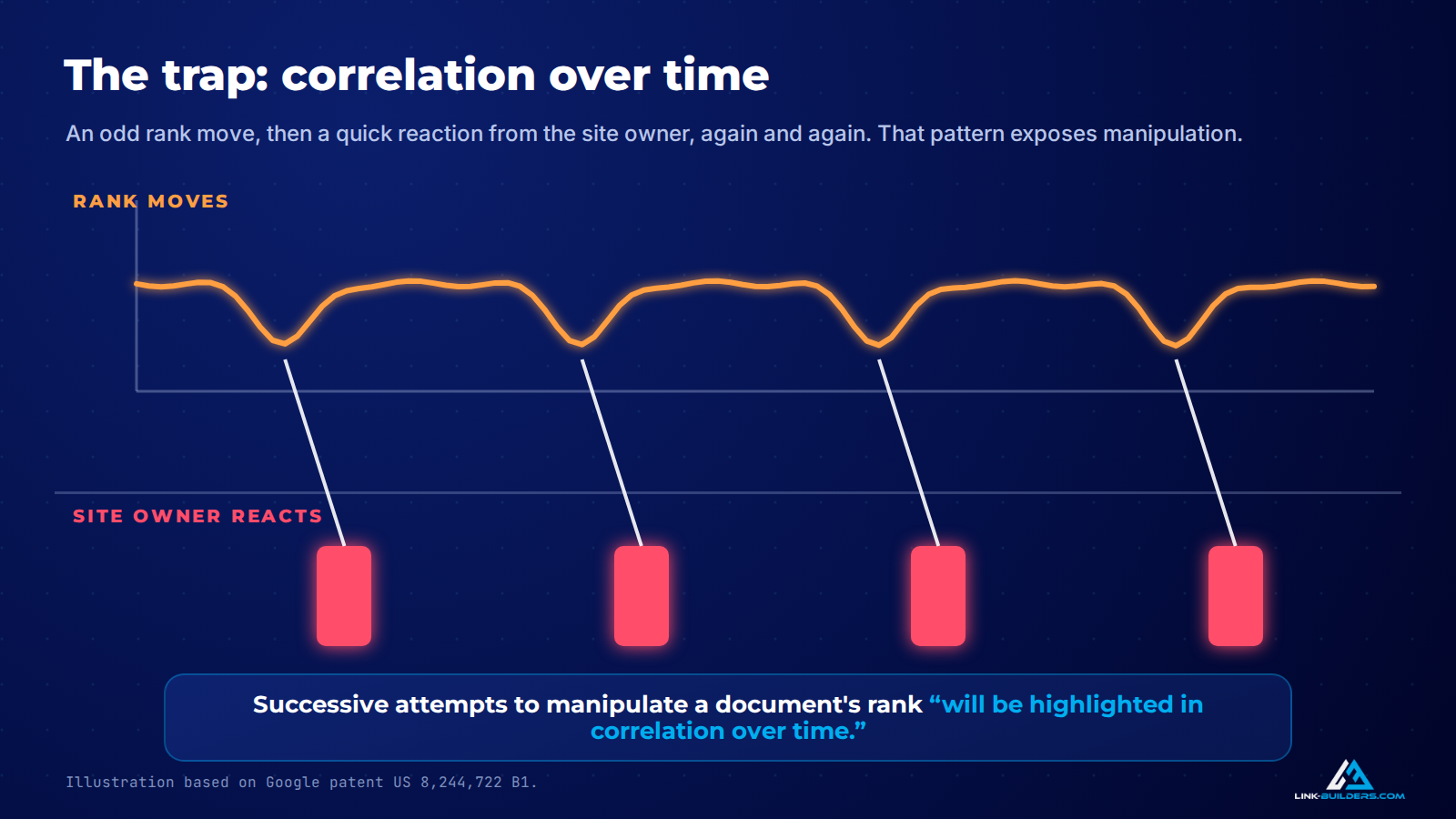
The patent describes two likely responses from someone manipulating rankings. If they see a drop, they may remove the changes they just made, which wipes out any long-term gain. If they see no movement, they may pile on more changes, such as more links, more keywords or more edits, trying to force a result.
How a real business behaves
A normal business owner rarely does either. They publish a good page, earn a few links and get back to running the business. They are not checking rankings every morning and reacting to every small move. That difference in behavior is exactly what the system uses.
Correlation over time
The pattern Google looks for is simple. The rank moves in an odd way, the site owner quickly changes their signals in response, and the cycle repeats. The patent puts it this way: successive attempts to manipulate a document’s rank “will be highlighted in correlation over time.” One reaction might be noise. A string of them lined up with each rank change becomes a clear signal.
Turning up the pressure on suspicious pages
For pages that already look suspicious, the patent allows “more extreme rank variations.” It also describes adding noise to a page’s rank on purpose, to draw out the kind of corrective moves that reveal a spammer.
The core lesson of the whole patent fits in one line: it punishes reactive behavior, not just links.
What Happens When a Page Gets Flagged
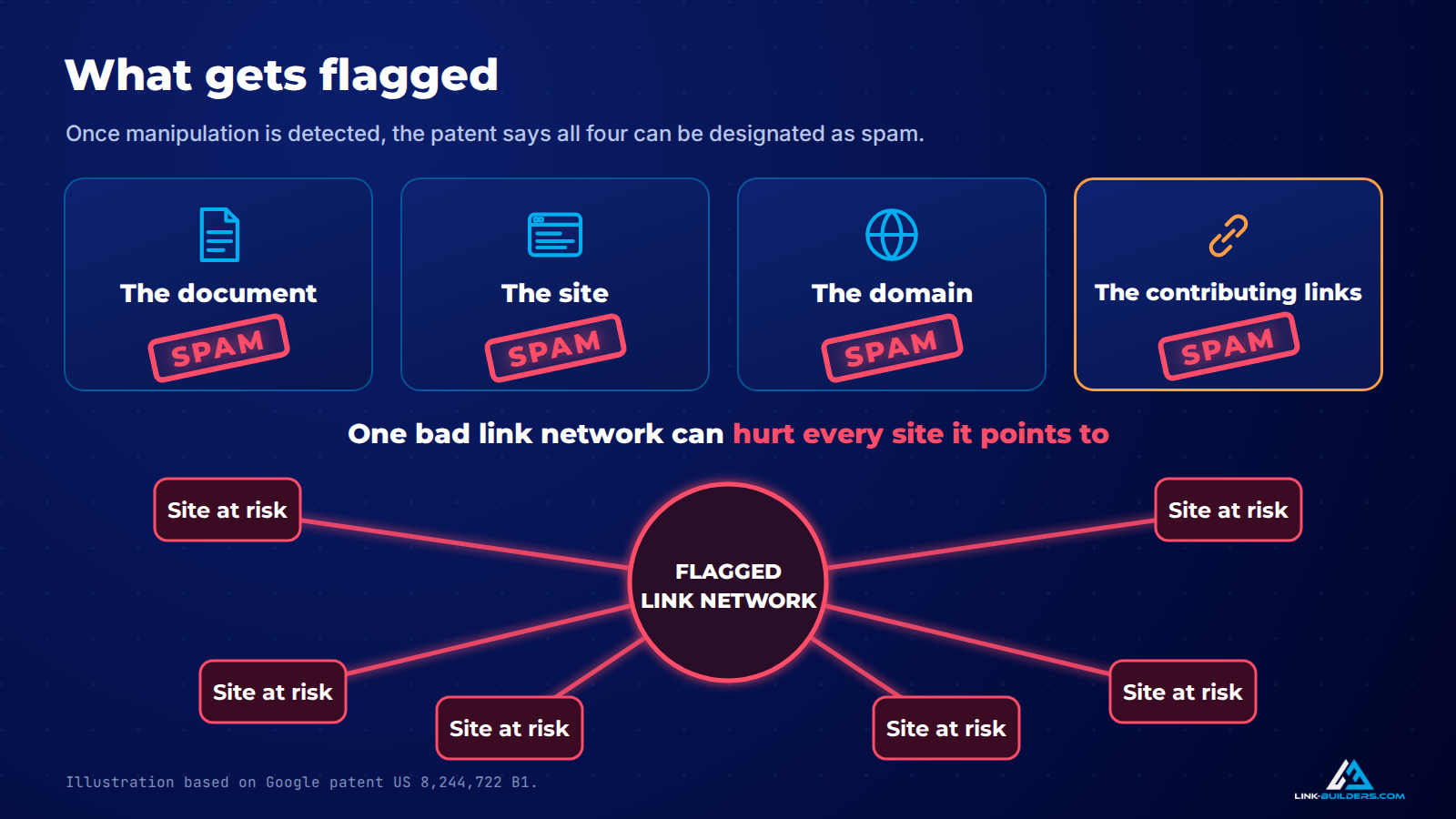
Once the system decides manipulation is happening, the patent says the document, the site, the domain and even the contributing links can be designated as spam.
That last item deserves attention. The links themselves can be flagged, which means a bad link network can hurt every site it points to. It is one more reason cutting corners to scale tends to backfire.
The patent says a spam designation can be used as a “contra-indication of quality.” In practice, that is a reason to push the page’s rank down, possibly below where it started. The first claim of the patent ends exactly this way: detect the manipulation during the transition period, then reduce the page’s rank.
What This Means for SEO Professionals
Expect a lag and plan reporting around it
New links can take weeks, or even a couple of months, to show their full effect. Build that into your monthly reports so a slow first month doesn’t read as failure. As we’ve covered before, Google takes a cautious approach to new links, and this patent shows one way that caution can work.
Treat a dip as data, not a verdict
A drop in the first few weeks of a campaign does not prove the links failed. It may be a transition function doing exactly what it was designed to do. Note it, keep watching, and give it time before drawing conclusions.
Don’t panic-edit mid-campaign
Tearing out links, rewriting a ranking page or dumping in extra links during a dip is the very behavior this system watches for. If a change is truly needed, make it for a sound reason, not because of a short-term ranking swing.
Avoid doing "quick fix" changes (like removing some page element because you heard it was bad for SEO). Instead, focus on making changes that make sense for your users and are sustainable in the long term.
— Google Search Central · Core updates guidance · Google Search Central: Core updates
Keep link velocity steady
Consistent link acquisition looks like a real business earning attention. A burst of links, followed by another burst when rankings stall, looks like someone chasing rankings. When it comes to pace, consistency beats bursts every time.
Treat link quality as risk management
Since contributing links can be flagged, links from networks and farms carry risk beyond simply being ignored. A cheap link that later gets tagged as spam can do real damage. This is a big part of why cheap links carry hidden costs.
Measure in months and set expectations before launch
Daily rank checking makes reactive decisions more likely, for you and for your client. Agree on monthly or quarterly checkpoints, and explain the possible lag and dip before the campaign starts. A client who expects a dip is far less likely to push you into a reactive move halfway through.
What This Means for Business Owners
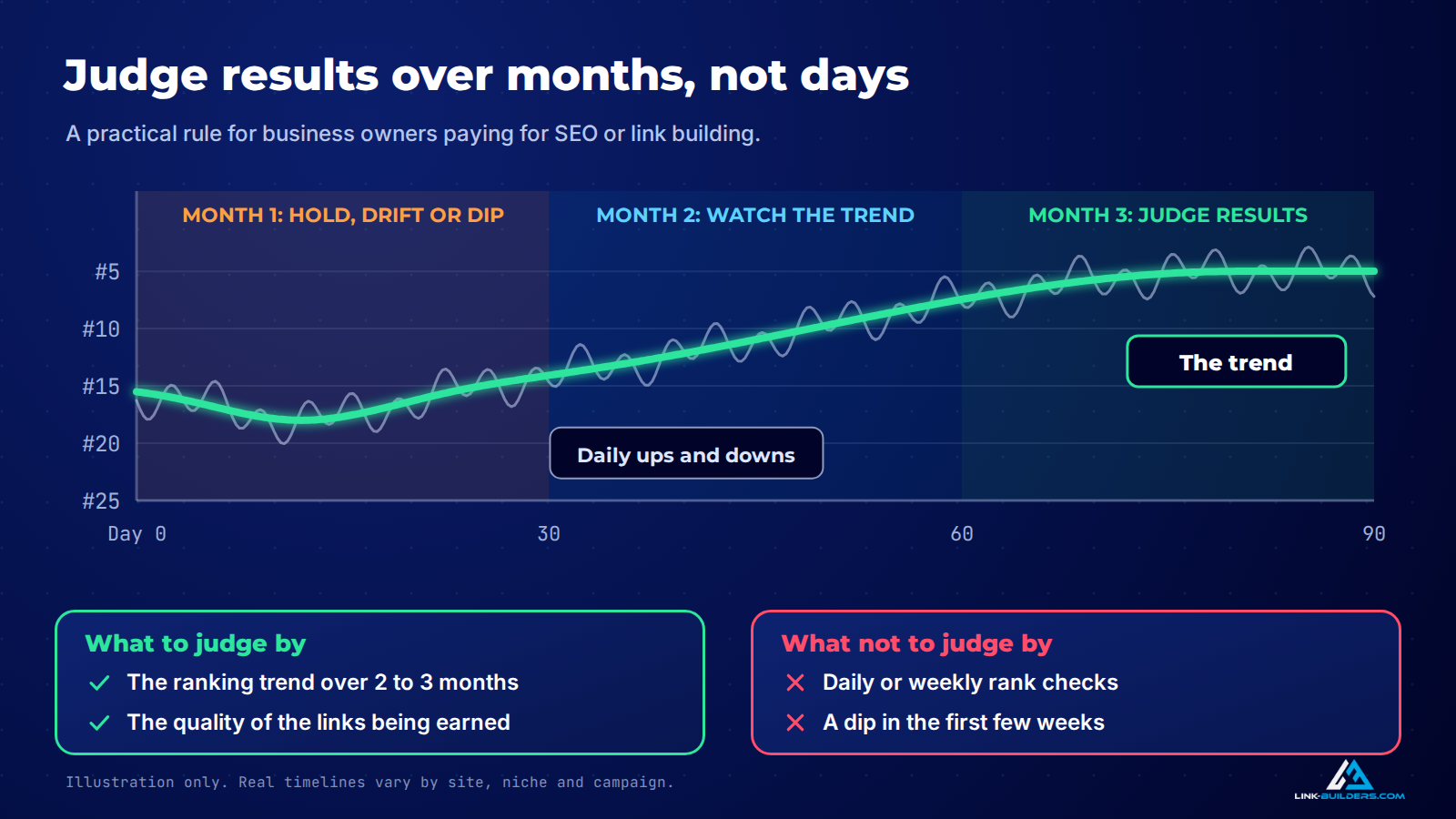
If you pay for SEO or link building, this patent gives you a practical rule: judge results over months, not days.
In the first few weeks after a campaign starts, rankings may hold steady, drift or even dip. That can be normal. What matters is the trend over two to three months, along with the quality of the links your provider is earning. For a sense of realistic output, see our breakdown of how many backlinks you can expect.
A few questions worth asking your provider:
- What timeline should I expect before seeing movement?
- Where are the links coming from, and can I approve sites before outreach?
- What will you do if rankings dip early in the campaign?
Be wary of anyone who promises instant ranking jumps, sells large bundles of cheap links, or wants to change strategy every time rankings move. Our guide on what to look for in a link building provider covers this in more detail.
Caveats: What This Patent Does and Doesn’t Prove
It is worth being honest about the limits here.
First, a patent is not proof of use. Google, like most large tech companies, patents far more ideas than it ever ships. We cannot confirm that this exact system runs in today’s algorithm.
Second, the patent has expired because the maintenance fees were not paid. That is a legal detail. It does not tell us whether the idea is in use.
Third, not every dip comes from this patent. Ranking swings can come from recrawl timing, index changes, competitors making moves, or Google’s broad core updates. The 20-day and 70-day figures come from the patent’s example drawings, not from any stated Google policy.
Even with those limits, the patent is valuable. It shows how Google thinks about spam: slow down feedback, hide cause and effect, and watch for the people who react.
FAQ
How long do new backlinks take to affect rankings?
There is no fixed number, but plan for weeks to a few months. The patent’s own example shows a change taking about 70 days to fully settle. Judge a campaign on its trend over two to three months, not its first two weeks.
Why did my rankings drop after building links?
There are several possible reasons, including normal recrawl timing, algorithm updates and competitor activity. This patent adds one more: a transition function that moves a page down before it moves up. An early dip is not proof that the links hurt you.
Should I remove links if my rankings dip?
Not as a knee-jerk reaction. Pulling links during a dip is one of the exact behaviors this patent is built to detect. Only remove links you have a real quality concern about, and do it for that reason alone.
Is the Google sandbox real?
Google has never confirmed a “sandbox” for new sites. Still, a system like this one would produce the same slow, uneven early results people describe when they talk about the sandbox.
Does Google still use this patent?
There is no public confirmation either way, and the patent has expired. The safest approach is to build links as if a system like this is running, because good practice holds up either way.
Final Thoughts
This patent comes down to five ideas:
- Google can separate where a page should rank from where it is shown.
- The path between the two can be delayed, gradual or inverse.
- The inverse dip works like bait, and reacting to it is the tell.
- Correlation over time exposes repeated manipulation.
- Patience and natural link building are the safer path, and by this patent’s logic, they are what gets rewarded.
At Link Builders, we build links with that long view in mind. Steady pacing, carefully vetted sites and honest timelines are how we have worked with more than 150 clients over the past 11+ years. If you want to see how that works for your site, start with our 30-hour trial at link-builders.com. Agencies can learn about our white label link building service.
For more advanced breakdowns like this one, watch the full video and subscribe to our YouTube channel – @whitelabelbacklinks.
About the author

Justin Davis has been building backlinks since 2015 and has built links for more than 150 clients across law, healthcare, real estate, software, and other industries. He built the first version after years of doing the research by hand, and now builds the same workflow for in-house teams. More on who Justin Davis is, on YouTube, on LinkedIn, or on X.