Google’s PBN Patent: Why 20 Sites Linking to You May Count as One
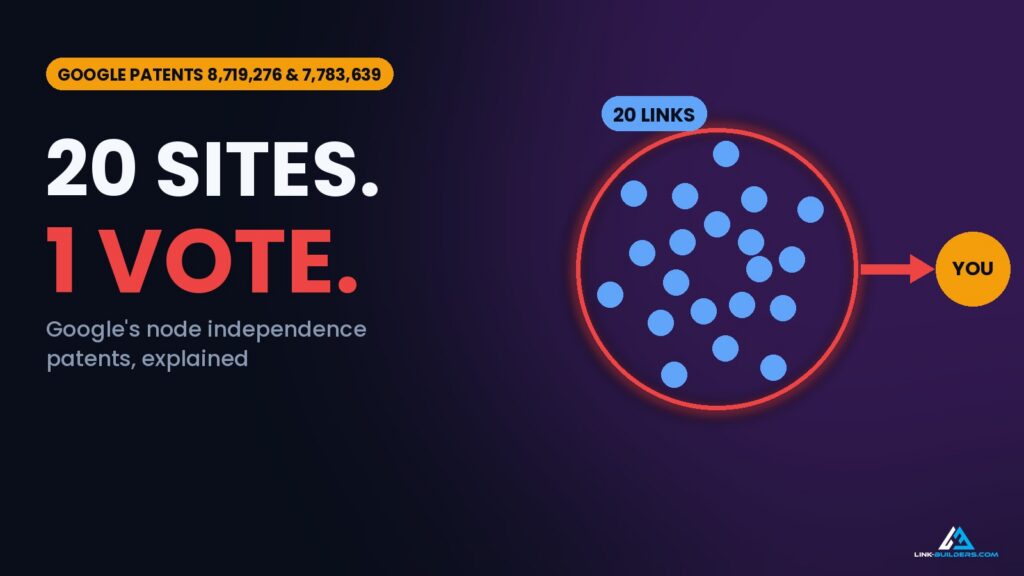
Say you build twenty websites, and each one links to your main site. That’s twenty links, right?
Under the Google patents in this article, they might count as one.
So far in this series, I’ve covered where a link sits on the page, where a link comes from on the web’s map, and when a link arrives. This article is about who is behind the link. It covers two related Google patents that describe how to spot sites controlled by the same owner, and how to shrink the votes they pass to each other. You can watch the full video breakdown below.
The Two Patents at a Glance
This article covers two related patents. The first is US 8,719,276, “Ranking nodes in a linked database based on node independence.” The second is US 7,783,639, “Determining quality of linked documents.”
| Detail | US 8,719,276 | US 7,783,639 |
|---|---|---|
| First filed | November 2003 (provisional) | June 30, 2004 |
| Granted | May 6, 2014 | August 24, 2010 |
| Inventors | Paul Haahr, Martin Kaszkiel, Amit Singhal | Krishna Bharat, Amit Singhal, Paul Haahr |
| Later versions | None | Continuations granted in 2012 and 2014 |
| Status | Expired | Expired |
The names are worth a second look. Amit Singhal went on to lead Google Search for years. Krishna Bharat created Google News.
One note on the title. The patents never use the term “PBN,” short for private blog network. They describe clusters of affiliated sites controlled by a single entity, which is what most link builders mean when they say PBN.
The Problem: One Owner, Many Votes
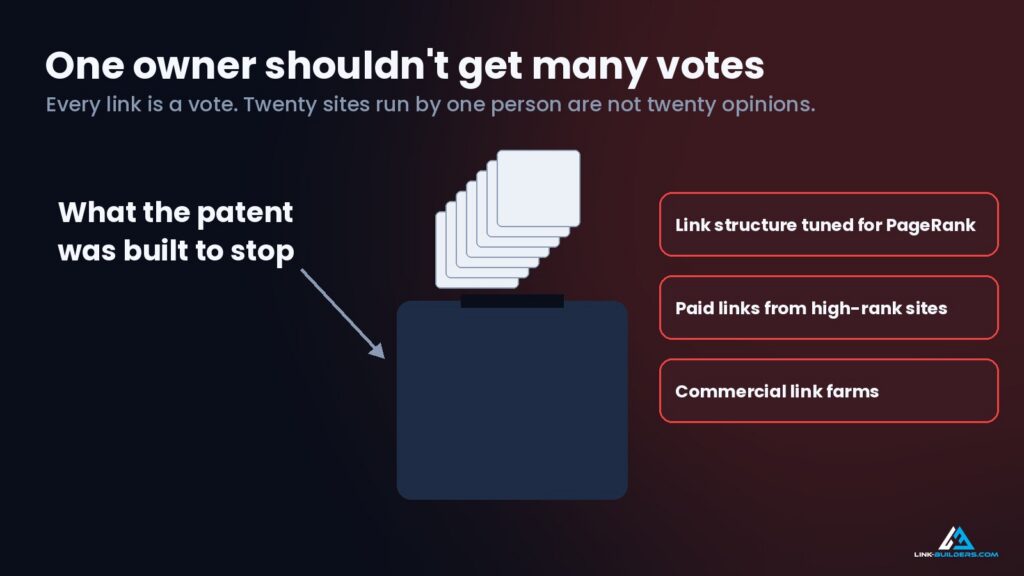
The node independence patent spells out the problem. Site owners were shaping their link structure around how PageRank worked. Some were paying high-ranking sites to link to them. And commercial link farms were trying to push rankings up artificially.
Think of every link as a vote. The idea behind both patents is simple: one entity shouldn’t get to vote over and over again. Twenty sites run by one person are not twenty independent opinions.
But to stop that, Google first has to figure out which websites belong to the same entity. That is where the patents get specific.
How Google Decides Sites Are Affiliated
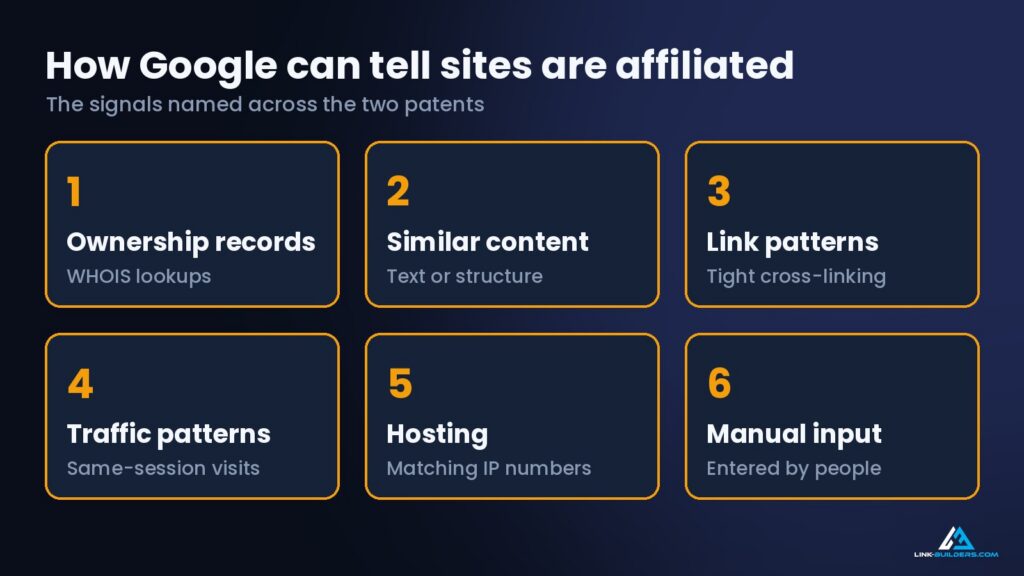
The patents describe grouping websites into clusters of affiliated sites. A cluster forms when there is a high probability the sites are all controlled by a single entity. Between them, the two patents name these signals:
| Signal | What the patents describe | Patent |
|---|---|---|
| Ownership records | Common ownership information, such as a WHOIS lookup | 8,719,276 |
| Similar content | Sites that look alike in their text or structure | 8,719,276 |
| Link patterns | How tightly the sites link to each other | Both |
| Traffic patterns | Sites that many users visit in the same session | 7,783,639 |
| Hosting | Similar hostnames, or IP addresses whose first two or three numbers match | 7,783,639 |
| Manual input | Information entered by people directly | 8,719,276 |
The IP address detail
The hosting signal is the most specific one. The second patent says that if the first two or three numbers of two servers’ IP addresses are the same, affiliation can be inferred. For example, 203.0.113.24 and 203.0.113.87 share their first three numbers.
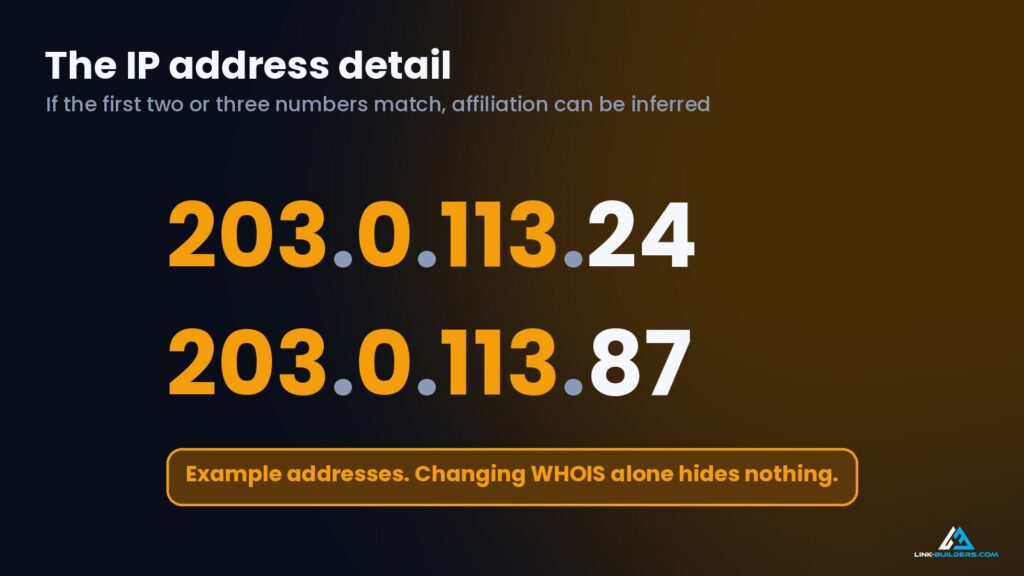
The bigger point is that there is no single signal to hide. Changing your domain registration details covers one signal out of many. The content, the structure, the linking, the traffic and the hosting can all still point back to the same owner.
The Math That Collapses a Network
Once sites are grouped into a cluster, the patents describe two ways to shrink their votes.
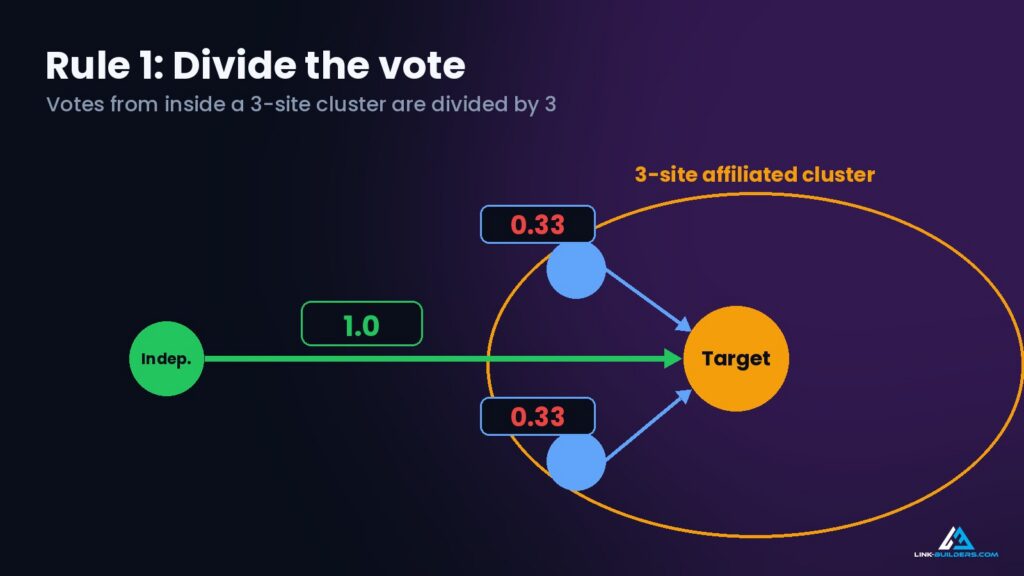
Rule 1: Divide the vote
The first patent gives an example. A page gets a full vote of 1.0 from an independent site. But when the page sits in a three-site affiliated cluster, each vote it gets from the other two sites in that cluster is divided by three, down to about 0.33 each.
Rule 2: Keep only the strongest vote
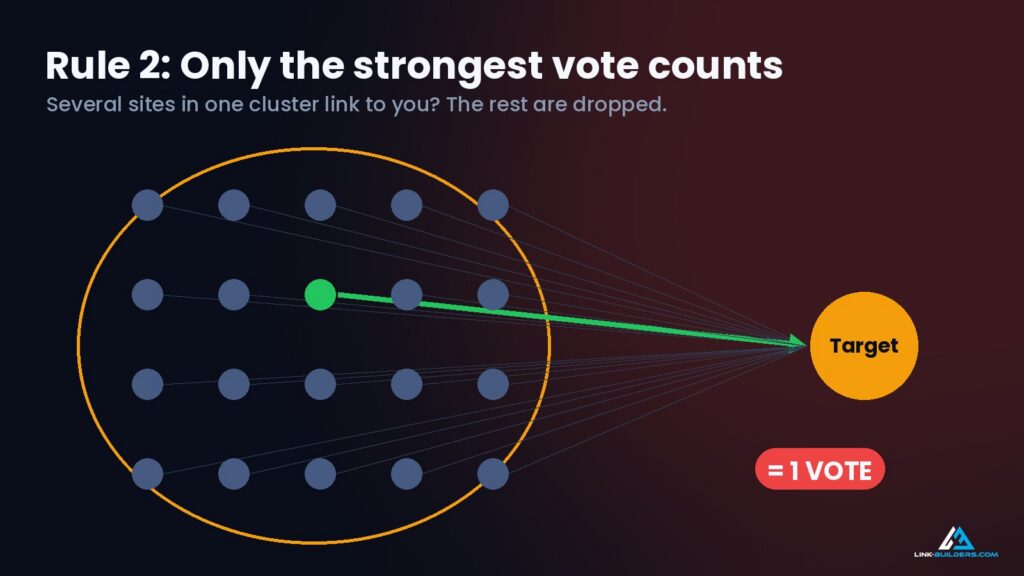
The second rule is even stronger. If several sites in the same cluster all link to one page, only the strongest of those votes counts. The rest are dropped.
That is the “twenty sites, one vote” rule from the start of this article. And it is not just a passing idea in the description. It is written into the claims of the patent, the part that defines what the patent actually protects.
One Author, Three Links
If networks collapse, what kind of links actually add up? The second patent answers with a simple example.
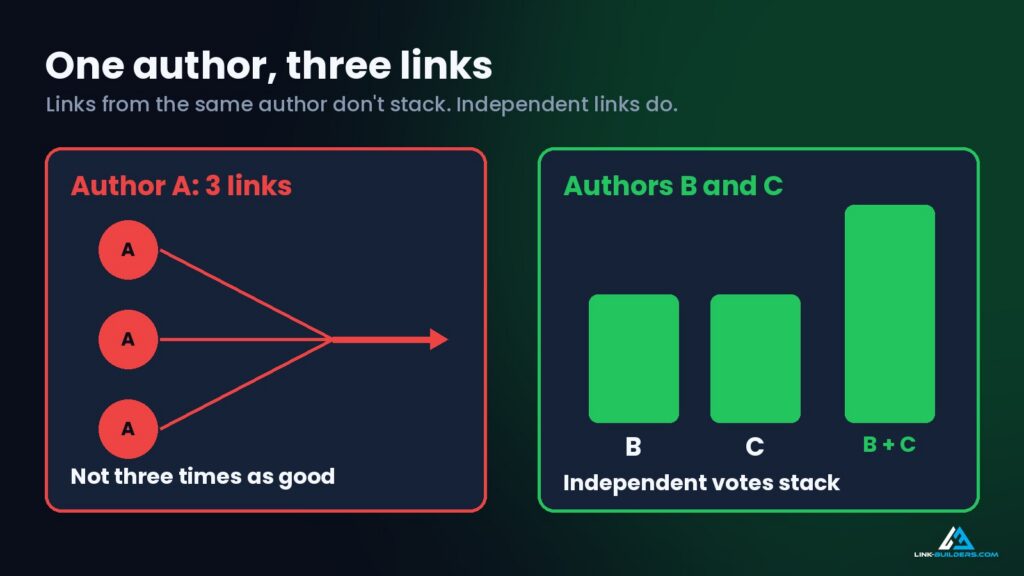
Three pages written by the same author all link to one page. Two other pages, from two different authors, link to it too. The patent’s reasoning is that three links from the same author don’t make the page three times as good. But the two independent links are different. The patent says they complement each other, so their value stacks.
Affiliation is not all or nothing
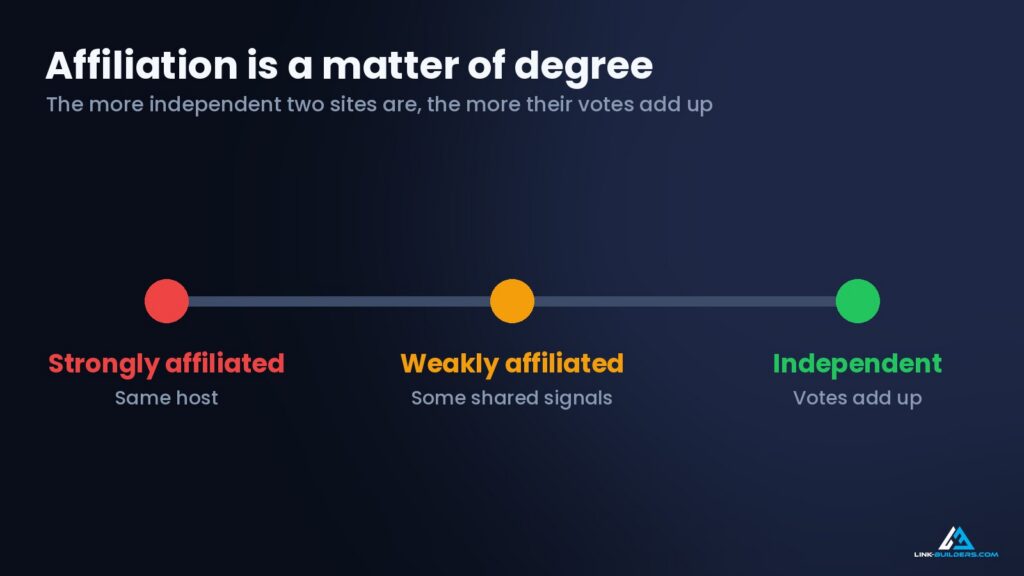
The patent also treats affiliation as a matter of degree. Sites on the same host can count as strongly affiliated. Sites with weaker evidence can count as weakly affiliated. The more independent two sites are, the more their votes add up.
That is why a wide spread of genuinely independent sources is so valuable, and why real independence is hard to fake. For more on building links at volume without cutting corners, read the truth about scalable link building.
The Cap and the Trusted Authorities
The first patent adds one more rule. No single site can pass more than a full vote. So even a huge site with an enormous number of links pointing at it cannot completely dominate the sites it links to.
But there is a twist. Sites that reach what the patent calls a trusted authority level can give a full vote to every site they link to, no matter how many outbound links they have. The patent says this discourages sites from hoarding their rank by linking to only a few places.
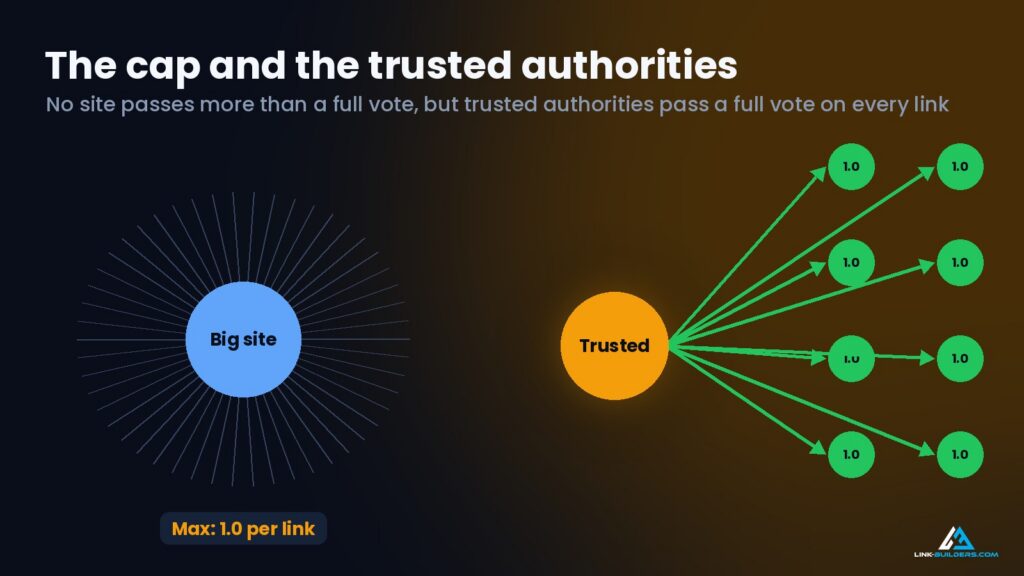
In the seed site article, I explained why pages with fewer outbound links tend to pass more value. For ordinary sites, that still holds. But in this design, a truly trusted authority’s link isn’t watered down by the other links on the page.
What This Means for Your Link Building
Here is what these patents suggest for anyone building links.
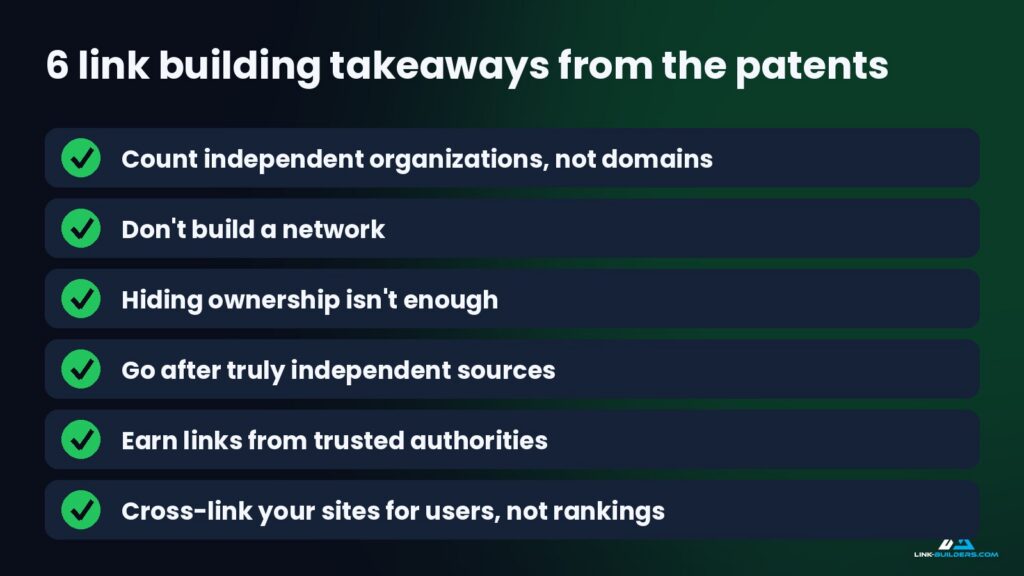
1. Count independent organizations, not referring domains
Ten links from sites owned by one company may add up to about one. When you review a backlink profile, group the linking domains by who actually owns them.
2. Don’t build a network
Links from sites you own or control collapse, no matter how many of them there are. Google’s spam policies also name partner pages built only for cross-linking as link spam.
Excessive link exchanges (‘Link to me and I’ll link to you’) or partner pages exclusively for the sake of cross-linking.
— Google Search Central · Spam policies · Google Search Central: Spam Policies for Google Web Search
3. Hiding ownership isn’t enough
The patents name signals far beyond domain registration records: content, structure, linking patterns, traffic and hosting. Masking one of them does not hide the others.
4. Go after links from truly independent sources
Independent endorsements are the ones that stack. Aim for links from many different organizations, not many sites from a few.
5. Earn links from trusted authorities
In this design, a trusted authority’s links can pass a full vote, even when the page links out a lot.
6. Cross-link your own properties for users, not rankings
Linking your own sites together is fine for navigation and for helping visitors. Just don’t expect it to move your rankings.
The Honest Caveat
A patent shows what Google invented and chose to protect. It does not prove this exact system runs in Google’s algorithm today. Both of these patents have now expired.
Still, the ideas in them have been public for more than twenty years, and they came from people who went on to run Google Search.
Conclusion
These patents come down to one idea: who is behind a link matters. Google described ways to spot sites controlled by the same owner, divide their votes, and count only the strongest one. Twenty links from one owner may be one vote. Twenty links from twenty independent sites are twenty.
Where a link sits matters. Where it comes from matters. When it arrives matters. And who is behind it matters too.
Next in this series, I look at Google’s link spam detection patent, and the clever “wobble test” it uses to tell a link farm from a genuinely popular site.
Want links from truly independent sites? Talk to Link Builders about your next campaign.
Sources
- US 8,719,276: Ranking nodes in a linked database based on node independence, Google Patents
- US 7,783,639: Determining quality of linked documents, Google Patents
- Spam policies for Google web search, Google Search Central
Want more breakdowns like this? Follow White Label Backlinks on YouTube for new videos on Google patents and link building.
About the author

Justin Davis has been building backlinks since 2015 and has built links for more than 150 clients across law, healthcare, real estate, software, and other industries. He built the first version after years of doing the research by hand, and now builds the same workflow for in-house teams. More on who Justin Davis is, on YouTube, on LinkedIn, or on X.