Google’s Other Voters: How Brand Searches and Clicks Can Shape Rankings
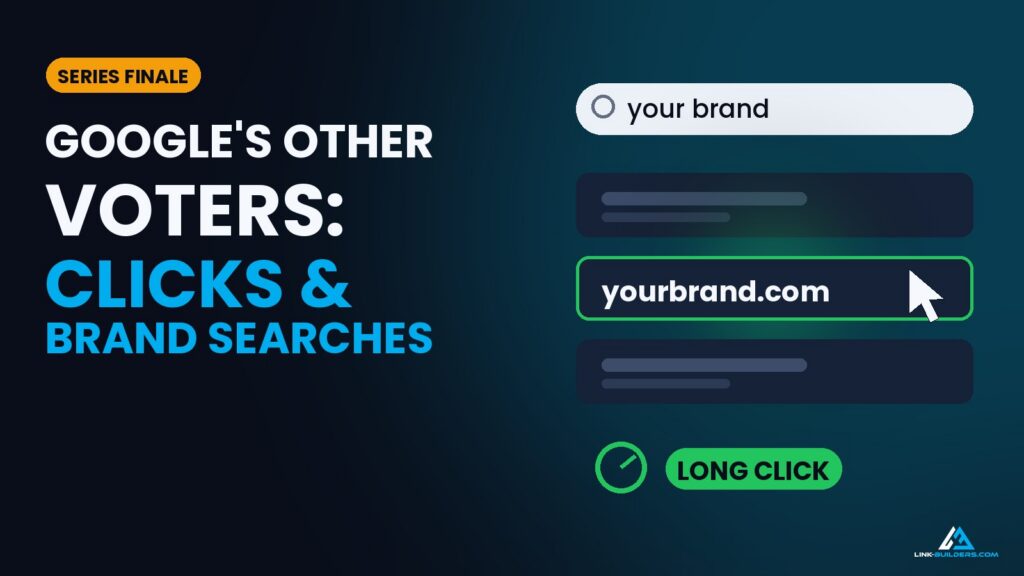
For six articles, I’ve treated links as votes. But Google has another group of voters: the people doing the searching.
This series has covered where a link sits, where it comes from, when it arrives, who is behind it, the shape of your whole profile, and the words in your links. In this final article, it’s about what people actually do: what they search for, and what they click.
I cover two Google patents, one about searches that ask for a site by name and one about clicks. By the end, you’ll see the one kind of link that feeds both of them at the same time. You can also watch the full video breakdown below.
The Two Patents at a Glance
The first patent is US 7,962,462, “Deriving and using document and site quality signals from search query streams.” It is about searches that ask for a website by name. The second is US 8,661,029, “Modifying search result ranking based on implicit user feedback.” It is about clicks.
| Detail | Brand searches (7,962,462) | Clicks (8,661,029) |
|---|---|---|
| Filed | 2005 | 2006 |
| Granted | 2011 | 2014 |
| Inventors | John Lamping, Mark Pearson | Hyung-Jin Kim, Simon Tong, Noam Shazeer, Michelangelo Diligenti |
| Family | Three versions | Six patents, the latest granted in 2023 |
| Status | Expired in 2025 | Active until 2031, according to Google Patents |
One name on the click patent stands out. Noam Shazeer later co-authored the 2017 Transformer research paper, the idea behind today’s AI chatbots.
When a Search Asks for a Site
Here’s the idea behind the first patent. When someone searches with a specific website already in mind, that search is a strong vote for the quality of that site. The patent’s example is someone typing “yahoo mail.” They’re asking for one specific place: mail.yahoo.com.
So how can Google tell when a search is asking for a site? The patent gives three tests.
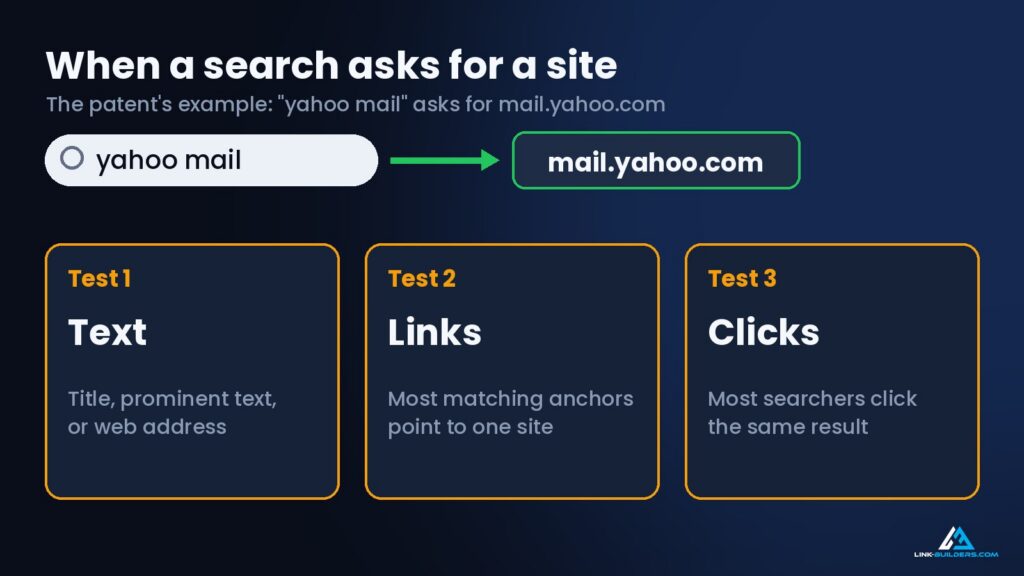
Test 1: The text
The search words match the page’s title, its most prominent text, or its web address.
Test 2: The links
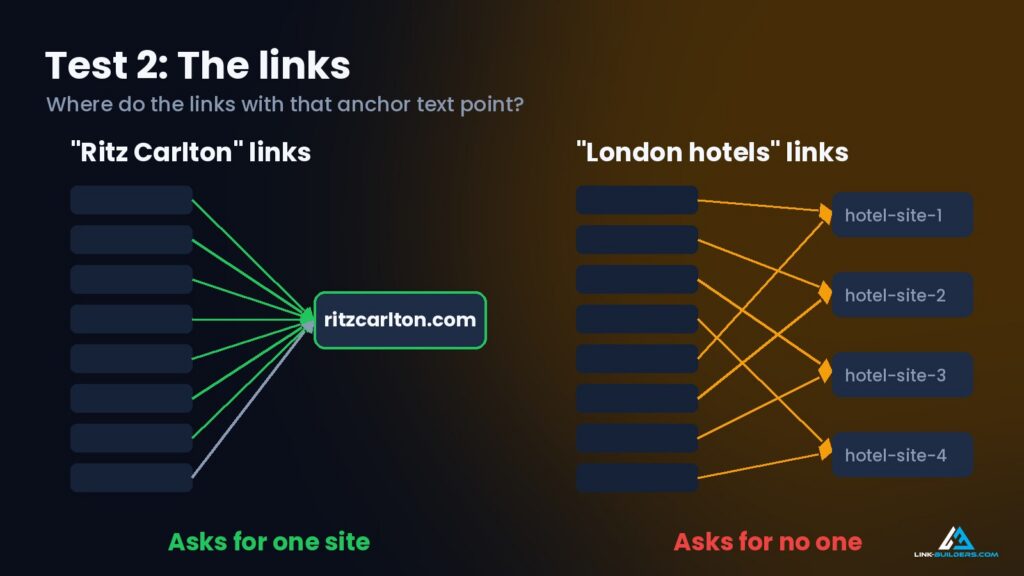
If most of the links that use the search phrase as their anchor text point to one site, the search is asking for that site.
The patent’s example is the Ritz Carlton. Most links that say “Ritz Carlton” point to the official Ritz-Carlton site, so that search is asking for it. But links that say “London hotels” are spread across lots of different sites. No single site gets most of them, so that search isn’t asking for anyone.
Test 3: The clicks
If most of the people who run a search click the same result, the search is asking for that result. The patent’s example of a majority is at least 51 out of 100 clicks.
Points That Boost Everything
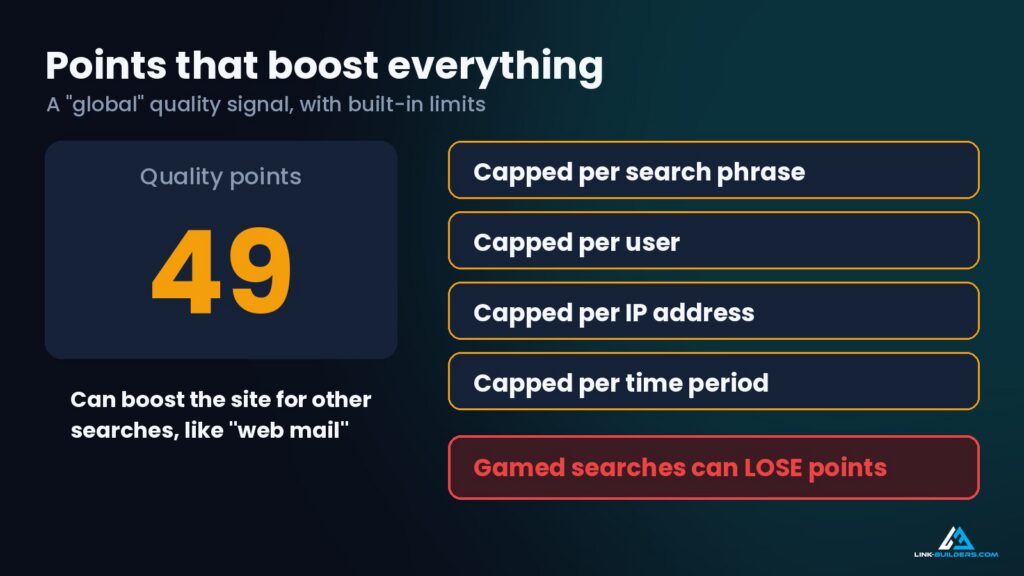
When a search asks for a site, that site earns points. The patent calls those points a global quality signal.
That word “global” matters. It means the points can boost the site for other searches too, not just the one that asked for it. A site that people keep searching for by name could rise for a broader search like “web mail.” The patent also says points can go to a whole site, not just a single page.
Built-in limits
The patent includes limits to stop people from gaming it. Points can be capped per search phrase, per user, per IP address, and per period of time. It even says points can be taken away if people run a search just to farm points for a site.
Why This Matters for Link Builders
Look again at the second test. It is about anchor text. When most of the links that use your brand name point to your site, the patent says Google can tell that searches for your name are asking for you.
That means branded anchors do double duty. In the anchor text article, we saw that they keep your profile looking natural. Here, they help tie your brand name to your website, which can feed a quality signal that reaches beyond your brand searches.
So the next time a branded anchor feels like a wasted opportunity, remember it may be doing more work than it looks.
Long Clicks and Short Clicks
The second patent looks at what happens after someone clicks a search result. How long do they stay before coming back to search again?
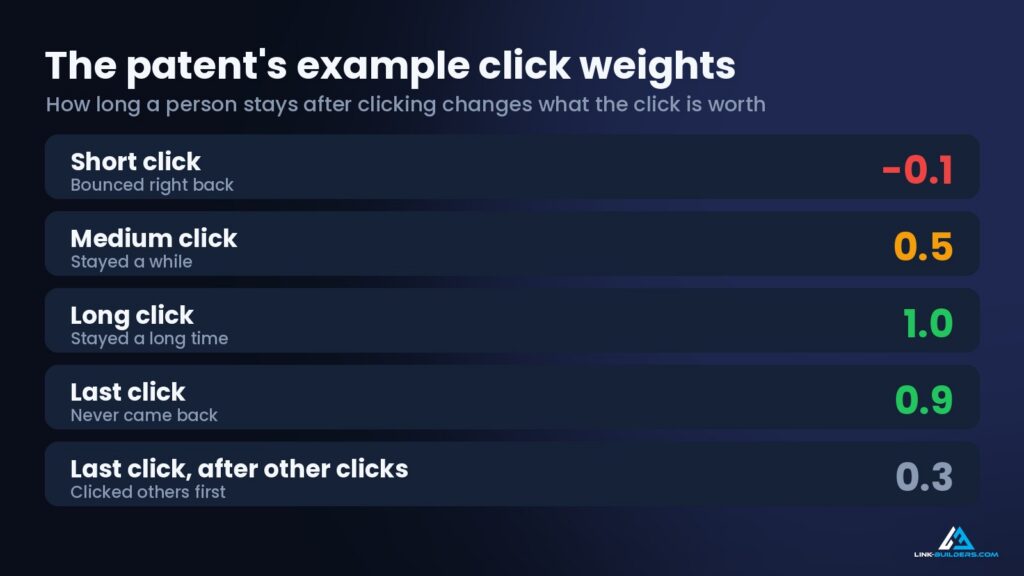
The patent gives example weights for different kinds of clicks:
| Kind of click | What happens | Example weight |
|---|---|---|
| Short click | The person bounces right back to the results | -0.1 |
| Medium click | The person stays a moderate amount of time | 0.5 |
| Long click | The person stays a long time | 1.0 |
| Last click | The person never comes back to search again | 0.9 |
| Last click, after other clicks | Same, but they clicked other results first | 0.3 |
The long click ratio
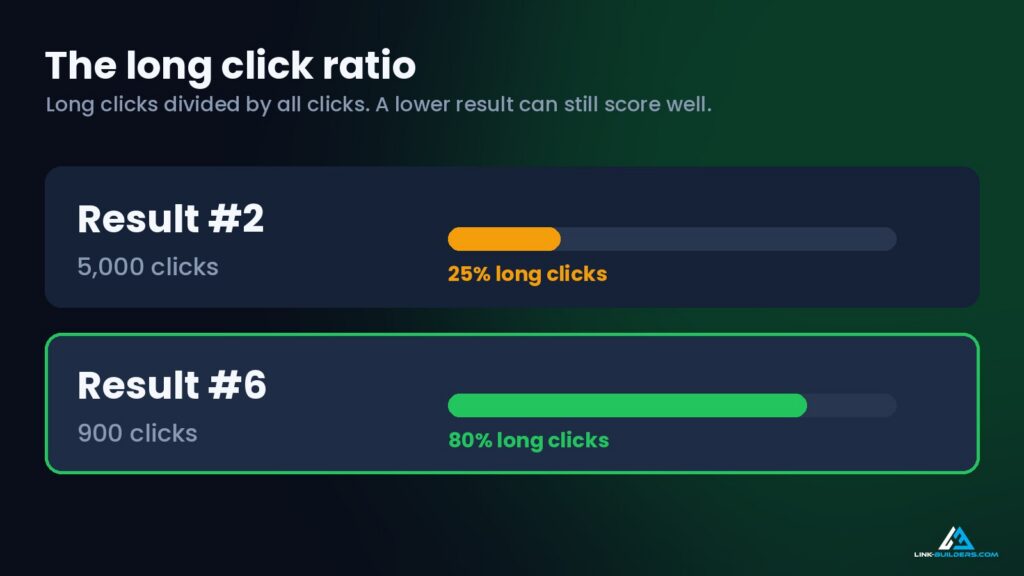
The patent then compares a page’s long clicks to all of its clicks. Because this ratio compares a page to itself, a result lower on the page can still score well, even if it gets fewer total clicks than the results above it. A page in sixth place that keeps people reading can look better than a page in second place that people bounce off.
Not Every Click Is Equal
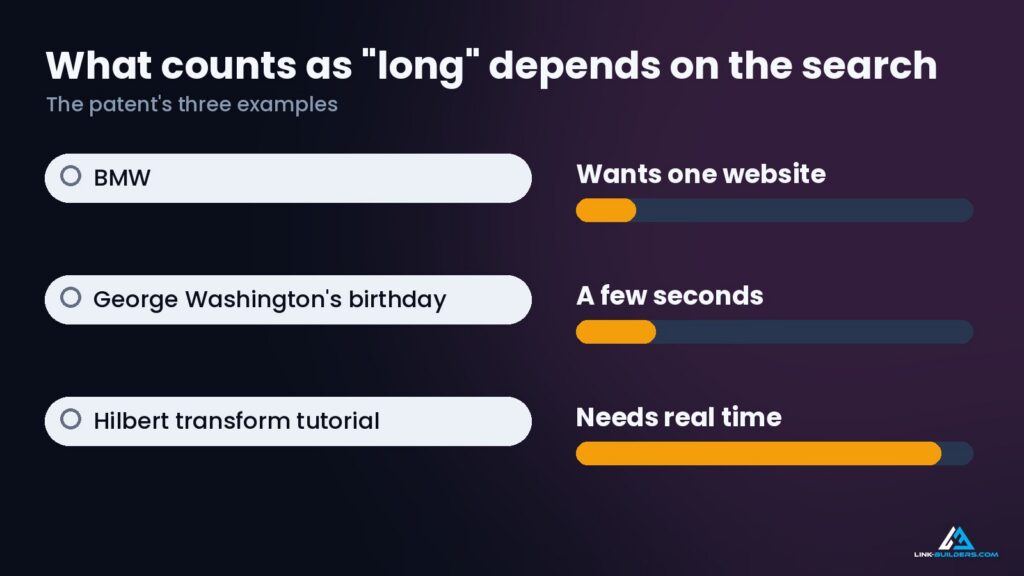
What counts as a long click depends on the search. The patent’s examples make the point well:
- Someone searching “BMW” wants one website. That is a navigational search.
- Someone searching “George Washington’s birthday” only needs a few seconds to get the answer.
- Someone searching “Hilbert transform tutorial” needs a lot longer to get what they came for.
The searcher matters too. The patent says clicks from people who tend to look past the top result can count for more, because they are pickier. And people who search a lot on one topic can be treated as having more expertise in it.
Fake Clicks Don’t Count
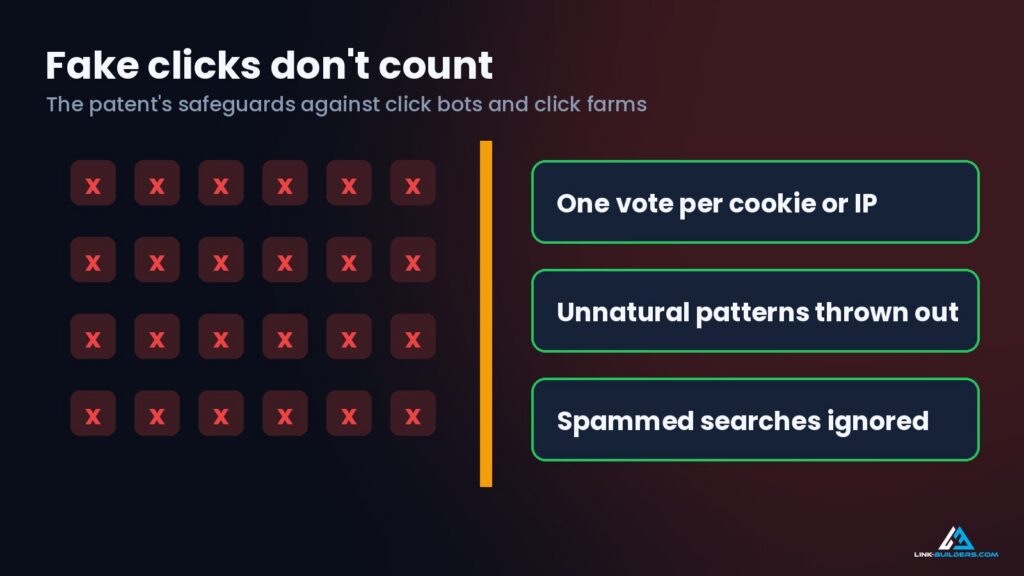
So could someone just fake a pile of clicks? The patent was built for exactly that problem. It describes three safeguards:
- One vote per cookie or IP address for each search and page.
- Unnatural patterns are thrown out, such as clicks with strange timing.
- Spammed searches are ignored, so the click data for a search that looks manipulated can be set aside entirely.
Click bots and click farms are exactly what this patent was designed to filter out. If you are ever offered a service that promises to boost rankings with fake clicks, this is why it is a bad bet.
What’s Public
This next part comes from news reporting, not from either patent.
In October 2023, during the U.S. antitrust trial against Google, the company’s vice president of search, Pandu Nayak, took the stand. According to Reuters, when the judge asked him how important user interaction was, Nayak acknowledged that user reactions to searches mattered, while stressing that other factors were key too. Search Engine Journal also covered his testimony. A click-based ranking system called NavBoost was also widely reported from the trial.
That doesn’t prove how this patent works today. But it does show that clicks are more than a theory.
We also use aggregated and anonymized interaction data to assess whether search results are relevant to queries. We transform that data into signals that help our machine-learned systems better estimate relevance.
— Google Search · How Search Works · Google Search: How Does Google Determine Ranking Results
The Link That Feeds Both
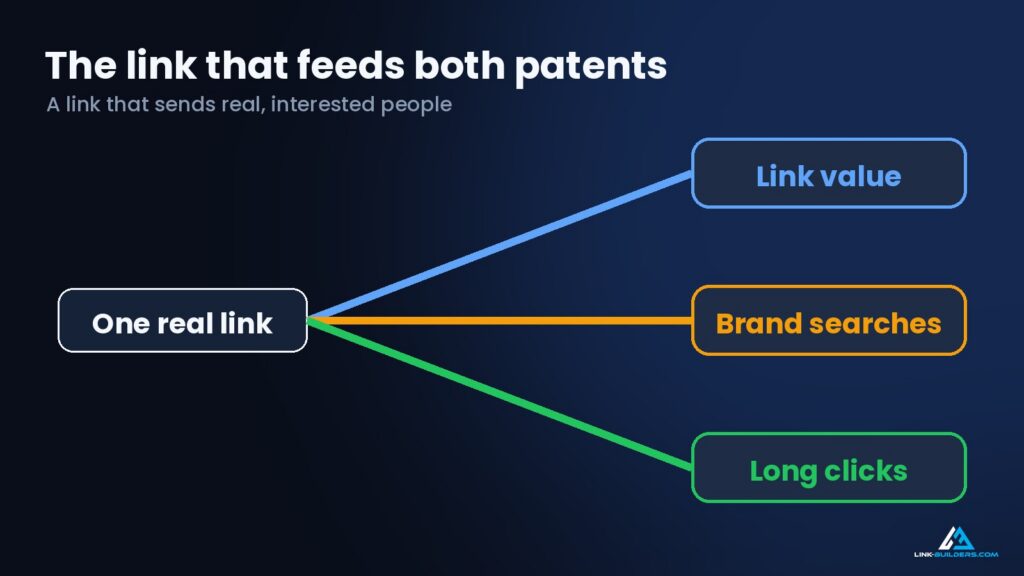
So what’s the one kind of link that feeds both of these patents at once? It’s a link that sends real, interested people.
Think back to the reasonable surfer patent from the start of this series. A link placed where your audience actually reads does three things at once:
- It passes the usual link value.
- It puts your brand in front of people who may search for you by name later.
- It sends visitors who stay, which is exactly what a long click looks like.
That’s the link worth building.
What This Means for Your Link Building
Here is what these two patents suggest for anyone building links.
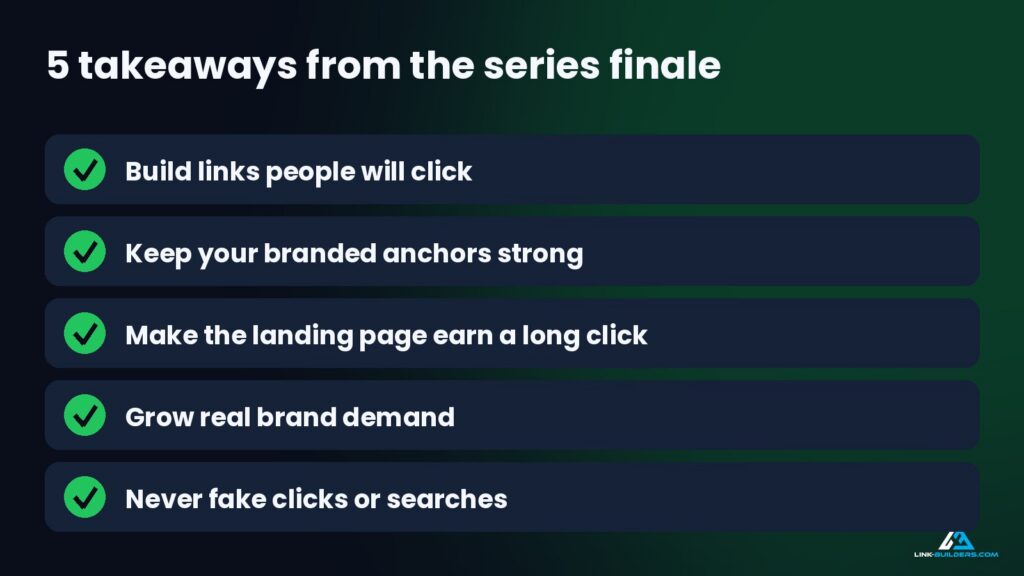
1. Build links people will click
Not just links that crawlers count. A link nobody sees does nothing for brand searches or clicks.
2. Keep your branded anchors strong
They help tie your name to your site. For how to balance them, see the anchor text ratio article.
3. Make the landing page earn a long click
The link brings the visit. The page has to keep it. Send links to pages that answer the question better than the result above them.
4. Grow real brand demand
PR, guest appearances and mentions all make people search for you by name.
5. Never fake clicks or searches
Both of these patents are built to catch it.
The Honest Caveat
As always, a patent shows what Google invented and chose to protect. The brand search patent has expired. The click patent is still listed as active. But neither one proves exactly what runs in Google today, and the trial reporting above is reporting, not a description of either patent.
The Series Wrap-Up
That brings this series to a close. Across seven articles, we’ve looked at every side of a link:
| # | What we covered | Article |
|---|---|---|
| 1 | Where a link sits | The reasonable surfer patent |
| 2 | Where it comes from | The seed site patent |
| 3 | When it arrives | The historical data patent |
| 4 | Who is behind it | The PBN patent |
| 5 | The shape of your profile | The link spam detection patent |
| 6 | The words in your links | The anchor text patent |
| 7 | What people do | This article |
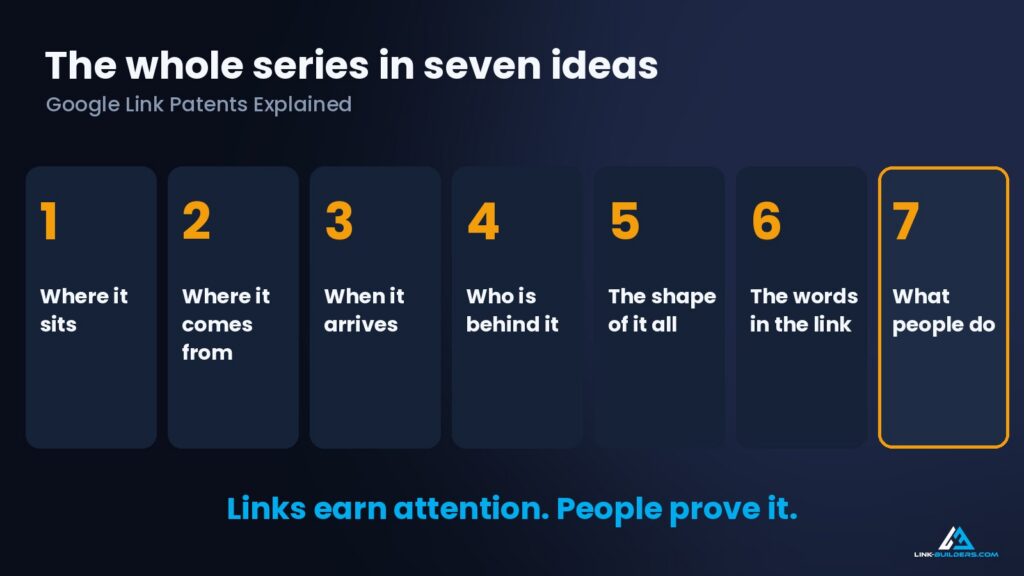
If there’s one idea that ties it all together, it’s this: links earn attention, and people prove it.
Want links that real people actually click? Talk to Link Builders about your next campaign.
Sources
- US 7,962,462: Deriving and using document and site quality signals from search query streams, Google Patents
- US 8,661,029: Modifying search result ranking based on implicit user feedback, Google Patents
- Google Search VP Defends Practices As Antitrust Trial Progresses, Search Engine Journal
Want more breakdowns like this? Follow White Label Backlinks on YouTube for new videos on Google patents and link building.
About the author

Justin Davis has been building backlinks since 2015 and has built links for more than 150 clients across law, healthcare, real estate, software, and other industries. He built the first version after years of doing the research by hand, and now builds the same workflow for in-house teams. More on who Justin Davis is, on YouTube, on LinkedIn, or on X.