Google’s Historical Data Patent: Why When You Get Links Matters
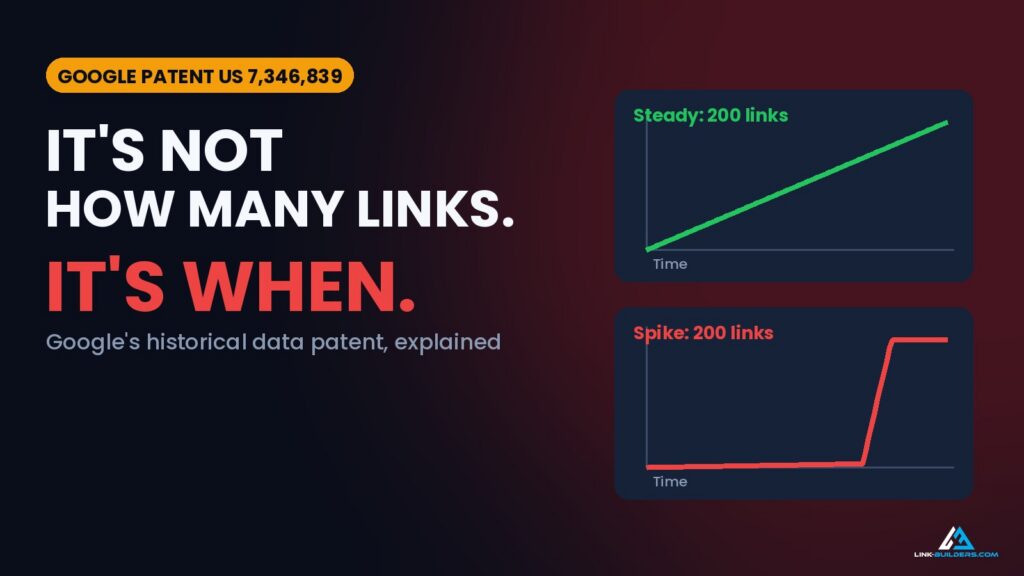
Picture two websites with 200 backlinks each. They have the same number of links and the same metrics. But one earned its links slowly and steadily over a year. The other had almost none, then gained 180 in a single month.
Google may treat those two sites very differently. The reason isn’t how many links they have. It’s when they got them.
In this series, I’ve covered where a link sits on the page and where a link comes from on the web’s map. This article is about timing, through one of the most detailed link patents Google has ever filed. By the end, you’ll also see why one popular trick for making links look natural can make them look fake. You can watch the full video breakdown below.
The Patent at a Glance
The historical data patent is US 7,346,839, titled “Information retrieval based on historical data.”
| Detail | Value |
|---|---|
| Patent number | US 7,346,839 |
| Filed | December 31, 2003 |
| Granted | March 18, 2008 |
| Inventors | Anurag Acharya, Matt Cutts, Jeffrey Dean, Paul Haahr, Monika Henzinger, Urs Hoelzle, Steve Lawrence, Karl Pfleger, Olcan Sercinoglu, Simon Tong |
| Assignee | |
| Patent family | About 18 US patents, with related patents granted as late as 2017 |
Look at who is on it. Ten Google engineers, including Jeff Dean, who also appears on the reasonable surfer patent, and Matt Cutts, who went on to lead Google’s webspam team.
This was not a one-off idea either. Google split it into a family of continuation patents, each focused on one kind of history signal. One of them is devoted entirely to scoring documents based on link-based criteria.
Two Problems and Thirteen Kinds of History
The patent names two problems it set out to solve. Spammers were pushing their rankings up artificially. And stale pages were outranking fresher, more useful ones.
Google’s answer was history. The patent lists thirteen kinds of history data it could use to score a page:
| Group | History data the patent names |
|---|---|
| The page itself | When it first appeared, how its content changes, its topics |
| Searches and users | Search queries, traffic, user behavior, user-maintained data like bookmarks |
| Links | Link-based criteria, anchor text, unique words in anchor text, links from independent peers |
| The site | Domain-related information |
| Results | Ranking history |
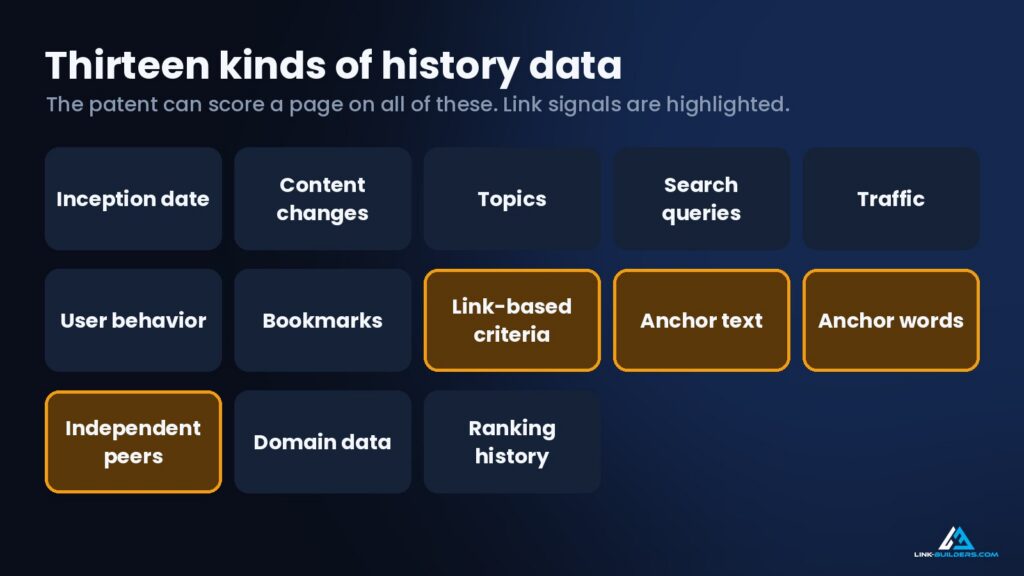
For link builders, the most important ones are about links. The rest of this article focuses on those.
Every Link Has a Birthday
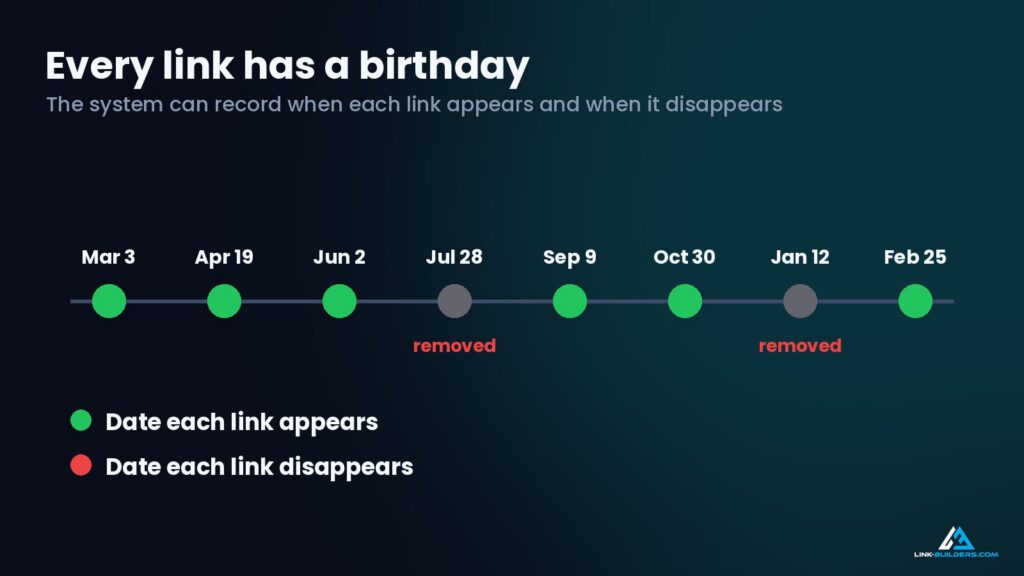
According to the patent, the system can record the date each link to your page first appears, and the date it disappears. That turns a link profile from a snapshot into a timeline.
With that timeline, the system can watch the trend. Are new links arriving faster or slower? Are old links dropping away? The patent says a downward trend in new links can signal that a page has gone stale. An upward trend can signal a fresh page that may be more relevant right now.
The 100-day example
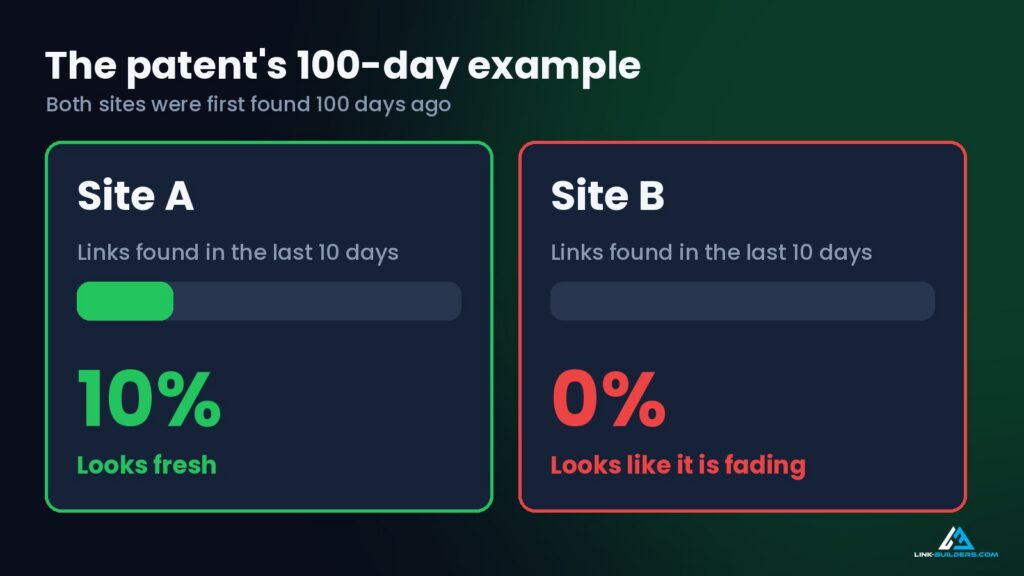
The patent gives a simple example. Two sites were both first found 100 days ago. One got 10 percent of its links in the last 10 days. The other got none. The first looks fresh. The second looks like it is fading.
The patent also describes weighting links by freshness, and treating a page as fresher when the pages linking to it are fresh too. So the age and activity of the sites linking to you can matter, not just your own.
The Spike
Here is the line from this patent every link builder should know. It says a typical, legitimate page attracts backlinks slowly.
So what happens when a page gets a sudden spike? The patent says a big spike usually means one of two things.
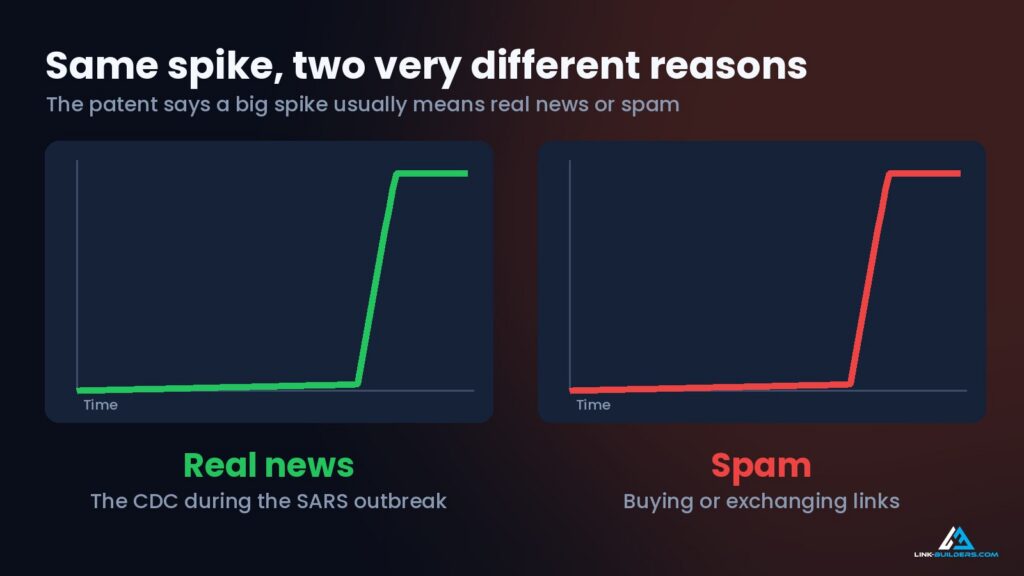
It could be real news
The patent’s example is the CDC website, which gained a flood of links during the SARS outbreak. That kind of spike has a clear, real-world cause.
Or it could be spam
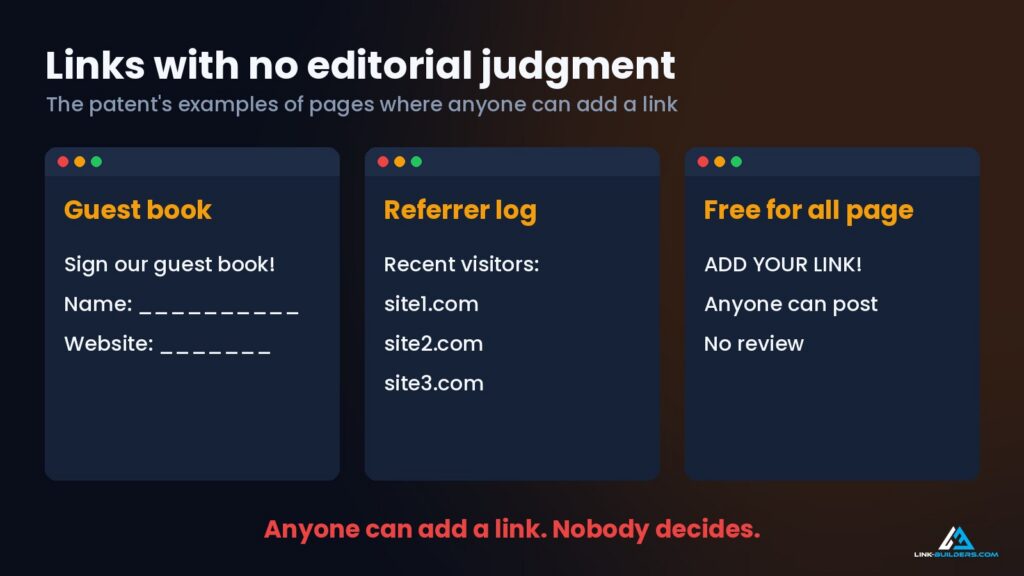
The patent names the tactics behind the other kind of spike: exchanging links, buying links, and getting links from pages with no editorial judgment at all. Its examples of pages without editorial judgment are guest books, referrer logs and “free for all” link pages, where anyone can add a link and nobody decides.
A speed limit on rankings
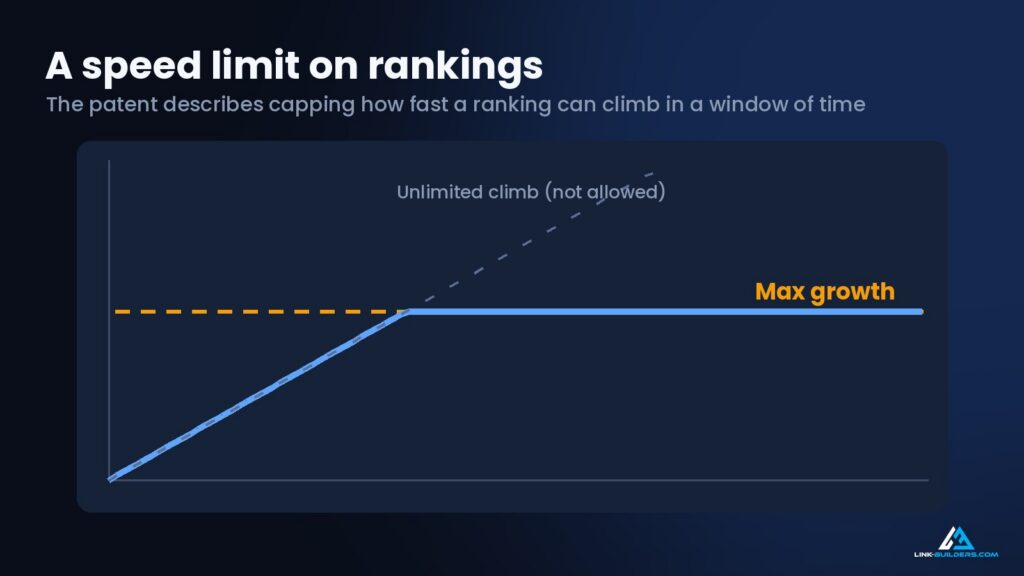
The patent also describes a way to slow things down. A page’s ranking might only be allowed to grow so fast, with a limit on how much it can climb in a given window of time.
To tell news from spam, one idea in the patent is simple: check whether anyone is actually talking about the page in news articles or discussion groups. As the patent points out, spam doesn’t get mentioned in the news. It also says some authoritative sources, such as government pages and web directories, can be treated as exceptions.
Why Faking Natural Doesn’t Work
The patent draws a clear line between two kinds of link growth. Links that grow naturally come from independent decisions: many different people choosing to link on their own schedule. Fake link graphs come from coordinated decisions, and coordinated decisions leave a pattern.
The objective is not to ‘make your links appear natural’, the objective is that your links are natural.
— Matt Cutts (then Google webspam) · Matt Cutts: Natural links are better than non-natural
The anchor text pattern
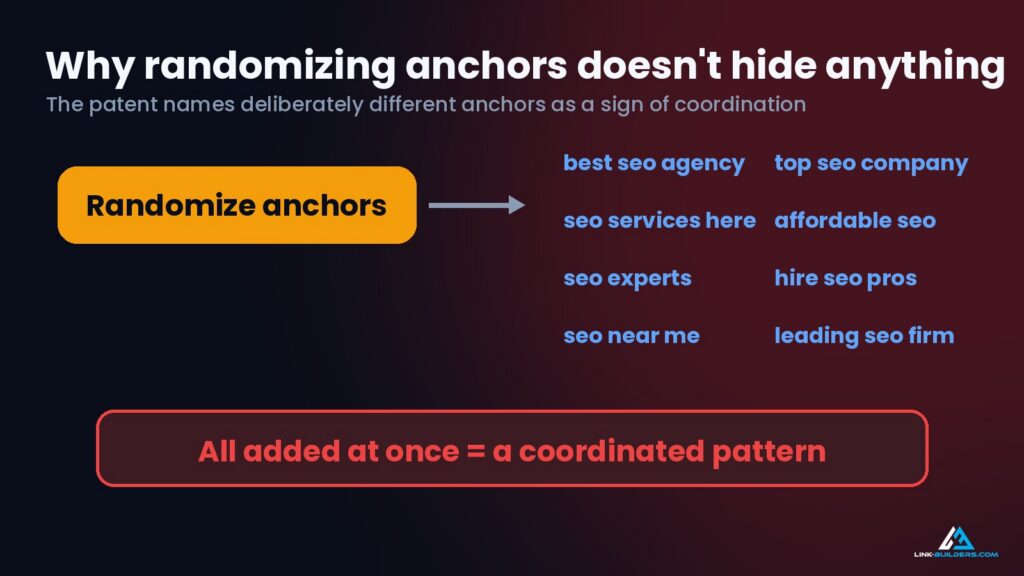
The patent says that pattern shows up in anchor text. When lots of identical anchors appear at once, the growth comes in sudden jumps instead of a smooth climb.
Here is the part that surprises most people. The patent also names deliberately different anchors, added from many pages at once, as a sign of coordination. So running your anchors through a tool to make them look varied does not hide anything. The timing and the pattern of the growth give it away. For more on getting anchor variety right, see why anchor diversity still matters when AI drafts link pitches.
A sudden rush of “independent” sites
The same logic applies to the linking sites. A sudden wave of seemingly independent sites all linking in at once can flag a synthetic link graph. The patent says the impact of those links can be capped or demoted.
When Links Go Stale
Links can also work against you on the way out. When a lot of links to a page disappear, the patent says that can mark the page as stale. And links that sit on pages judged to be stale may be discounted or ignored.
Consistency matters too. The patent says a page that features a different link every day may be weighted lower than a page that consistently links to the same place over time. A permanent link inside an article that stays up for years sends a stronger signal than a rotating “featured link of the day” slot.
Expired Domains and Ownership Changes
This section matters most for anyone buying expired domains or redirecting them.
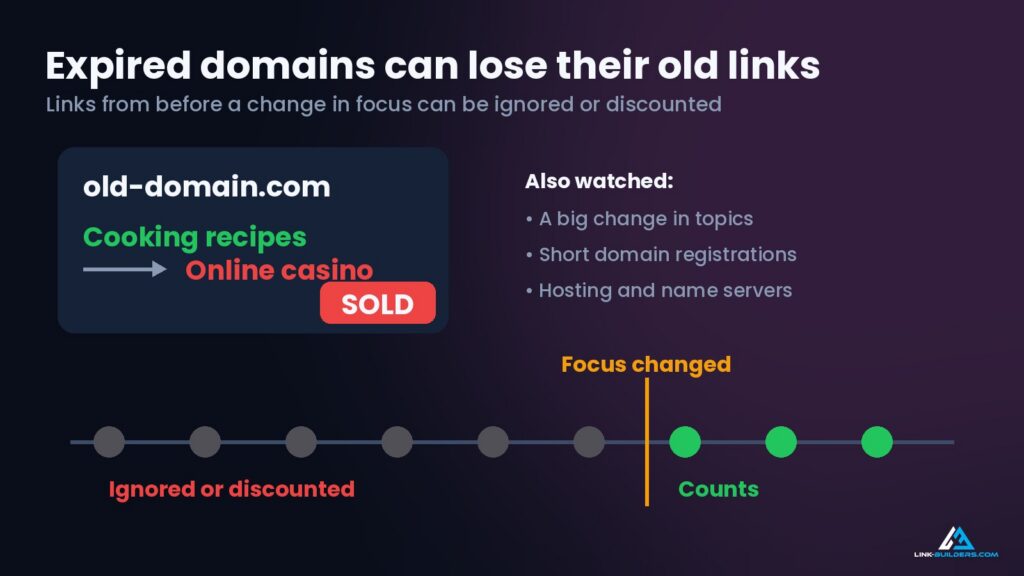
The patent walks through this scenario. A domain expires. Someone new buys it. The content changes completely, but the domain still has its old backlinks, with anchor text about the old topic.
The patent’s fix is to estimate the date the domain changed focus, then ignore or discount the links and anchor text from before that date. In other words, the old links may not carry over to the new site.
Topic changes
The patent also says a big change in a page’s topics may mean the owner changed. When that happens, it says the old signals, like the page’s score and its anchor text, may no longer be reliable.
Registration length
The patent even looks at how far ahead a domain is paid for. It says legitimate domains are often registered several years in advance, while throwaway doorway domains are rarely used for more than a year. It also mentions hosting and name server details as possible signals.
What This Means for Your Link Building
Here is what the patent suggests for anyone building links.
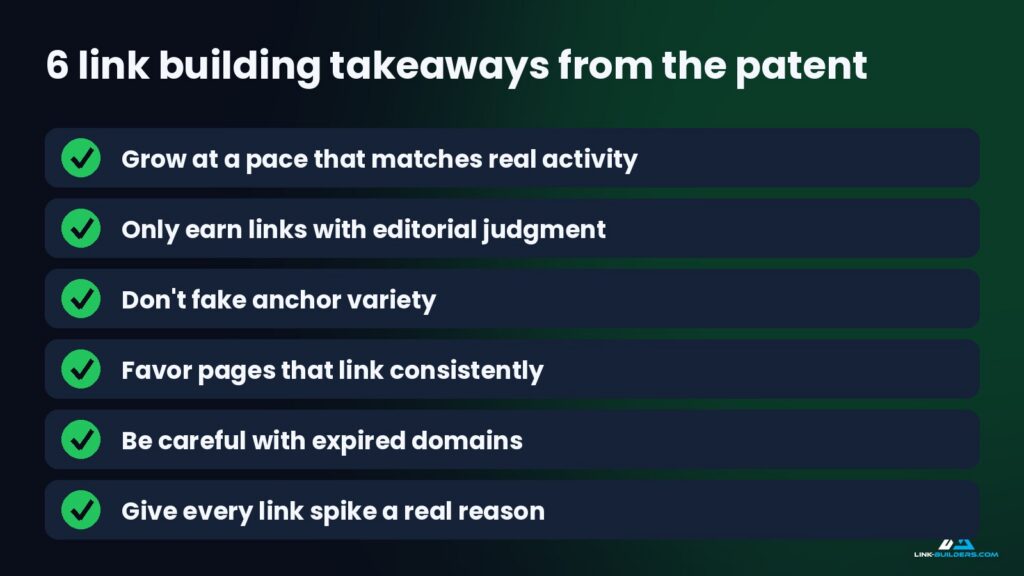
1. Grow at a pace that matches real activity
Steady growth tied to what is actually happening in your business beats a sudden burst out of nowhere. This is one reason a natural backlink profile is built over months, not days.
2. Only go after links with editorial judgment behind them
If anyone can post a link on a page without someone deciding it belongs there, it is not worth having. Guest books, open comment sections and auto-approved directories fall into this group.
3. Don’t fake variety
Natural anchor text comes from real people writing about you, not from a spreadsheet of variations. The patent names deliberately varied anchors as a sign of coordination.
4. Favor pages that are alive and link consistently
A permanent link inside an article that stays up beats a rotating featured slot. Pages that keep getting updated also help the freshness of the links they carry.
5. Be careful with expired domains and redirects
If a domain’s topic changed, the patent says its old links may not carry over. Buying an expired domain for its backlinks is riskier than it looks.
6. Give your spikes a reason
If you land a burst of links, tie it to something real, such as a study, a product launch or news that people actually talk about. A spike with a clear cause looks very different from one with no explanation.
The Honest Caveat
A patent shows what Google invented and chose to protect. It does not prove this exact system runs in Google’s algorithm today, and much of this patent is written as things the system “may” do.
Still, Google kept building on this idea for fourteen years, from the first filing in 2003 to the last related patent in 2017. Google Patents lists the original as expired in 2025. And the timing ideas here line up with another Google patent I have covered, on how rankings can shift slowly and even move the wrong way first. Both point the same direction: patience and steady, real link growth.
Conclusion
The historical data patent comes down to one idea: when a link arrives matters. Google described a system that records when links appear and disappear, watches how fast a profile grows, and treats sudden, unexplained spikes and coordinated patterns as warning signs.
Where a link sits matters. Where it comes from matters. And when it arrives matters too. Build links the way real people would give them, at a pace that matches real activity, and time stops being your enemy.
Next in this series, I look at Google’s node independence patent, which explains why links from sites under the same owner may count for far less than you think.
Want links that grow the way real links do? Talk to Link Builders about your next campaign.
Sources
- US 7,346,839: Information retrieval based on historical data, Google Patents
Want more breakdowns like this? Follow White Label Backlinks on YouTube for new videos on Google patents and link building.
About the author

Justin Davis has been building backlinks since 2015 and has built links for more than 150 clients across law, healthcare, real estate, software, and other industries. He built the first version after years of doing the research by hand, and now builds the same workflow for in-house teams. More on who Justin Davis is, on YouTube, on LinkedIn, or on X.