Google’s Seed Site Patent: How Close Is Your Site to the Web’s Most Trusted Pages?
Most link builders judge a backlink by the linking site’s metrics. A high Domain Rating looks good, and a low one looks weak. But Google has described a way of ranking pages that barely cares about a site’s size. It cares about distance.
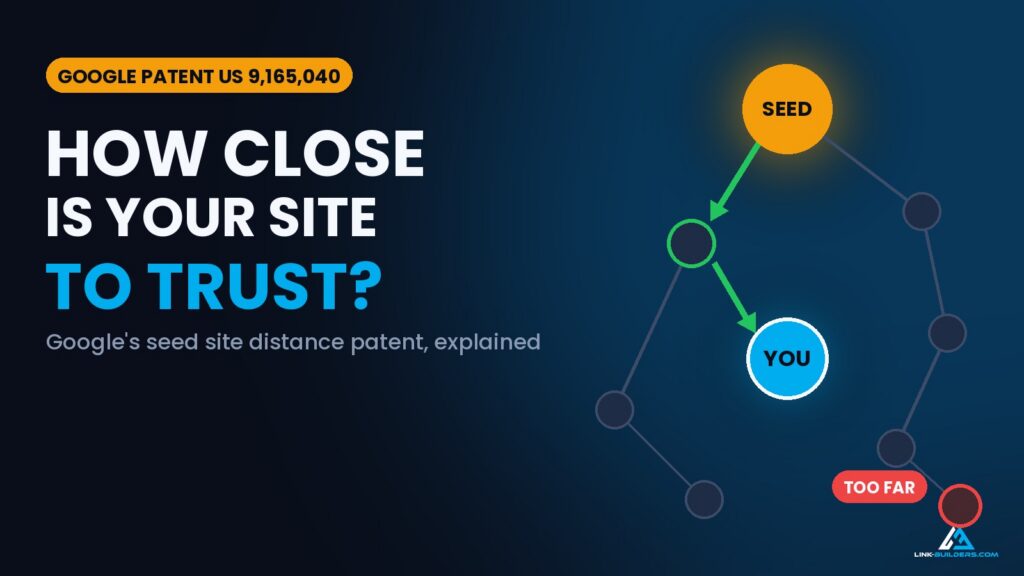
In 2006, Google filed a patent for a system that starts from a small set of trusted pages, follows the links outward, and measures how close every other page sits. The closer a page is to those trusted pages, the higher it scores.
In the first article in this series, I covered the reasonable surfer patent, which weighs each link by how likely a real person is to click it. This article covers the next idea: where a link comes from on the web’s map. You can also watch the full video breakdown below.
The Patent at a Glance
The seed site patent is US 9,165,040, titled “Producing a ranking for pages using distances in a web-link graph.”
| Detail | Value |
|---|---|
| Patent number | US 9,165,040 |
| Filed | October 12, 2006 |
| Granted | October 20, 2015 |
| Inventor | Nissan Hajaj |
| Assignee | |
| Later version | Continuation granted in 2018 |
The patent took nine years to be granted. Google then filed a continuation of it right away, which was granted in 2018. Google Patents lists the original as still active until 2027.
The Problem Google Was Solving
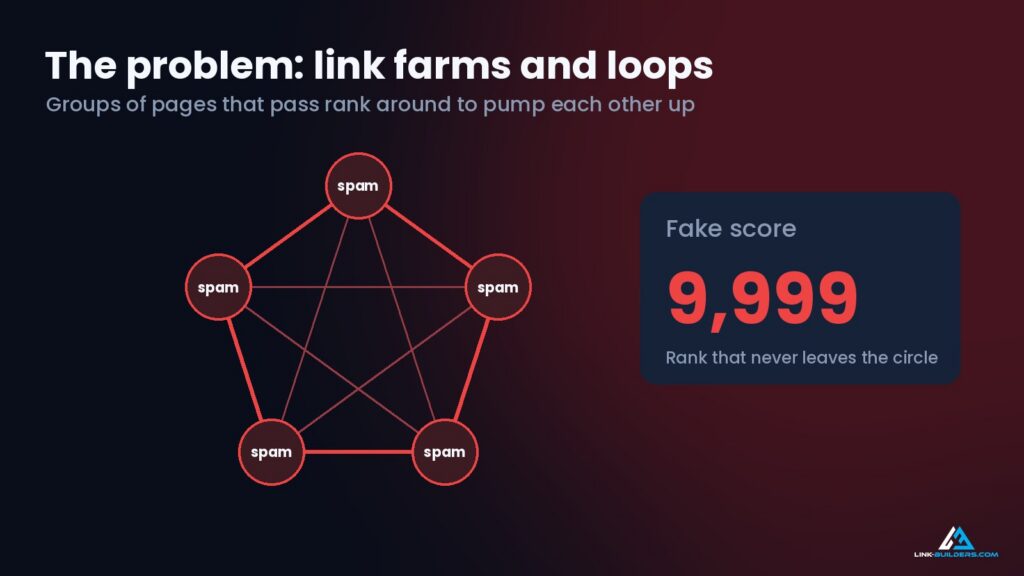
The patent opens by admitting a weakness in the original PageRank formula: it could be manipulated. It names two tricks that spammers used to inflate their scores. The first is link farms, groups of pages that exist mainly to link to each other. The second is loops, where pages pass rank around in a circle and pump each other up.
The patent’s answer is to change the starting point. Instead of treating every page on the web as an equal place to begin, the system starts from a handful of pages it already trusts. It then follows their links outward to find the other good pages on the web. The patent calls these starting points seed pages.
What Makes a Seed Page
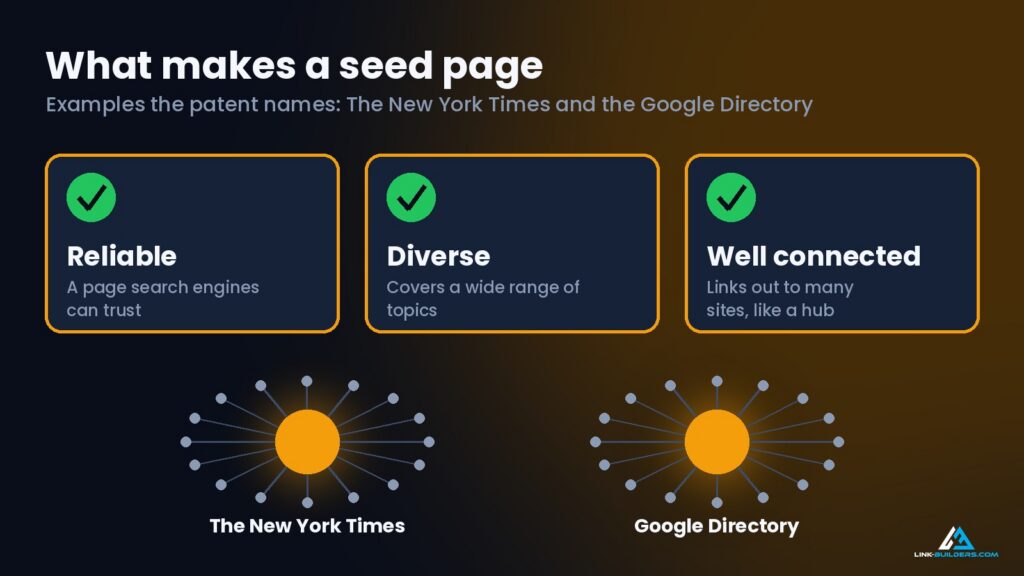
The patent says a good seed page has three qualities:
- Reliable. It is a page the search engine can trust.
- Diverse. It covers a wide range of topics.
- Well connected. It links out to a large number of other pages, which the patent describes as acting as a hub on the web.
The patent even gives two examples of seeds: the Google Directory and The New York Times. Both were large, trusted, and linked out to a huge number of other sites.
The patent also says seeds are chosen by people, and that using too many of them would make them easier to manipulate. So the list stays small on purpose.
Links Have Length
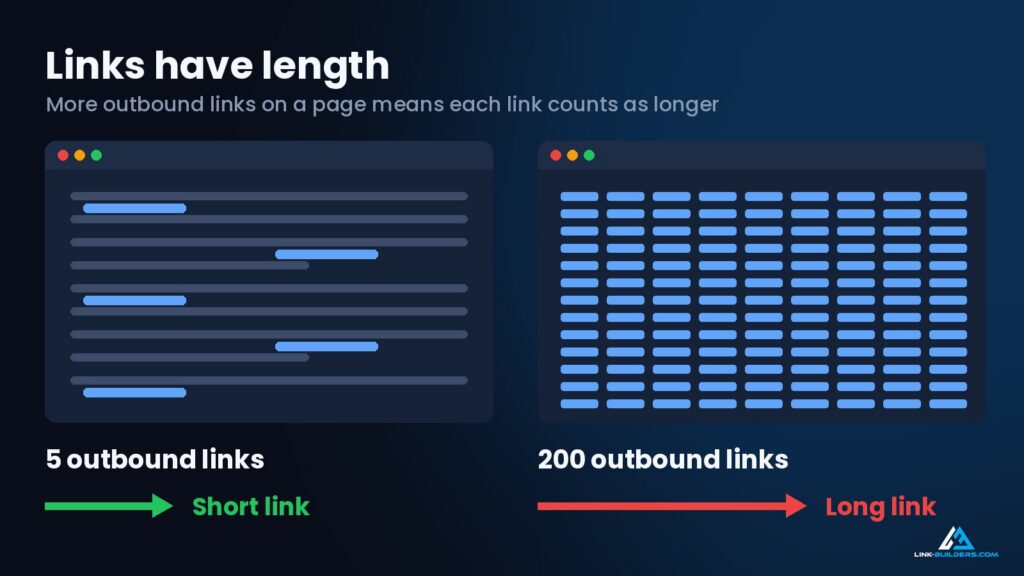
This is the core of the patent. In this system, every link has a length, and that length depends on the link itself and on the page it comes from.
The patent mentions features like a link’s position and its font, which echo the reasonable surfer patent. But the main factor it spells out is simple: how many outgoing links the source page has. The more outgoing links a page has, the longer each of those links becomes. A link from a page with five outbound links is short. A link from a page with two hundred is long.
Distance is the lengths added up
To find a page’s distance, the system adds up the link lengths along the shortest path from a seed page to that page. A page two short hops from a seed is close. A page reached only through long links from crowded pages is far away.
Closer pages score higher, fast
The patent then turns distance into a score. In simple terms, the score falls off exponentially as the distance grows:
\text{Score} = e^{-\text{distance}}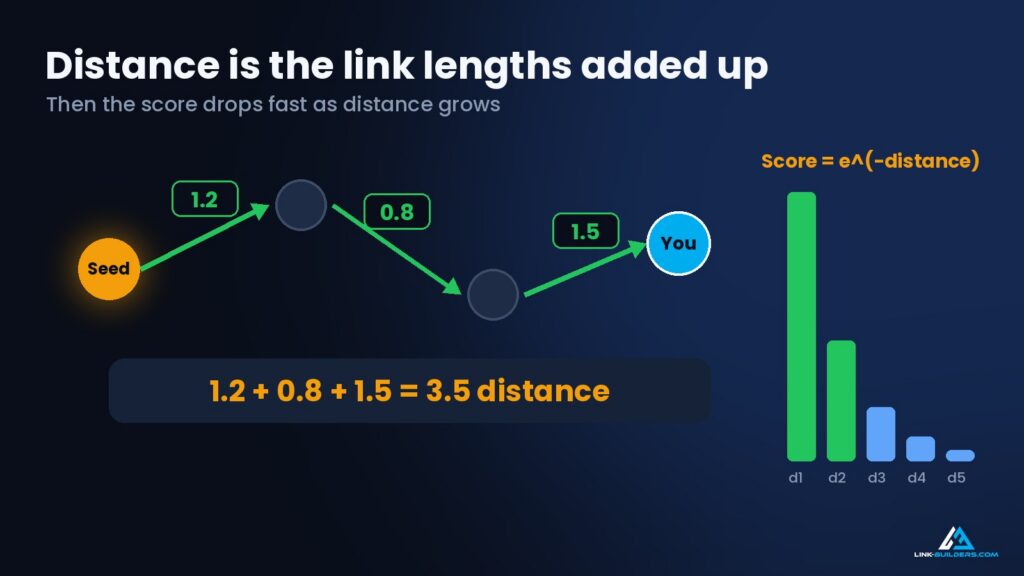
That means small differences in distance can make large differences in score. Being one short hop closer to the trusted part of the web can matter a lot.
Close to Several Seeds, Not Just One
You might think the goal is to get one link from one trusted site. The patent adds a twist.
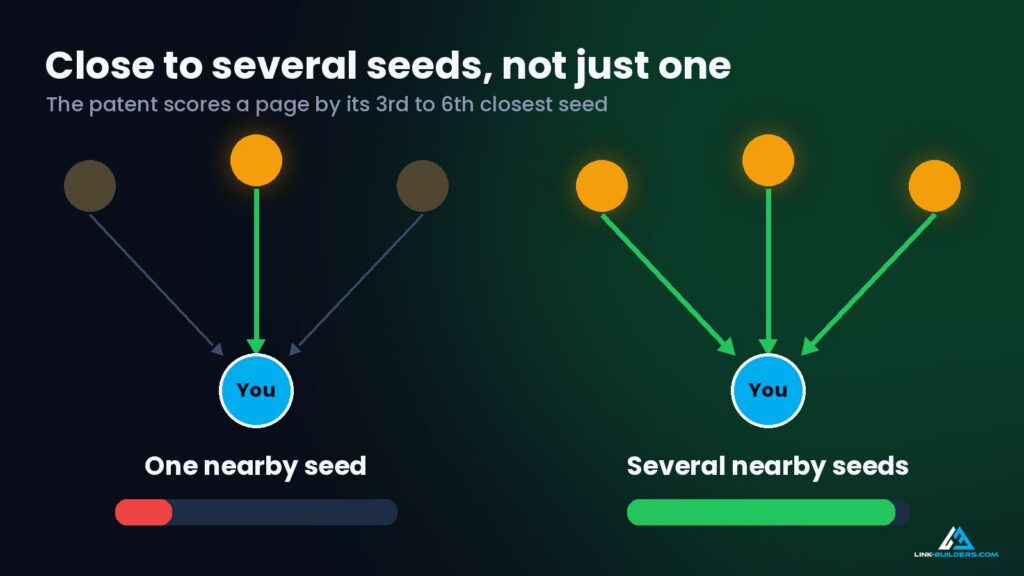
The system does not score a page by its single closest seed. It uses a seed further down the list, the third, fourth or fifth closest. The patent gives small numbers like three to six as examples, and its claims require this number to be more than one.
The patent explains why. Using a seed further down the list suppresses unfairly high scores that come from sitting right next to a single seed. In plain terms, being one hop away from one trusted site is not enough. A page does better when it sits close to several independent trusted hubs.
Your Best Few Links Do Most of the Work
Two details in this patent get skipped in most summaries, and they matter a lot for link builders.
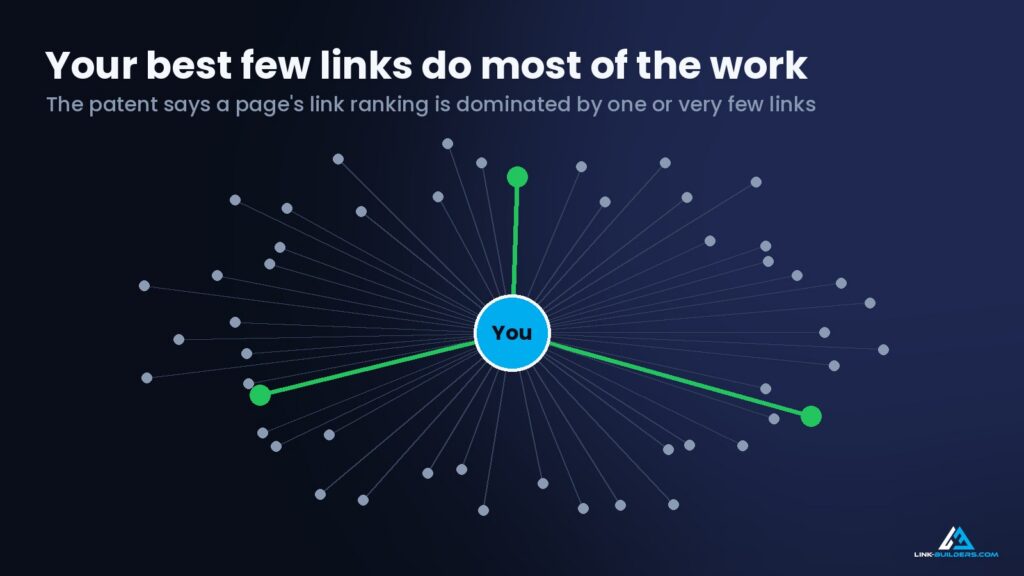
First, the patent says that in practice, the ranking a page receives from its links is dominated by one or very few of those links. A page might have fifty backlinks, but a handful of them carry most of the value. That skew is part of why a shortest-path approach can stand in for the full PageRank calculation.
Second, when the system maps out all the shortest paths from the seeds, it builds a smaller version of the link graph. In that smaller map, each page keeps only a few of its incoming links: the ones on its shortest paths back to the seeds.
Put those together, and a small number of strong, well-connected links can carry most of a page’s link-based ranking. That is about as close as a patent gets to saying quality beats quantity. It also fits what I have written about how many backlinks a site really needs.
Pages the Seeds Cannot Reach
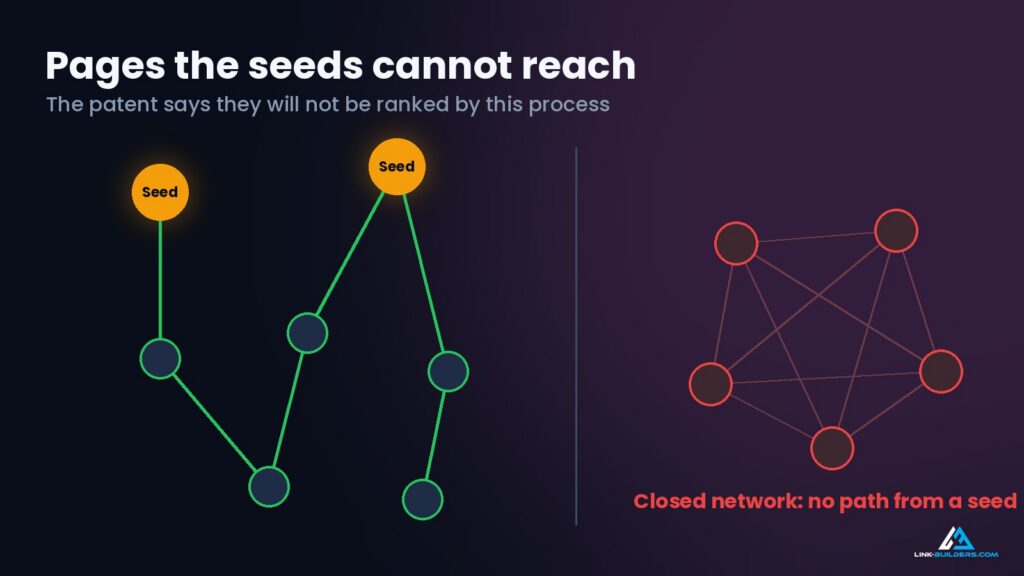
One more line from the patent is worth reading closely. It says a page that cannot be reached from any seed page will not be ranked by this process.
Loops do not help either. A shortest path never gets shorter by going around in a circle, so pages that pass links back and forth among themselves gain nothing from it.
This next point is my interpretation, not the patent’s words. It is a big reason closed link networks struggle under a model like this. If a group of sites only link to each other, and no path leads back to a trusted seed, the links inside that group do not add up to much. Google’s own spam policies also name excessive link exchanges and partner pages built only for cross-linking as link spam.
Remember, the PageRank algorithm does not incorporate any knowledge about the quality of a site, nor does it explicitly penalize badness… In contrast, our TrustRank is meant to differentiate good and bad sites: we expect that spam sites were not assigned high TrustRank scores.
— TrustRank paper (Stanford/Yahoo), quoted by Paddy Moogan at Moz · Moz: The Anatomy of a Link
What This Means for Your Link Building
Here is what the patent suggests for anyone building links.
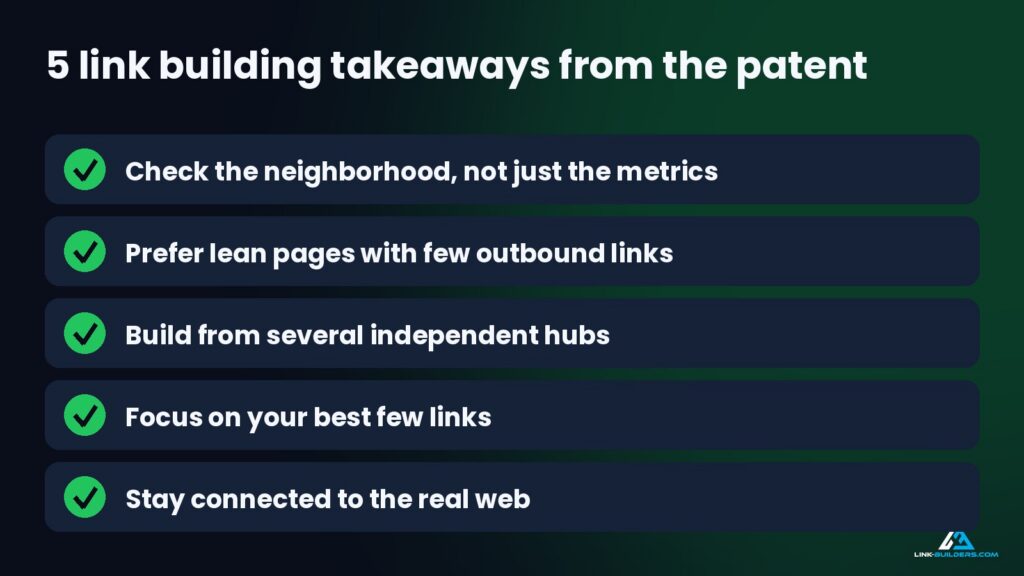
1. Check the neighborhood, not just the metrics
Before you go after a link, look at who links to that site. Is it cited by respected publications and the major hubs in your field? A site with modest metrics that sits close to trusted hubs may be worth more than a bigger site that sits far from them.
2. Prefer lean pages
A link from a page with a few outbound links creates a shorter path than a link buried in a roundup with two hundred others. This is one more reason to be careful with large resource lists and link-stuffed pages.
3. Build from several independent hubs
Links that trace back to different trusted neighborhoods beat a pile of links from one source. Aim for variety in where your best links come from, not just more of the same.
4. Focus on your best few links
A small number of strong, close links can outweigh dozens of weak ones. For more on setting realistic expectations, see how many backlinks you can expect.
5. Stay connected to the real web
Links from sites that only link to each other may never trace back to a seed at all. Build from sites that are part of the wider web in your niche, the kind of sites that make up a natural backlink profile.
The Honest Caveat
A patent shows what Google invented and chose to protect. It does not prove this exact system runs in Google’s algorithm today.
Still, this one took nine years to be granted, and Google filed a second version of it right away, which was granted in 2018.
One more point. You will hear people call this a “trust” algorithm. The seeds are chosen because they are trusted, but what the patent actually measures is distance. It does not describe a separate trust score.
Conclusion
The seed site patent comes down to one idea: where a link comes from on the web’s map matters. Google described a system that starts from a few trusted hubs, measures how far every other page sits from them, and rewards the pages that sit closest.
For link builders, that means looking past a site’s metrics to its neighborhood. Get close to the trusted hubs in your field, from more than one direction, and let a few great links do the heavy lifting.
Next in this series, I look at Google’s historical data patent, which is about when your links arrive and how your link profile changes over time.
Want links that trace back to the right neighborhoods? Talk to Link Builders about your next campaign. Want more breakdowns like this? Follow White Label Backlinks on YouTube for new videos on Google patents and link building.
Sources
- US 9,165,040: Producing a ranking for pages using distances in a web-link graph, Google Patents
- Spam policies for Google web search, Google Search Central
About the author

Justin Davis has been building backlinks since 2015 and has built links for more than 150 clients across law, healthcare, real estate, software, and other industries. He built the first version after years of doing the research by hand, and now builds the same workflow for in-house teams. More on who Justin Davis is, on YouTube, on LinkedIn, or on X.