Google Now Says to Fact-Check AI Content by Hand: What It Means for Guest Posts and Link Building
· @Justin Davis
On October 1, 2026, Google quietly rewrote part of its guidance on AI-generated content. Most of the coverage so far has been written for in-house content teams. Link builders should pay just as close attention, because the content we write ends up on someone else’s website, under someone else’s editorial standards.
If you place guest posts, pitch link insertions, or sell content-backed links, this update changes the conversation you will have with site owners. Here is what changed, why it matters, and how to adjust your process.
What Google Changed on October 1
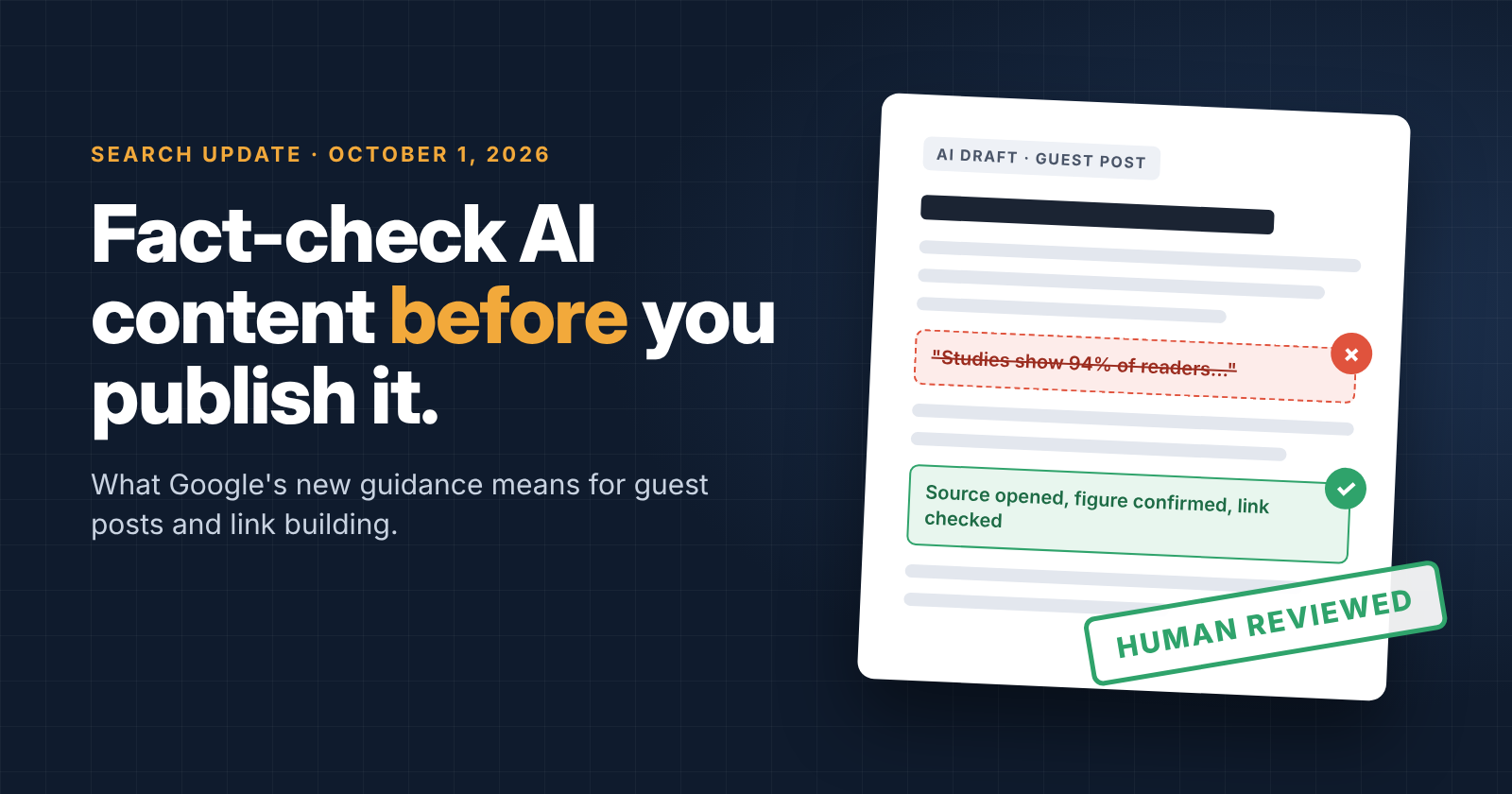
Google updated its guidance on using generative AI content in Search Central. The page now says: “It is critical to manually factcheck and review all AI-generated content for accuracy and trustworthiness before publishing.”
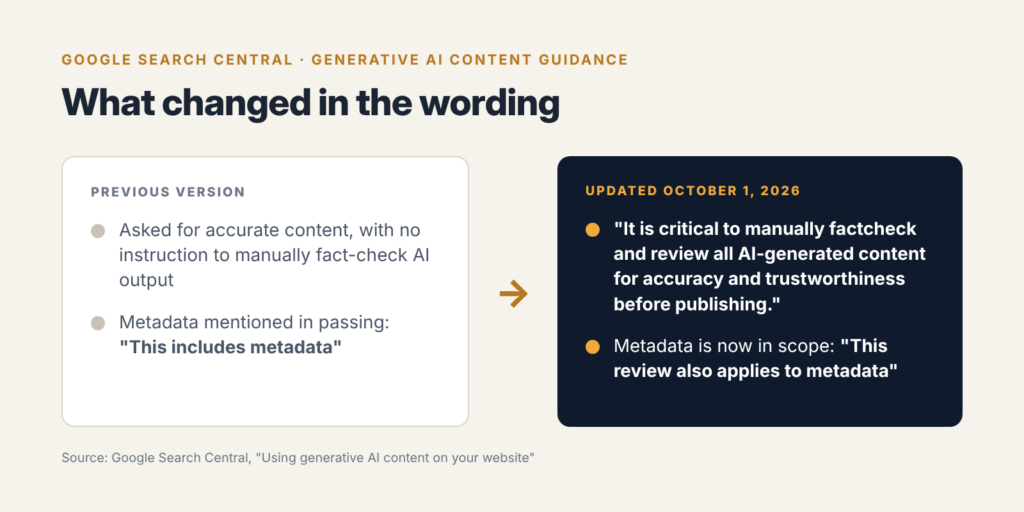
Google also explains why. Generative models predict a likely sequence of words based on their training data. They do not look up facts, so their output can include errors that Google calls hallucinations.
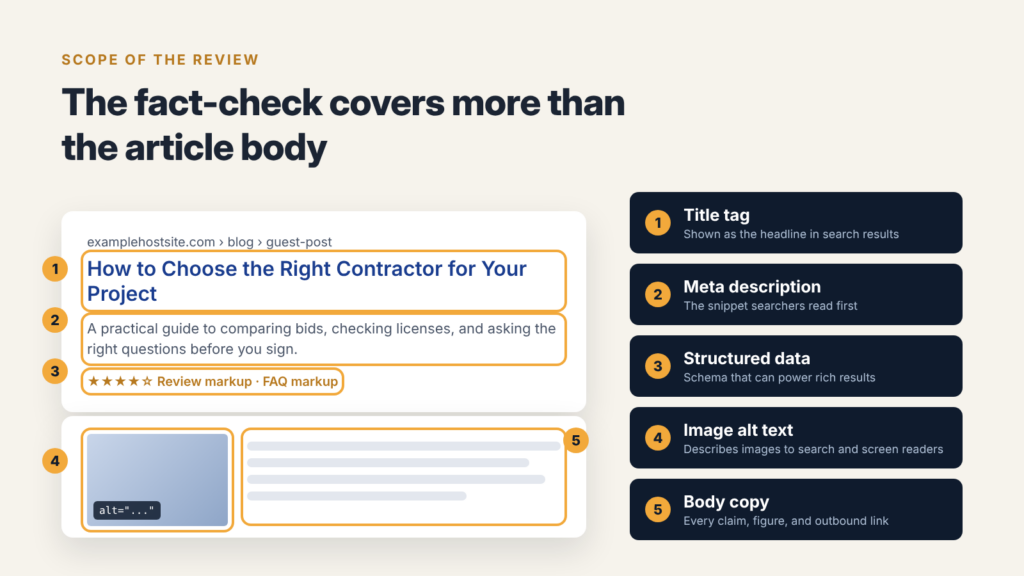
The scope got wider too. Earlier wording said the guidance “includes metadata.” The new version says the review “also applies to metadata,” which covers title tags, meta descriptions, structured data, and image alt text. Google’s documentation changelog says the page was updated with information from the Search Quality Rater Guidelines to match what Google presents at its developer events.
Why the Timing Matters
The change went live while Google’s September 2026 spam update was still rolling out. That update began on September 24 with a two-week window, and scaled content abuse is one of the policies it targets.
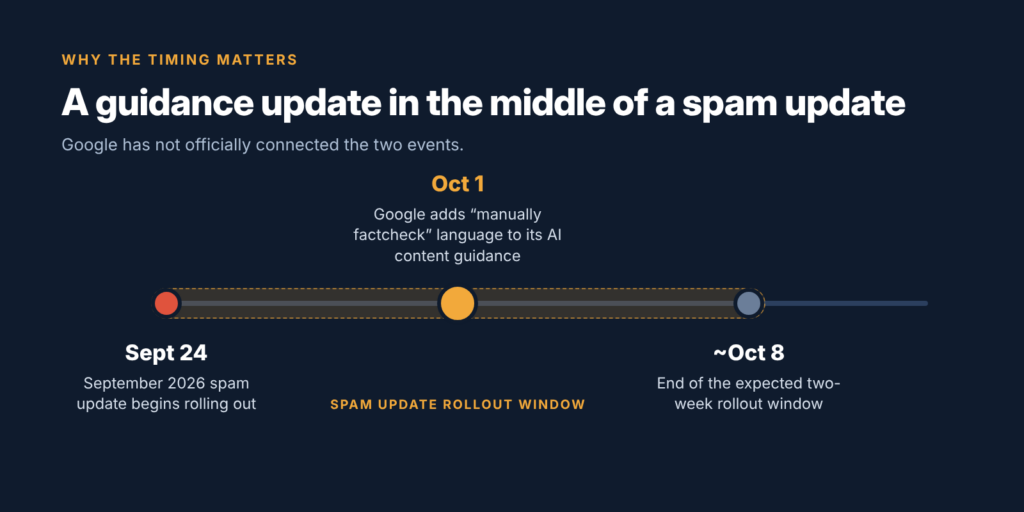
Google has not officially linked the two, and we should not assume a direct connection. Still, as Search Engine Roundtable pointed out, Google rarely uses a word as strong as “critical” in its help documents. PPC Land also noted that the stated reason for the update does not fully match the new sentences. Taken together, the message to publishers is clear: unreviewed AI content is a liability.
What This Means for Guest Post Content
Editors Now Have Cover to Say No
Many site owners already suspected that the guest posts landing in their inbox were raw AI drafts. Now they have Google’s own wording to back up a rejection. Expect stricter editorial review, more revision requests, and more outright refusals of thin content. Sites that care about their search visibility will treat this guidance as their new baseline.
Metadata Is Part of the Review
Link builders often send a suggested title, meta description, and image alt text along with a guest post. Under the new wording, those pieces need the same fact-check as the article body. A made-up statistic in a meta description is still a made-up statistic, and it shows up directly in search results.
Hallucinated Facts and Sources Are the Real Risk
The biggest danger is not that a post sounds robotic. It is that an AI draft states a fact that is false or cites a source that does not exist. When a host site publishes that, its readers lose trust and the editor remembers who sent it. One bad post can close a door you spent weeks opening.
A Practical Fact-Check Workflow for Link Builders
AI is still useful in link building. The key is knowing where it saves time and where a person has to sign off. Before any piece of content leaves your hands, run it through these steps:
- Verify every claim. Check each fact, date, and statistic against a primary source you have actually opened.
- Confirm every outbound link. Make sure each cited page exists, loads, and says what the article claims it says.
- Review the metadata. Read the title tag, meta description, schema, and alt text with the same care as the body.
- Check the author bio. Credentials and experience should be accurate and specific to the person named.
- Read it as the editor would. Ask whether the post adds something the host site’s readers cannot find elsewhere.
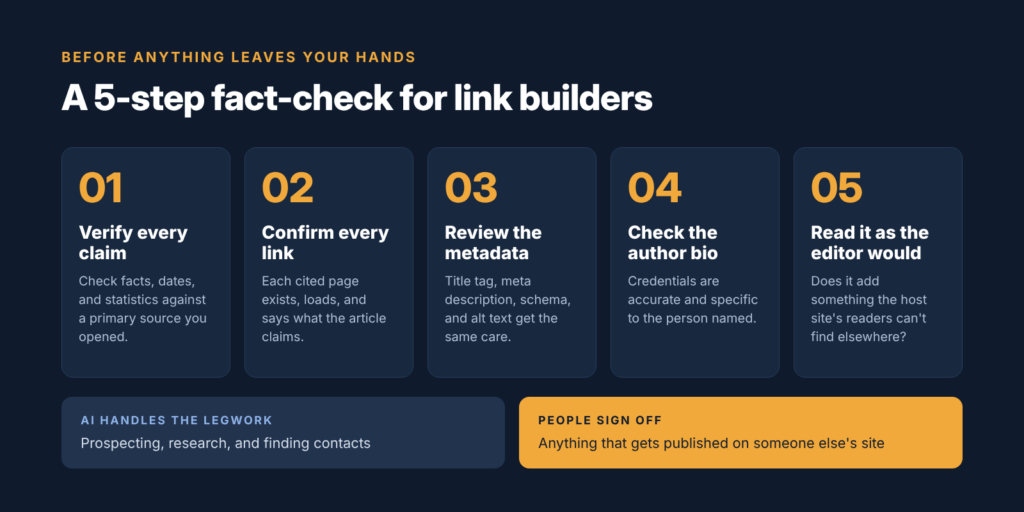
The smartest split is to let AI handle the repetitive work, such as prospecting and finding contacts, while people handle anything that gets published. We cover that balance in Building Backlinks in an Age of AI and in our post on building an AI link building tool after 10 years of manual outreach. You can also see where human review fits in our full link building process.
What This Update Does Not Mean
This is not a ban on AI-assisted content. Google still judges content by its quality and its value to users, not by how it was produced. The update does not add a new penalty, and it does not require you to disclose AI use, although Google still suggests telling readers how content was made when that context helps them.
What has not changed is just as important. Using AI to publish many pages that add no value can still violate Google’s spam policy on scaled content abuse. Link builders who mass-produce guest posts for placement have always been close to that line. This update simply makes the line easier to see.
The Takeaway for Link Builders
Human review used to feel like overhead. After this update, it is a selling point. Site owners want contributors they can trust, and clients want links that will hold up over time. A documented fact-check step gives both groups a reason to choose you.
If you are weighing how to grow output without cutting corners, our article on the truth about scalable link building explains why quality control has to scale along with volume. As Search Engine Journal noted, publishers now have Google’s official backing for mandatory review. Link builders should adopt the same standard before editors start enforcing it for them.
Sources
- Google Search Central: Using generative AI content on your website
- Google Search Central: Documentation updates
- Search Engine Roundtable
- Search Engine Journal
About the author

Justin Davis has been building backlinks since 2015 and has built links for more than 150 clients across law, healthcare, real estate, software, and other industries. He built the first version after years of doing the research by hand, and now builds the same workflow for in-house teams. More on who Justin Davis is, on YouTube, on LinkedIn, or on X.