How Much Keyword Anchor Text Is Safe? A Google Patent and the Ratios SEOs Use
Every link carries words, and those words tell Google something about the page on the other end. But how much can those words actually do? And how many keyword-rich anchors can you use before they start working against you?
This article answers both questions. First, I walk through a Google patent that shows how the words in and around a link can decide how much credit flows through it. Then I cover the anchor text ratios most SEOs aim for, where those ratios bend, and the trick I’ve used for years to decide how keyword-rich an anchor can safely be.
It’s the sixth article in my Google Link Patents series, after where a link sits, where it comes from, when it arrives, who is behind it, and the shape of your whole profile. You can watch the full video breakdown below.
[Embed: How Much Keyword Anchor Text Is Safe? A Google Patent and the Ratios SEOs Use, YouTube]
The Patent at a Glance
The anchors patent is US 8,959,093, titled “Ranking search results based on anchors.”
| Detail | Value |
|---|---|
| Patent number | US 8,959,093 |
| Filed | March 15, 2010 |
| Granted | February 17, 2015 |
| Inventor | Ajay P. Nerurkar |
| Assignee | |
| Status | Active until 2030, according to Google Patents |
Unlike most of the patents in this series, this one is still listed as active. That doesn’t prove Google uses it, but it does mean Google still considers it worth protecting.
The Problem: Click Credit Lands on the Wrong Page
The patent starts with a simple example. Someone searches for “hotel New York.” They click on a page that lists a bunch of hotels in New York. Then, from that list, they click a link to one specific hotel. That hotel page is the one they actually wanted.
Here is the problem. Google’s click data gives the credit to the list page, because that is the result the person clicked. The hotel page gets nothing, even though it is what the searcher was looking for.
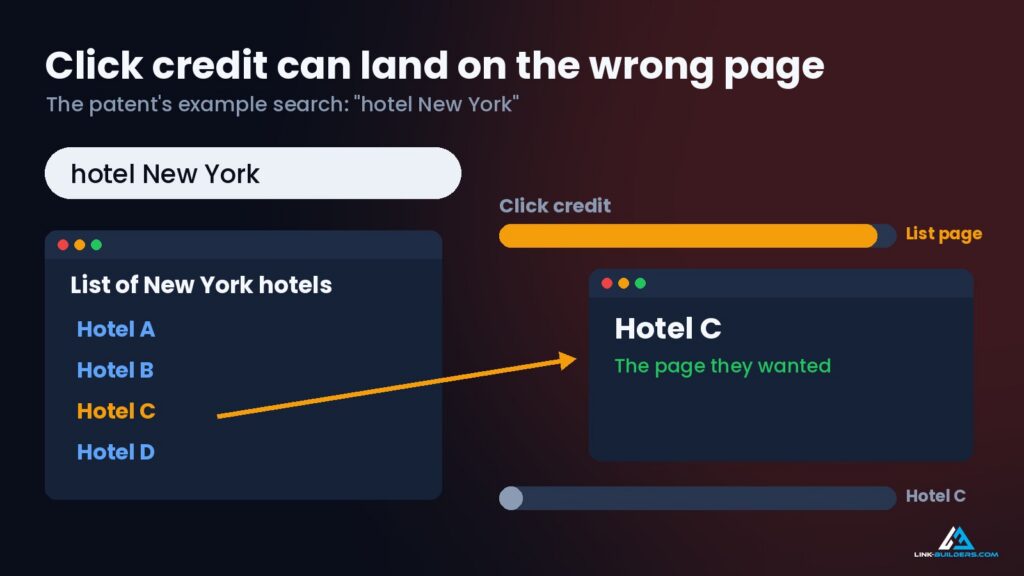
The patent says this happens all the time. It names secondary sources such as Wikipedia, news feeds and blogs, which summarize a topic and then link to the original source. When people click through, the credit ends up in the wrong place.
Passing Credit Through the Link
The patent’s fix is to pass some of that click credit through the link, to the page it points to. The hotel page then gets credit for being the page people actually wanted.
The patent even notes that the credit can be shared in whole or in part. And it adds a safeguard: the list page’s own credit does not have to drop, because the system is only estimating where people went next.
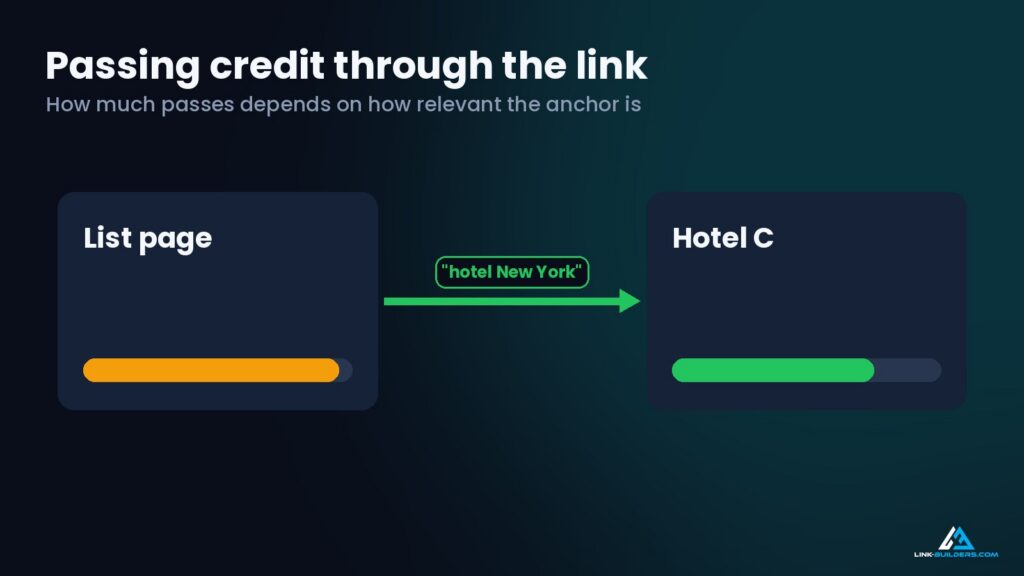
But not every link passes the same amount. How much credit flows depends on how relevant the anchor is to the search. That is where anchor text comes in.
What Makes an Anchor Relevant
The patent lists the signals it can use to judge whether an anchor is relevant to a search. Here are the six that matter most for link builders.
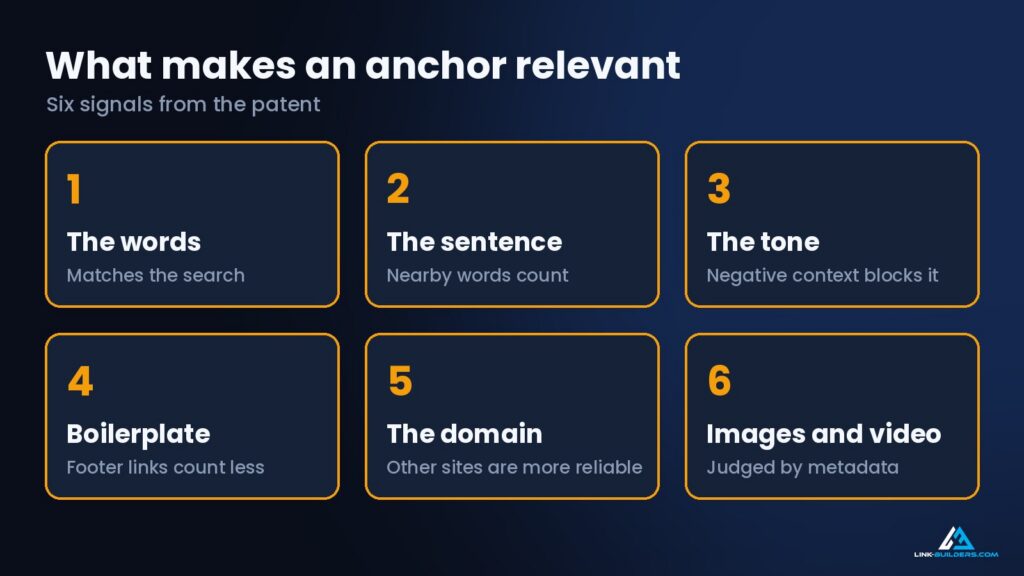
1. The words themselves
When the anchor text matches the words in the search, that counts. The patent says an anchor containing the exact search phrase is more relevant than one containing only half of the search words. It also says the degree of relevance can set the percentage of credit that passes through.
2. The sentence around it
Nearby text counts too. The patent’s example is an anchor containing the word “hotel” that sits in the same sentence as “New York.”
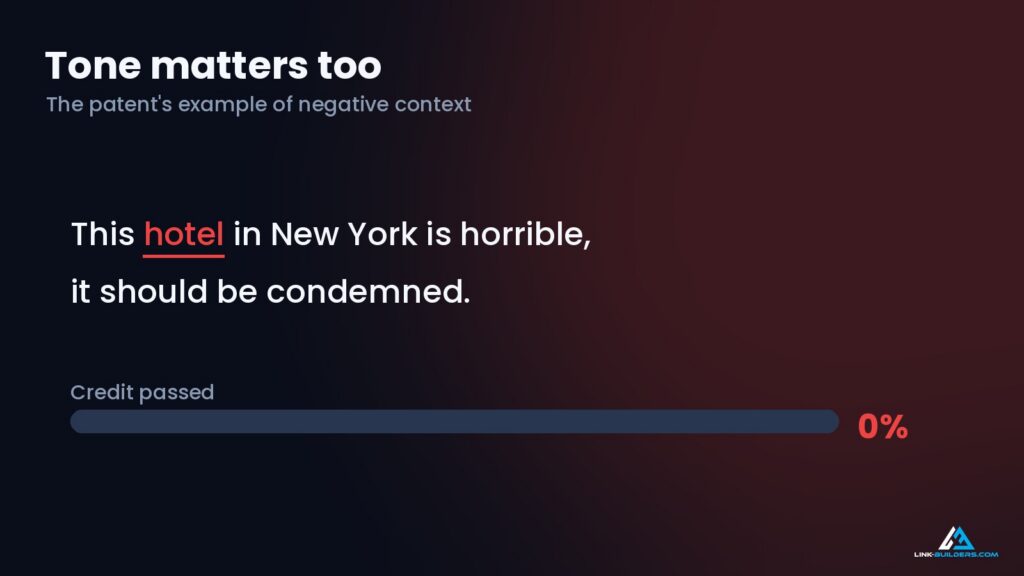
3. The tone
The patent’s own example is a sentence like “This hotel in New York is horrible, it should be condemned.” It says a link inside negative context like that may not pass credit at all.
4. Boilerplate
A link that appears in the footer of every page on a site, such as a link to a legal page, counts as less relevant than links in the main content.
5. Where the link comes from
The patent describes limiting credit sharing to links between different domains, because those links are not a site promoting itself.
6. Images and video
It’s not just text. Image and video links can count too, based on their metadata, such as an image tagged as a New York hotel.
The Catch: Over-Optimization
If matching words help, why not make every anchor an exact-match keyword?
Because over-optimized anchors are one of the clearest signs of link manipulation. When most of the links to a page use the same money keyword, the profile stops looking like people linked on their own.
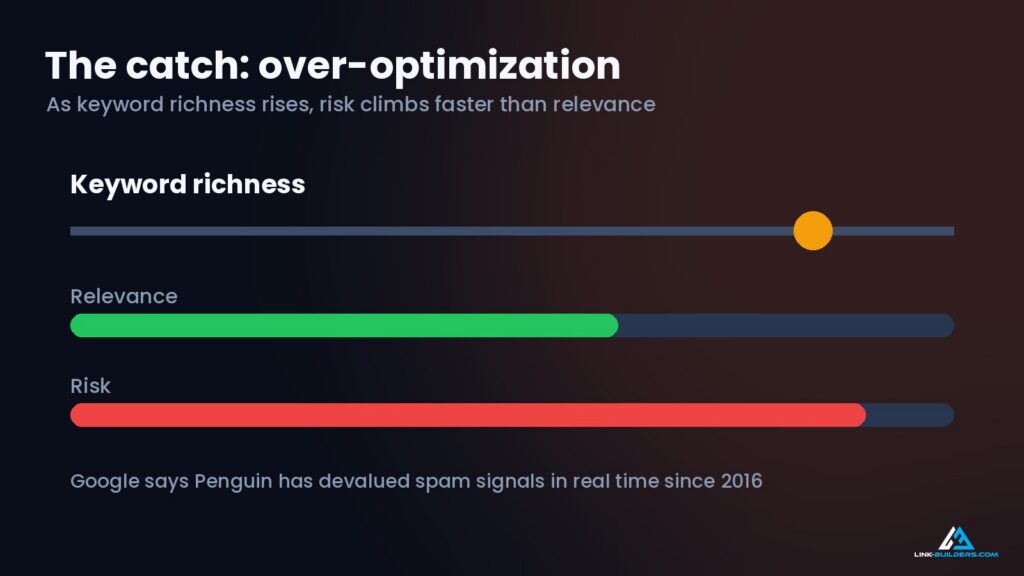
Here is what’s public. In September 2016, Google announced that Penguin had become part of its core algorithm. Google said Penguin now runs in real time and devalues spam by adjusting rankings based on spam signals, rather than affecting the ranking of a whole site. But manual actions for unnatural links still happen.
So the goal isn’t the most keyword-rich profile. It’s a natural one.
Write as naturally as possible, and resist the urge to cram every keyword that’s related to the page that you’re linking to… If it feels like you’re forcing keywords into the anchor text, then it’s probably too much.
— Google Search Central · Google Search Central: Link best practices for Google
The Anchor Ratios SEOs Aim For
Important: These ranges are common SEO heuristics, not Google-published thresholds. Anchor profiles vary by niche, site age, brand demand, and the kinds of links a site earns. Use them as a comparison prompt-not a formula to hit. See Moz’s anchor-text guide and Ahrefs’ anchor-text guide for the broader principle: keep anchor text descriptive and varied, and avoid repeating exact-match anchors unnaturally.
Google has never published official anchor text numbers. Nothing in this section comes from the patent or from Google. These ranges are industry consensus, built from years of experience across the SEO community, and they are a starting point, not a rule.
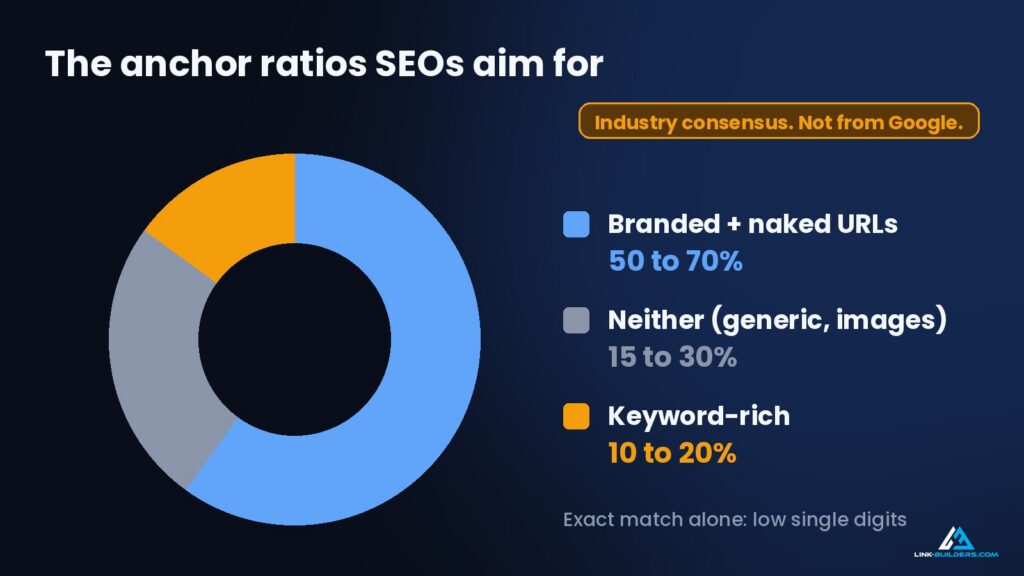
Three buckets
I like to think about anchors in three buckets:
- Branded, including naked URLs: about 50 to 70 percent. That’s your company name, variations like “Link Builders agency,” and plain web addresses. This is the bulk of any natural profile.
- Neither: about 15 to 30 percent. Generic phrases like “click here,” “learn more” or “this site,” plus image links.
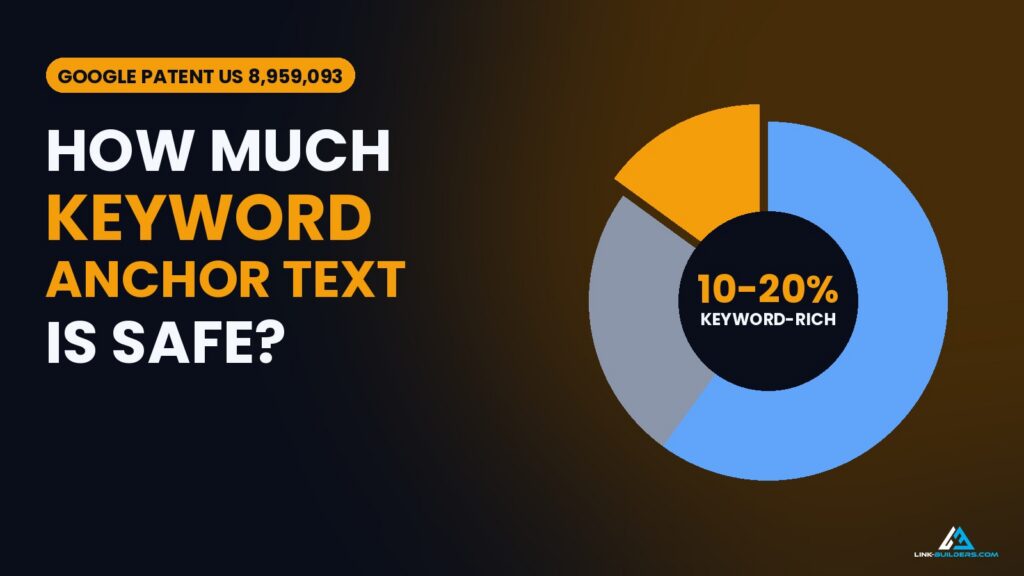
- Keyword-rich: about 10 to 20 percent, combining exact match and partial match. Past about 20 to 25 percent is where most people start getting nervous.
The six anchor types
| Anchor type | Example | Typical share |
|---|---|---|
| Branded | Link Builders, Link Builders agency | 30 to 60% |
| Naked URL | link-builders.com | 10 to 30% |
| Generic | click here, learn more, read more | 10 to 25% |
| Partial match | a guide to white label link building | 5 to 15% |
| Exact match | link building services | 1 to 5%, rarely above 10% |
| Image or empty | an image link with no text | A few percent |
Illustrative industry ranges only-there is no single verified “natural” distribution and no Google threshold behind these percentages. Benchmark comparable competitors in Link Explorer and Site Explorer rather than chasing a fixed formula.
Exact match on its own should usually stay in the low single digits.
Where the Ratios Bend
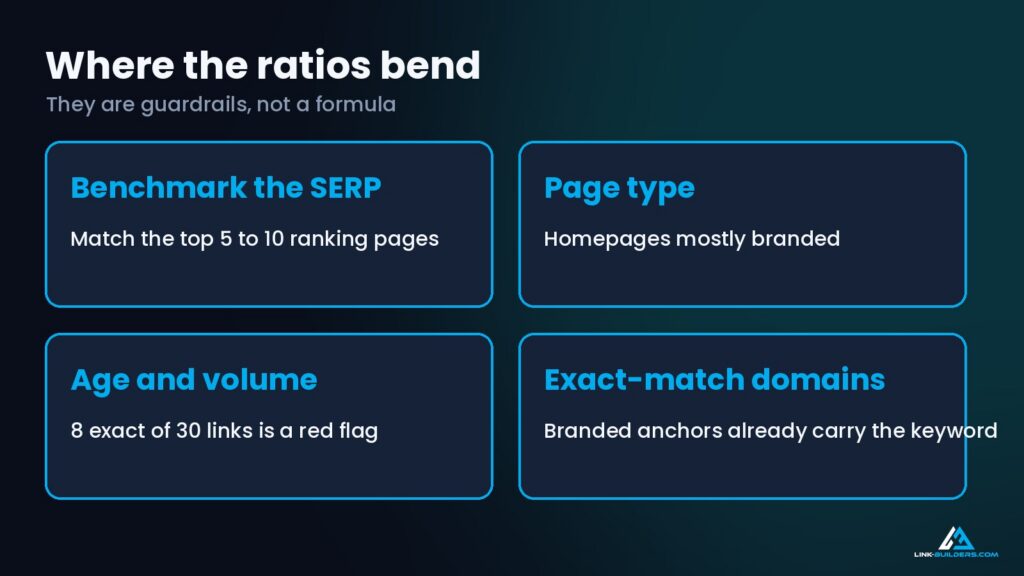
These ratios aren’t a formula. Most experienced SEOs agree they bend in four ways.
Benchmark the search results
The most defensible approach is to look at the anchor mix of the top five to ten ranking pages for your target keyword, using an SEO data tool, and stay inside their range. Some niches, such as local services, affiliate sites and exact-match domains, tolerate much more keyword-heavy anchors than others.
The page type matters
Homepages should be mostly branded and URL anchors. Inner service pages can carry a higher share of partial-match anchors, because natural links to a specific page tend to describe its topic.
Link age and volume matter
A new site with 30 links and 8 exact-match anchors looks a lot worse than a mature site with thousands of links and the same percentage.
Exact-match domains blur the line
If your brand name contains your keyword, your branded anchors count as keyword anchors too. Take an example brand like “Denver Plumbing Pros.” Every branded link already includes “Denver plumbing,” so keep true exact-match anchors even lower.
My Anchor Text Trick
Here’s what I’ve done for years. Before I decide how keyword-rich to make an anchor, I look at all of the natural anchor text already pointing to the site from its other links.
If a ton of those natural links use the company’s business name, say 80 or 90 percent of the time, I know there’s room for me to use keyword-rich anchors.
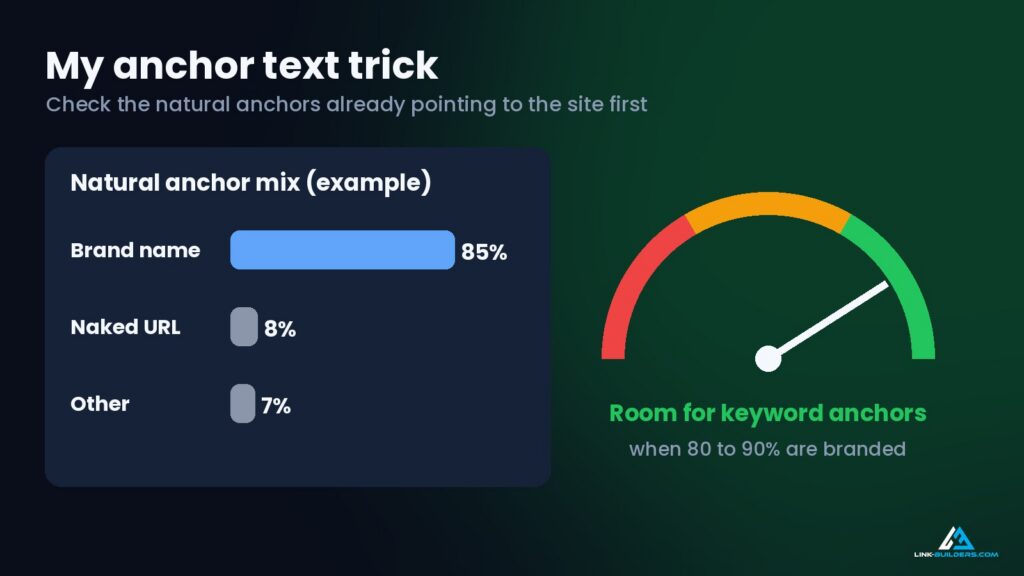
It works because it starts from what the site’s real profile already looks like, instead of a generic formula. A site whose natural links are overwhelmingly branded can absorb a few descriptive, keyword-rich anchors without its profile starting to look manufactured.
What This Means for Your Link Building
Here is what the patent and the ratios suggest together.
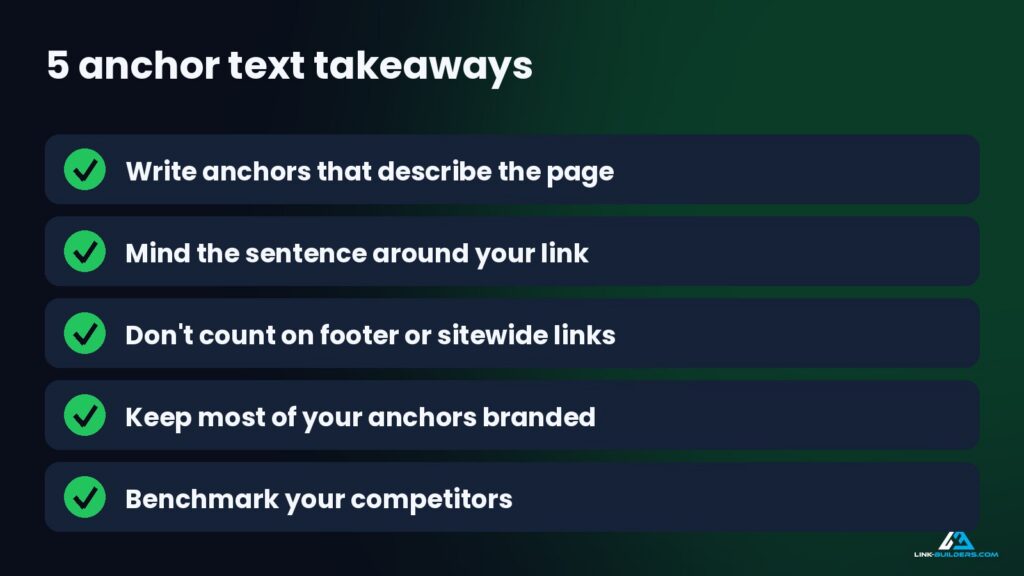
1. Write anchors that describe the page
Relevant words help credit flow. An anchor like “guide to boutique hotels in New York” tells both readers and search engines what they will find.
2. Mind the sentence around your link
On-topic, positive context helps. A link in a sentence that criticizes the page may pass little or nothing.
3. Don’t count on footer or sitewide links
Boilerplate links count as less relevant. They are fine for navigation, but they are not a ranking strategy.
4. Keep most of your anchors branded
Check the site’s natural anchor mix before you add keyword anchors. For more on keeping anchor variety natural, see why anchor diversity still matters when AI drafts link pitches.
5. Benchmark your competitors
The anchor mix of the pages already ranking for your keyword is a better guide than any single magic ratio.
The Honest Caveat
There are two caveats in this article, and both matter.
First, a patent shows what Google invented and chose to protect. Even though this one is still active, that does not prove this exact system runs in Google’s algorithm today.
Second, the ratios come from experience across the industry. Google has never published official anchor text numbers, so treat them as guardrails, not rules.
Conclusion
The words in your links matter. Google described a system where the anchor text, the sentence around it, and even the tone can decide how much credit flows through a link. But the same words can become a warning sign when they are overused.
Make your anchors relevant, keep them natural, and let the site’s real profile tell you how far you can push.
This patent runs on click data. In the final article of this series, I look at the two Google patents where clicks and brand searches take center stage.
Want anchors that work without the risk? Talk to Link Builders about your next campaign.
Sources
- US 8,959,093: Ranking search results based on anchors, Google Patents
- Penguin is now part of our core algorithm, Google Search Central Blog
Want more breakdowns like this? Follow White Label Backlinks on YouTube for new videos on Google patents and link building.
About the author

Justin Davis has been building backlinks since 2015 and has built links for more than 150 clients across law, healthcare, real estate, software, and other industries. He built the first version after years of doing the research by hand, and now builds the same workflow for in-house teams. More on who Justin Davis is, on YouTube, on LinkedIn, or on X.