Brand Mentions vs. Backlinks for AI Search: What the 2026 Data Actually Says
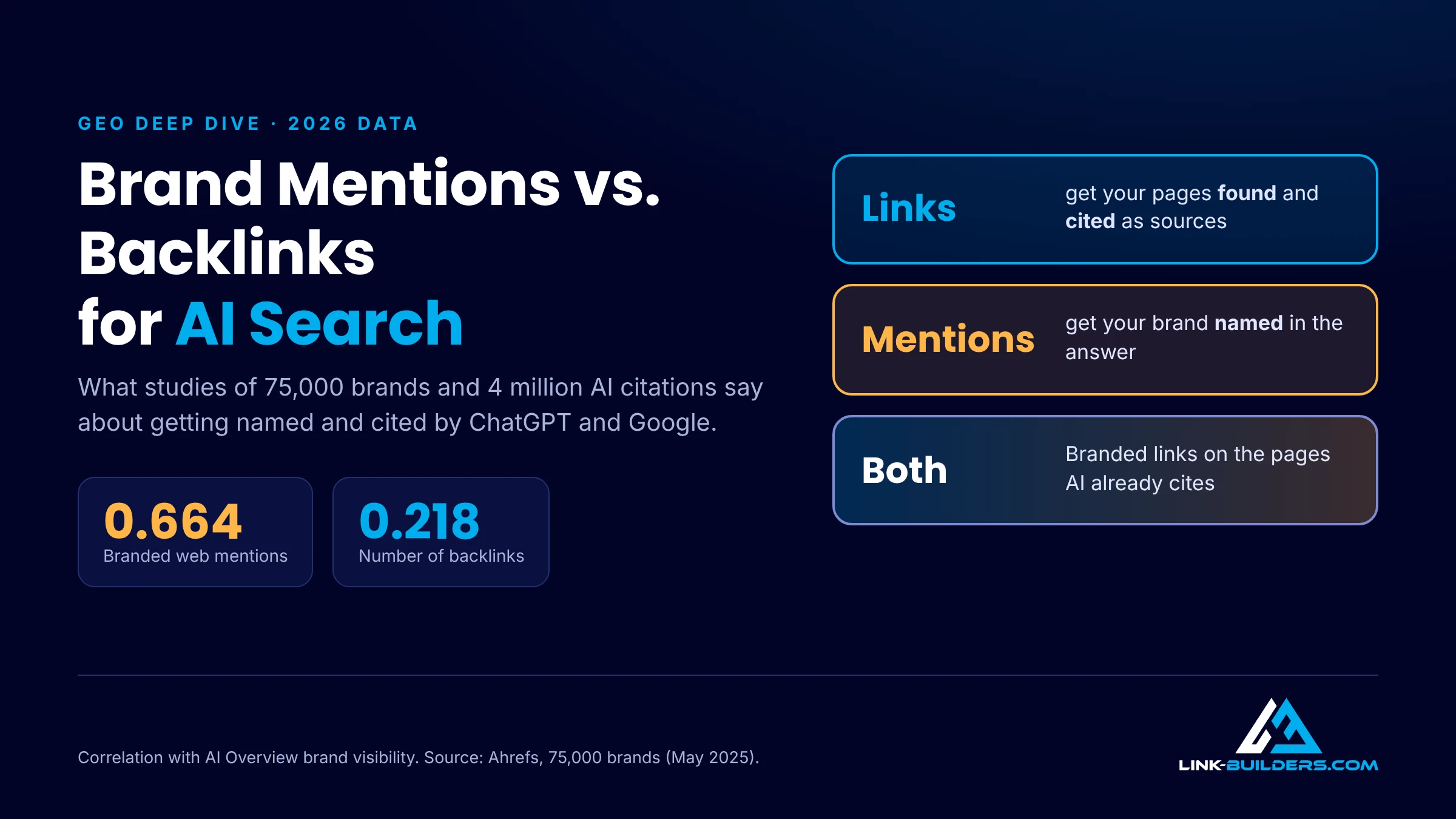
Mentions and links do different jobs in AI search. The best off-site work does both.
Author: Justin Davis, Link Builders
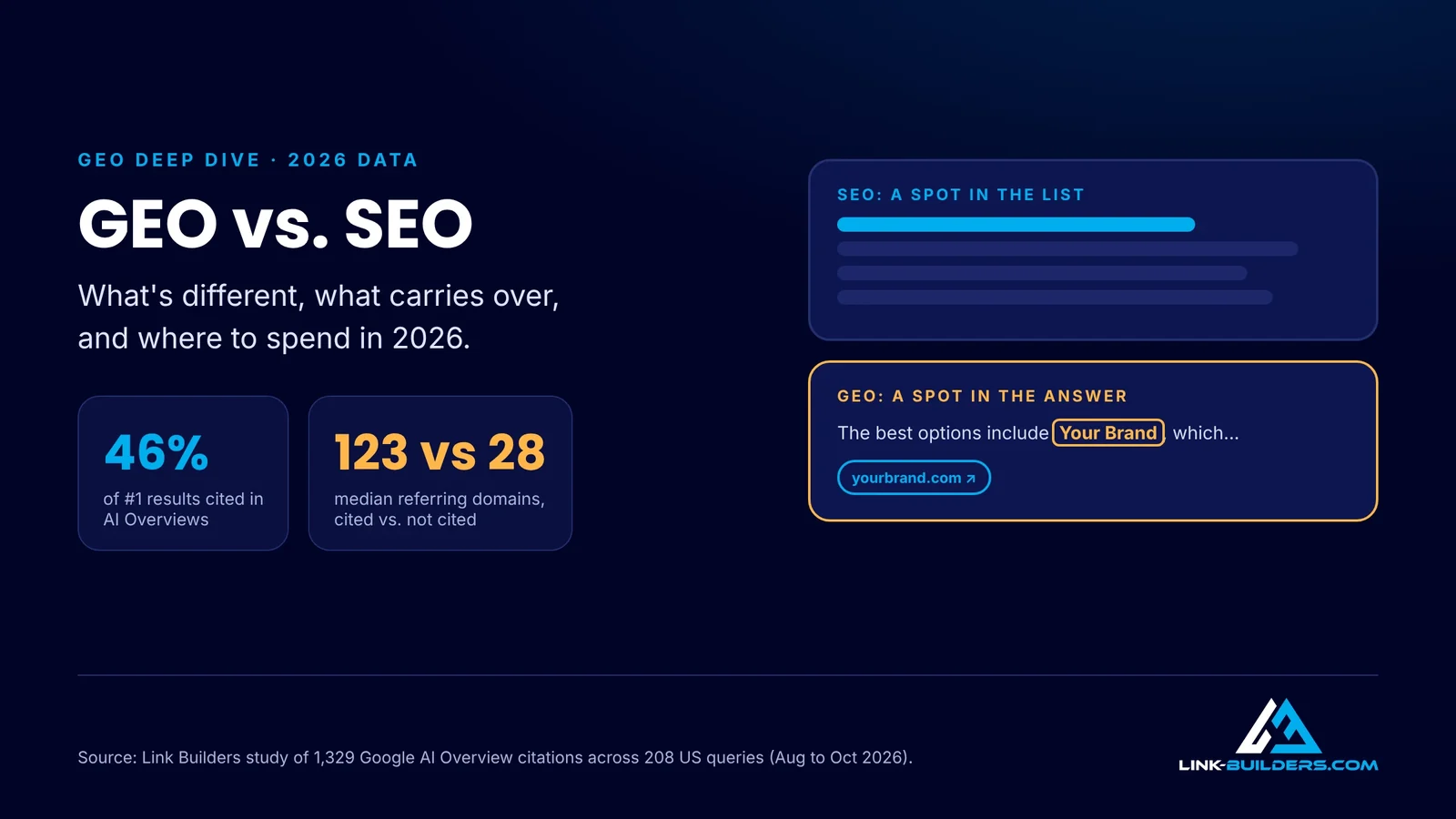
Brand mentions on trusted, independent websites are the strongest known signal for getting your brand named in AI answers. Across 75,000 brands, branded web mentions correlated with AI visibility about three times more strongly than backlink counts. But backlinks still matter, just in a narrower way than they used to. They help specific pages rank for the smaller searches AI tools run behind the scenes, and that’s how pages get cited as sources. Links get you found. Mentions get you named. A branded link on a page AI already reads does both.
I’ve built backlinks since 2015, so the first study on this topic stung a little. Since then, more data has come out, and some of it seems to contradict the rest. One study says links barely matter. Another ranks search rankings, which links help drive, near the top of what gets a page cited. Both are right, once you separate two things most articles treat as one: being mentioned and being cited.
This guide goes through the studies, what they can and can’t tell you, Google’s newest warning about mentions, a real example from my own tour company, and the five-step workflow we now use for off-site work. It’s the written version of my video Brand Mentions vs. Backlinks for AI Search, so you can watch it or read it.
Mentions and Citations Are Two Different Wins
Before looking at any correlation, it helps to define what “AI visibility” means, because it covers two different outcomes.
A mention happens when an AI answer names your brand in its text. “For private tours in this city, consider Company A or Company B.”
A citation happens when an AI answer links to one of your pages as a source. Your URL shows up in the source list or as a link chip next to a sentence.
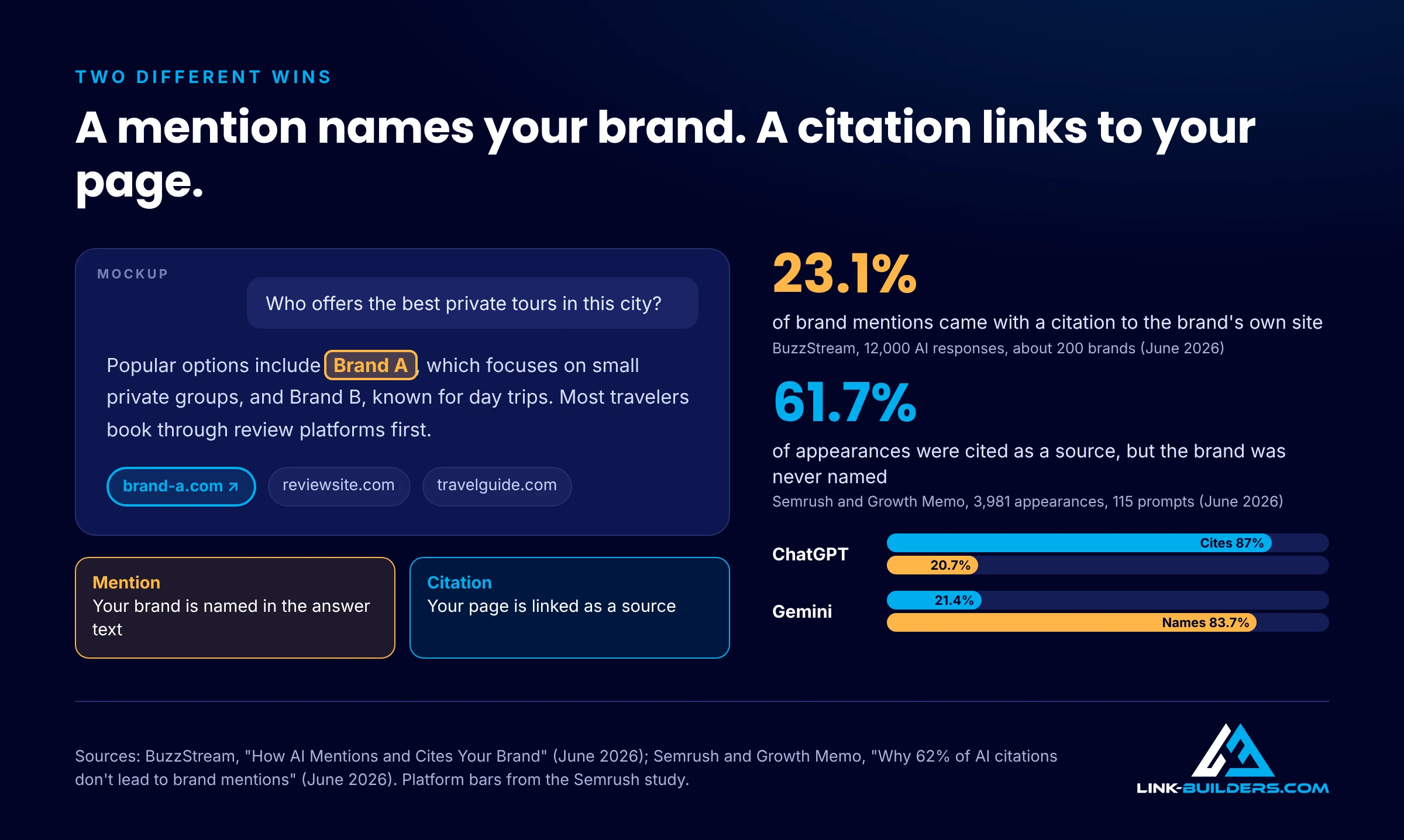
A mention names your brand. A citation links to your page. They often don’t happen together.
These two don’t travel together as often as you’d expect. In a June 2026 study of 12,000 AI responses about roughly 200 brands, BuzzStream found that only 23.1% of brand mentions came with a citation to that brand’s own site. A separate study by Semrush and Kevin Indig’s Growth Memo found the reverse problem: in 61.7% of appearances, a domain was cited but its brand was never named in the answer.
The platforms also lean in opposite directions. In the Semrush study, ChatGPT included a citation in 87% of appearances but named the brand in only 20.7%. Gemini named brands in 83.7% of appearances and cited a source in 21.4%. That study used 115 prompts, so treat the exact figures as a snapshot, but the gap is too wide to ignore.
Here’s the simplest way I’ve found to think about it:
- A citation is a retrieval result. The AI went looking, ran searches, and pulled your page. Retrieval runs on search.
- A mention is a knowledge result. The model connects your brand to the topic, either from what it learned in training or from the third-party pages it pulled. That comes from what the rest of the web says about you.
BuzzStream’s own conclusion points the same way. A mention without a citation suggests your pages aren’t winning the searches AI runs. A citation without a mention suggests your brand isn’t being discussed enough in the sources AI reads. Each gap has a different fix, and the mentions versus backlinks debate gets much simpler once you keep them apart.
What the 75,000-Brand Studies Found
The study that started this debate came from Ahrefs in May 2025. Researchers took 75,000 brands and compared 11 signals against how often each brand was mentioned in Google’s AI Overviews. They used Spearman correlation, where 0 means no relationship and 1 means a perfect one.
| Signal | Correlation with AI Overview mentions |
|---|---|
| Branded web mentions | 0.664 |
| Branded anchors | 0.527 |
| Branded search volume | 0.392 |
| Domain Rating | 0.326 |
| Referring domains | 0.295 |
| Number of backlinks | 0.218 |
Branded web mentions led by a wide margin. The raw number of backlinks sat near the bottom. The distribution was also lopsided: brands in the top quarter for web mentions averaged 169 AI Overview mentions, while the next quarter averaged 14.
In December 2025, Ahrefs repeated the study across three platforms and added YouTube.
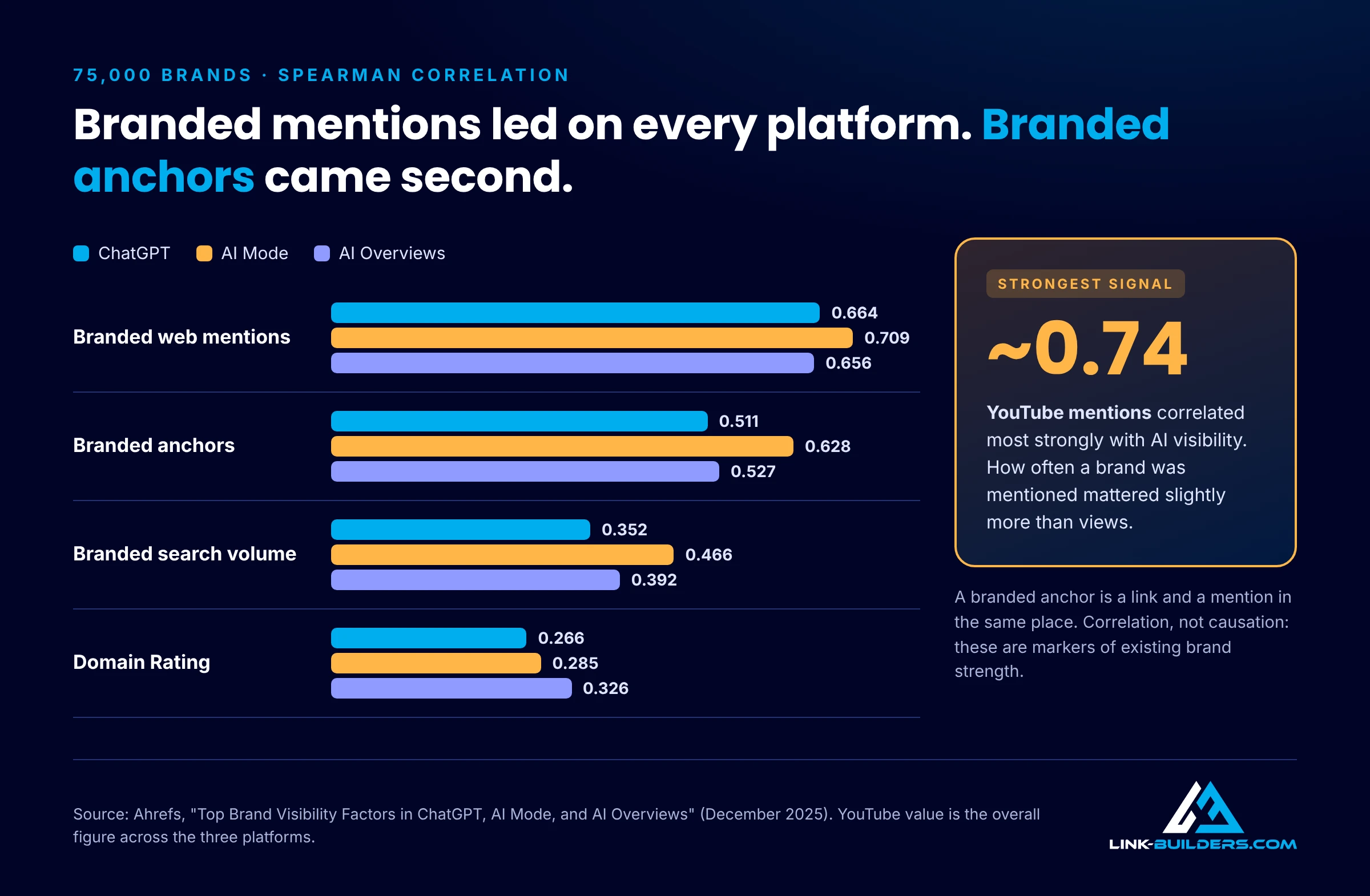
Branded web mentions led on every platform. Branded anchors came second.
| Signal | ChatGPT | AI Mode | AI Overviews |
|---|---|---|---|
| Branded web mentions | 0.664 | 0.709 | 0.656 |
| Branded anchors | 0.511 | 0.628 | 0.527 |
| Branded search volume | 0.352 | 0.466 | 0.392 |
| Domain Rating | 0.266 | 0.285 | 0.326 |
YouTube mentions scored highest of all, at about 0.737 overall. How often a brand was mentioned on YouTube mattered slightly more than how many views those videos got.
Two details from these studies matter for anyone who builds links. First, branded anchors came second on every platform. That’s a link where the clickable text is your brand name, which makes it a link and a mention at the same time. Second, Google’s AI Mode leaned hardest on brand signals, while ChatGPT showed the weakest connection to authority metrics of the three.
Ahrefs is clear about the limits: “correlation isn’t causation,” and the signals are “simply markers of existing brand strength.” Famous brands get talked about everywhere and also get mentioned by AI, so fame could be driving both. You can’t buy your way up this chart. But every study since has pointed in the same direction.
Why Domain Metrics Don’t Predict AI Mentions
If mentions matter so much, what about the domain-level authority metrics SEOs have used for years? The evidence here is surprisingly consistent.
Top 50 sites. In June 2025, Ahrefs compared the 50 websites mentioned most often in AI answers against the strength of their link profiles. The correlation was 0.01 for ChatGPT, -0.12 for AI Overviews and -0.34 for Perplexity. None of those reached statistical significance at the usual level, and 50 very large sites is a small, top-heavy sample. On its own, it’s a hint, not proof.
Four million citations. In April 2026, BuzzStream published a much larger dataset: about 4 million citations from 3,600 prompts across ChatGPT, Google AI Mode, AI Overviews and Gemini, collected over one week in January 2026. The correlations between traditional SEO metrics and being cited all landed near zero:
| Metric | Correlation with AI citations |
|---|---|
| Domain Authority | -0.128 |
| Domain Rating | -0.111 |
| Site referring domains | -0.108 |
| Links to the cited page | -0.095 |
| Site organic traffic | -0.089 |
| Page keywords | +0.002 |
The article doesn’t report significance tests or explain how the metrics were pulled, so I’d read these as “no meaningful relationship” rather than “links hurt.”
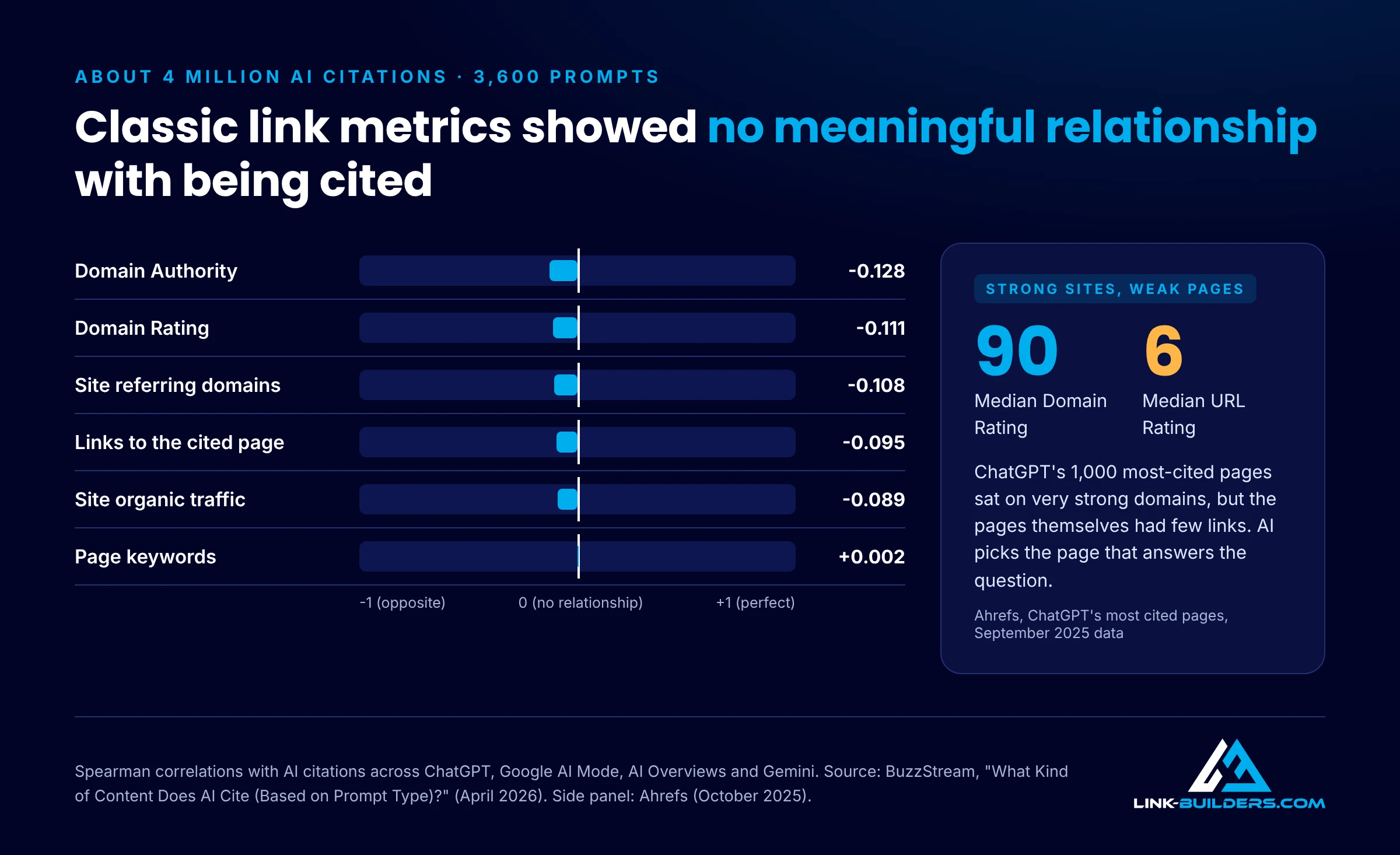
Across 4 million AI citations, classic link metrics showed no meaningful relationship with being cited.
Strong sites, weak pages. Ahrefs also pulled ChatGPT’s 1,000 most-cited pages for September 2025. Among pages with ranking data, the median Domain Rating was 90, but the median URL Rating was just 6. In Ahrefs’ words, “ChatGPT cites pages from authoritative domains, but not necessarily the most linked-to pages on those domains.”
Put together, the picture is clear. AI tools favor well known sites, but a big link profile doesn’t predict which page they’ll cite or which brand they’ll name. They pick the page that answers the specific question.
So Do Backlinks Still Matter for AI Search?
Yes, but for a narrower reason than most people assume.
In 2026, Cyrus Shepard of Zyppy published a review of 54 AI citation studies, explainers and patents and scored 23 factors from 0 to 10 based on how often findings repeated, the strength of the evidence and official support. The scores are his judgment of the evidence, not measured effects, but the ranking is telling. Near the top:
- URL accessibility: 9.5
- Search rank: 9.4
- Fan-out rank: 9.3
Domain authority scored 5. An llms.txt file scored 2. URL accessibility simply means AI bots can reach and read your page, and my AI crawler guide shows which ones to allow.
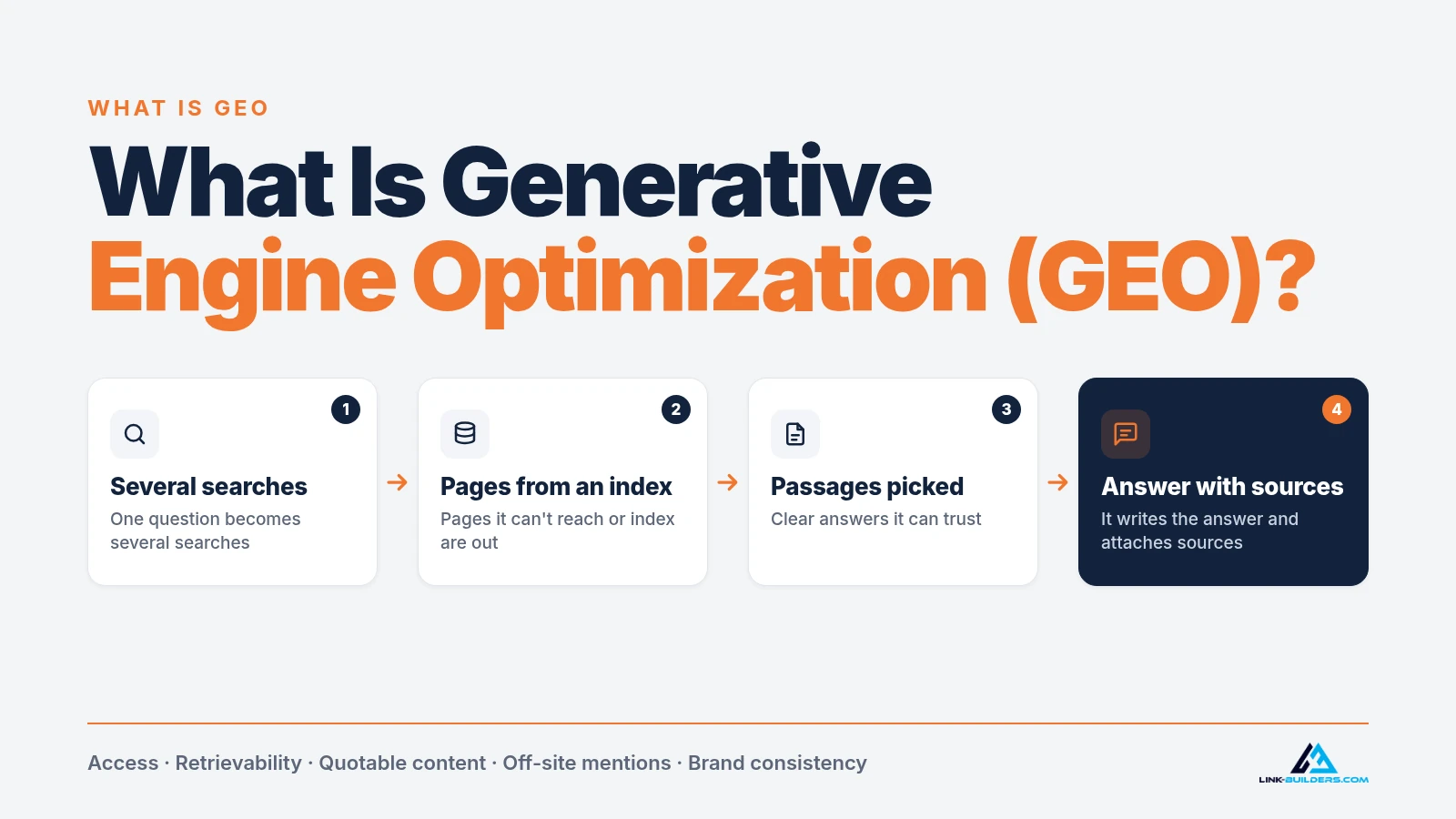
“Fan-out rank” refers to query fan-out. When you ask an AI tool a question, it often splits the question into several smaller searches, pulls the top results for each, and cites the best passages it finds. Google has confirmed that its AI Overviews and AI Mode work this way. I covered how it works in Episode 4 of my AI search series, and in my guide on how to get cited by AI.
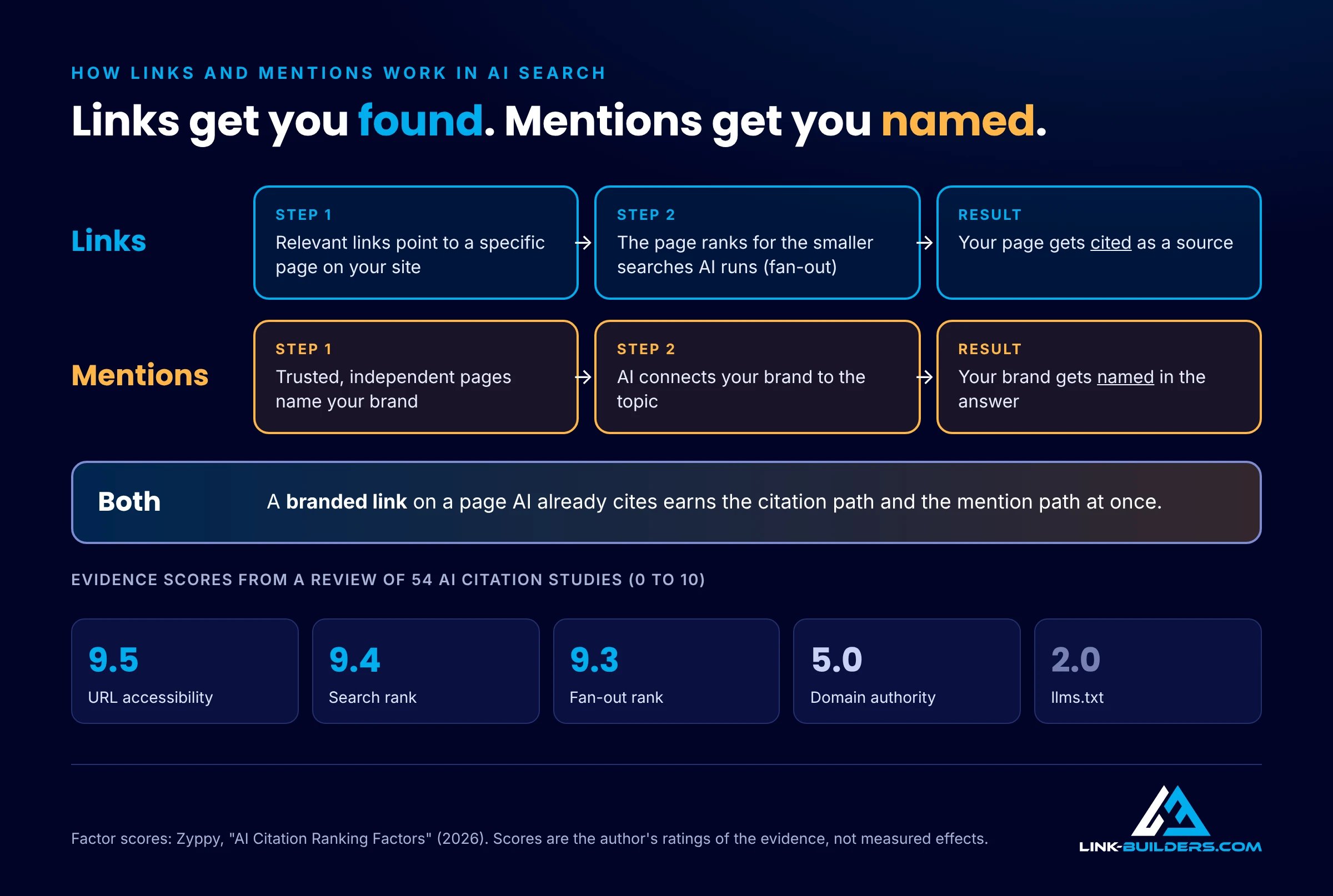
Links help your pages get retrieved. Mentions help your brand get named. Branded links on cited pages do both.
Those smaller searches run on regular search rankings, and links still help pages rank. That’s the missing piece. Links matter for citations, but the old domain-level metrics don’t capture it. A high Domain Rating doesn’t get you cited. A specific page that ranks for a specific sub-question does, and relevant links to that page help it get there.
So here’s the model I use now:
- Links get you found. A relevant link helps the right page on your site rank for the sub-queries AI runs. That’s how your pages get cited.
- Mentions get you named. Being discussed on trusted, independent pages teaches AI tools who you are and what you’re known for. That’s how your brand ends up in the answer text.
- Branded links on the right pages do both. That’s why branded anchors scored second in every Ahrefs study.
This isn’t an argument for chasing link counts. It’s an argument for putting links and mentions in the same place, on the pages AI already reads. If you want the longer version of why, I wrote about building backlinks in an age of AI and how many links a page really needs in how many backlinks do you need.
Where AI Mentions Actually Come From
If mentions on other people’s pages matter most, which pages count? The BuzzStream four-million-citation study split every citation into owned sources, meaning a brand’s own site, and earned sources, meaning news, reviews, forums, social posts and other independent websites.
- Across the full dataset, earned sources made up 47.7% of citations.
- After removing general informational prompts that didn’t involve any brand, earned sources rose to about 80%.
- On evaluative prompts, the “which one should I choose” questions closest to a purchase, earned sources made up 93.75% of citations.
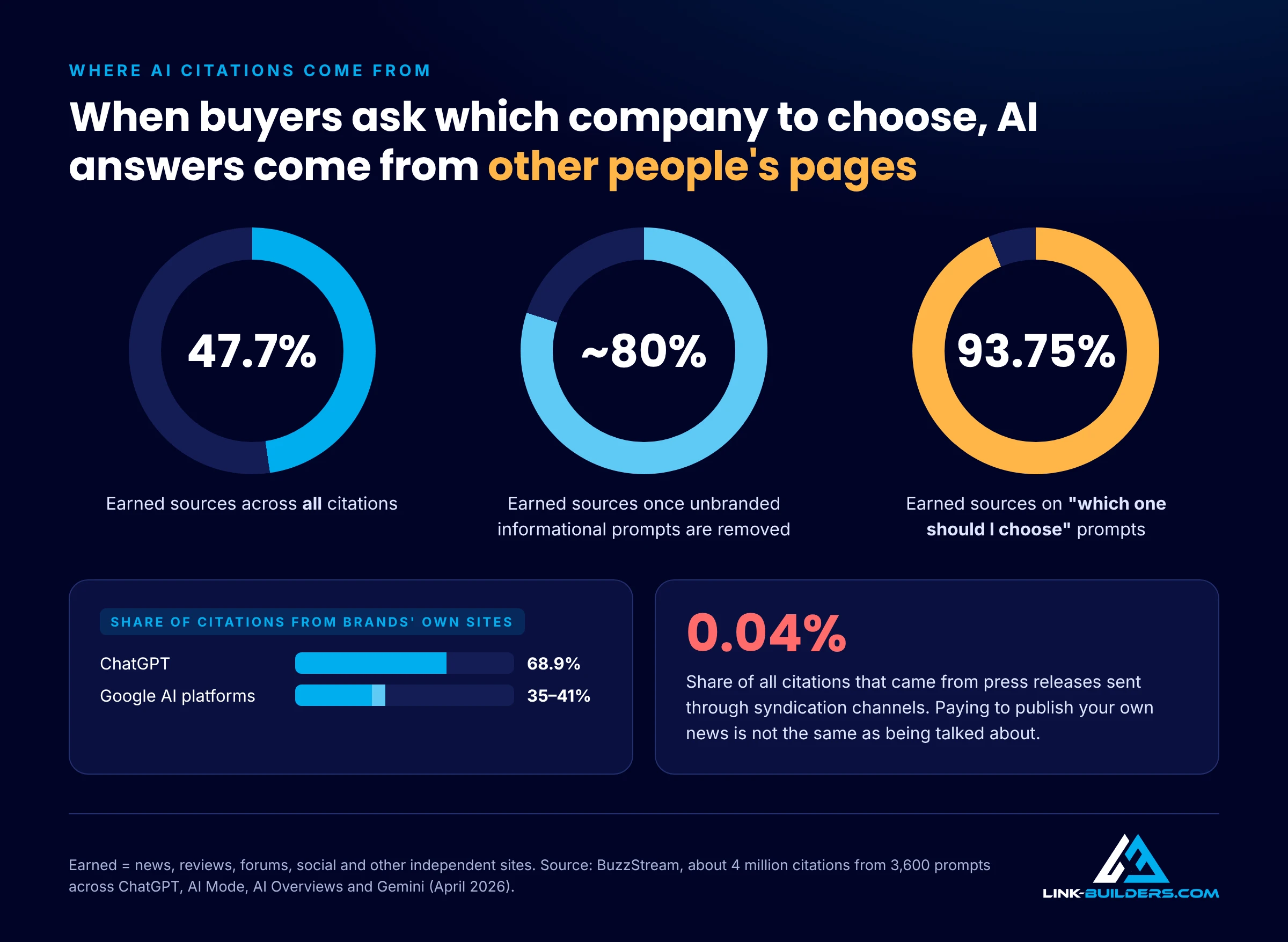
When buyers ask which company to choose, AI answers are built almost entirely from other people’s pages.
There’s an important twist by platform. ChatGPT’s citations were 68.9% owned content, compared with 35% to 41% on Google’s AI platforms. So your own site still matters, especially when someone asks about your company by name. But when a buyer asks an AI tool to compare options, the answer is built mostly from what other people wrote about you.
The same study found that press releases distributed through syndication channels made up just 0.04% of all citations. Paying to publish your own announcement on a newswire is not the same as being talked about.
This matches what other research has found: AI tools lean heavily on independent, third-party sources, which I covered in Episode 3 of my AI search series. In practice, that means review platforms, editorial articles, comparison and resource pages, industry guides, forums and YouTube. Those are the pages worth earning a place on.
Google’s Warning About Inauthentic Mentions
The moment people hear that mentions matter, some try to manufacture them. Google has already addressed this.
In its guide to optimizing for generative AI features in Search, Google says that “seeking inauthentic ‘mentions’ across the web isn’t as helpful as it might seem.” On May 15, 2026, Google also updated its spam policies so that the definition of spam now includes “attempting to manipulate generative AI responses in Google Search.” The link spam section already lists examples like “Exchanging money for links, or posts that contain links” and “Sending someone a product in exchange for them writing about it and including a link.”
So the line between an earned mention and a manufactured one matters more than ever.
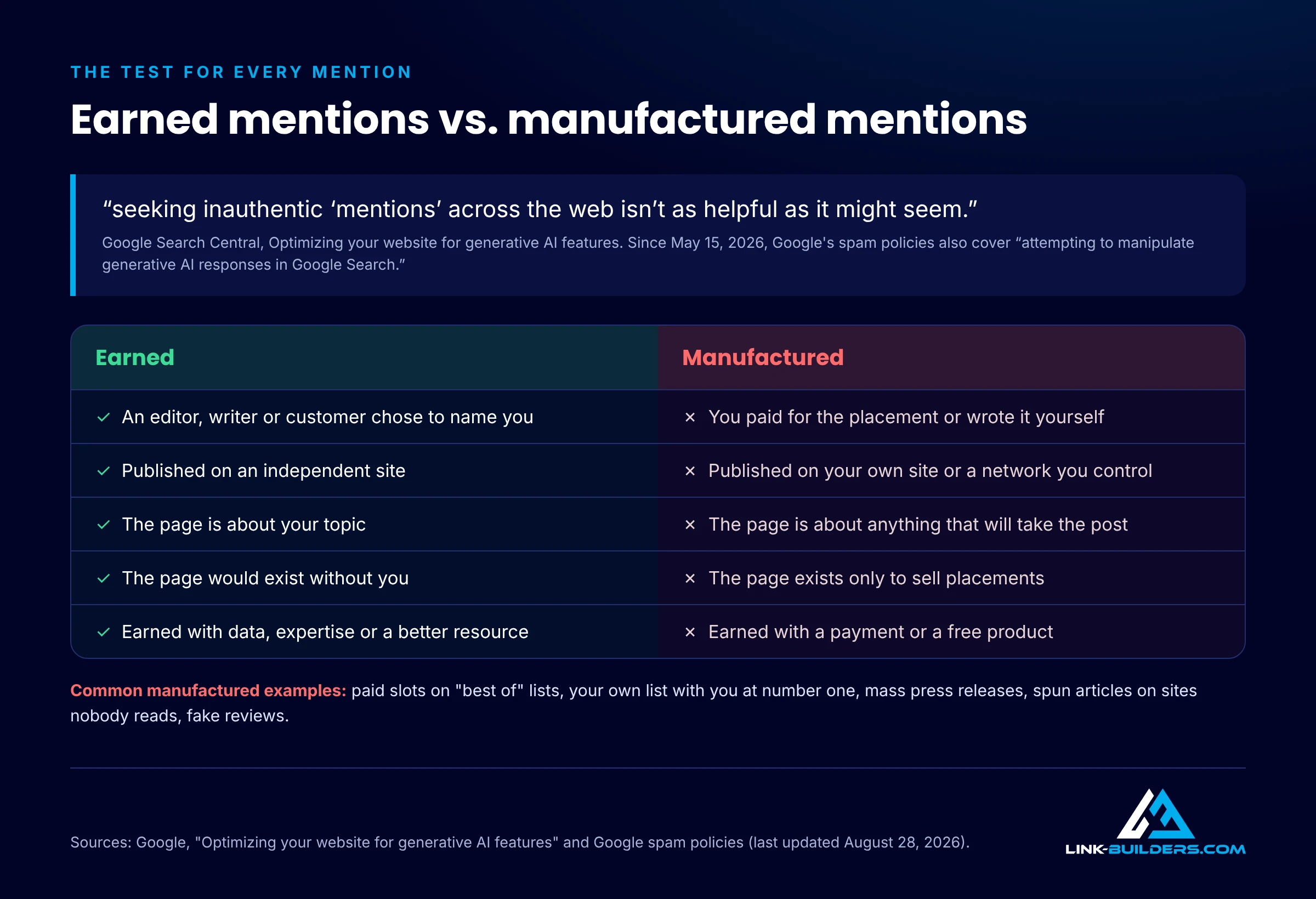
An earned mention exists because someone chose to name you. A manufactured one exists because you paid for it or published it yourself.
| Earned mention | Manufactured mention |
|---|---|
| An editor, writer or customer chose to name you | You paid for the placement or wrote it yourself |
| Published on an independent site | Published on your own site or a network you control |
| The page is about your topic | The page is about anything that will take the post |
| The page would exist without you | The page exists only to sell placements |
| You earned it with data, expertise or a better resource | You earned it with a payment or a free product |
Self-promotional “best of” lists that rank the publisher at number one are a common example of the second column. They’ve already drawn attention for losing organic visibility, and I covered the wider risk in my breakdown of Google’s September 2026 spam update. The short version is that the shortcuts to fake mentions are exactly what Google is now looking for in AI answers.
A Real Example: What ChatGPT Pulled for My Tour Company
I ran this test on my own business, Medellin Tours. In October 2026, I asked ChatGPT seven questions a tourist might ask about tours in Medellín, such as which company offers the best private tours or the best Comuna 13 tour. ChatGPT didn’t recommend Medellin Tours once.
What mattered more was where it got its answers. Across those questions, the sources it showed included Tripadvisor, Viator, Colombia Trip Insider, Medellin Guide and Descubre Medellín, plus other tour companies’ own pages for the more general questions. Every company it recommended had a large volume of reviews on the major review platforms.
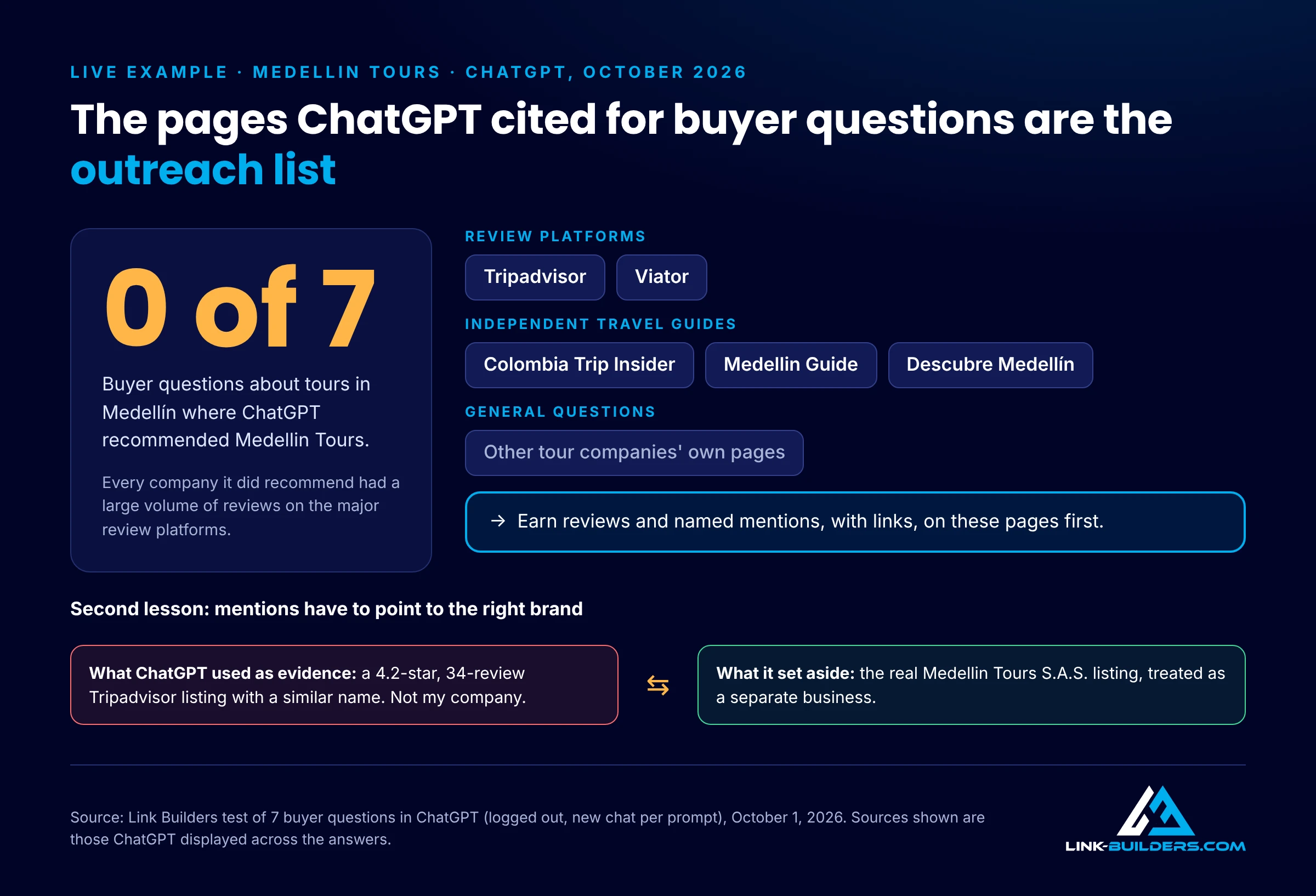
The pages ChatGPT cited for buyer questions are the outreach list.
That list of sources is more than a diagnosis. It’s an outreach list. Those are the review profiles, guides and resource pages that decide who gets named when a tourist asks ChatGPT for a recommendation.
The test turned up a second lesson. When I asked ChatGPT about Medellin Tours by name, it recognized the company. But it backed that up with another company’s Tripadvisor listing that uses a similar name, and it treated my real listing as a separate business. So mentions don’t only need to exist. They need to point to the same brand, under the same name, linking to the same website. A mention that AI credits to someone else does nothing for you. Consistent naming across your site, your listings and your structured data is part of off-site work now.
The Mention-First Link Building Workflow
Here’s how we now run off-site work at Link Builders. It treats every placement as a chance to earn both a mention and a link.
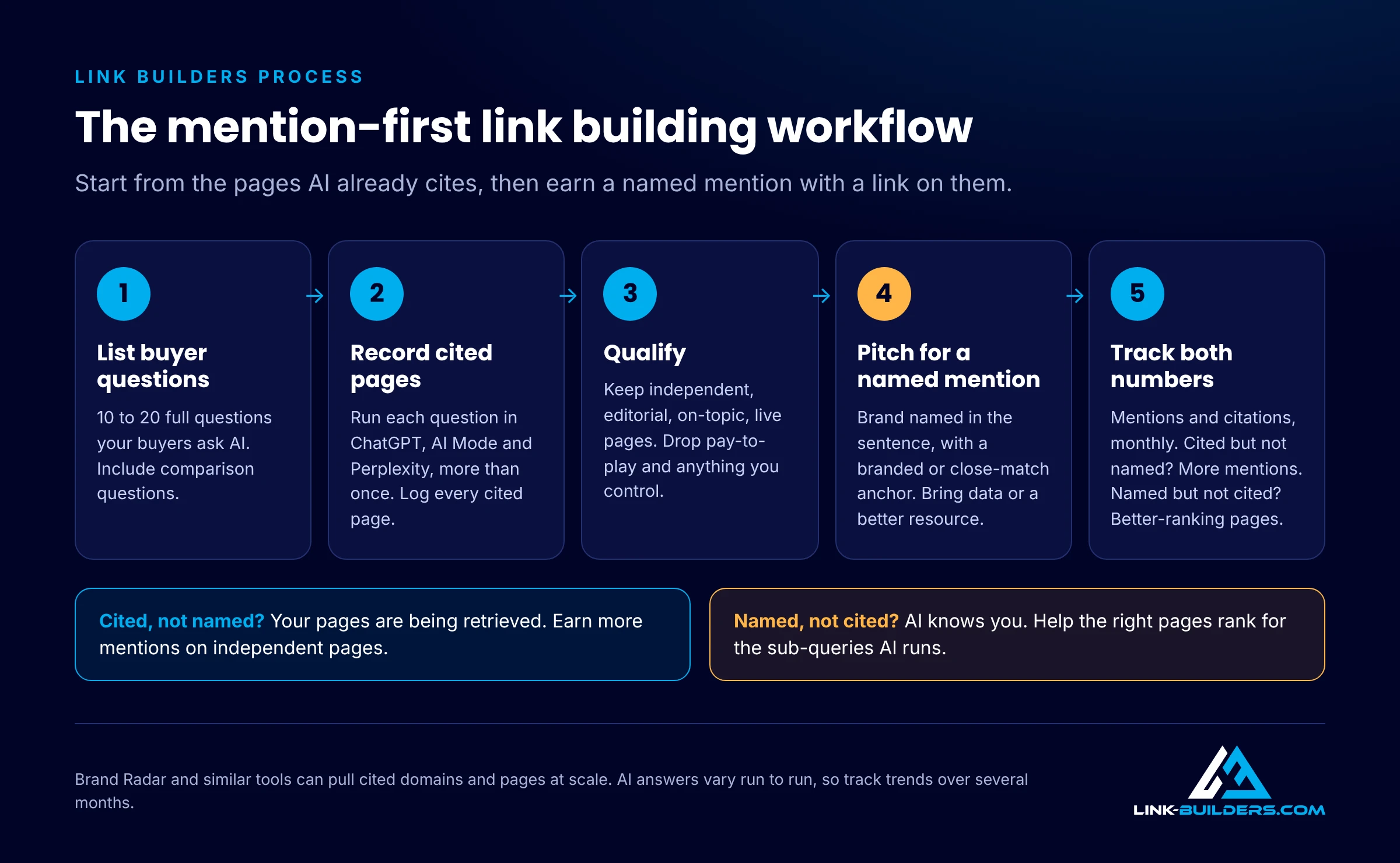
Start from the pages AI already cites, then earn a named mention with a link on them.
Step 1: List the Questions Your Buyers Ask AI
Write down 10 to 20 questions your buyers actually ask an AI assistant. Use full questions, not keywords. “Who is the best company for this service in this city?” is closer to how people use these tools than a two-word keyword. Include comparison questions, since those are where earned sources dominate.
Step 2: Record Which Pages Each Engine Cites
Run each question through ChatGPT, Google AI Mode and Perplexity, and record every page they cite. Run each question more than once, because answers change from run to run. You can do this by hand in a spreadsheet, or use a tracking tool such as Ahrefs Brand Radar to pull cited domains and pages at scale.
Step 3: Qualify the Pages
Keep the pages that are independent, editorial, on topic and still live. Drop anything that’s pay to play, anything that looks like it exists only to sell placements, and anything you or a competitor controls. The pages left are the ones AI already trusts for your topic.
Step 4: Pitch for a Named Mention, Not Just a Link
When you reach out, ask for a mention, not only a link. Your brand should be named in the sentence, with a link that uses your brand name or a close variation. Give the writer a real reason to include you: original data, a useful quote from your team, or a better resource than what’s on the page now. That’s what separates an earned mention from a bought one. If you’ve never thought about anchor text in these terms, my guide to building a natural backlink profile covers the basics.
Step 5: Track Mentions and Citations Separately
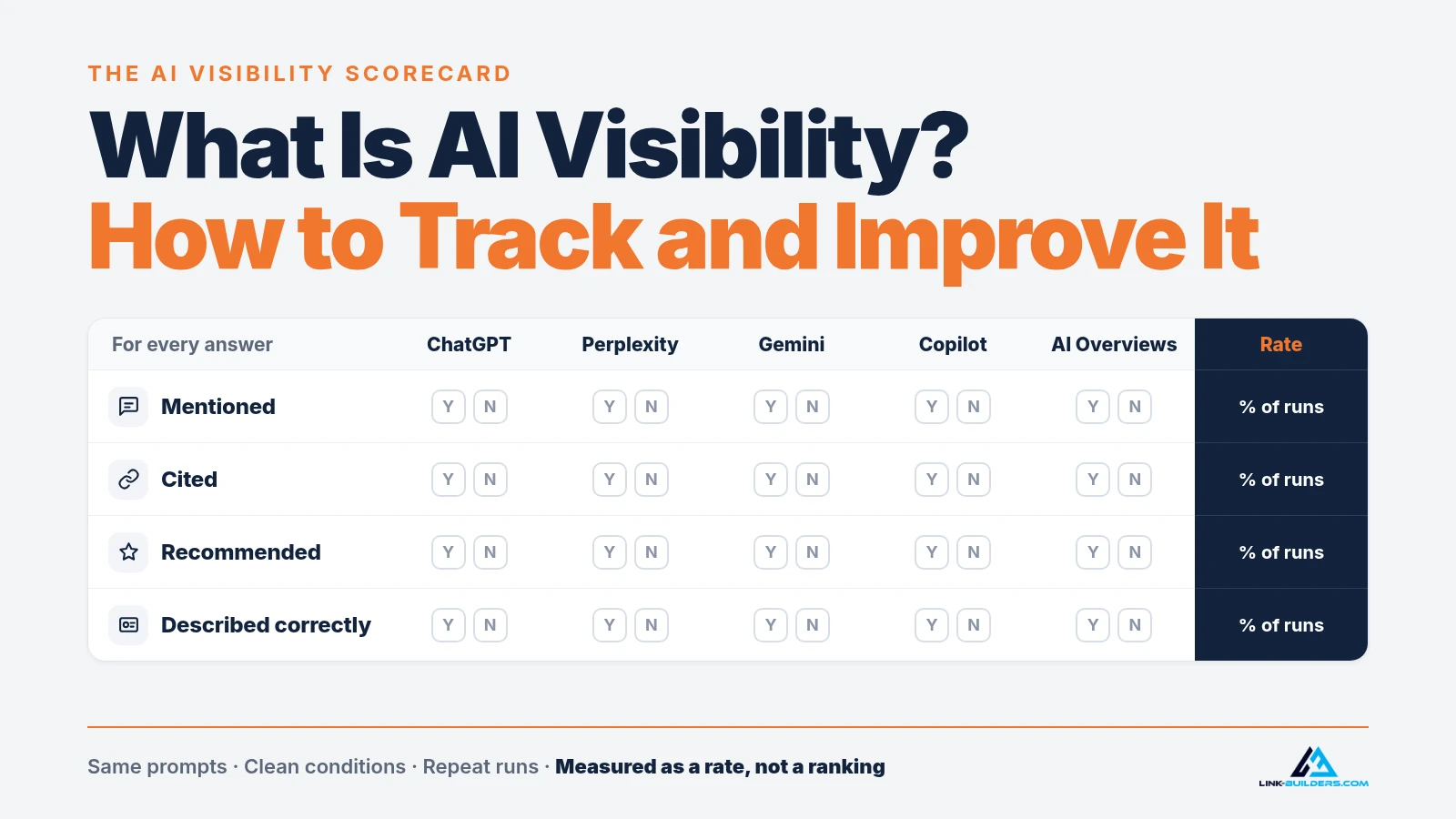
Track two numbers every month: how often your brand is named, and how often your pages are cited. If you’re cited but not named, you need more mentions on independent pages. If you’re named but not cited, your pages need to rank better for the sub-queries AI runs. AI answers vary from run to run, so look at trends over several months, not single results. For the traffic side, I walk through the AI reports in how to read Search Console and GA4 data for SEO.
Frequently Asked Questions
Are brand mentions more important than backlinks for AI search?
For getting your brand named in AI answers, yes. Ahrefs found branded web mentions correlated with AI visibility at about 0.66, compared with about 0.22 for backlink counts, across 75,000 brands. But backlinks still help specific pages rank for the sub-queries AI tools run, which is how pages get cited. The strongest approach earns both on the same page.
Do unlinked brand mentions help with AI visibility?
They appear to. AI models read text, so a sentence that names your brand alongside a topic is a signal whether or not it carries a link. In the Ahrefs studies, the strongest signal was how often a brand is named on other websites, which is measured separately from backlinks. A linked, branded mention is still better, because it can also help your page rank.
What’s the difference between an AI mention and an AI citation?
A mention is when an AI answer names your brand in its text. A citation is when it links to one of your pages as a source. In a 2026 study of 12,000 AI answers, only 23.1% of brand mentions came with a citation to the brand’s site.
Does Domain Rating predict whether AI will cite a page?
Not on its own. A 2026 study of about 4 million AI citations found near-zero correlations between citations and Domain Rating, Domain Authority, referring domains and links to the cited page. AI tools favor well known sites, but they pick the specific page that best answers the question.
Can you buy brand mentions to show up in ChatGPT or Google AI?
Paid or manufactured mentions carry real risk. Google says seeking inauthentic mentions “isn’t as helpful as it might seem,” and its spam policies now cover attempts to manipulate generative AI responses in Google Search. Paying for links or for posts that contain links is already listed as link spam.
Which websites do AI tools cite most?
It depends on the platform and the question. In BuzzStream’s 2026 study, earned sources such as news, reviews, forums and independent sites made up about 94% of citations for “which one should I choose” prompts. Ahrefs found YouTube mentions had the strongest correlation with AI visibility of any signal it tested.
Key Takeaways
- A mention names your brand in an AI answer. A citation links to your page. They often don’t happen together, and each has a different fix.
- Branded web mentions are the strongest known correlate of AI visibility, at about 0.66 across 75,000 brands. Backlink counts came in at about 0.22.
- Domain-level link metrics show little to no relationship with AI citations. AI tools pick the specific page that answers the question.
- Links still matter because they help pages rank for the sub-queries AI runs. Links get you found. Mentions get you named.
- For buyer comparison questions, about 94% of AI citations come from earned, third-party sources.
- Google warns against inauthentic mentions, and its spam policies now cover manipulating AI answers. Earn mentions; don’t manufacture them.
- Start with the pages AI already cites for your buyers’ questions, and earn a branded, named mention with a link on them.
Get Named on the Pages AI Already Reads
The work that gets a brand named in AI answers looks a lot like good link building always has: earning a place on independent, relevant pages that real people read. The difference now is where you start. Instead of chasing domain metrics, start with the pages AI tools already cite for your buyers’ questions, and make sure your brand is named on them, with a link to the right page.
That’s what Link Builders does every day, with full transparency on every opportunity, contact and cost. Request a free sample of 20 vetted link opportunities for your site. If you’re weighing a broader AI search program, my guide to GEO services covers what they include and what they cost. If you want me to run that work for you, here’s how I work as a generative engine optimization agency. If you run an agency and need an off-site partner for your clients, read about our white-label link building service.
About the author

Justin Davis is the founder of Link Builders, a white-label backlink agency, and has been building links since 2015 for more than 150 clients in law, healthcare, real estate, software and other industries. After years of doing prospecting research by hand, he built an AI agent link building system that handles each step, from finding link opportunities and vetting sites to finding contacts and preparing outreach. He now runs that system for agencies and in-house SEO teams, and teaches it on YouTube. Find Justin Davis on YouTube, LinkedIn and X.