Building an AI Link Building Tool After 10 Years of Manual Outreach
Updated October 2, 2026 · Originally published November 16, 2025
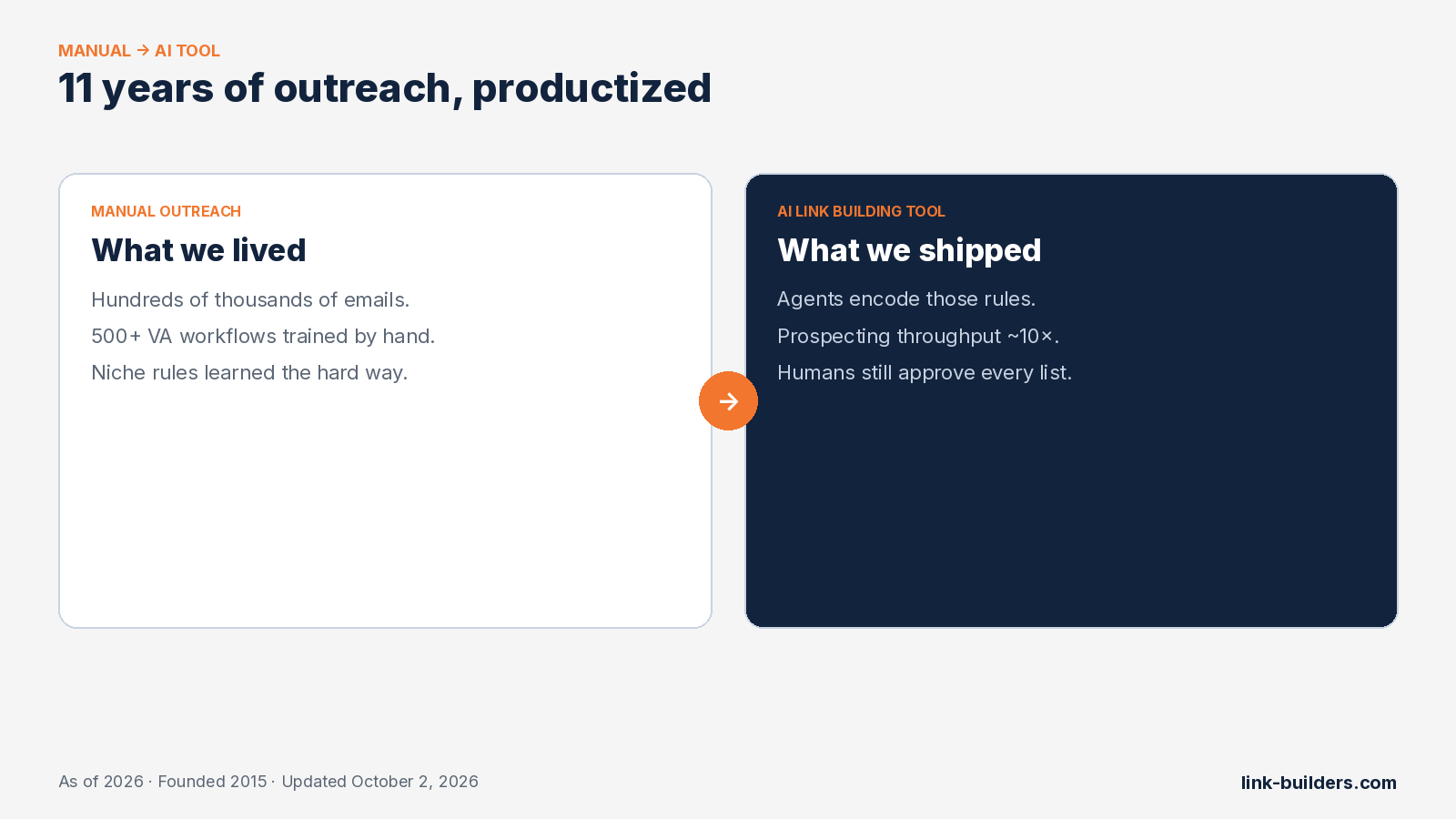
I’ve sent over 100,000 link building prospecting emails. Here’s why I finally automated the process, and why I waited so long.
As of 2026, after 11 years of running Link Builders (founded in 2015), my SEO agency, I had a reputation for being selective. I turned down about 90% of potential clients. I worked with everyone from mental health treatment centers to law firms to healthcare software companies. My business was built on one principle: quality over quantity, always.
But there was a problem I didn’t want to admit. I was drowning.
The Day Everything Changed
Last year, I took on a client in the legal space. They needed guest post opportunities, and I promised them 40 high-quality prospects. I sat down on a Tuesday morning to build their list.
Eight hours later, I was still at my desk.
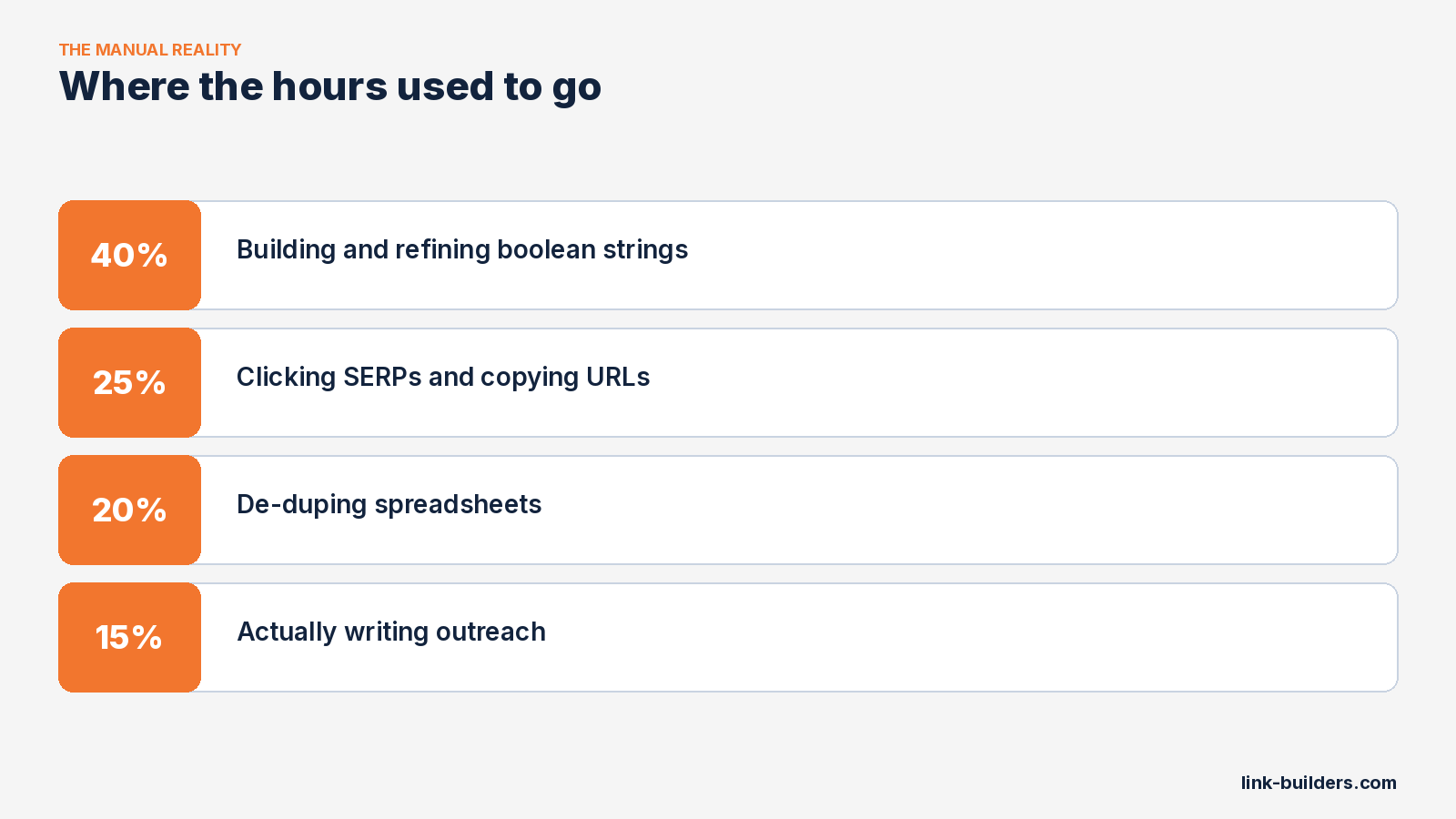
Let me break down what those eight hours looked like. The first two hours were spent running Boolean searches and building an initial list of about 200 websites. Hours three and four went to checking domain authority, traffic estimates, and niche relevance. By hour five, I was hunting down contact information. Hours six and seven were spent verifying email addresses and looking for guest post guidelines. The final hour was dedicated to organizing everything and making sure these prospects were actually worth reaching out to.
At the end of it all, I had my 200 prospects. The campaign would probably work fine. But I did the math in my head. Eight hours at what my time was worth meant this single prospecting campaign for the day cost $800 in labor.
I remember sitting back in my chair and thinking: I’m not a link builder anymore. I’m a data entry clerk.
Why I Resisted For So Long
For years, I had philosophical objections to automation. Link building is about relationships, I told myself. You can’t automate genuine human connection. I had tried tools before. I experimented with Ahrefs API automation back in 2019, but it gave me too many false positives. I used some generic prospecting software that returned mostly irrelevant results. I even built a simple scraper once, but it could only gather quantity, not evaluate quality.
Every time I tried to automate something, the results were worse than what I could do manually. So I kept doing it manually. Twelve hour days, six days a week. I lost a major client because my turnaround time was too slow. I watched competitors advertise their AI link building tool and win clients with promises I couldn’t match.
But here’s the real truth about why I waited so long. It wasn’t just philosophical resistance or failed experiments. The technology simply wasn’t there yet. I had this vision in my head of exactly what I needed, but I’m not a developer. I couldn’t code it myself, and explaining my methodology to someone else always fell short.
Then something changed in the past year. Vibe-coding tools and AI-assisted development platforms reached a point where I could actually translate what was in my head into working software. I could describe my prospecting process, my quality filters, my decision-making framework, and the technology could help me build it.
That’s when I realized I could create something that didn’t exist before. Not just for me, but for anyone doing serious link building work.
What I Actually Built
I spent three months building what I now call the first comprehensive AI link building tool. I invested about $5,000 between my own time and hiring freelance developers for specific components. But the breakthrough was that I could finally guide the development process in a way that actually matched how I think about link prospecting.
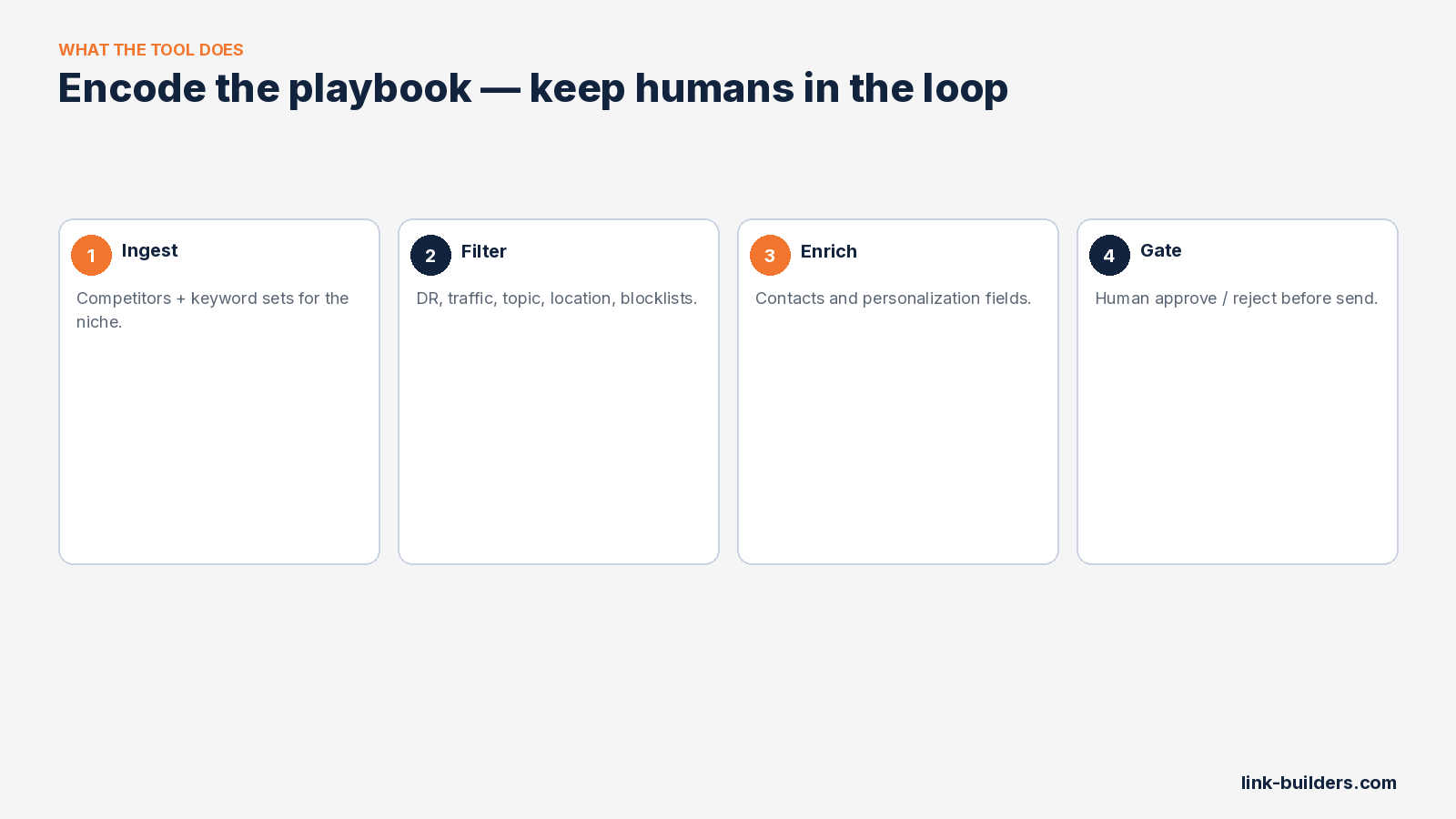
Most of the tools I have created are not magic button apps (except one, which does only need 3 inputs from the user and then does all of the prospecting and even comes up with the outreach emails, personalized for each lead!). It’s more like a research assistant that handles the parts of link building that were eating up all my time. The prospecting component uses advanced Boolean search operators combined with built-in filters for domain authority, traffic, and niche relevance. What used to take me two hours now takes about 15 minutes.
I also built a contact finder that scrapes email patterns and verifies them through multiple sources. This turned another two-hour task into something that happens in the background while I’m doing other work.
Here’s what I didn’t automate: the actual outreach emails. I tried that in month three of development. I sent out 100 emails that the AI had “personalized” based on prospect websites. My normal response rate is around 15% to 20%. That batch got 2%. The emails were technically personalized, but they felt robotic. People could tell. Now, you have to have a human approve each email (it’s great because they can also add any last personal touches). This requires the human’s stamp of approval.
That failure taught me something important. AI can give you the information you need to personalize an email, but it shouldn’t push send on the email until a human has approved it (otherwise you’re simply gambling with yours or your client’s brand).
The 10x Result Nobody Expected
After I launched the tool for my own use, the numbers were dramatic. Those 40 prospects that used to take eight hours now took about 45 minutes to an hour. I went from being able to realistically handle about 150 quality prospects per week to being able to process 400 to 500.
But here’s the thing. I didn’t start doing 10 times more campaigns. I started doing about three times more campaigns at three times higher quality. What happened to the rest of that time?
I spent it actually building relationships. I spent it on strategy calls with clients. I spent it thinking creatively about link opportunities instead of just grinding through spreadsheets. The tool freed me up to do the work that actually matters in link building.
My response rates stayed between 15% and 18%. That was proof that the AI wasn’t hurting my quality. If anything, I was doing better work because I wasn’t exhausted all the time. I could decline prospects that weren’t quite right without feeling guilty about wasted time. I had plenty of options now.
The unexpected benefit was client education. I suddenly had time to explain to clients why certain prospects were valuable. I could show them my process instead of just delivering results. That transparency built more trust than any sales pitch ever could.
What AI Still Can’t Do
After using this tool every day for months, I’ve learned exactly where the boundaries are. AI is incredible at pattern recognition and processing volume, but it can’t make certain judgment calls.
A site might look perfect on paper. Domain authority of 65, relevant niche, good traffic numbers. But when I look closer, I notice a toxic backlink profile or content that doesn’t match the quality metrics suggest. The AI can flag potential issues, but it can’t make that final call about whether a prospect is worth my time.
Relationship building still takes the same amount of time it always did. Reading between the lines of an email response, knowing when to follow up versus when to back off, understanding an editor’s preferences beyond their stated guidelines. None of that has changed.
The strategic thinking is still completely human. When a campaign isn’t working and I need to pivot the approach. When a client’s business changes and their link building strategy needs to adapt. When I need to get creative because the standard approaches aren’t getting results. The AI provides information, but strategy is still on me.
What I Learned The Hard Way
The biggest lesson was about what to automate and what to keep human. I started by trying to automate everything at once. That was a mistake. The better approach was automating the prospecting bottleneck first, then gradually moving to other areas.
I also learned that being transparent about using AI actually builds trust with clients. I tell them I use technology for the research and data processing. I also tell them where my human judgment comes in. The response has been overwhelmingly positive. Clients appreciate knowing the process. They understand that link building isn’t magic, it’s intelligent systems combined with experience.
The development process taught me that your first version will always be wrong in ways you can’t predict. I beta tested on five existing clients for three months before rolling it out wider. That testing period caught bugs that would have been embarrassing and helped me refine the tool based on real campaign results.
The Real Transformation
Building this tool changed my business, but not in the way I expected. I thought I would just be faster at the same work. Instead, I became better at different work. I’m more hands-on with strategy now than I ever was. I have more conversations with clients about their goals. I spend more time actually building relationships with editors and site owners.
The efficiency gain wasn’t about doing more. It was about doing the right things better. I still leave the office at 6pm now instead of working 12-hour days. I take on more complex, interesting projects because I’m not buried in spreadsheets. I’m more selective than ever, now turning down about 95% of potential clients.
The technology didn’t replace what makes me good at link building. It cleared away the busywork so I could focus on what I’m actually good at: understanding what makes a valuable link, building genuine relationships, and developing strategies that work for specific clients in specific situations.
Looking Forward
The advances in vibe-coding and AI development tools made this possible. What I built couldn’t have existed even two years ago, not because the AI wasn’t smart enough, but because the tools for building it weren’t accessible to non-developers like me.
That’s going to change the industry. More link builders will create tools that match their specific methodologies. The gap between people doing quality work and people just spamming will get wider. AI will make bad link building faster, but it will also make good link builders much more effective.
If you’re doing manual prospecting right now and feeling overwhelmed, start small. You don’t need to build a custom tool like I did. Look at your biggest bottleneck and find one piece of technology that addresses it. Use AI for research, but keep the human elements that make your work valuable.
The future isn’t AI or humans in link building. It’s humans using AI to clear the path so they can focus on what actually matters: building real relationships that lead to quality links. That’s what I learned as of 2026, after 11 years of doing this manually and eight months of building the tool I wish I’d had from the start.
If you want to see how that process runs on a live engagement — hours, not a promised link count — start with our link building process or current backlink pricing ($160/hr; Justin’s Machine 30 hours for $4,800; Buy the Machine $9,600 including onboarding and an 8-hour prospecting cycle).
About the author

Justin Davis has been building backlinks since 2015 and has built links for more than 150 clients across law, healthcare, real estate, software, and other industries. He built the first version after years of doing the research by hand, and now builds the same workflow for in-house teams. More on who Justin Davis is, on YouTube, on LinkedIn, or on X.