GEO vs. SEO: What’s Different, What Carries Over, and Where to Spend in 2026
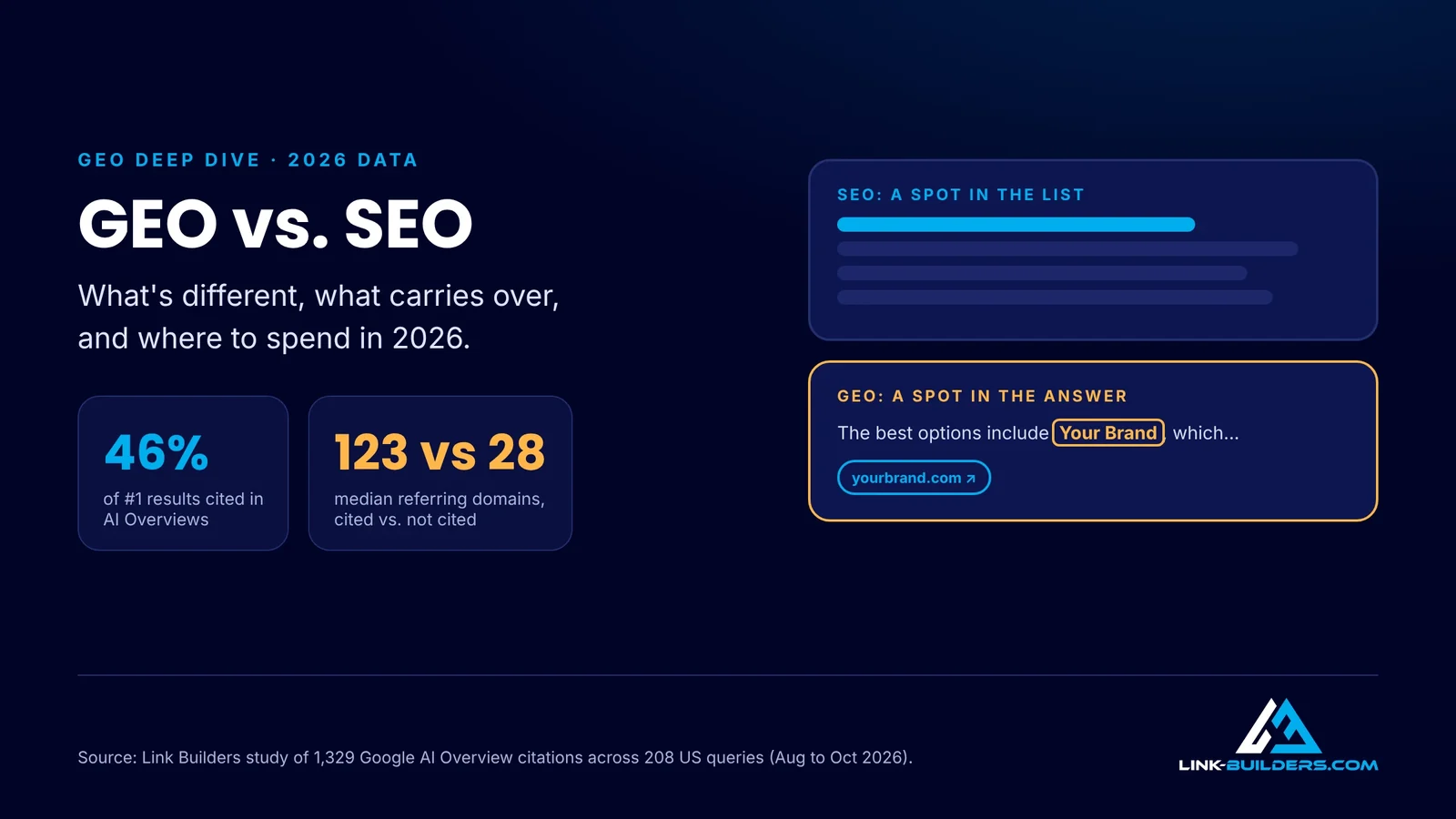
SEO earns a spot in the list. GEO earns a spot in the answer. Most of the work feeds both.
SEO (search engine optimization) is the work of ranking your pages in the list of search results. GEO (generative engine optimization) is the work of getting your brand cited, mentioned or recommended inside AI answers from ChatGPT, Google AI Overviews and AI Mode, Perplexity, Gemini and Copilot. The two aren’t rivals. AI answers are built from search results, so strong SEO is the foundation GEO stands on. What GEO adds is a sharper focus on quotable passages, the smaller searches AI runs behind the scenes, and what other websites say about you.
That’s the short version. The longer version matters if you’re deciding where to spend time or budget, because most “GEO vs. SEO” articles stop at a comparison table. This one uses real data, including my own study of 1,329 Google AI Overview citations, to show what carries over from SEO, what actually changes, how to measure each one, and how to split the work.
I’ve built backlinks since 2015, which puts me on the side of SEO that people keep saying AI will make obsolete. The data says otherwise, but it also shows where old habits stop working.
GEO vs. SEO at a Glance
Here’s how the two compare side by side.
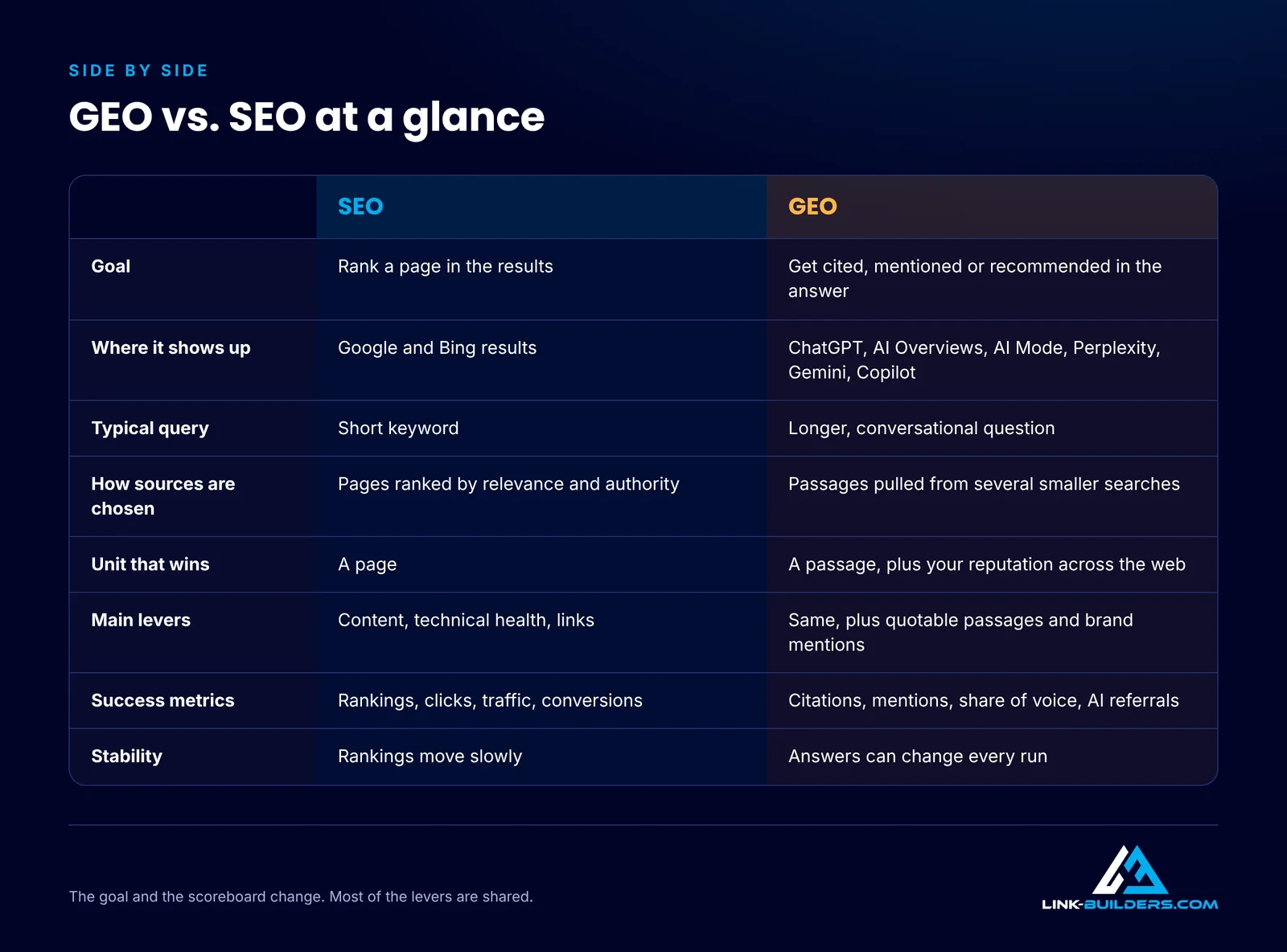
The two disciplines share most of their levers. The goal and the scoreboard are what change.
| SEO | GEO | |
|---|---|---|
| Goal | Rank a page in the search results | Get cited, mentioned or recommended in an AI answer |
| Where it shows up | Google and Bing results pages | ChatGPT, AI Overviews and AI Mode, Perplexity, Gemini, Copilot |
| Typical query | Short keyword (“geo vs seo”) | Longer question (“should I hire a GEO agency or an SEO agency?”) |
| How sources are chosen | Pages ranked by relevance and authority | Passages pulled from several smaller searches, then summarized |
| Unit that wins | A page | A passage, plus your brand’s reputation across the web |
| Main levers | Content, technical health, links | Same, plus quotable passages, brand mentions and consistent brand details |
| Success metrics | Rankings, clicks, organic traffic, conversions | Citations, mentions, share of voice, AI referral traffic |
| Stability | Rankings move slowly | Answers can change from one run to the next |
If you want the full definition of GEO and the steps to start, I cover that in what generative engine optimization is. This article is about the comparison.
How Each One Works
How SEO Works
A search engine crawls the web, stores pages in an index, and ranks them for each query using signals like relevance, content quality, links and page experience. The searcher sees a list and clicks. Your goal is to be near the top of that list, and success shows up as clicks and traffic.
How GEO Works
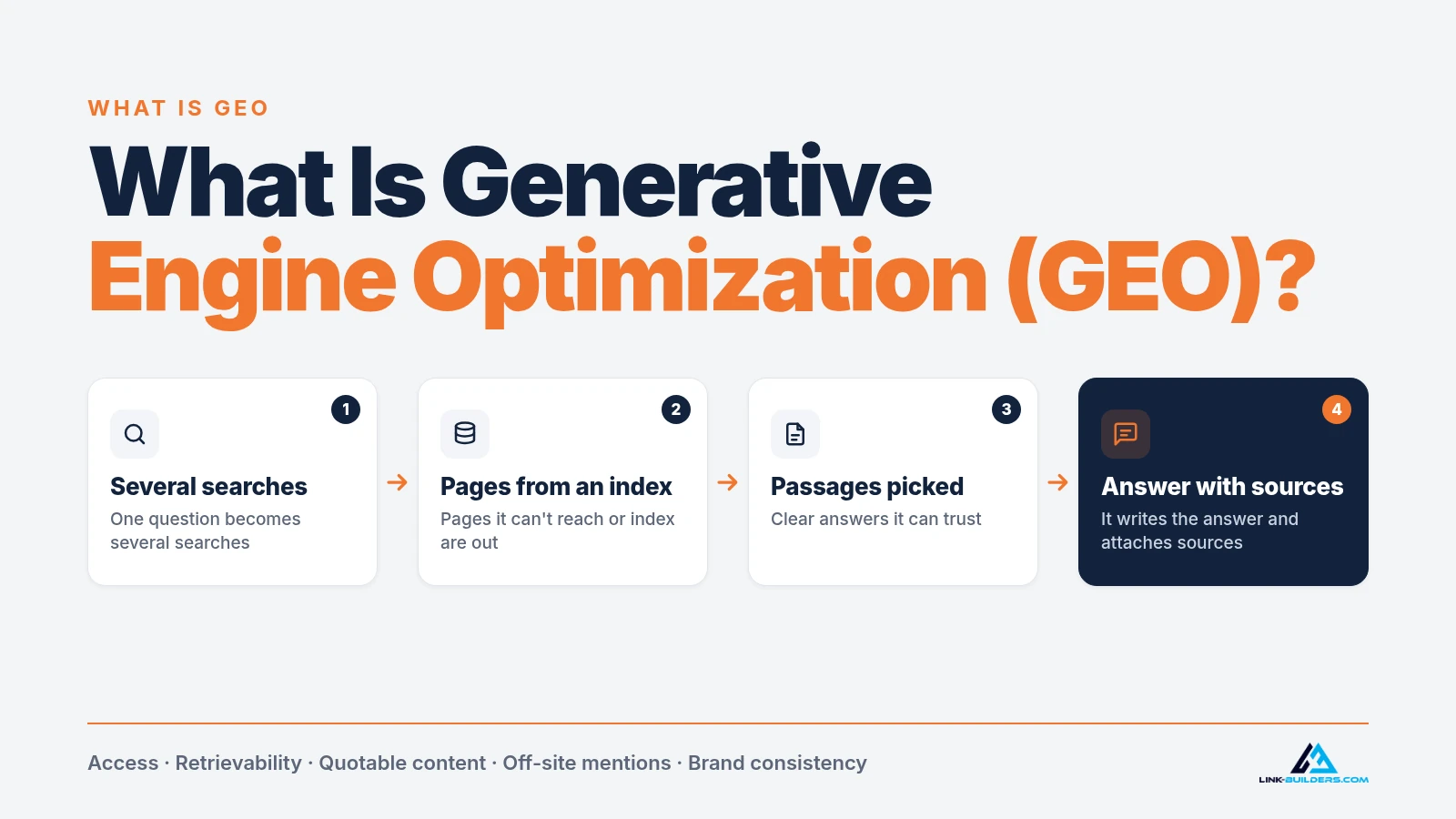
An AI search tool usually starts the same way, with a search index, but it adds three steps. First, it often splits your question into several smaller searches, which Google calls query fan-out. Second, it reads the pages it finds and pulls out the passages that answer each part of the question. Third, it writes one answer and attaches some of those pages as sources.
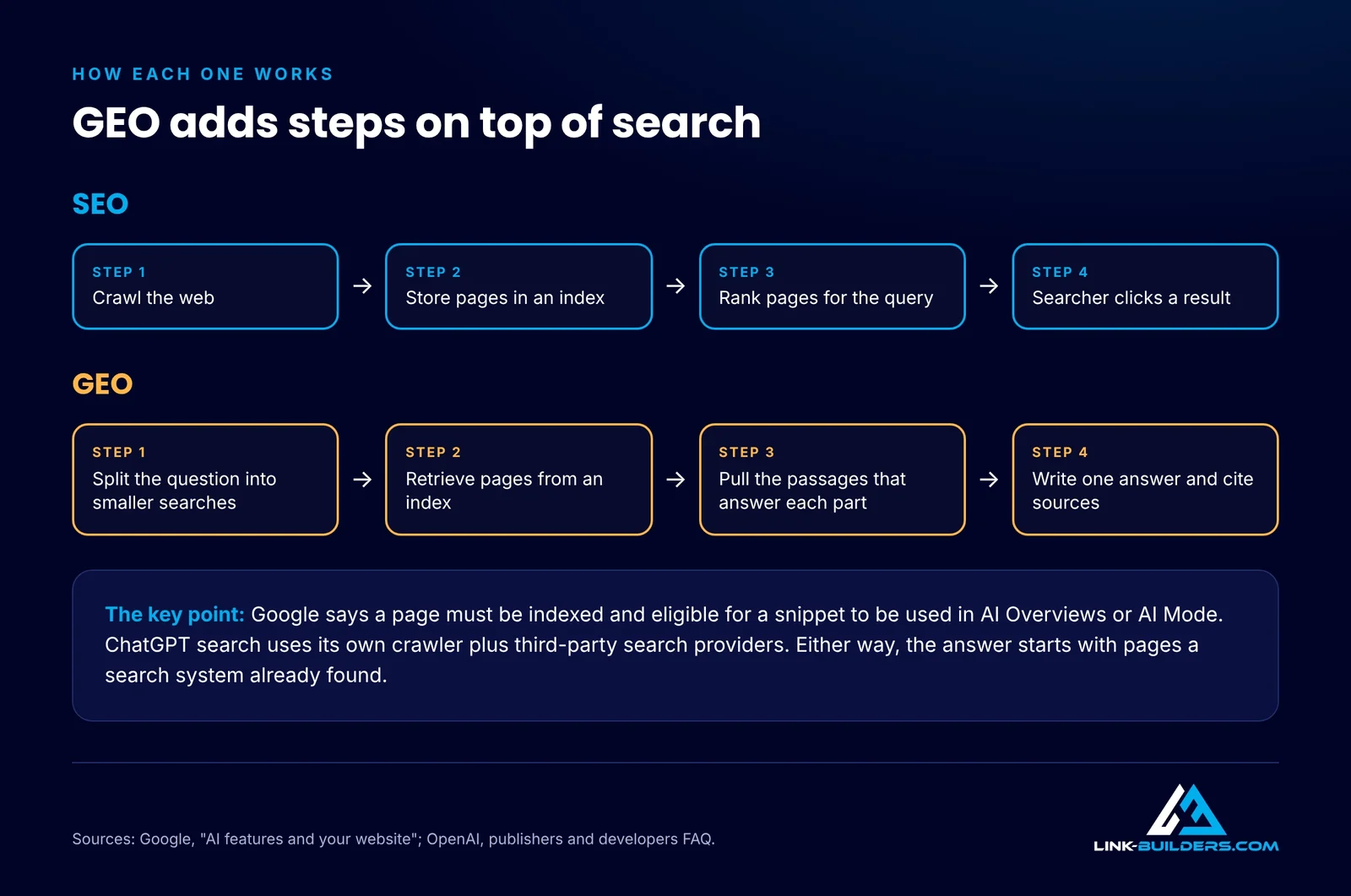
GEO adds steps on top of search. It doesn't replace the index underneath.
That search index is the key point. Google’s documentation on AI features and your website says a page has to be indexed and eligible to show a snippet in regular search to be used as a source in AI Overviews or AI Mode. There’s no separate AI index to get into. OpenAI’s publishers and developers FAQ says ChatGPT search uses its own crawler and also draws on third-party search providers. Either way, the answer is built from pages that a search system found first.
What Carries Over From SEO
This is the part most GEO pitches skip. A lot of the work you already do for SEO is also the work that gets you cited.
Rankings Still Feed AI Answers
In my study of 1,329 AI Overview citations across 208 search queries, 77% of AI Overviews cited at least one page that already ranked on page one for that query. The higher a page ranked, the more often it was cited. The first organic result was cited 46% of the time. The eighth was cited 18% of the time.
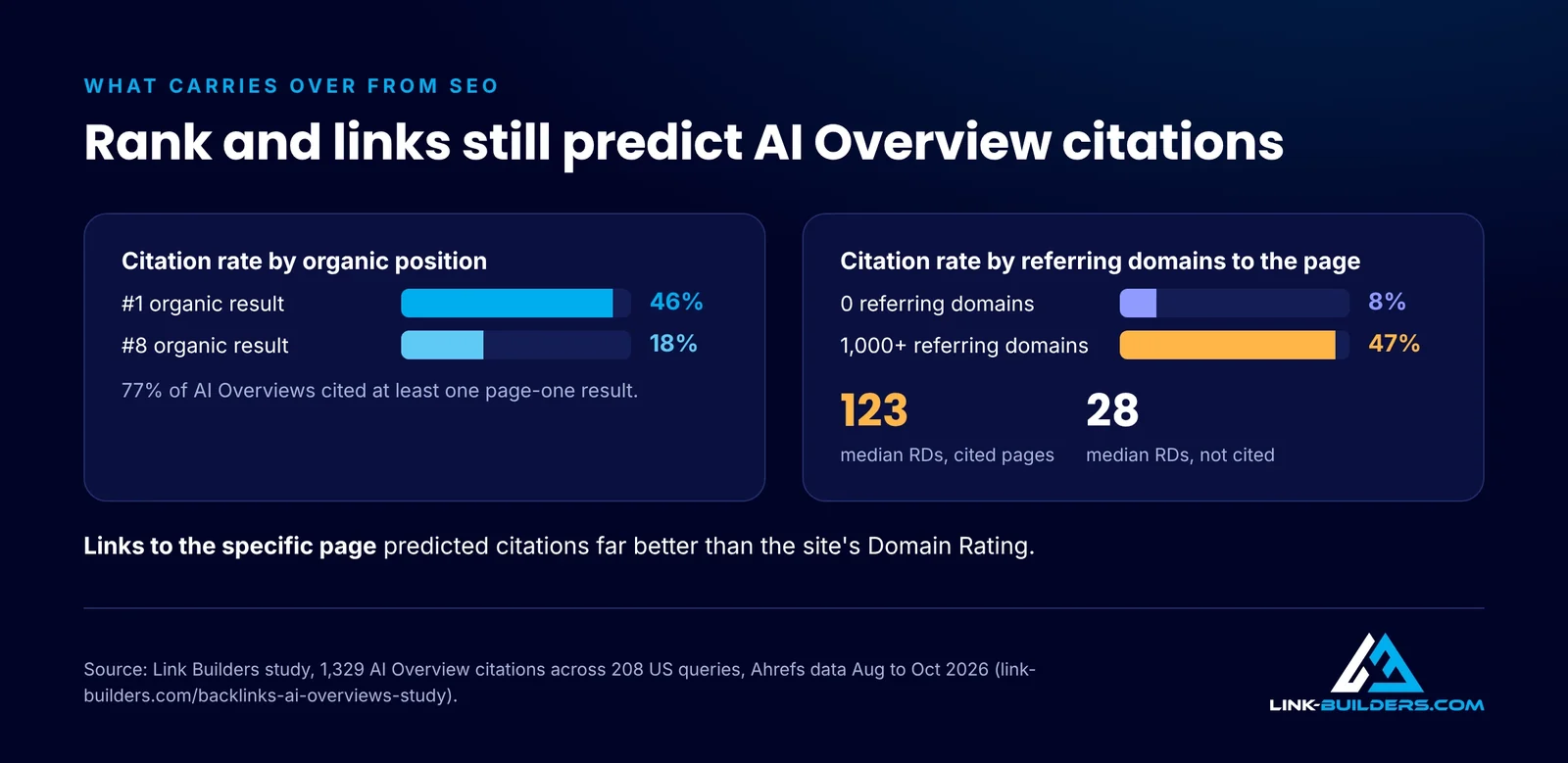
Rank and links still predict which pages Google's AI Overviews cite.
Links Still Matter, at the Page Level
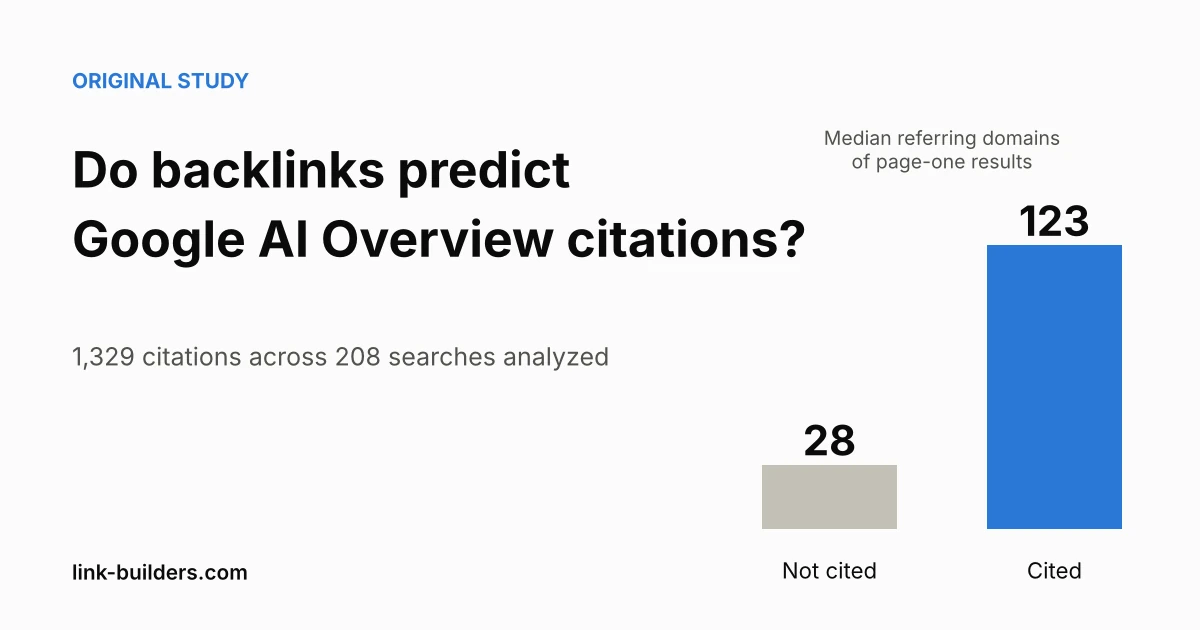
The same study found a strong link between backlinks and citations. Page-one results with zero referring domains were cited 8% of the time. Pages with more than 1,000 referring domains were cited 47% of the time. The median cited page-one result had 123 referring domains, compared with 28 for page-one results that weren’t cited. That held up even when I compared pages ranking side by side for the same query.
One detail matters for how you build links. The number of sites linking to the specific page predicted citations far better than the site’s overall Domain Rating. I go deeper on that in brand mentions vs. backlinks for AI search.
Technical Access and Indexing
If search engines can’t crawl and index a page, AI tools that rely on them can’t use it either. GEO adds one more check: making sure you aren’t blocking the AI companies’ own search bots, often by accident through a firewall or CDN setting. My AI crawler map shows which bots to allow and which you can safely block.
Helpful, Original Content
Google’s guide to optimizing for generative AI features says the same SEO best practices apply to its AI features, and it encourages original, expert content that goes beyond common knowledge. Content that earns rankings and links tends to be the same content AI tools want to quote.
What Changes With GEO
Here’s where GEO does ask for something new.
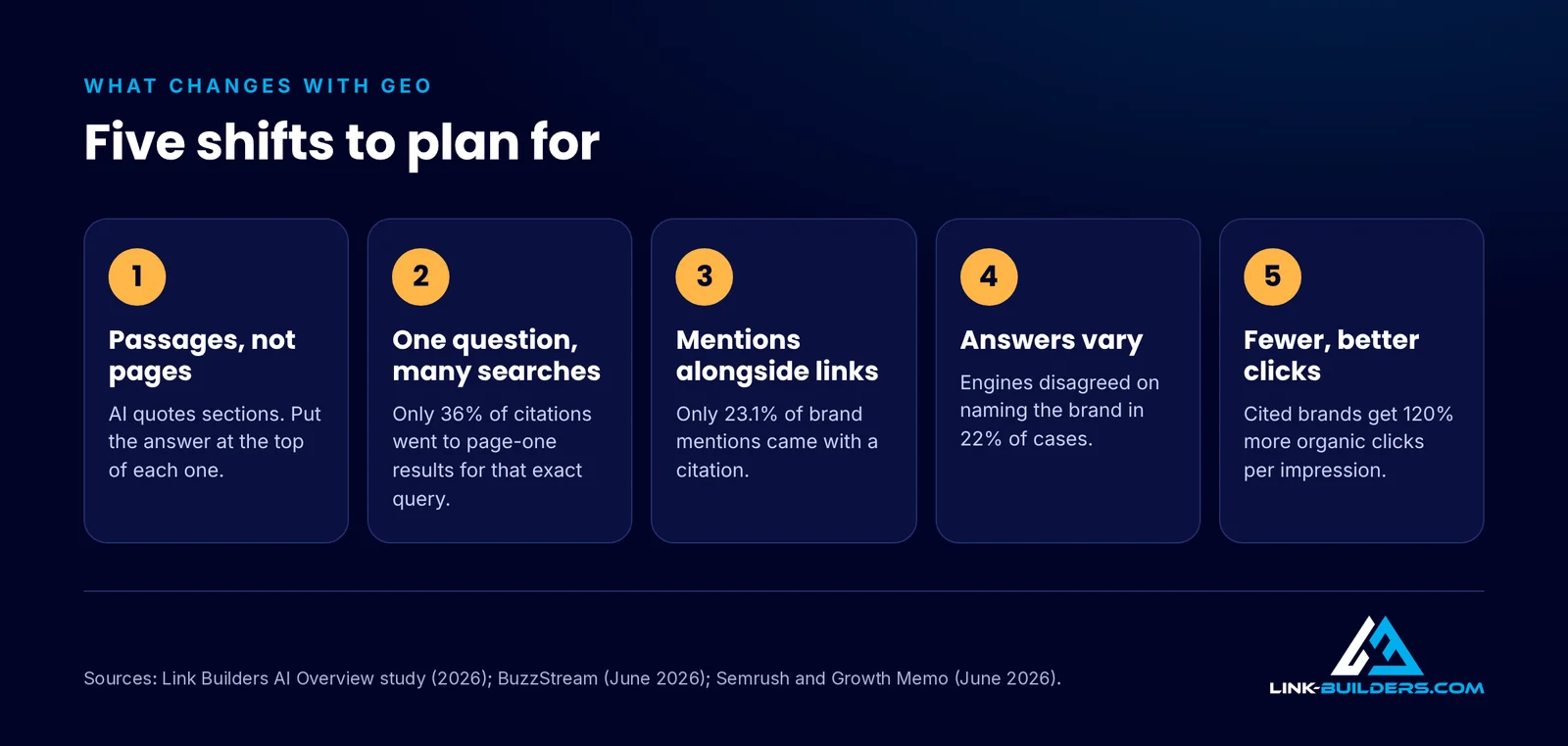
Five shifts to plan for when you add GEO to an SEO program.
1. The Unit Is a Passage, Not a Page
AI tools quote sections, not whole pages. A page can rank well and still never be cited if its key answer is buried in the fifth paragraph. Clear headings, a direct answer under each one, real numbers and named sources make a section easy to lift. That doesn’t mean chopping pages into fragments. Google says there’s no need to break content into tiny pieces, and I cover how to square that with Microsoft’s advice in should you chunk content for AI search.
2. One Question Becomes Many Searches
Because AI tools fan a question out into smaller searches, a page can be cited for a query it doesn’t rank for. In my study, only 36% of AI Overview citations went to pages ranking on page one for that exact query. Most of the rest went to pages on strong domains and to platforms like YouTube and Reddit. In SEO you plan around one keyword per page. In GEO you also plan around the follow-up questions a buyer would ask next.
3. Mentions Matter Alongside Links
An AI answer can name your brand without linking to you, or link to you without naming you. Those are two different wins. In a June 2026 study of 12,000 AI answers, BuzzStream found that only 23.1% of brand mentions came with a citation to the brand’s own site. Getting named depends heavily on what other trusted sites say about you, which is why off-site mentions carry more weight in GEO than in classic SEO.
4. Answers Change From Run to Run
A ranking stays fairly stable from day to day. An AI answer can change every time someone asks. Different AI tools also disagree with each other: in a Semrush and Growth Memo study, the engines disagreed on whether to name a brand in 22% of prompt and domain pairs. GEO results have to be read as trends over weeks and months, not as a single snapshot.
5. Fewer Clicks, but Better Clicks
AI answers reduce clicks. Pew Research tracked real browsing in March 2025 and found that people clicked a regular search result on 8% of visits when an AI summary appeared, compared with 15% when it didn’t. They clicked a link inside the summary on just 1% of visits.
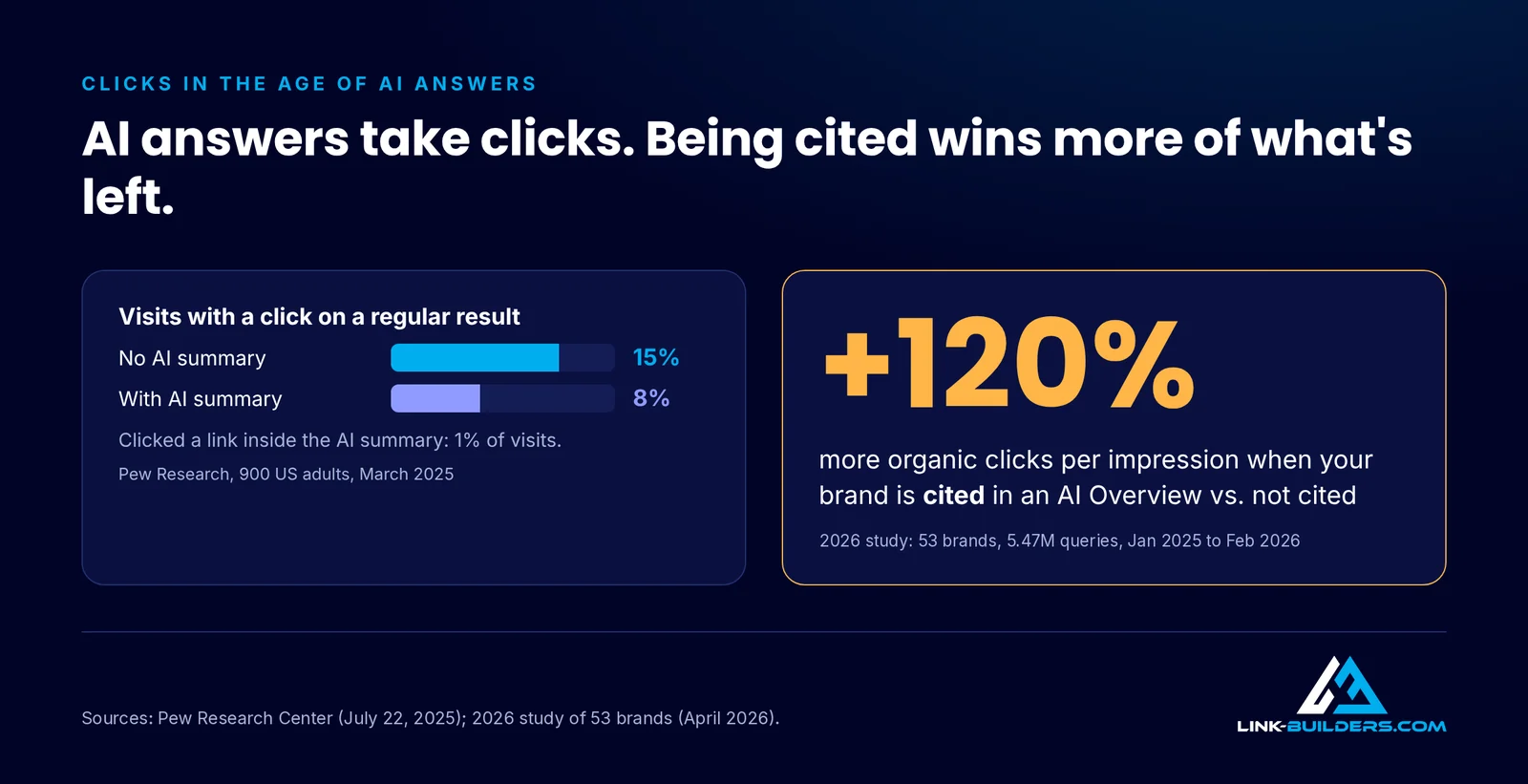
AI answers take clicks. Being the cited source wins a bigger share of what's left.
Being cited changes that math. A 2026 study of 53 brands and 5.47 million queries found that brands cited in an AI Overview got 120% more organic clicks per impression than brands that weren’t cited on the same kind of query. Cited results still trailed queries with no AI Overview at all, so the traffic you get from search is changing either way. The question is whether you’re the source or the brand that got summarized away.
GEO vs. SEO KPIs: What to Measure
The two disciplines need different scoreboards, and mixing them up is the fastest way to misread your results.
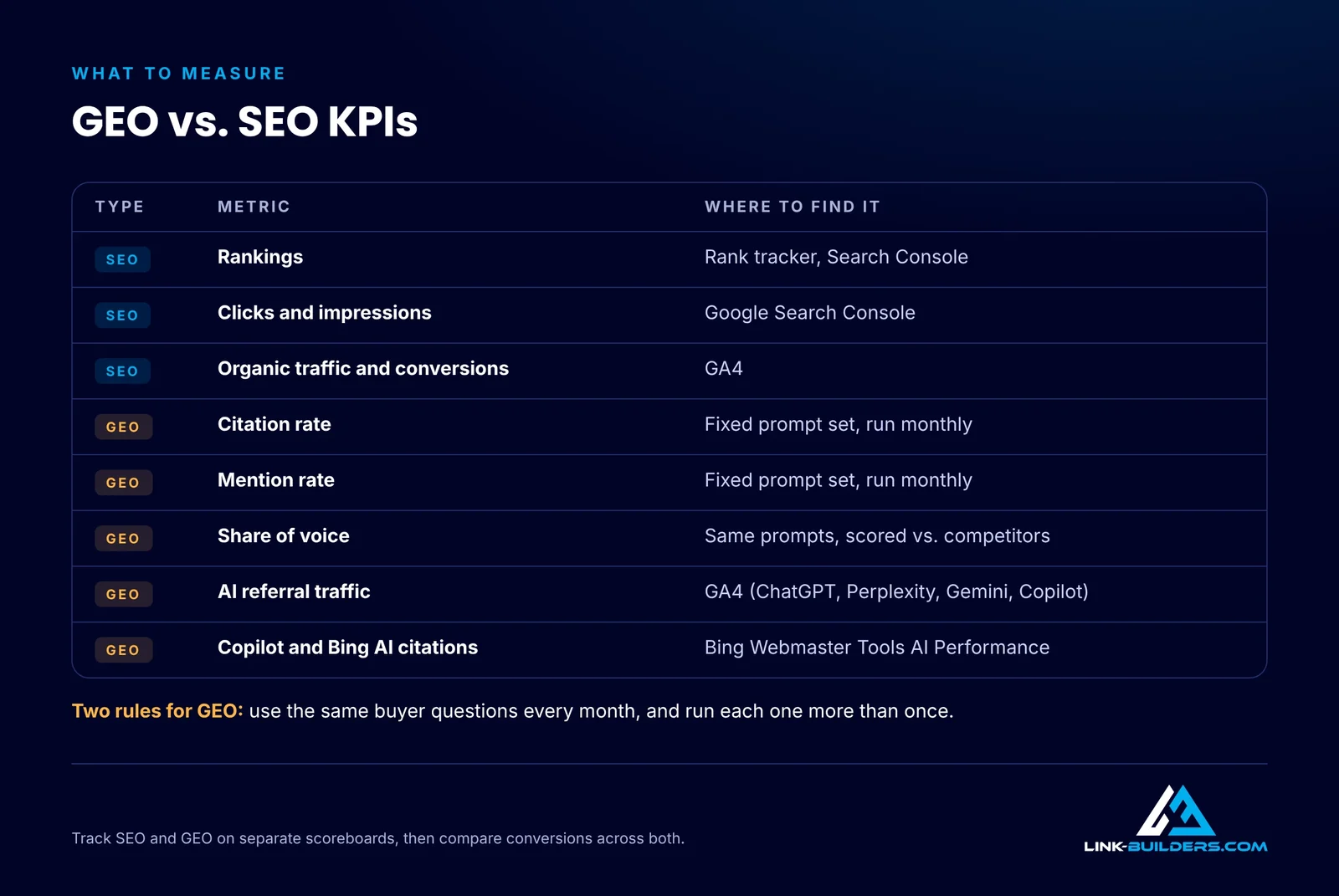
Track SEO and GEO on separate scoreboards, then look at conversions across both.
| Metric | SEO or GEO | Where to find it |
|---|---|---|
| Rankings for target keywords | SEO | Rank tracker, Google Search Console |
| Clicks and impressions | SEO | Google Search Console |
| Organic traffic and conversions | SEO | GA4 |
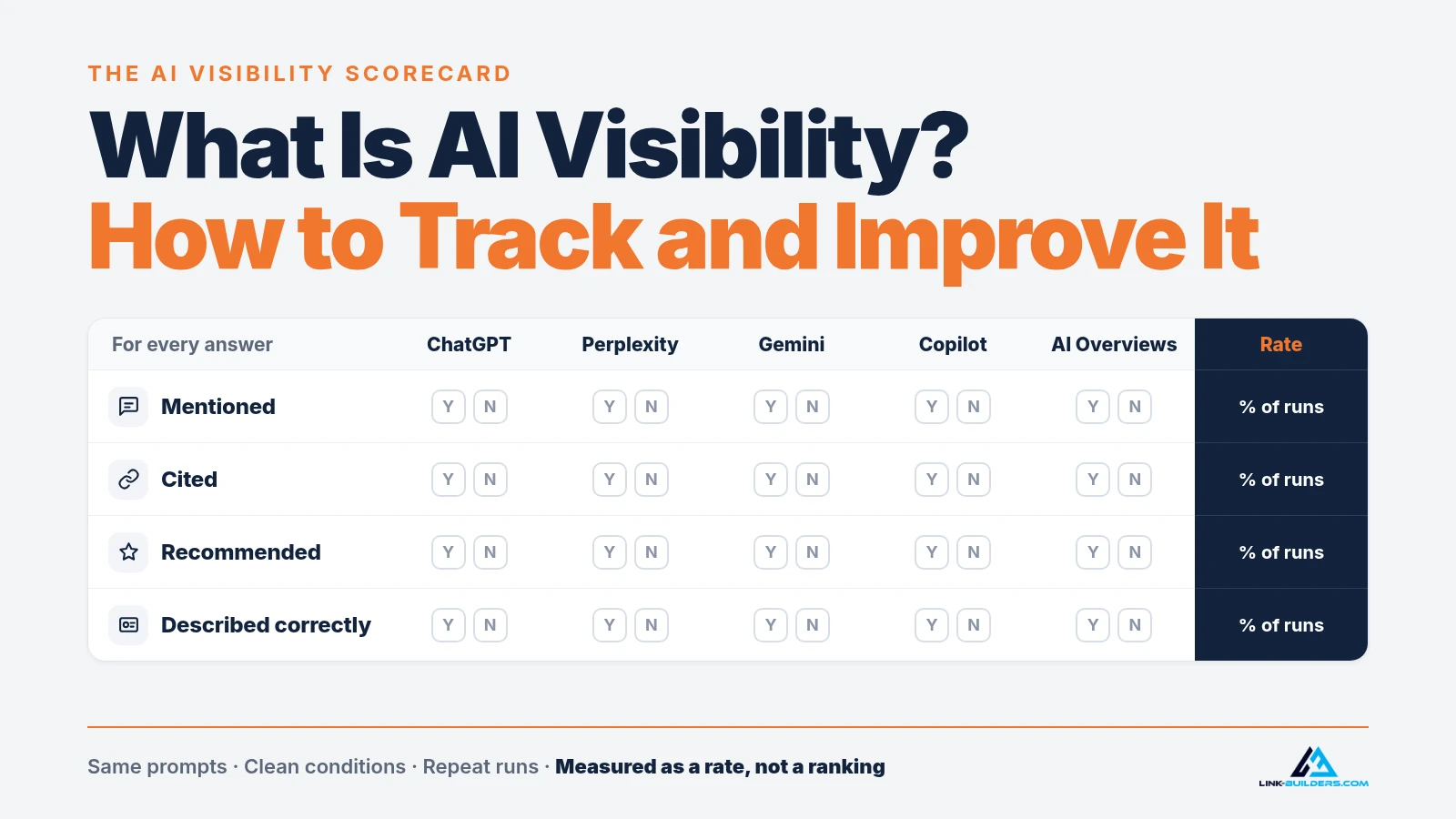
| Citation rate (how often your pages are cited for a fixed set of buyer questions) | GEO | Manual prompt tracking or an AI visibility tool |
| Mention rate (how often your brand is named) | GEO | Manual prompt tracking or an AI visibility tool |
| Share of voice against competitors | GEO | Same prompt set, scored against named competitors |
| AI referral traffic | GEO | GA4, with ChatGPT, Perplexity, Gemini and Copilot referrals grouped |
| Copilot and Bing AI citations | GEO | Bing Webmaster Tools AI Performance report |
Two rules make the GEO side reliable. Use the same set of buyer questions every month, and run each question more than once, because answers vary. I walk through a free monthly routine in what is AI visibility and how to track it, and the Search Console and GA4 side in how to read Search Console and GA4 data for SEO.
GEO vs. SEO vs. AEO
You’ll also see AEO, answer engine optimization. It started with featured snippets and voice answers and now gets used for AI answers too. In practice, AEO and GEO describe nearly the same work, and many people use them interchangeably. SEO is the broader discipline both sit on top of. I compare all the labels, including AI search optimization and LLMO, in my guide to GEO.
Is GEO Replacing SEO?
No. GEO depends on SEO. AI answers are assembled from pages that search systems already found and trust, and in my data the pages that rank and earn links are the ones most likely to be cited. What’s changing is how the results show up and how you measure them. A site that drops SEO to chase AI visibility removes the very thing AI tools pull from.
What is fading is SEO that only works on rankings: thin pages built around one keyword, links bought for their metrics, and reporting that ends at position numbers. That kind of work does little for AI answers, and it’s the same work Google has been discounting for years.
Where to Spend: How to Split the Work
There’s no fixed percentage that fits every business. The better approach is to find where you’re losing and put the next dollar there.
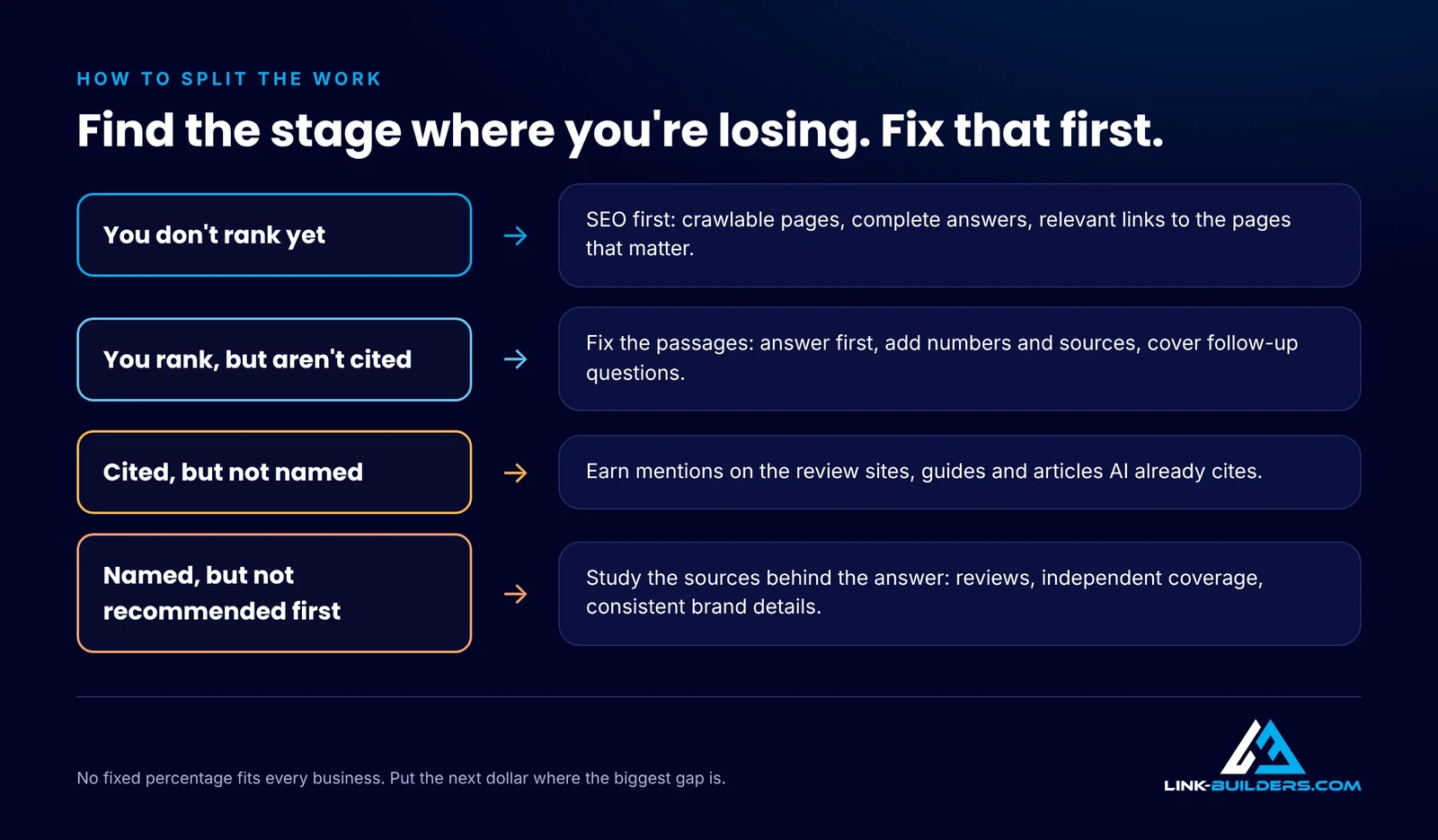
Find the stage where you're losing, then fix that stage first.
You don’t rank for your core topics yet. Put most of your effort into SEO: crawlable pages, content that answers the question fully, and relevant links to the pages that matter. Without this, AI tools have little to pull from.
You rank, but AI answers don’t cite you. Work on the passages. Put the answer at the top of each section, add specific numbers and sources, and cover the follow-up questions buyers ask. Check that AI search bots can reach your pages.
AI cites your pages, but doesn’t name your brand. Work on mentions. Earn coverage on the review sites, guides, comparison pages and industry articles that AI tools already cite for your topic, with your brand named in the sentence.
AI names you, but recommends competitors first. Look at the sources behind those answers. The competitors that win usually have more reviews, more independent coverage and more consistent brand details across the web. That’s off-site work, and it’s the same work that builds links.
Work That Serves Both
If you only have time for a short list, these tasks help in search results and in AI answers at the same time:
- Make sure your important pages are crawlable, indexed and allowed to show snippets.
- Allow the AI search bots you want citing you.
- Answer the main question in the first lines of each page and each section.
- Add original data, clear definitions and named sources.
- Cover the follow-up questions your buyers ask, not just the head keyword.
- Keep your brand name, description and contact details consistent everywhere.
- Earn links to the specific pages you want cited, not just your homepage.
- Get your brand named on independent pages that AI tools already cite for your topic.
- Track citations and mentions monthly, alongside rankings and traffic.
GEO vs. SEO FAQ
Is GEO replacing SEO?
No. AI answers are built from pages that search systems already found and ranked, so GEO depends on SEO. In my study of 1,329 Google AI Overview citations, the first organic result was cited 46% of the time and pages with more referring domains were cited far more often.
Is AI SEO the same as GEO?
Mostly, yes. “AI SEO,” “AI search optimization,” “AEO” and “GEO” are used for overlapping work: getting cited and mentioned in AI answers. The labels matter less than the work. Judge any provider or advice by what it actually changes on your site and across the web.
Is SEO dead now with AI?
No, but its scoreboard is changing. AI summaries reduce clicks on some searches, so rankings alone tell you less than they used to. Search still feeds the AI answers, and a 2026 study of 53 brands found that brands cited in AI Overviews get 120% more organic clicks per impression than brands that aren’t cited.
Do backlinks still matter for GEO?
Yes, especially links to the specific page you want cited. In my AI Overview study, the median cited page-one result had 123 referring domains, compared with 28 for page-one results that weren’t cited. Brand mentions on trusted sites matter too, because they help AI tools name your brand.
What are the main KPIs for GEO vs. SEO?
SEO is measured with rankings, clicks, organic traffic and conversions. GEO is measured with citation rate, mention rate, share of voice against competitors and AI referral traffic, using the same set of buyer questions every month.
Do I need a separate GEO agency?
Not necessarily. A good SEO program already covers much of GEO. What it may lack is prompt tracking and off-site work aimed at the pages AI tools cite. My guide to what GEO services include and cost breaks down what to ask any provider.
Key Takeaways
- SEO earns a place in the list of results. GEO earns a place inside the AI answer. GEO is built on top of SEO, not instead of it.
- Rankings and links still carry over. In my study, the first organic result was cited 46% of the time, and cited page-one results had a median of 123 referring domains versus 28 for page-one results that weren’t cited.
- GEO changes the unit (passages), the searches (fan-out), the signals (mentions alongside links) and the stability (answers vary).
- AI answers reduce clicks, but cited brands get far more of the clicks that remain.
- Measure SEO and GEO on separate scoreboards, then fix the stage where you’re losing first.
Build the Authority Both Depend On
Whether a buyer finds you in a list of links or inside an AI answer, the deciding factor is often the same: what other trusted websites say about you. Earning those links and mentions on relevant, independent pages is the part of SEO and GEO that can’t be faked, and it’s what I’ve done every day since 2015.
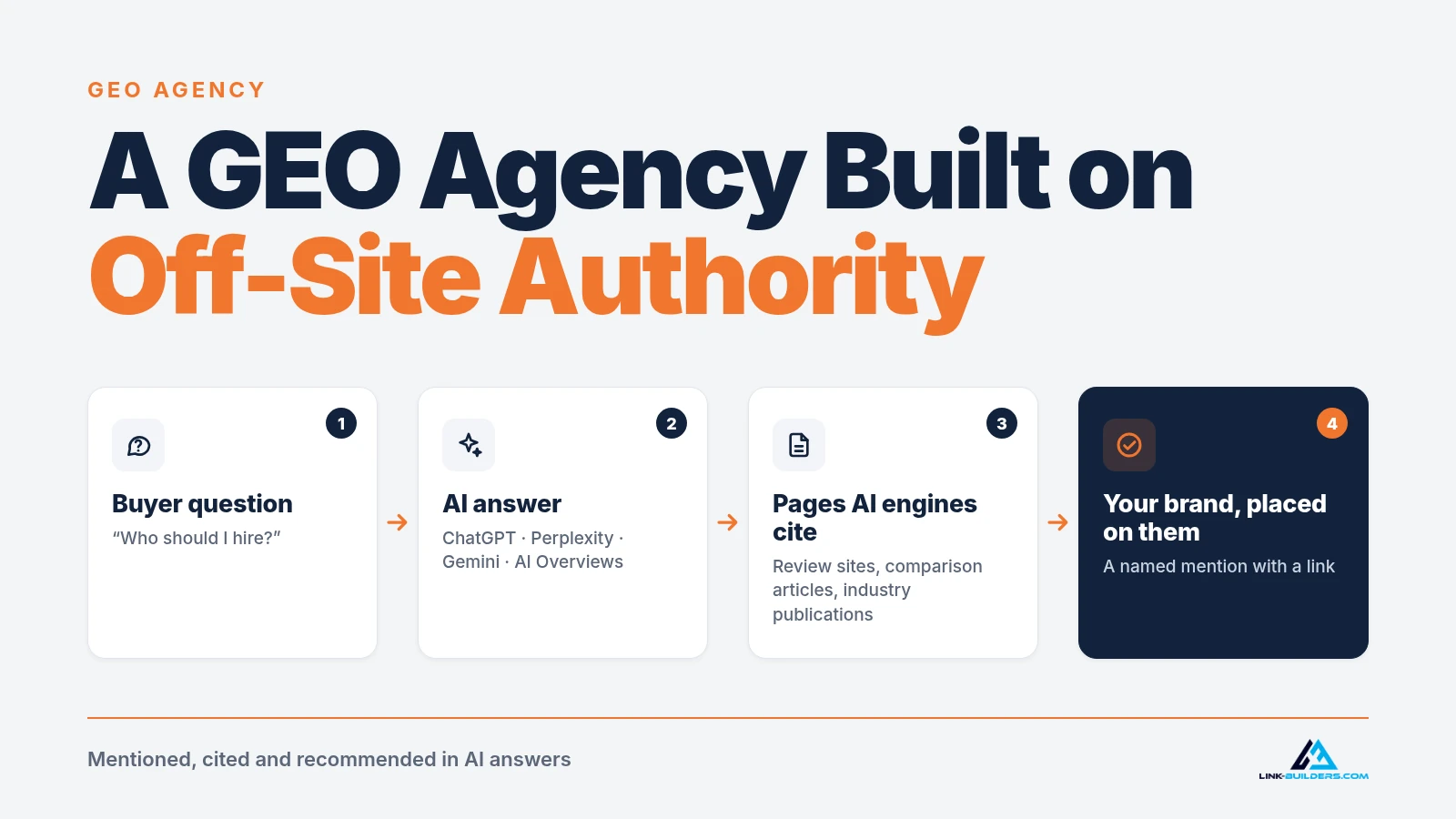
If you want help with it, Link Builders works as a GEO agency built on off-site authority, with full transparency on every opportunity, contact and cost. Request a free sample of 20 vetted link opportunities for your site. If you run an agency, read about my white-label link building service.
About the author

Justin Davis is the founder of Link Builders, a white-label backlink agency, and has been building links since 2015 for more than 150 clients in law, healthcare, real estate, software and other industries. After years of doing prospecting research by hand, he built an AI agent link building system that handles each step, from finding link opportunities and vetting sites to finding contacts and preparing outreach. He now runs that system for agencies and in-house SEO teams, and teaches it on YouTube. Find Justin Davis on YouTube, LinkedIn and X.