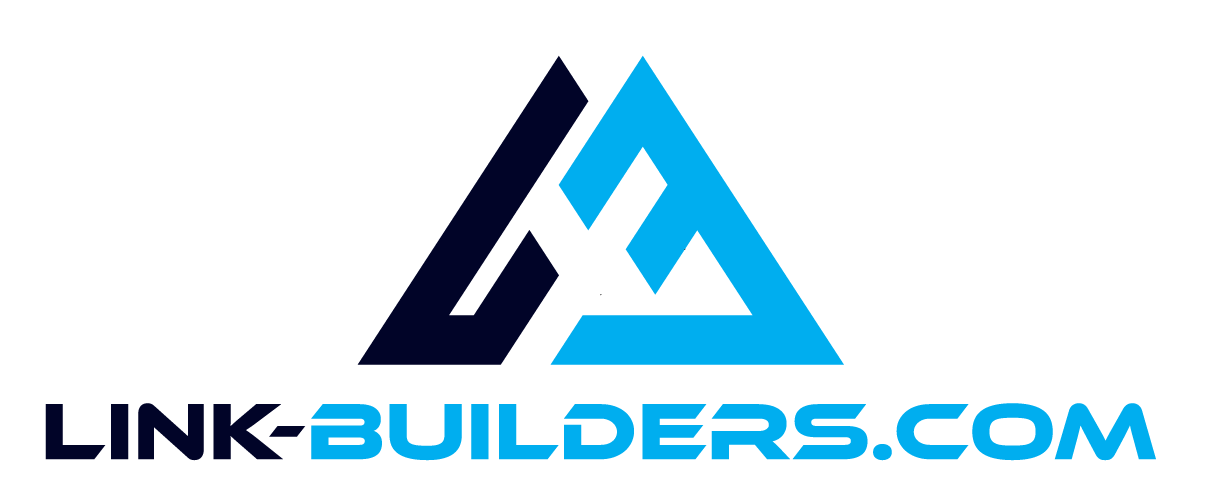
681 Webmasters Said Yes. Here’s What They Actually Asked For
@Justin Davis
A few weeks ago I published the reply rates from six of my cold outreach campaigns. We contacted 6,657 prospects, and the response rate ranged from 5.4% to 27.6%. That article was about getting a webmaster to answer. This one is about what happens next, which turned out to be the more interesting part.
A positive reply feels like the finish line. It isn’t. When I went back through the same six campaigns, about two out of every three positive replies had not turned into a link when I counted. So I read what the webmasters actually wrote back, and the reason jumped out right away. Most of them weren’t saying “sure, we’ll add your link.” They were sending a price.
Everything below comes from my own campaign spreadsheets. It isn’t a survey, and I’m not borrowing someone else’s study. I counted the rows with a script on October 3, 2026, and I’ve kept every client and every industry anonymous. You’ll see what webmasters asked for, what they charged, which kinds of yes actually closed, and what I changed in my process because of it.
How I Counted This
Every client campaign I run lives in a shared master workbook. Each one has the same three tabs: Link Opportunities, Positive Responses, and Gained Links. When a site replies with interest, the row moves to Positive Responses, along with the price they quoted and my notes from the email thread. When a link goes live, it moves to Gained Links with the price we paid, if any.
For this article I pulled the Positive Responses and Gained Links tabs from the same six cold campaigns as part one. I left out the warm campaign I excluded last time, because many of those sites already knew me, and that would skew the results. I’ve labeled the six campaigns Industry 1 through Industry 6.
A script sorted each reply into one of four groups: it came with a price, it was a swap or trade, it was free, or the sheet doesn’t say. Where a webmaster quoted two prices, such as one for a guest post and one for a link insert, I used the first price listed. These spreadsheets were built to run client work, not to be studied, so treat the numbers as close counts rather than lab results.
A “Yes” Usually Comes With a Rate Card
Across all six campaigns there were 681 positive replies. Of those, 86% included a price.
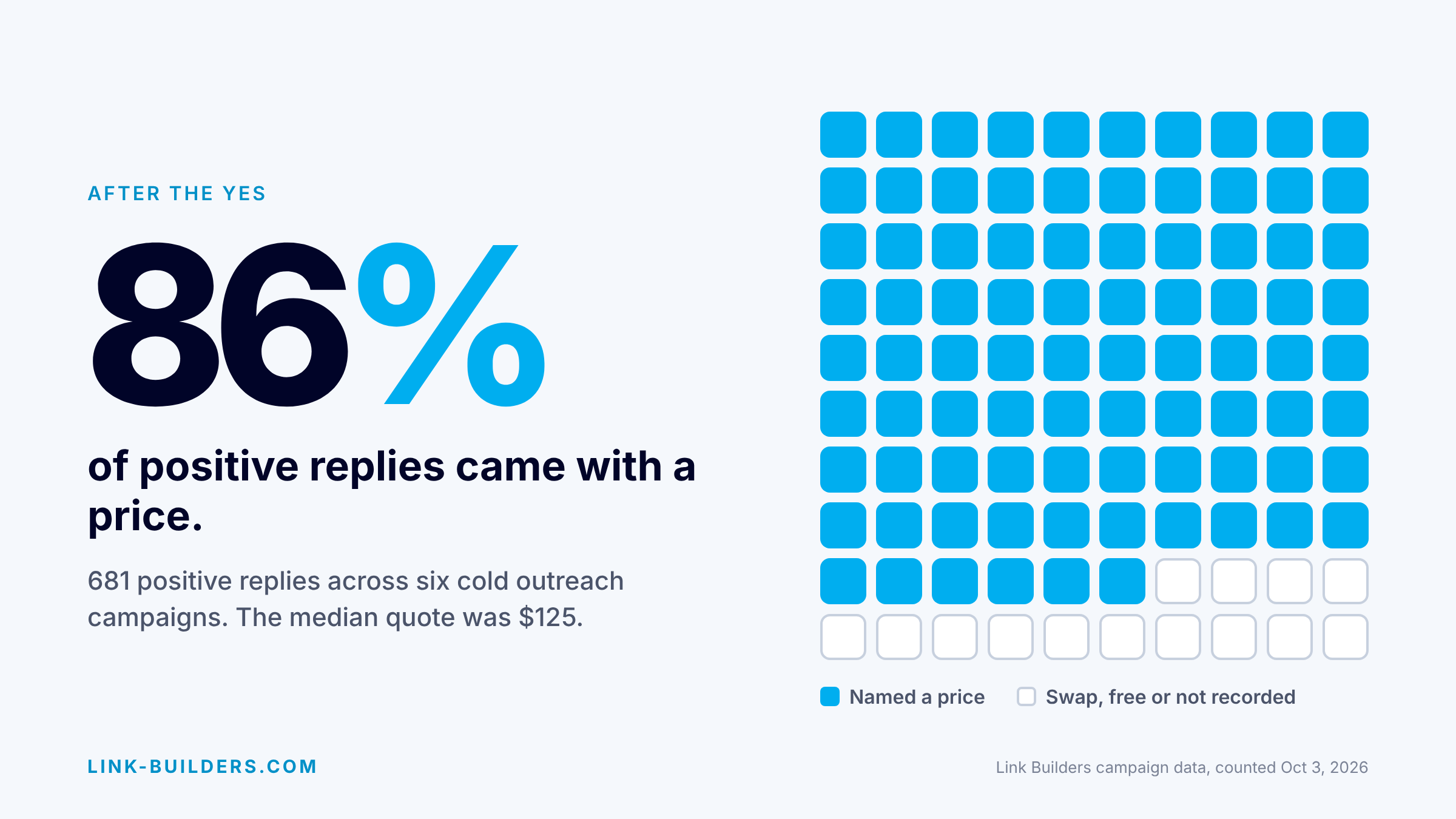
86 of every 100 positive replies came with a price.
That one number changes how you should think about outreach. When people talk about reply rates, they picture a webmaster who reads your pitch, likes it, and agrees to link. That happens, but it’s the exception. Far more often, the reply is something like “Thanks for reaching out, here are our rates.” In my sheets, that counts as a positive response because the door is open. It just isn’t a link yet.
Here’s how the six campaigns break down.
| Campaign | Positive replies | Came with a price | Median quoted price | Quotes over $250 | Tracked placements | Replies that became placements |
|---|---|---|---|---|---|---|
| Industry 1 | 75 | 56% | $195 | 35% | 48 | 64% |
| Industry 2 | 121 | 93% | $126 | 26% | 67 | 55% |
| Industry 3 | 204 | 88% | $100 | 25% | 87 | 43% |
| Industry 4 | 49 | 88% | $695 | 68% | 7 | 14% |
| Industry 5 | 144 | 92% | $100 | 10% | 12 | 8% |
| Industry 6 | 88 | 89% | $130 | 20% | 5 | 6% |
| All six | 681 | 86% | $125 | 25% | 226 | 33% |
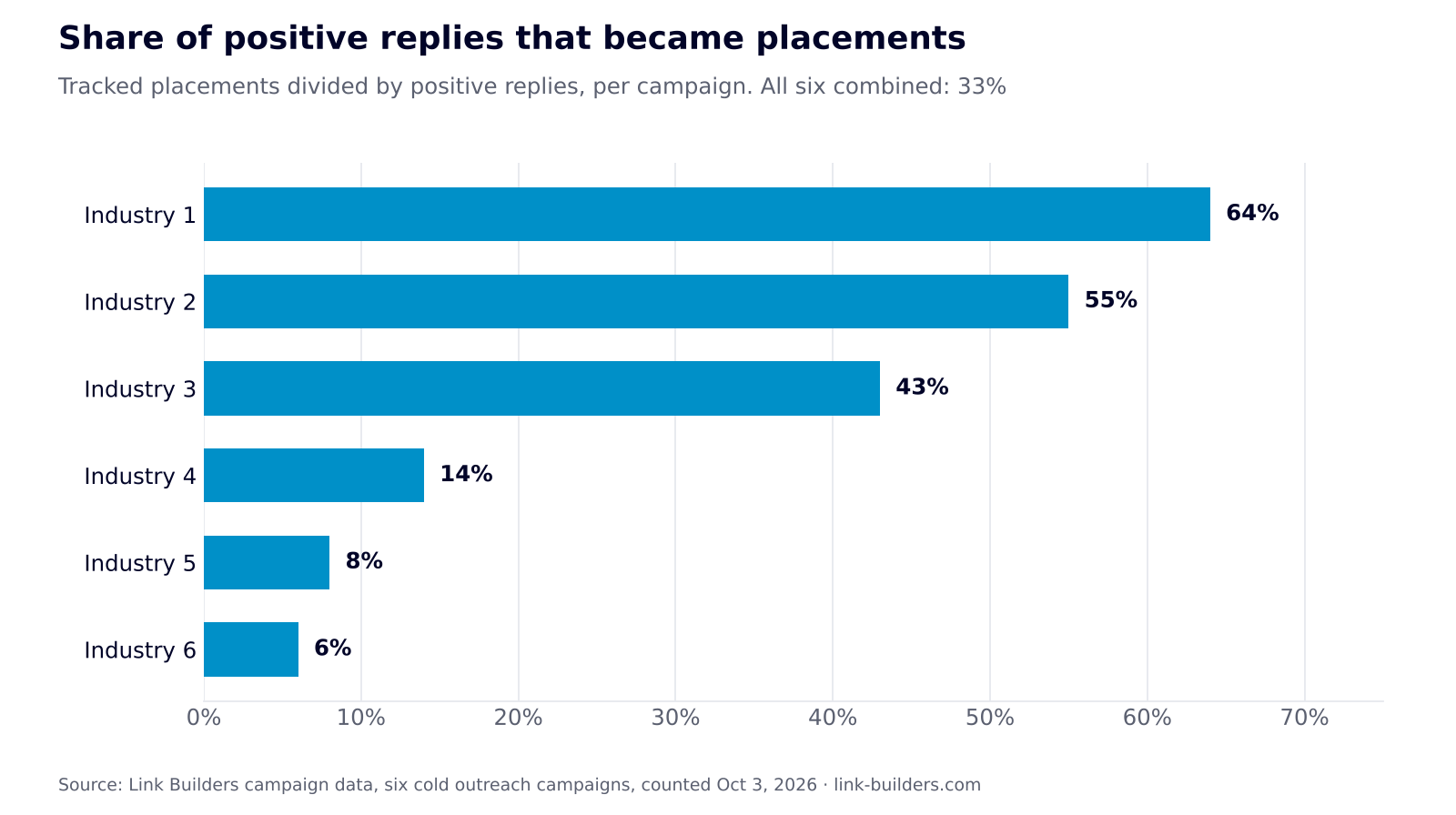
Share of positive replies that became tracked placements, by campaign.
What the Quotes Look Like
There were 576 replies with a clear dollar figure. The median was $125. A quarter of the quotes came in under about $67, and a quarter came in above $250. Past that, prices kept climbing. 81 quotes, about one in seven, were $500 or more, and 41 were $1,000 or more. Industry 4 alone accounted for 16 of those.
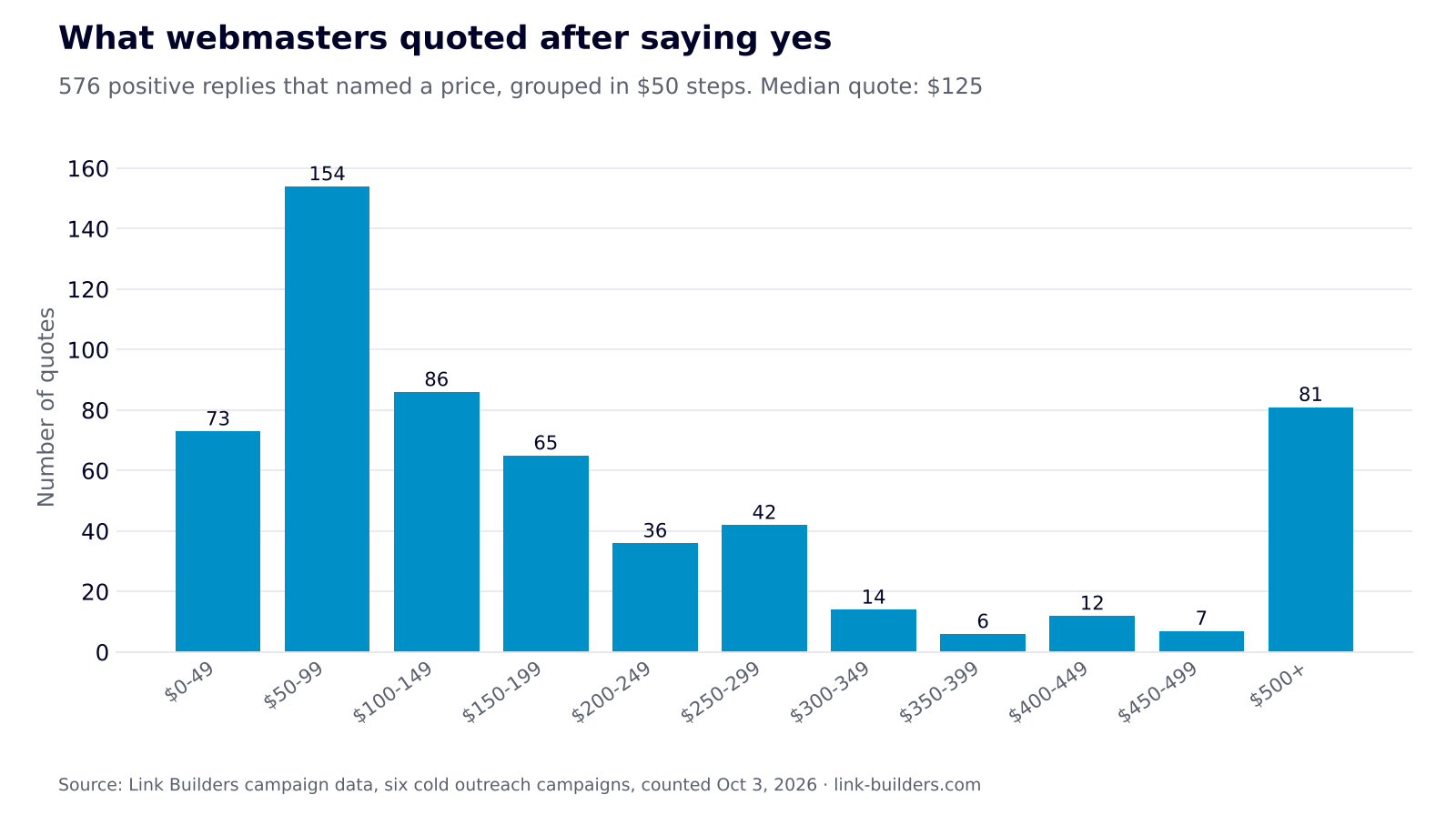
Prices webmasters quoted after saying yes. Median: $125.
That’s one reason I always check traffic and topic before paying any attention to the price tag. A quote tells you what the owner thinks the link is worth. It doesn’t tell you what it’s worth to your client.
Why So Many Replies Include a Price
Sites with real traffic get pitched all the time. Many owners have stopped treating these emails as favors and started treating them as ad sales. They have a rate for a guest post, a rate for adding a link to an existing article, and sometimes a rate for a mention in their newsletter. If you reach them, you get the rate card.
My own outreach adds to this, and I’m fine with that. My first email usually asks the site owner directly whether they offer this kind of opportunity, including through advertising packages. I’d rather learn the price in the first reply than three emails later, after everyone’s time has been spent.
For a sense of how rare this kind of data is, the best-known public benchmark is the Backlinko and Pitchbox study of 12 million outreach emails. It found that only 8.5% of outreach emails got a response. That’s a useful number, but the study measured replies, not what the replies said, and it’s from 2019. Reply rates alone miss the step where most campaigns lose their links.
Price Is the Biggest Leak Between Reply and Link
If most yeses come with a price, then the price itself becomes the main filter. The campaigns in my data back that up.
Industry 4: The Expensive Yes
Industry 4 had the highest quotes by far. Its median reply asked for $695, and more than two-thirds of its quotes were over $250. Only 14% of its positive replies became placements.
The links that did close tell the rest of the story. The median fee paid on Industry 4’s placements was around $150. In other words, the yeses that turned into links were mostly the cheap ones. The expensive ones stayed in the spreadsheet. That’s not because the client was being stingy. A $700 placement on a site that’s only somewhat on topic is hard to justify when a $150 one on a closer match is available.
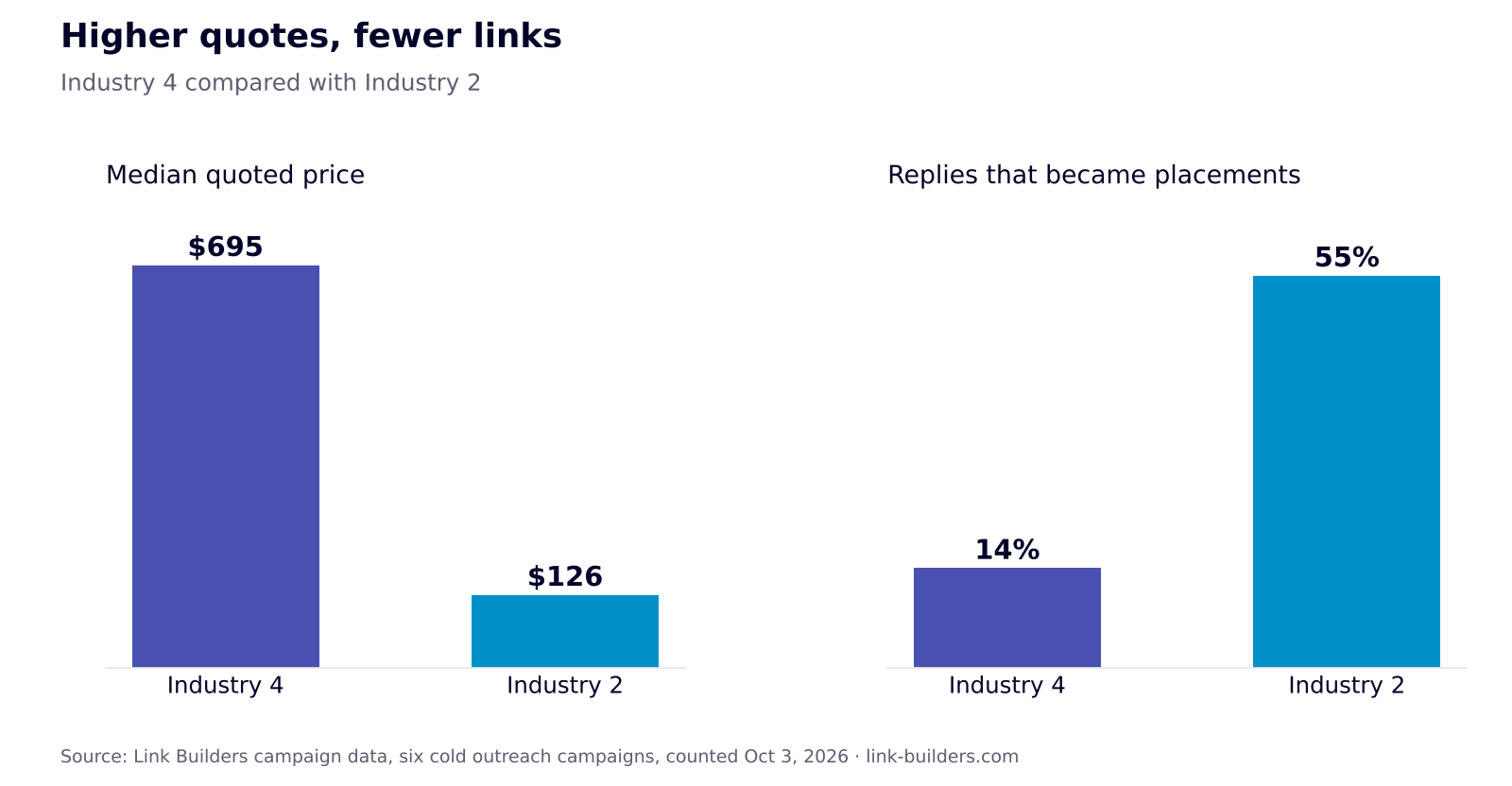
Industry 4 had the highest quotes and one of the lowest conversion rates.
Industries 2 and 3: The Affordable Yes
Compare that with Industries 2 and 3. Their median quotes were $126 and $100. Industry 2 turned 55% of its positive replies into placements, and Industry 3 turned 43%. Industry 3 also produced the most placements of any campaign, at 87.
Both of these campaigns had lower reply rates than some of the others in part one. Industry 3’s was the lowest in the whole set. But once a site said yes, the price was usually one the client could approve, so the yes became a link.
What Buyers Should Take From This
If you hire someone to build links, a report that says “we got 200 positive replies” doesn’t tell you much. Ask what those replies asked for. Ask what share were free, what share wanted money, and how many actually turned into live links. A campaign with fewer replies and reasonable prices can easily beat one with a big reply count full of $700 quotes.
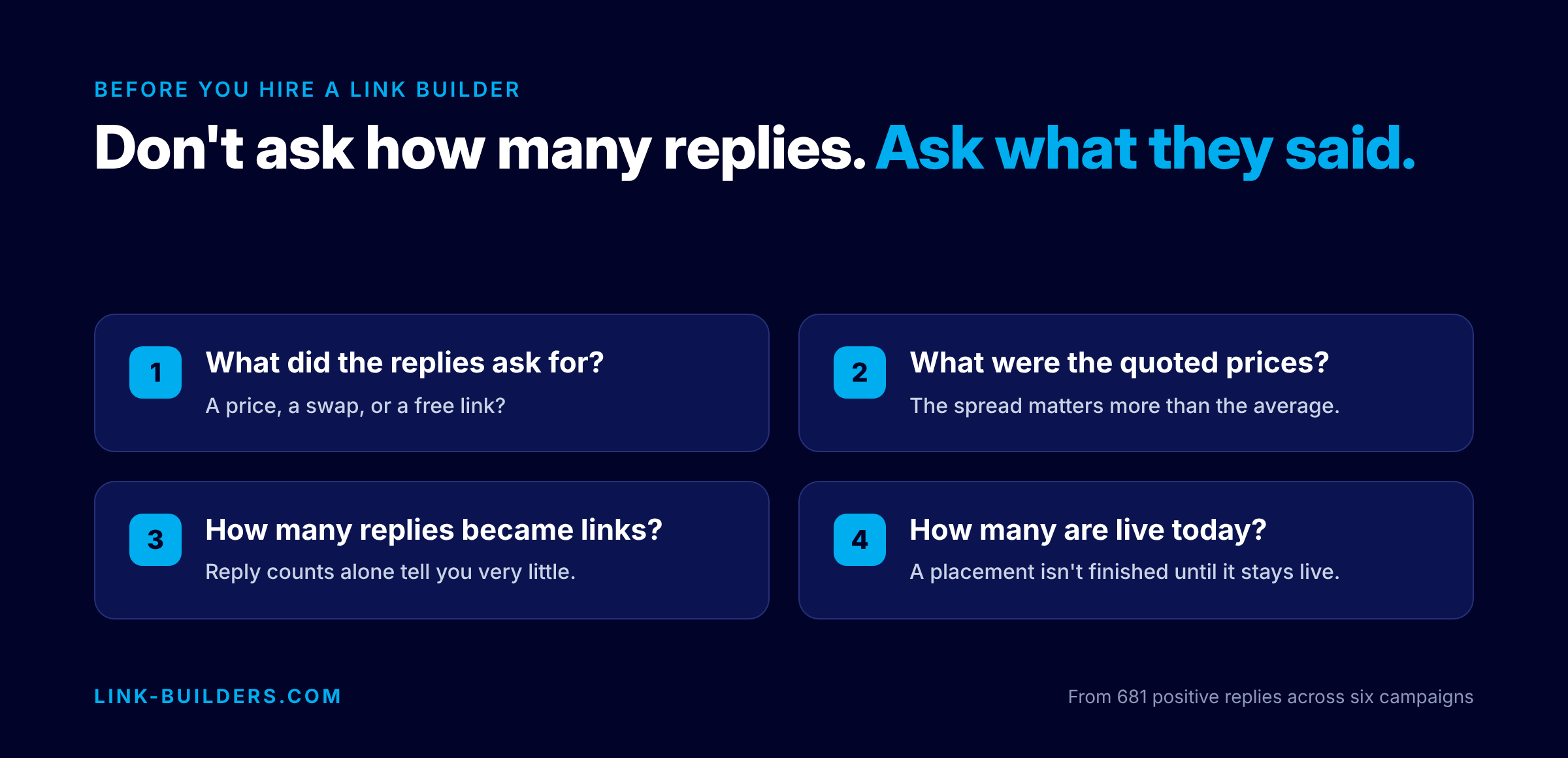
Four questions to ask before you hire a link builder.
One caution. These are six campaigns, and the pattern is a correlation, not a law. Price isn’t the only thing that decides whether a link closes, as you’ll see below. But it was the most visible gap between reply and link in my data.
The Yeses That Weren’t About Money
The best campaign in the set was the one where fewer replies mentioned money.
Industry 1: Something to Offer Besides Cash
Only 56% of Industry 1’s positive replies came with a price, the lowest share of any campaign. The rest were swaps, trades, and free adds. It also converted 64% of its replies into placements, which was the best rate in the set.
Industry 1’s client sells physical products. That gave us something to trade that most service businesses don’t have. Some site owners were happy to link in exchange for store credit or a gift card they could actually use. Others had several sites of their own and wanted to set up link exchanges with the client. Of the 48 placements Industry 1 tracked, 15 were swaps or trades and 5 were free.
When a site owner gets something they value from the deal, the conversation is short. There’s no back and forth over price and no waiting on a budget decision. That’s a big part of why this campaign closed so well.
The ABC Swap
One trade I use often is what I call an ABC swap. Some site owners won’t take money for a link, or they want a link back instead. A direct swap between the two sites is a pattern search engines can spot easily, so I set it up differently. I find a third site in the same industry where I can secure a link, usually for around $100 or less. That link points to the site owner’s site, and in return they link to my client. Site A links to my client, site C links to site A, and nothing points straight back and forth.
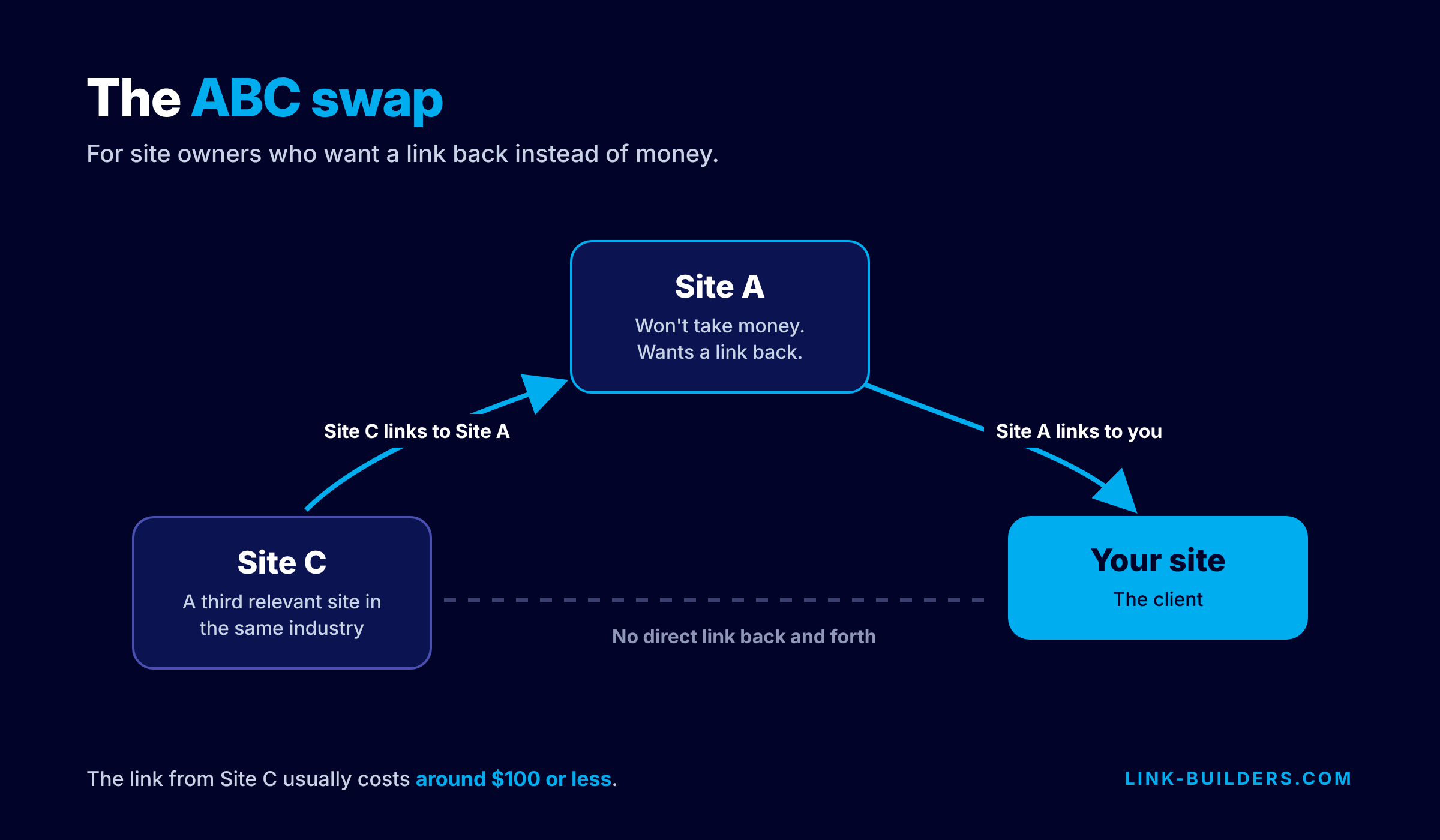
How an ABC swap is set up.
It takes more coordination, but it opens doors that money alone doesn’t. In my campaigns it lands links every week with site owners who would never answer a rate-card email.
Free Links Still Happen
About 7% of tracked placements in my data were free. That’s a small share, but they’re worth noticing. They tend to come from resource pages, from broken links we pointed out, and from owners who added a link on their own after reading our email. In one campaign the only free placement came from telling a site about a dead link they had to a page that no longer existed.
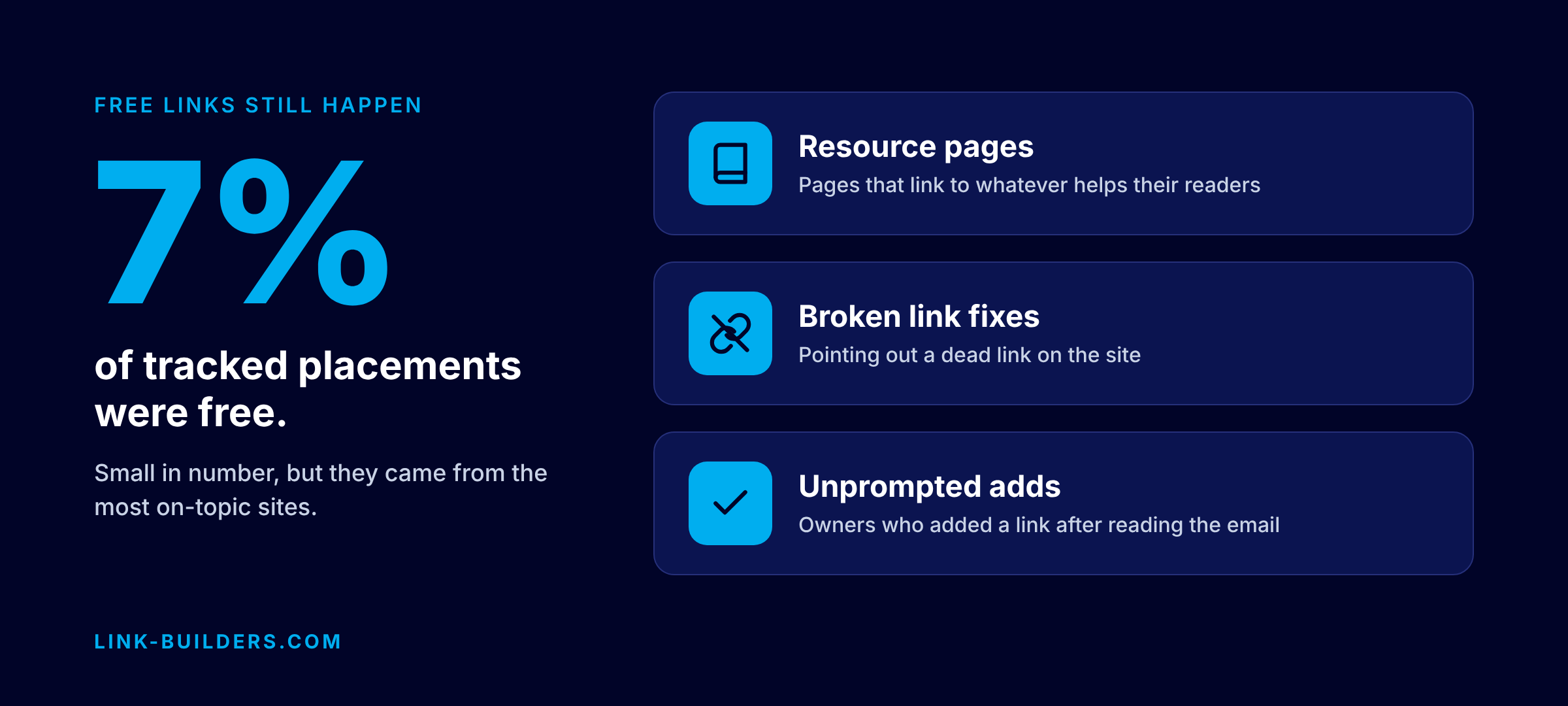
Where the free links came from.
These free links come from the most topical targets almost every time. A resource page about a subject links to whatever genuinely helps its readers, and a good page on the same subject qualifies. That’s the same point I made in part one about relevance. The closer the match, the less you have to pay for the yes.
When the Price Isn’t the Problem
Some campaigns had reasonable quotes and still converted poorly. That’s how I know price isn’t the whole story.
Industry 5
Industry 5 had the second-most positive replies, at 144. Its median quote was $100, and only 10% of its quotes were over $250. Those are some of the friendliest prices in the data. Yet just 8% of its replies became placements.
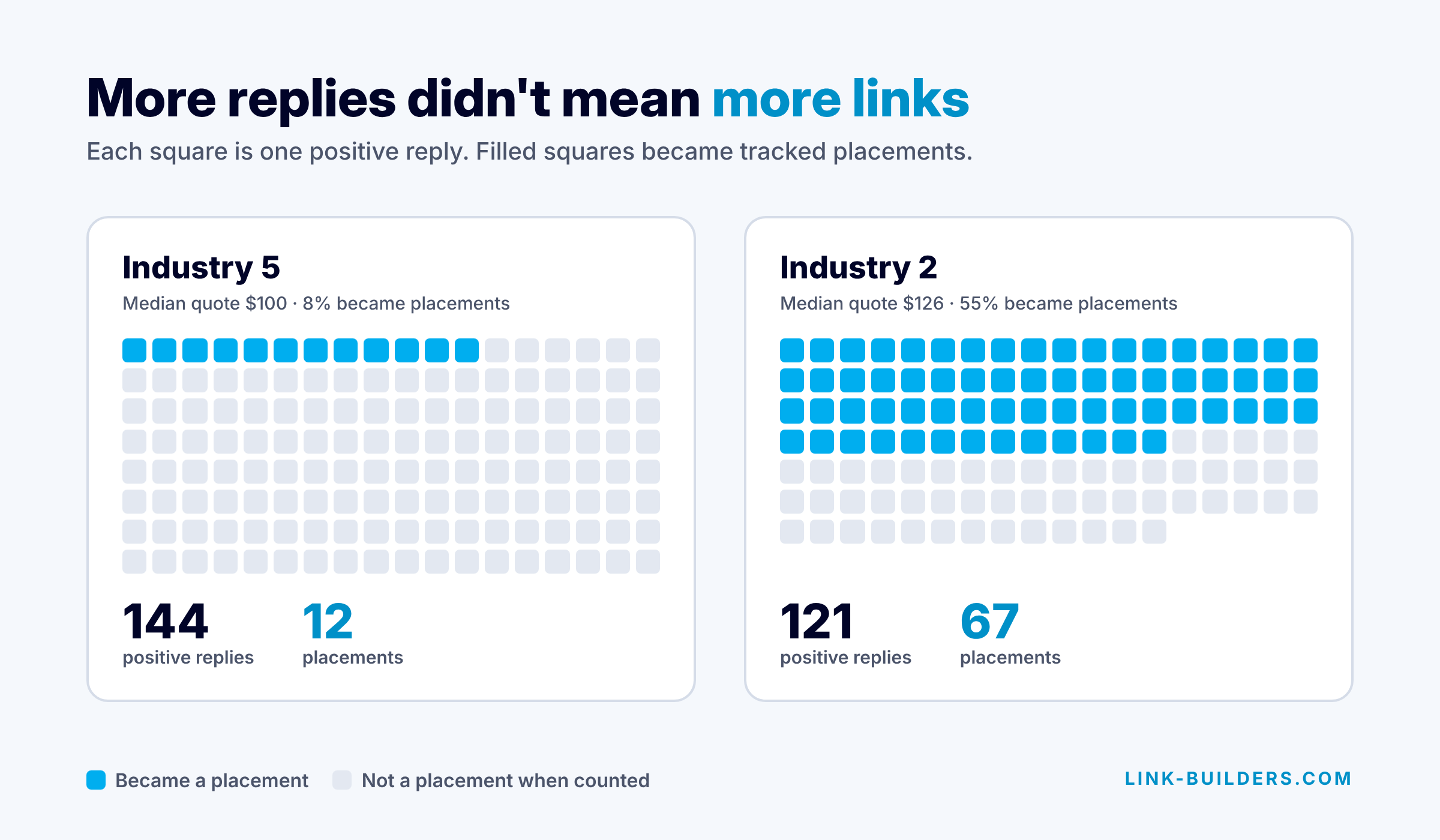
More replies did not mean more links.
The notes don’t point to one cause. What they do show is how many steps sit between a yes and a live link. The client picks which placements to fund. Content gets written, sent for approval, and sometimes revised more than once at the webmaster’s request. Invoices go back and forth. Some publishers change their price partway through. Each step is small, but every one is a place where a link can stall.
Industry 6
Industry 6 showed a similar pattern. Its median quote was $130, but only 6% of its 88 positive replies became placements. Here too, the notes show several replies waiting on approvals and budget decisions on the client’s side.
That isn’t a criticism of either client. Every business has its own budget and its own pace. The lesson is for anyone planning a campaign. A strong reply rate means very little if the steps after the reply can’t keep up with it.
Where the Open Replies Sit
In part one I mentioned 458 positive replies that were still open. This is where they live. They aren’t failures. Most are sites that said yes and are waiting on a decision, a piece of content, or a payment. Clearing that backlog is often the cheapest way for a campaign to gain links, because the hard part, getting a stranger to say yes, is already done.
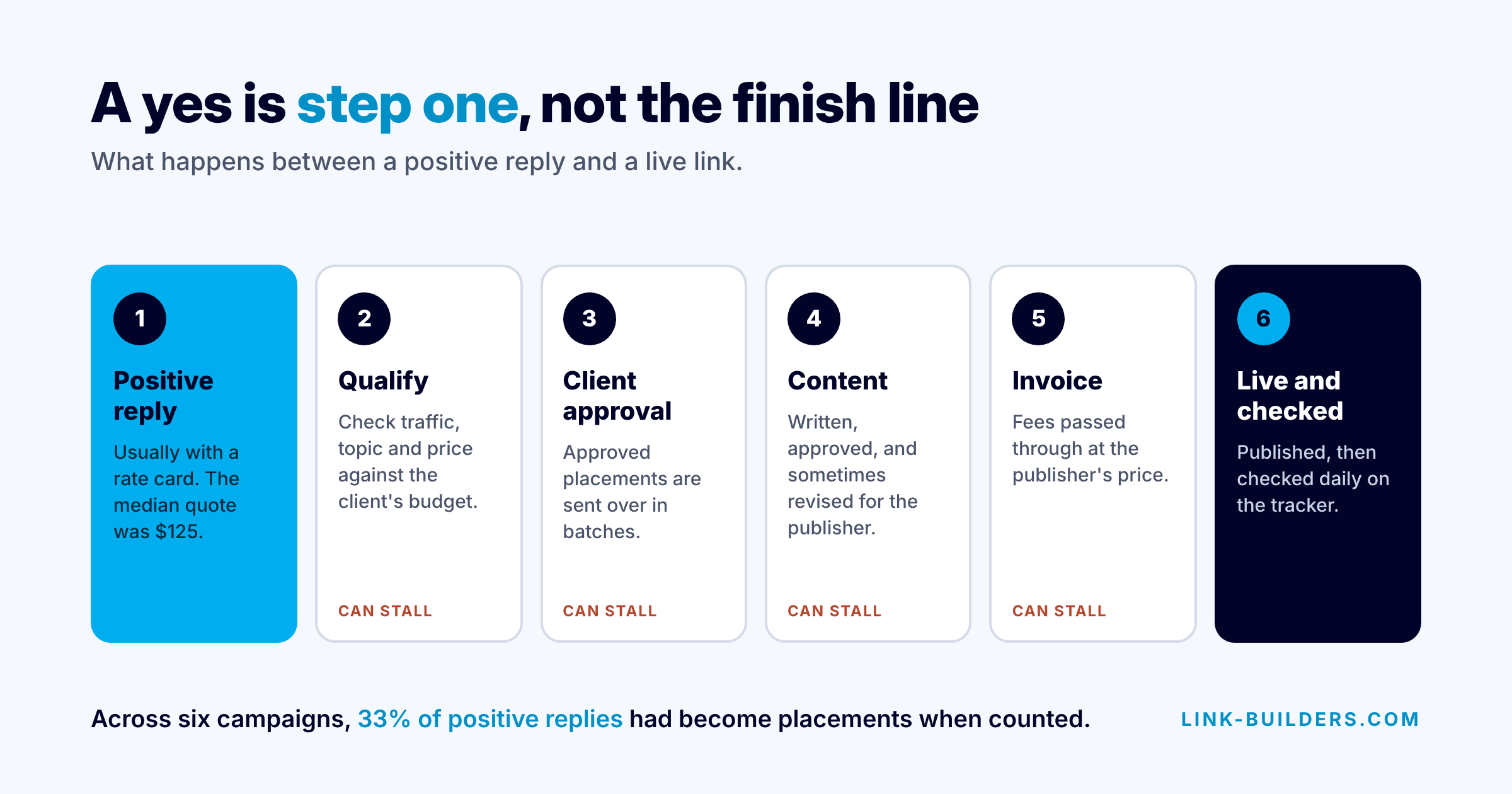
The steps between a positive reply and a live link.
A Note on Paid Placements and Google
Since most of the placements here involved a fee, it’s fair to ask how that fits with Google’s rules.
Most of the paid placements in my data are sponsored posts and paid link inserts on real sites in the client’s field. Google’s spam policies cover links that are bought to manipulate rankings. Google also explains how sites should qualify outbound links, asking publishers to mark paid links with rel=”sponsored” or rel=”nofollow.”
The publisher controls how its own links are marked. I accept nofollow and sponsored links as part of a natural mix, and I don’t treat a link as worthless because it carries one of those labels. I also think the safest placements are the ones a site would be comfortable explaining to its own readers. That means relevant sites with real traffic and content that helps the people who read it. If a placement only makes sense because of the link, I skip it. I covered how Google looks at link patterns in more detail in my article on the link spam detection patent, and in my breakdown of the September 2026 spam update.
How Placements Actually Closed
Here’s the full picture for all 226 tracked placements across the six campaigns:
- About 77% involved a fee, mostly sponsored posts and paid link inserts
- About 7% were swaps or trades
- About 7% were free
- About 9% don’t record how they closed
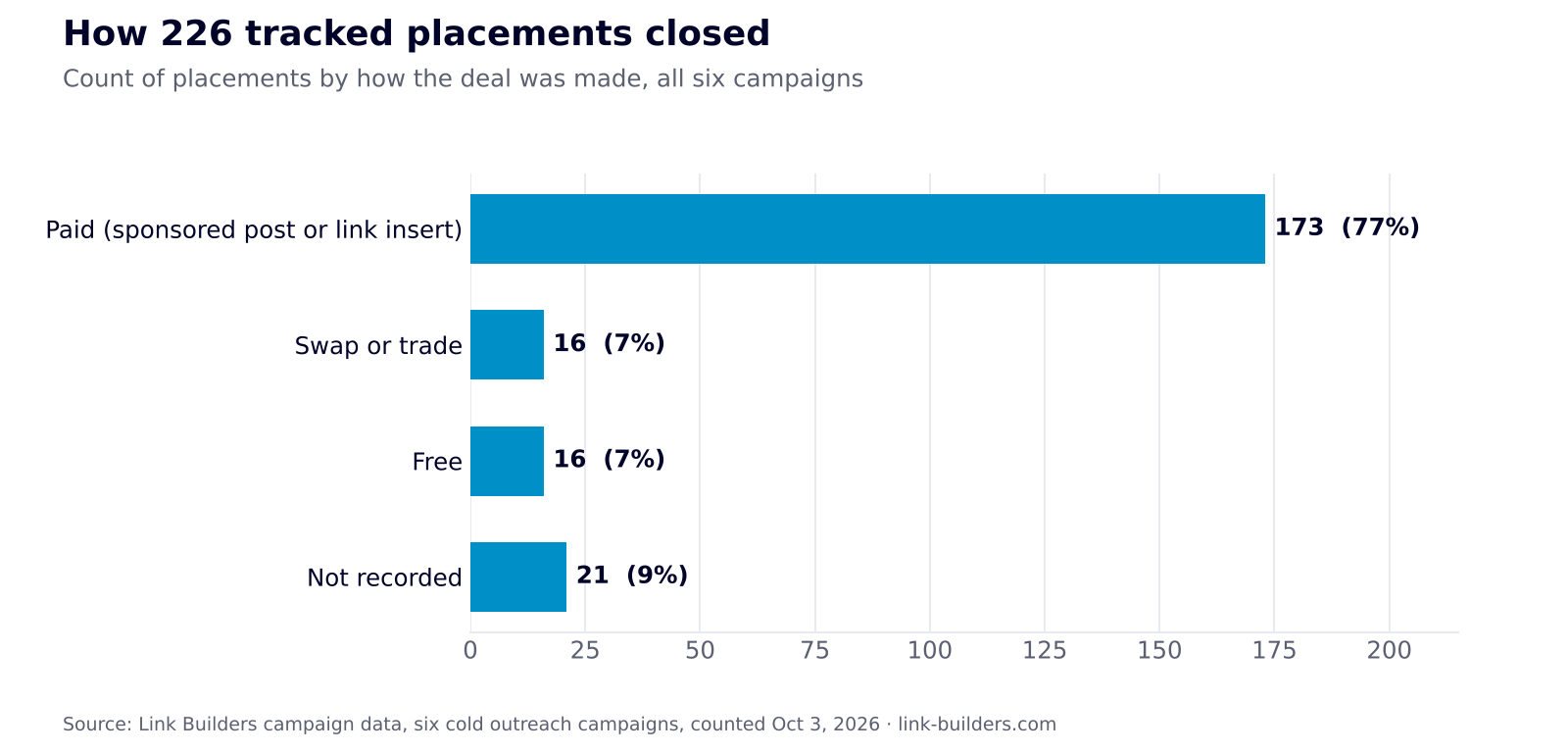
How 226 tracked placements closed.
The median fee paid was $115, and the middle half of fees fell between $75 and $156. That’s a good deal lower than the $125 median quote. Part of the gap is the pattern from earlier: cheaper yeses close more often, so the links that get built skew cheaper than the quotes that come in. Part of it is negotiation. When a quote is higher than the link is worth, I ask whether there’s room on the price, and sometimes there is.
What I Changed Because of This Data
Looking at the yes side of the funnel changed several things about how I run campaigns.
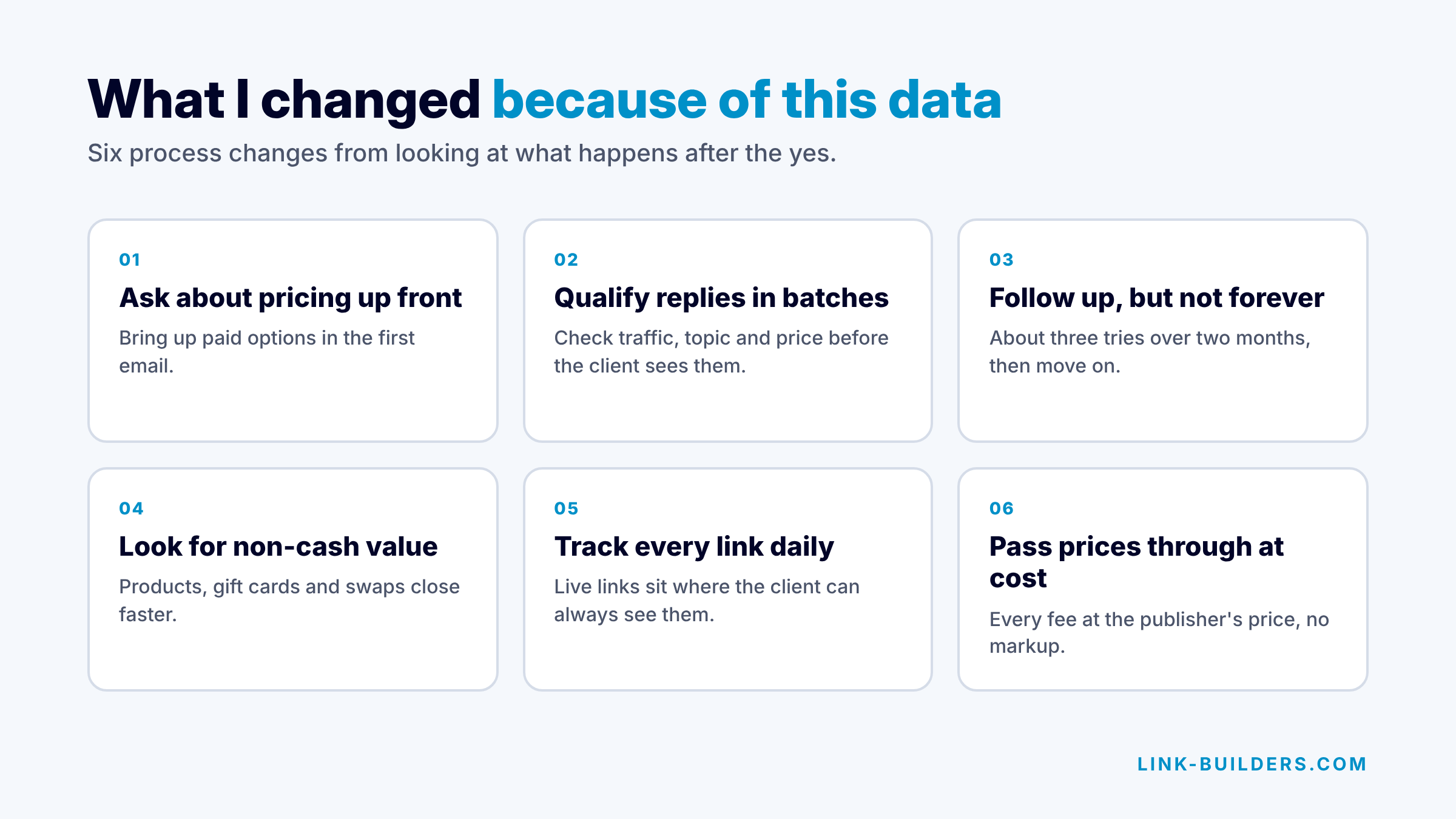
Six changes to how I run campaigns.
I Ask About Pricing Up Front
I bring up advertising and paid options in the first email. It saves weeks. A webmaster who wants $2,000 can tell me now, and a webmaster who’s happy to add a link for free can say so too. Nobody feels misled later in the thread.
I Qualify Replies in Batches
I don’t forward each yes to the client the moment it arrives. I let the replies build up, check each site’s traffic, topic, and price against the client’s budget, and then send over a batch of placements I’d actually recommend. Clients make faster decisions when they can compare options side by side.
I Follow Up, but Not Forever
When a site says yes and then goes quiet, I follow up. I stop after about three tries over two months. Past that point the odds drop off, and the time is better spent on the next reply in line.
I Look for Non-Cash Value
If the client has products, a store, gift cards, or relationships with other relevant sites, I put those on the table. Industry 1 showed how much faster a deal closes when the site owner gets something they actually want.
I Track Every Link Daily
A placement isn’t finished just because it went live once. I check every client link daily on my own tracker, and live links sit on a Gained Links tab the client can open anytime. If a link disappears, I email the site owner to ask why.
I Pass Prices Through at Cost
Every placement fee goes to the client at the price the publisher charged, with no markup added. The client sees every quote in the shared spreadsheet and decides what to buy. That transparency is also what made this article possible. I could only publish these numbers because they were already sitting in a spreadsheet my clients can see.
A lot of the tracking and qualifying above now runs through my AI backlink building agent, which handles the research and data work while I handle the judgment calls. If you’re curious how that works, I walked through it in I rebuilt my prospecting process as an AI agent. I’ve also written about how AI personalization layers improve link building outreach and how AI outreach QA gates protect link building quality.
What These Numbers Don’t Say
A few honest limits before you quote any of this:
These are past results from six specific campaigns. They are not a forecast for any other campaign, and they don’t promise anything about rankings or traffic.
The price groups were sorted by a script that read prices and notes from spreadsheets built for client work. It’s a close count, not a perfect one.
The totals cover the full life of each campaign, and the campaigns ran over different stretches of time. Nothing here says how many links a campaign builds per month.
Not every tracked placement has been confirmed live. Some are recorded as submitted or pending.
Finally, many of the replies counted as “not yet a placement” are still open. The 33% figure will move as those conversations close.
Key Takeaways
- Most yeses are a price. 86% of 681 positive replies came with a quote, and the median was $125.
- High quotes go with weak conversion. The campaign with a $695 median quote turned only 14% of replies into links, while campaigns with quotes near $100 to $126 turned roughly half into links.
- Non-cash value closes fastest. The campaign that could offer trades and swaps had the fewest price quotes and the best conversion, at 64%.
- Reasonable prices aren’t enough on their own. Approvals, content, and invoicing can stall a campaign even when the quotes are fair.
- Ask your link builder what the replies said. Reply counts mean little without the prices behind them and the share that actually became links.
Want This Kind of Transparency on Your Campaigns?
Every campaign I run comes with the full spreadsheet: every site, every reply, every quoted price, and every placement, with fees passed through at cost. If you run an agency and want to offer white label backlinks to your own clients without hiring a team, that’s what I do. You can find more outreach data and link building research on the backlink blog.