How to Choose a White Label Link Building Service
Author: Justin Davis, Link Builders
The best white label link building service is the one that lets you check its work before you pay. It shows you every site before outreach, works under your brand, itemizes what you pay for, and reports live URLs you can verify yourself. If a vendor can’t do those four things, its price and its pitch deck don’t matter. This guide gives you the questions to ask, the red flags to walk away from, a 6-point scorecard and a way to check every link. It ends with how my own white label link building service stacks up against the same list.
I’ve built backlinks since 2015, for more than 150 clients in law, healthcare, real estate, software and other industries. Over that time I fired 500 link builders. Most of what follows comes from those hires: what they told me before I paid, and what I found after.
Hire a Link Builder, an Agency or a White Label Service?
When people search for how to hire a link builder, they’re usually choosing between three kinds of vendors. They do similar work, but they sell it differently.
| Option | Who it suits | What to watch |
|---|---|---|
| Freelance link builder | A business or in-house team with someone who can manage the work and review sites | Quality varies widely from one freelancer to the next. You do the vetting and the quality control. |
| Link building agency | A business that wants the work run for it, under the agency’s name | Packages built around a monthly link count, and sites you never got to approve |
| White label link building service | An SEO agency that sells links to its own clients and needs the work done under its brand | Confidentiality, non-solicit terms and reports you can put your logo on |
The checklist below works for all three. If you run an agency, the white label section near the end covers the extra questions you need to ask.
What the Best Backlink Builders to Hire Have in Common
You won’t find a ranked list of vendors here. I don’t name competitors, and a list goes stale the month after it’s written. What doesn’t go stale is the set of habits the good ones share. In my experience, the backlink builders worth hiring all do these six things:
- They do outreach, not inventory. They research your niche and pitch sites one by one, instead of selling you placements from a list of sites that already sell posts to anyone.
- They let you approve before anything happens. You see every site before it’s pitched and every piece of content before it’s published.
- They vet for relevance and real traffic. A high domain rating on a site with almost no visitors, or visitors from the wrong country, isn’t worth much to your client.
- They’re transparent about price. You know what you’re paying for the work and what goes to publishers, as separate numbers.
- They report links you can check. Every placement comes with its live URL, the target page and the cost.
- They won’t promise what nobody controls. No guaranteed rankings, no guaranteed DR, no guaranteed number of links.
Those six habits are also the scorecard further down. Start with the questions that tell you whether a vendor has them.
12 Questions to Ask Before You Hire
Ask these on the first call. A good vendor answers them without hesitating. A vague answer to any of them is an answer.
- Where do the link opportunities come from? You want to hear about research and outreach to sites that fit your client. “Our network” or “our publisher list” means inventory.
- Can I approve every site before you pitch it or pay for it? The only good answer is yes.
- How do you vet a site? Listen for organic traffic, where that traffic comes from, topic focus and who else the site links to, not just a domain score.
- Who writes the content, and do I approve it before it’s published? Your client’s name goes on it, so you should see it first.
- What exactly am I paying for? Ask how the price splits between the vendor’s work and any publisher fees, and whether those fees are marked up.
- Do you guarantee rankings, DR or a number of links? The right answer is no. Nobody outside Google controls rankings, and a link quota pushes the work toward the cheapest sites that will say yes.
- Do you use PBNs or sites you own? Private blog networks are link schemes, and link schemes are what Google’s spam policies target. If the answer is anything but no, stop there.
- Whose brand goes on the outreach and the reports? For white label work it should be yours, or nobody’s.
- Will you sign an NDA and a non-solicit agreement? A white label partner should sign both before you share a client’s name.
- Can I see a sample report? Look for live URLs, target pages, anchors and costs, not a screenshot collage.
- Who actually does the work? You’re entitled to know whether it’s the person you’re talking to, an in-house team or subcontractors you’ll never meet.
- Where can I read reviews you don’t control? Testimonials on a vendor’s own site are curated. More on that below.
Red Flags That Should End the Conversation
Some answers aren’t worth negotiating over. If you hear any of these, move on to the next vendor.
- PBNs or “private networks.” Sometimes they’re called “our own sites” or “a high-DR network.” They put your client’s domain at risk, and your agency’s reputation goes with it.
- Guaranteed DR, rankings or link counts. A guarantee like that is a sales figure, not a forecast. Usually it means the vendor already knows which cheap sites it will use to hit the number.
- Link farms. These are sites that link to anyone who pays, in every industry, often with a public price list for posts.
- A per-link price with no site list. If you can’t see the sites before you pay, you’re buying blind. That holds however reasonable the price looks.
- No approval step. Links go live and you find out from the report.
- Reports without live URLs. Screenshots, “placement confirmed” emails and domain names without the actual page don’t count as proof.
- A vendor that wants to talk to your client. In white label work, that’s how agencies lose clients.
You can spot most link farms in about a minute. Check six things on any site a vendor offers you:
- Traffic vs. score: real organic traffic, not just a high domain rating
- Outbound links: whether every recent post links to a different business
- Topic sprawl: business, health, travel and finance all on one site
- Selling footprints: a “write for us” page with prices
- Real people: authors with names who exist somewhere else
- Traffic shape: a sudden spike followed by a cliff
Fail one, look closer. Fail two or three, skip the site. I walk through the full check in this video, from the DR trap to spotting a link farm, and the written version is the free checklist linked below it.
How to Read Link Building Company Reviews
Reviews are useful, but only some of them. Here’s how I’d read link building company reviews before hiring anyone, including me:
- Prefer reviews tied to paid contracts. On Upwork, client reviews are linked to the contracts they came from. Reviews like that are harder to fake than testimonials a vendor posts on its own site.
- Look for specifics. A useful review names the industry, the kind of project, how long it ran or whether the client came back. “Great service, highly recommend” tells you nothing.
- Look for repeat clients. An agency that hires the same vendor again and again is better evidence than any single five-star review.
- Read the weak reviews and the replies. How a vendor handles a complaint tells you how they’ll handle a placement that goes wrong.
- Check that recent reviews are about the work you’re buying. A strong history in another service doesn’t transfer to link building.
- Ask for live examples. Reviews tell you clients were happy. A few live placements tell you what the vendor actually builds.
You can read my contract-linked client reviews on my Upwork profile. Read them the same way.
How Much Does White Hat Link Building Cost Per Link?
There isn’t one honest per-link price for white hat link building, and anyone who quotes one is pricing a package, not your niche. Per-link quotes in the market run from cheap to very expensive, and the sticker alone won’t tell you which one is the better deal. Here’s why.
A per-link price bundles several costs into one number:
- Publisher fees. Some sites charge to publish. Many good ones don’t, and the link costs only the time it took to earn it.
- Outreach time. Prospecting, vetting, finding the right contact, pitching and following up. In competitive niches, most of the cost is here, because most pitches don’t land.
- Content. Writing the article or resource the link sits in.
- The vendor’s margin. It comes out of whatever is left.
That last line is the problem with per-link pricing. If the price is fixed, the vendor’s margin depends on which site it uses. A site that takes weeks of outreach eats the margin. A site that sells posts to anyone protects it. So per-link pricing quietly pays the vendor to skip the hard, valuable opportunities. You see the same incentive in monthly packages with a fixed link count.
You’ll generally run into three pricing models:
| Model | How it works | The catch |
|---|---|---|
| Per link | A set price for each placed link, often by domain-score tier | Pushes the work toward the cheapest site that qualifies for the tier |
| Monthly package | A retainer for a promised number of links a month | Same incentive as per-link pricing, with a quota on top |
| Hourly | You pay for the work. Publisher fees are separate. | No fixed link count in advance, so you have to judge the process and the reports |
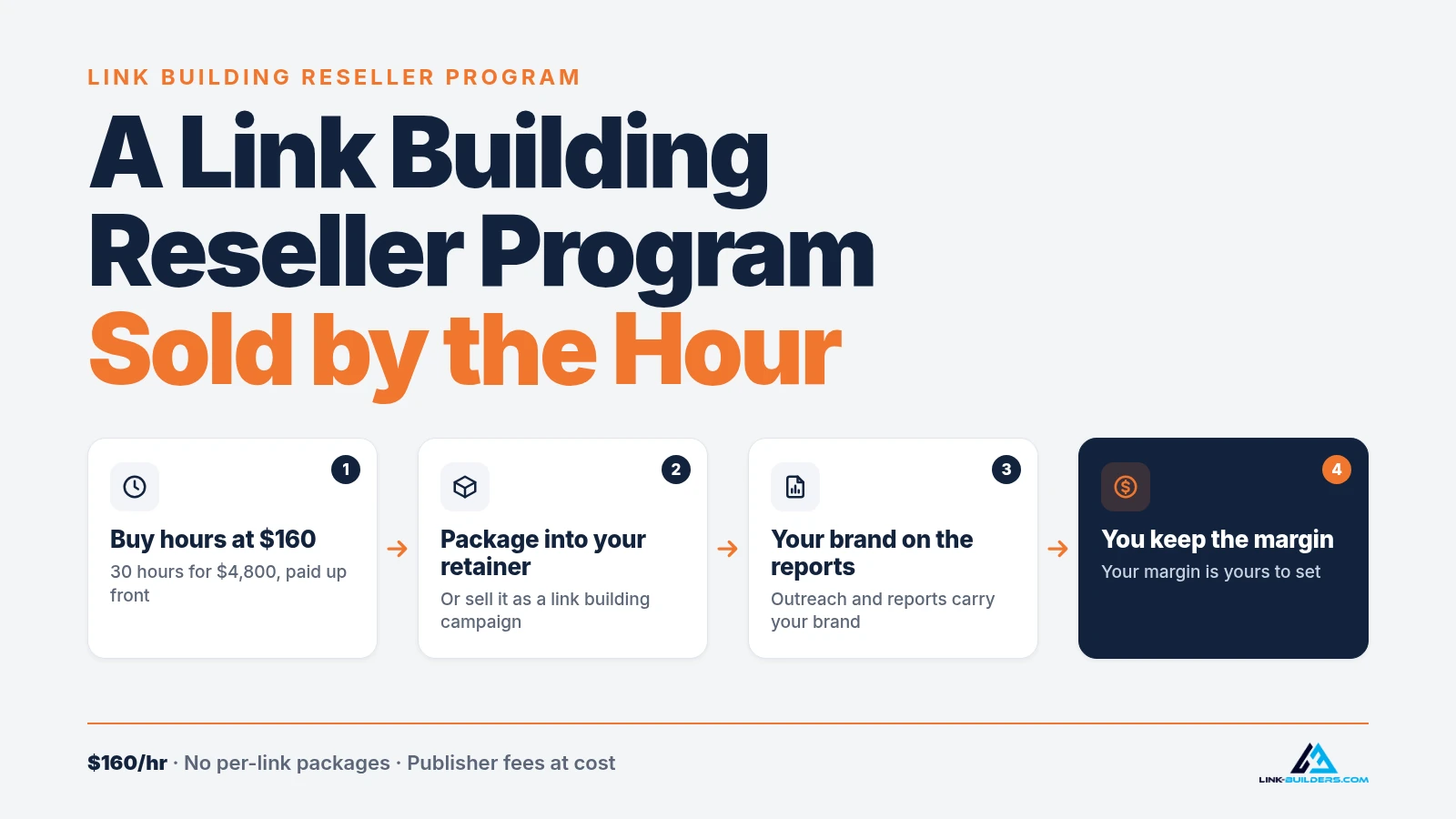
I sell hours. The rate is $160 an hour. New clients usually start with a 30-hour trial: a prepaid block of 30 hours for $4,800. After that, hours are billed at the same rate. Publisher fees, when a site charges one, are passed through at cost with no markup, and you approve each one before it’s paid. I don’t sell per-link packages. If you want a cost-per-link number for your own reporting, you can work it out afterward: hours used times $160, plus publisher fees, divided by links placed. I won’t quote that number in advance, because it depends on your niche and on reply rates. Promising it would push me toward the same cheap sites I’m telling you to avoid. Full details are on my backlink pricing page.
How to Verify Live URLs Yourself
Don’t take a report’s word for it. Checking a placement takes about two minutes:
- Open the URL in a private window. The page should load for anyone, not just a logged-in editor.
- Find the link. Make sure it points to the right page on your client’s site, with the anchor text you agreed on.
- Check the link attributes. Right-click the link and choose Inspect. Note whether it’s a plain link or marked nofollow, sponsored or ugc, and make sure the report matches what’s on the page.
- Make sure the page can be indexed. In the page source, look for a robots meta tag that says noindex. A link on a page that tells search engines to skip it won’t do much.
- Make sure the page is part of the site. It should be reachable from a category page, the blog feed or another article, not orphaned where no visitor or crawler will find it.
- Check again later. Re-check placements after a month and again after a few months. Links do disappear, and you want to know before your client does.
White Label Specifics: NDA, Non-Solicit and Reports You Can Rebrand
If you resell link building under your own brand, three extra things matter.
Confidentiality. Your vendor shouldn’t need your client’s name to get started. A good one can build the first prospect list from a competitor’s URL in the same niche. When you do share the client, it should be under an NDA.
Non-solicit. Get it in writing that the vendor won’t contact your clients or pitch them its own services, during the engagement or after it.
Reports you can rebrand. You should be able to put your logo on the report and send it to your client as it is. A good report includes:
| Field | Why it matters |
|---|---|
| Live URL of each placement | Your client can click it and see the link |
| Target page and anchor text | Shows the link supports the page you’re trying to rank |
| Publisher fee, if any | Lets you pass costs through or fold them into your price |
| Date placed | Gives you a baseline for re-checks |
| Sites contacted and replies | Shows the work behind the links, not just the wins |
| Hours used | Ties what you paid to what was done |
No vendor names, no vendor logo and nothing your client would need to have explained.
A 6-Point Scorecard for Comparing Vendors
Score each vendor on these six points after the first call. A vendor needs all six to make the shortlist. A PBN, or a guarantee of rankings or DR, is an automatic fail whatever else it scores.
| # | Criterion | Pass | Fail |
|---|---|---|---|
| 1 | Sourcing | Research and outreach to sites that fit the niche | A network, a publisher list or “our sites” |
| 2 | Approval | You approve every site and every piece of content | Links go live before you see them |
| 3 | Vetting | Traffic, country, topic and outbound links checked | Domain score only |
| 4 | Pricing | Work and publisher fees itemized separately | One opaque number per link |
| 5 | Reporting | Live URLs, targets, anchors, costs, in a rebrandable format | Screenshots or domain names only |
| 6 | Confidentiality | NDA and non-solicit signed, your brand on everything | Refuses, or wants to talk to your client |
Where I Fit, and Where I Don’t
Here’s how I answer my own checklist. I run every engagement myself, with AI agents doing the heavy prospecting and research I used to do by hand. Over the years that’s added up to hundreds of thousands of outreach emails.
- Sourcing: outreach to sites that fit your client’s niche. No recycled lists, no link farms and no PBNs.
- Approval: you approve every site before outreach and every piece of content before it’s published.
- Pricing: $160 an hour. New clients usually start with a prepaid 30-hour trial for $4,800. Publisher fees are passed through at cost. There are no per-link packages.
- Reporting: every placement with its live URL and cost, plus a record of who was contacted and who replied, ready for your logo.
- Confidentiality: outreach and reports carry your brand, not mine. I never contact your clients unless you ask me to, and I’ll sign your NDA or non-solicit agreement before we start.
- Guarantees: none on rankings, DR or link counts. You get the process and full visibility into every site, reply and cost.
I’m not the right fit if you want a fixed number of links a month at a fixed price, or a guaranteed DR. Plenty of vendors sell that. This checklist should help you see what’s behind it.
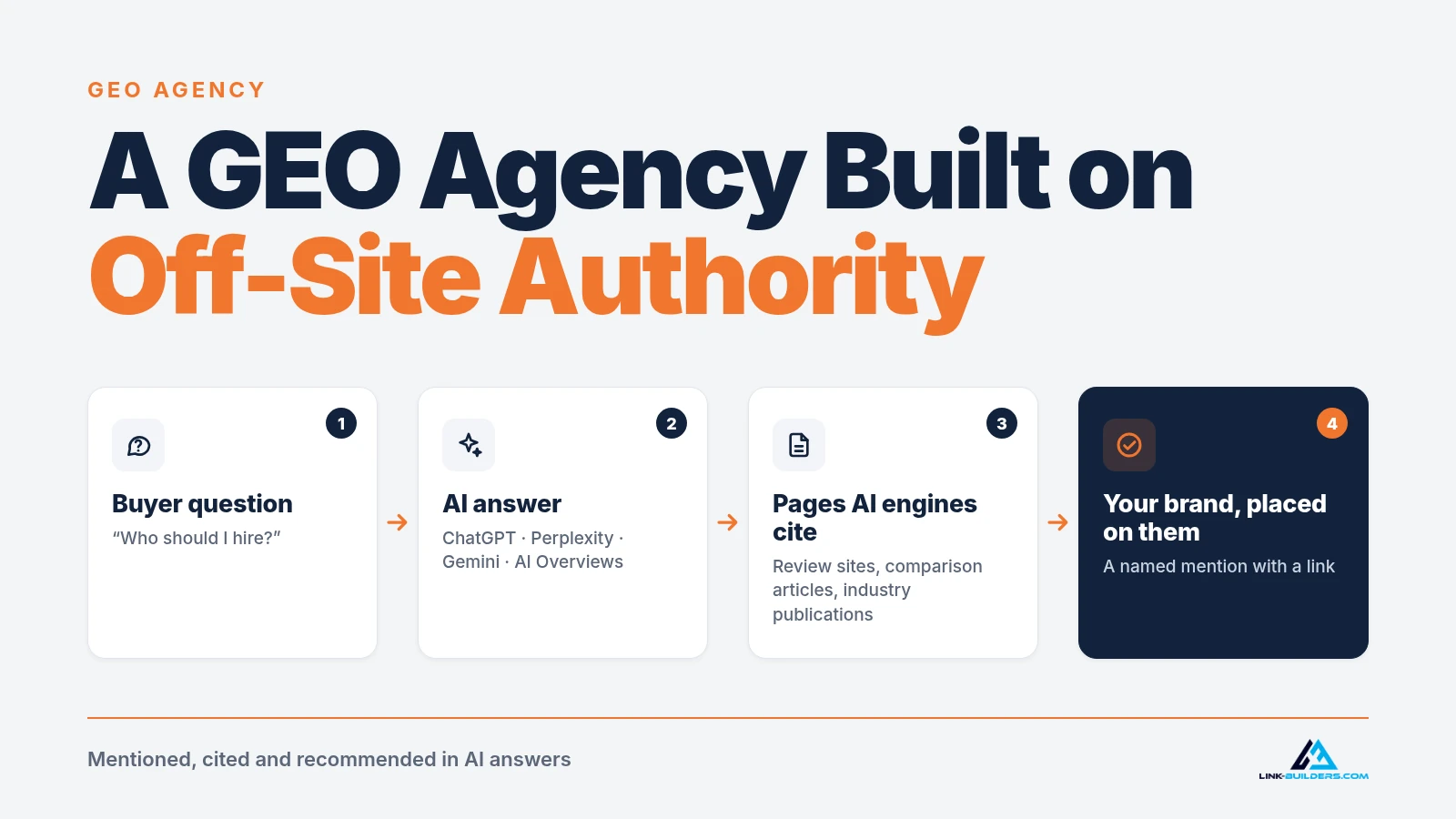
If you’re an agency, my white label link building page explains how the work runs under your brand. If you want to add link building to your price list and set your own margin, read about my link building reseller program. If your clients are asking about ChatGPT and AI Overviews, the same off-site work is the core of what I do as a GEO agency.
The easiest way to judge me against this list is to see the work. Request a free sample: send one URL, a competitor’s if you’d rather keep your client private, and within 24 hours you’ll get 20 hand-vetted link opportunities for it.
FAQ
What is the best white label link building service?
The one that passes all six points on the scorecard above: real outreach, your approval on every site and piece of content, real vetting, itemized pricing, verifiable reports you can rebrand, and signed confidentiality. Ignore any ranking of vendors that doesn’t show how they scored on those points.
How much does white hat link building cost per link?
It depends on the niche, the publisher fees and how much outreach each link takes, which is why honest vendors don’t quote one number. I charge $160 an hour with publisher fees at cost, and you can work out your own cost per link afterward from hours used, fees and links placed.
Should I hire a freelance link builder or an agency?
Hire a freelancer if you have someone who can manage the work and review every site. Hire an agency if you want the work run for you. If you’re an SEO agency reselling to your own clients, hire a white label service that works under your brand and signs a non-solicit.
Is white label link building safe?
The arrangement itself is just who gets credit for the work. The risk depends on how the links are built. Outreach to real, relevant sites is fine. PBNs, link farms and other link schemes are what Google’s spam policies target.
About the author

Justin Davis is the founder of Link Builders, a white-label backlink agency, and has been building links since 2015 for more than 150 clients in law, healthcare, real estate, software and other industries. After years of doing prospecting research by hand, he built an AI agent link building system that handles each step, from finding link opportunities and vetting sites to finding contacts and preparing outreach. He now runs that system for agencies and in-house SEO teams, and teaches it on YouTube. Find Justin Davis on YouTube, LinkedIn and X.