AI-Powered Boolean Search for Link Prospecting: Advanced Tactics
AI-Powered Boolean Search for Link Prospecting: Advanced Tactics
By Justin Davis
Link prospecting has changed dramatically over the past few years. I remember spending hours manually crafting search strings, testing them one by one, and hoping to stumble upon opportunities that competitors hadn’t already exhausted. The process was tedious, and I knew I was missing hundreds of viable targets simply because I couldn’t think of every possible search variation. AI has fundamentally altered how we approach this work. I’m not talking about replacing the strategic thinking that makes a good link builder valuable. Instead, AI amplifies our ability to generate, test, and refine search strings at a scale that was impossible before. The boolean operators that power our prospecting haven’t changed, but our capacity to use them effectively has multiplied. This guide focuses on the intersection of AI capability and boolean search mastery. If you’re already comfortable with basic search operators and you’re looking to find opportunities that others are missing, these tactics will help you get there.Understanding Boolean Search Fundamentals
Before we get into AI applications, let’s make sure we’re on the same page about boolean fundamentals. The core operators (AND, OR, NOT, quotation marks, and parentheses) are your building blocks. Most link builders use these daily, but few use them to their full potential. Where most people fall short is with advanced operators. The intitle: operator finds pages with specific words in the title tag. The inurl: operator targets words in the URL. The site: operator restricts results to specific domains. The filetype: operator finds specific document types. The intext: operator looks for words in body content only. These operators become powerful when combined. A search like intitle:”resources” inurl:links site:.edu -inurl:student finds educational institution resource pages while excluding student-created content. Each component serves a specific purpose. The most common mistake is creating search strings that are either too broad or too narrow. Too broad and you’re drowning in irrelevant results. Too narrow and you’re missing opportunities that don’t match your exact parameters. Finding the sweet spot requires testing, and that’s where AI becomes invaluable.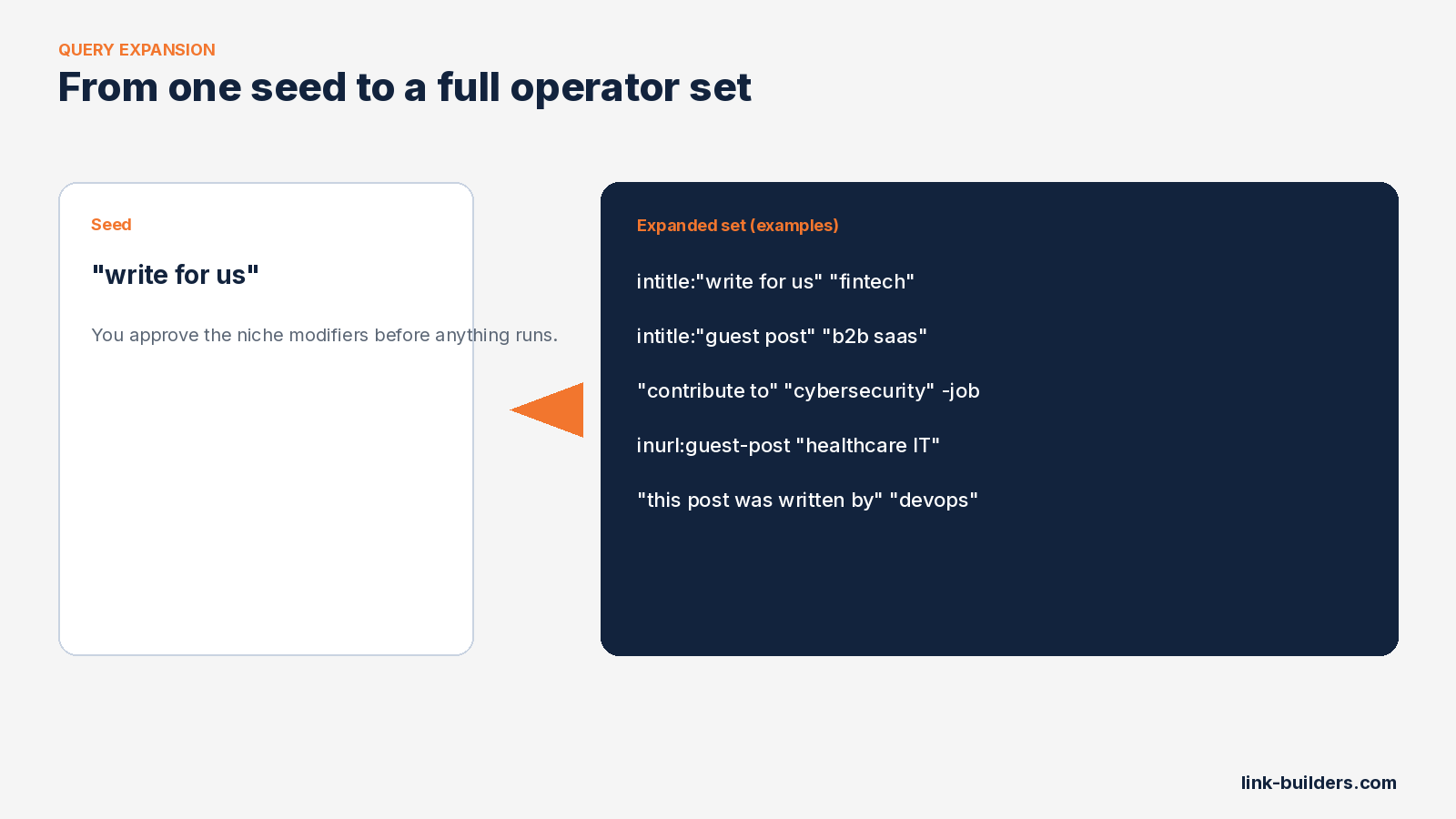
How AI Transforms Boolean Search Strategy
Traditional boolean search creation relies on your personal experience and creativity. You think of a link type you want to pursue, brainstorm the language those pages might use, and craft a search string. Maybe you create five or ten variations if you’re thorough. AI removes the bottleneck of human ideation speed. You can generate fifty or a hundred variations in minutes, each testing different combinations of operators, keywords, and logic structures. More importantly, AI can spot patterns in successful strings that aren’t obvious to human observers. The real transformation happens when you use AI iteratively. You generate search strings, test them, feed the results back to the AI with notes about what worked and what didn’t, and let it refine its approach. This creates a feedback loop that gets smarter over time. AI also helps overcome cognitive biases. We tend to search using the same mental frameworks repeatedly. If you always think about guest posts using certain keywords, you’ll keep finding the same types of opportunities. AI doesn’t have those limitations and can suggest terminology you wouldn’t have considered.Generating Complex Search Strings with AI
The quality of your AI-generated search strings depends entirely on the quality of your prompts. Generic requests produce generic results. Specific, context-rich prompts produce targeted, effective search strings. When prompting AI for search string generation, provide these elements at minimum: your niche or industry, the specific type of link opportunity you’re targeting, any known high-value targets or examples, and constraints on what to exclude. Instead of asking “Give me search strings for guest post opportunities,” try: “I’m targeting guest post opportunities in the commercial real estate investment niche. These pages typically use phrases like ‘write for us,’ ‘contribute,’ ‘guest author,’ or ‘submit article.’ I want to find blogs that cover multifamily investing, commercial property analysis, and real estate syndication. Generate 20 search strings using various boolean operators. Exclude real estate agent blogs and residential focus sites.” This prompt gives the AI enough direction to create useful variations while leaving room for creative operator combinations you might not have considered. For resource page prospecting, structure your prompts around unique characteristics of your ideal targets. Resource pages use predictable language patterns: “useful links,” “helpful resources,” “recommended sites,” “our favorite tools.” They often appear in specific URL structures like /resources/ or /links/. Your prompt should direct the AI to exploit these patterns while varying the approach enough to catch pages that don’t fit the standard template. When replicating competitor backlink opportunities, feed the AI examples of URLs where competitors have links. Ask it to identify common characteristics and generate search strings that would find similar pages. The AI can spot patterns in URL structures, page titles, and content types that might not be immediately obvious. International and multi-language prospecting opens up entirely new opportunity sets. Most link builders stick to English-language targets. AI can generate search strings in any language, helping you find opportunities in markets your competitors are ignoring. The iterative refinement process is where AI really shines. After running your initial batch of search strings, note which ones produced the highest percentage of relevant results. Feed that information back: “Search string number 7 produced excellent results with 80% relevance. Search string number 12 only gave me 20% relevance. Generate 10 new variations more similar to number 7.” The AI will analyze what made number 7 successful and apply those principles to new strings.Testing and Validating Search String Variations
Generating search strings is only half the battle. Without systematic testing, you’re just creating noise. I maintain a spreadsheet that tracks every search string I test, along with key metrics: total results, estimated relevant results in the first 50, time to evaluate, and ultimate conversion rate from prospect to acquired link. When testing search string variations, change one element at a time when possible. If you modify both the keyword set and the operator structure simultaneously, you won’t know which change caused any improvement or decline in results. Exclusion testing deserves special attention. The negative keywords you use to filter out irrelevant results can make or break a search string’s efficiency. AI can help generate lists of terms to exclude based on the patterns it sees in your unwanted results. Sample size matters for validation. A search string that produces 15 total results might all be highly relevant, but it’s not scalable. A search string that produces 500 results with 60% relevance might be more valuable, because you’re getting 300 viable prospects instead of 15. AI can analyze your test results to identify patterns you might miss. Export your tracking spreadsheet and ask the AI to identify correlations between search string characteristics and performance metrics.Finding Hidden Link Opportunities
The most valuable link opportunities are the ones your competitors haven’t found yet. This requires thinking beyond the standard search patterns that every guide teaches. AI helps by suggesting non-obvious variations that humans tend to overlook. Obscure page types that competitors miss include supplier directories, industry buyers guides, vendor comparison pages, and educational curriculum resource pages. These pages exist in almost every industry, but they don’t show up in standard “write for us” or “resources” searches. Alternative terminology is where most link builders leave opportunities on the table. If you’re in the home services industry and you only search for “plumbers” or “plumbing,” you’re missing pages that use terms like “drain specialists,” “pipe repair,” or “water systems.” AI can generate comprehensive synonym and alternative term lists. Reverse engineering competitor strategies starts with their backlink profiles. Export your competitor’s backlinks from Ahrefs or Majestic. Feed a sample of those URLs to AI and ask it to identify common characteristics. Once you identify the pattern, ask the AI to generate search strings that would find similar pages. Temporal opportunities require time-based search operators that many link builders forget about. Google’s date range filters let you find newly published or recently updated pages. Fresh resource pages are more likely to add your link because they’re actively maintained. Cross-industry inspiration has been useful for my work. Link building tactics that work in one niche often transfer to others with minor modifications. Ask AI to analyze successful search strings from different industries and suggest how to adapt them to yours. Vertical-specific hidden opportunities are everywhere once you start looking. Academic institutions have department pages and course resource pages that link out regularly. Government websites maintain business directories and approved vendor pages. Industry associations have member directories and resource libraries. These opportunities exist in virtually every niche, but you need targeted search strings to find them efficiently.Advanced AI-Powered Tactics
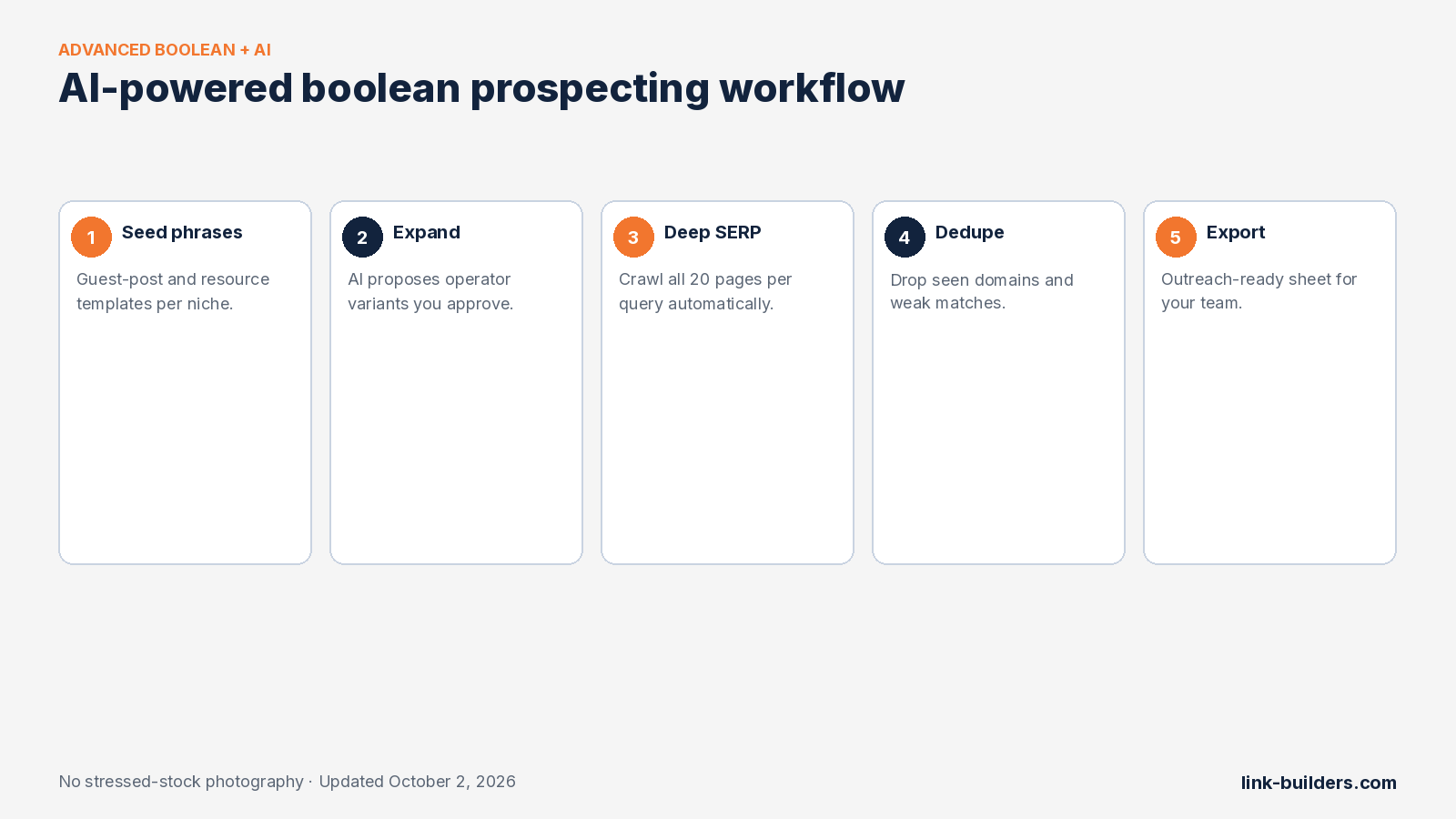
Once you’re comfortable with basic AI-assisted search string generation, you can layer in more sophisticated approaches. Combining multiple data sources gives you a more complete picture of available opportunities. Custom search operators and footprints take your prospecting beyond what generic search strings can find. Every content management system has unique HTML signatures. WordPress sites have specific CSS class names. Squarespace sites have distinctive footer patterns. If you can identify these signatures, you can create search strings that target specific platform types. Finding proprietary CMS signatures requires viewing page source on your target sites and looking for unique identifiers. Once you identify these patterns, you can use the intext: operator to find other sites using the same platform. Automation and scaling becomes necessary when you’re processing hundreds of search queries. You can build workflows that execute search strings, extract results, score them for relevance, and populate your CRM automatically. The human oversight is still essential for final evaluation, but the AI handles the high-volume grunt work. Contact information extraction is tedious when done manually but straightforward for AI. Once you have a list of prospect URLs, AI can visit those pages and extract email addresses, contact forms, and social media profiles. Predicting outreach success probability is an emerging application. If you track outreach attempts and ultimate link acquisition across hundreds of prospects, AI can identify patterns in what types of prospects are most likely to convert. This intelligence helps you prioritize efforts toward the highest-probability targets.Niche-Specific Search String Strategies
Different industries require different search approaches. Local and regional backlink prospecting demands geographic modifiers combined with your target keywords. If you’re building links for a Houston-based business, search strings like intitle:”Houston” OR intitle:”Texas” (inurl:resources OR inurl:links) will surface locally-relevant opportunities. Healthcare and medical niches have unique opportunities in patient education resources, medical school course pages, and health department information pages. Legal and professional services can target bar association directories, legal aid society resource pages, and law school research guides. SaaS and technology companies benefit from software directories, alternative comparison pages, and tool roundups. Target these with search strings focused on “alternatives to,” “vs,” “comparison,” and “best [category] software.” Content type-specific strategies matter as much as industry-specific approaches. Statistics and data pages are fantastic link targets because they cite their sources. Search for pages that aggregate statistics in your industry, then offer your data as a cited source. Tool and software roundups are great backlink types that exist for virtually every software category. Bloggers love creating “10 best [category] tools” articles because they drive traffic. Your search strings should focus on “best,” “top,” “tools,” “software,” combined with your category keywords.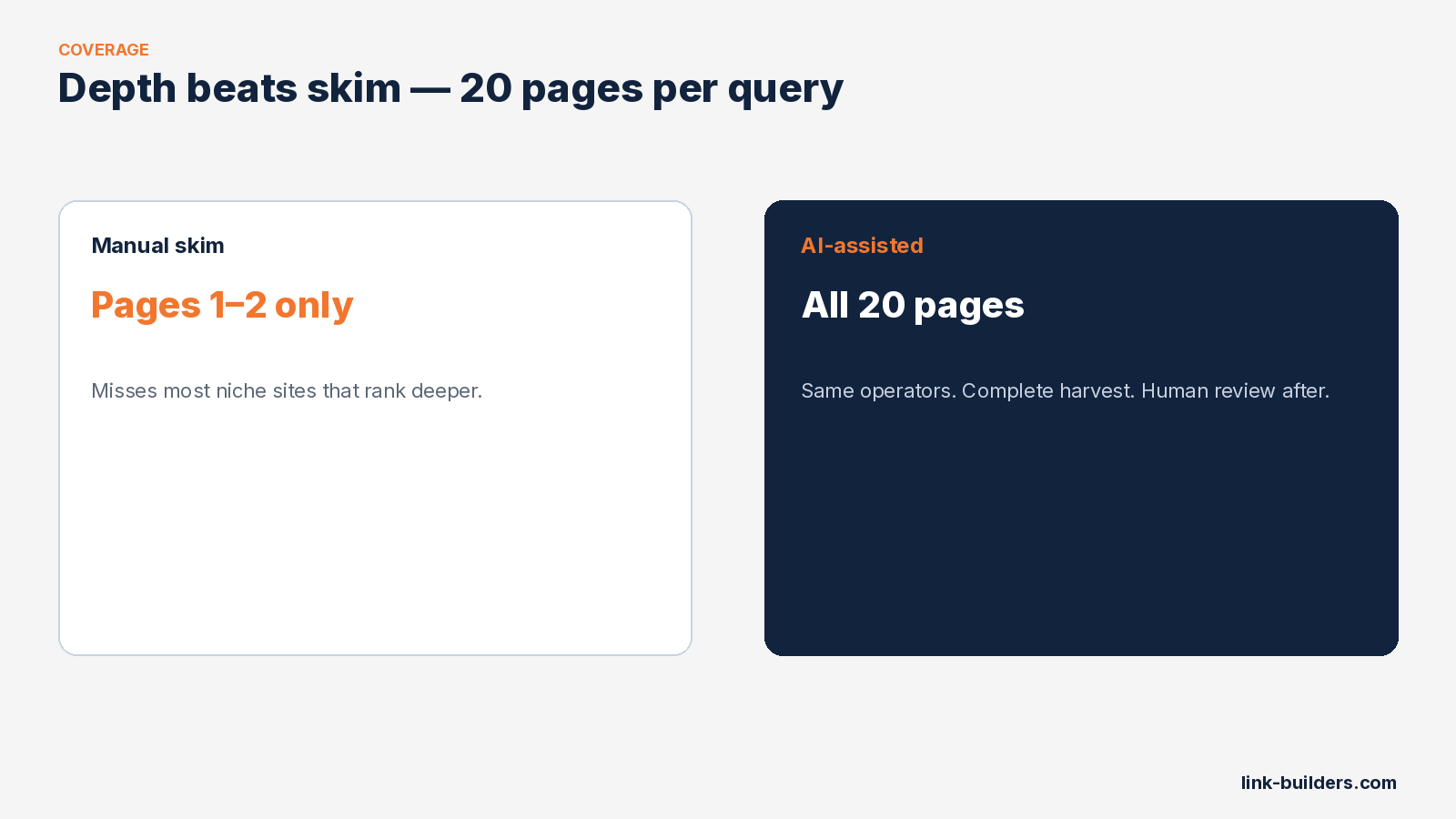
Common Pitfalls and How AI Helps Avoid Them
Over-optimization of search strings is a real problem. You add more operators, more keywords, more exclusions, and eventually your string becomes so specific that it only returns a handful of results. AI can help identify when you’ve crossed the line from thorough to excessive. Missing obvious opportunities happens when you focus exclusively on advanced tactics and forget the basics. Sometimes simple search strings still work. Don’t get so caught up in clever operator combinations that you skip straightforward approaches. Footprint burning becomes a concern when you’re using very distinctive search strings repeatedly. If you’re finding opportunities through unusual search patterns, others will eventually discover the same patterns. AI helps by continuously generating new approaches rather than relying on a fixed set of successful patterns. Scaling too quickly without validation is tempting when AI makes it easy to generate massive numbers of search strings. Resist this temptation. Validate your approach with a smaller sample first, refine based on what you learn, then scale to larger volumes.Tools and Implementation
The practical implementation of AI-powered boolean search requires the right combination of tools and workflows. ChatGPT and Claude are the most accessible AI tools for search string generation. Your success depends more on prompt engineering skill than which AI you use. Creating custom GPTs or Claude Projects specifically for link prospecting is worth the effort if you do this work regularly. You can load these custom assistants with your best prompt templates, examples of successful search strings, and information about your niche. Google remains the primary search engine for most link prospecting work. However, don’t ignore Bing entirely. Bing sometimes surfaces different results, particularly for pages that haven’t achieved strong Google rankings. SERP scraping tools and APIs let you execute search strings programmatically and capture results at scale. This is essential if you’re processing dozens of searches daily. Options range from simple browser extensions to sophisticated APIs. Building your AI-powered prospecting workflow starts with defining your current process. Map out each step and identify which steps AI can accelerate or improve. Implement one improvement at a time rather than trying to overhaul everything simultaneously.Measuring Success and ROI
Metrics for AI-powered prospecting should focus on efficiency gains and opportunity discovery. Time saved compared to manual prospecting is the most immediate benefit. Track how long your old process took versus how long the AI-assisted process takes for comparable outcomes. Opportunity discovery rate measures whether AI is helping you find prospects you wouldn’t have found otherwise. Track the sources of your best links over time. If AI-generated search strings are consistently finding higher-quality or more unique opportunities, that’s a strong signal of value. Link quality metrics include domain authority, topical relevance, referring domain diversity, and traffic potential. Higher-quality links provide more SEO benefit, so even if AI doesn’t increase your total link volume, improving average link quality creates real value. The continuous improvement loop is what makes AI-powered prospecting compound in value over time. Every search string you test provides data. Feed that data back into your AI prompting process. Your AI-assisted workflow should get progressively better at generating relevant opportunities.Conclusion
AI-powered boolean search for link prospecting represents a genuine step forward in efficiency and effectiveness. The tactics covered here work because they combine the pattern-matching capabilities of AI with the strategic thinking that experienced link builders bring to their work. Start with prompt engineering for search string generation. Get comfortable providing rich context to your AI tool and refining prompts based on output quality. Build a testing framework so you can systematically validate which search strings actually perform well. Use AI to identify patterns in your successful approaches and generate variations that expand your opportunity set. The balance between AI assistance and human judgment is crucial. AI should accelerate your prospecting work and help you find opportunities you’d otherwise miss. It should not replace your evaluation of prospect quality, your outreach strategy, or your relationship building efforts. Your competitive advantage comes from using these tools more effectively than others in your niche. AI is accessible to everyone, but not everyone will invest the time to develop sophisticated prompting skills, build testing frameworks, and iterate based on results. Those who do will consistently find better opportunities and acquire better links than those who don’t.About the author

Justin Davis has been building backlinks since 2015 and has built links for more than 150 clients across law, healthcare, real estate, software, and other industries. He built the first version after years of doing the research by hand, and now builds the same workflow for in-house teams. More on who Justin Davis is, on YouTube, on LinkedIn, or on X.